
Homework Answers
Add Answer to:
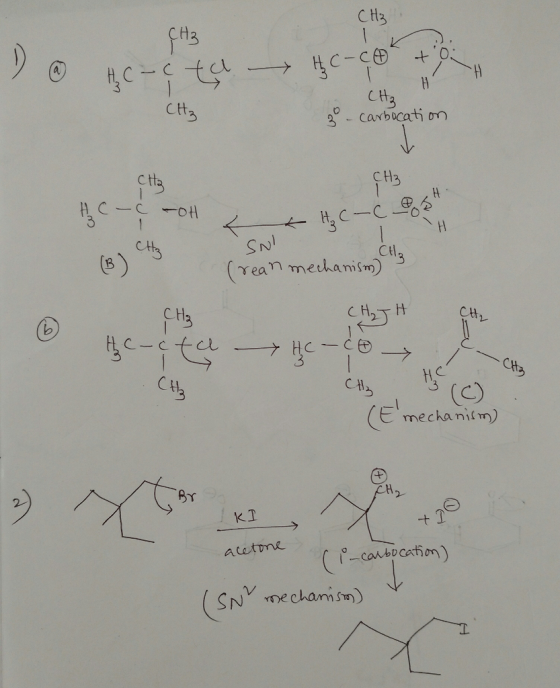
Consider the reaction below to answer the following questions. a) Compound B is the S_N2/S_N1/E2/El product...
Draw the products in the following reaction. Identify which mechanism(s) the reaction will undergo. S_N1 S_N2...
 Draw the products in the following reaction. Identify which mechanism(s) the reaction will undergo. S_N1 S_N2 E1 E2 The number of E_2 product(s): 2 The E2 products: (major) (minor)
Draw the products in the following reaction. Part 1 Identify which mechanism(s) the reaction will undergo....
 Draw the products in the following reaction. Part 1 Identify which mechanism(s) the reaction will undergo. A. S_N1 B. S_N2 C. EI D. E2 Part 2 The number of S_N1 product(s): The number of E1 product(s):
2. Complete the El reaction and answer the following questions. Reagent: Major El product: AH>O a....
 2. Complete the El reaction and answer the following questions. Reagent: Major El product: AH>O a. Draw a mechanism of the reaction above. b. Draw an energy diagram of the reaction. Provide the structures of the starting material, intermediates product, and all transition states.
QUESTION 16 Consider the reaction shown below to answer questions 16-19. LINR What will be the...
 QUESTION 16 Consider the reaction shown below to answer questions 16-19. LINR What will be the dominant mechanism that occurs in this reaction? O a. El b. E2 QUESTION 16 Consider the reaction shown below to answer questions 16-19. LINR What will be the dominant mechanism that occurs in this reaction? O a. El b. E2
2. Complete the El reaction and answer the following questions Yoon 14 a. Draw a mechanism...
 2. Complete the El reaction and answer the following questions Yoon 14 a. Draw a mechanism of the reaction above. b. Draw an energy diagram of the reaction. Provide the structures of the starting material, intermediates product, and all transition states.
Study the reaction shown below, involving rrans-2-chlorocyclohexanol (pK_a = 12.7), and answer the questions posed underneath....
 Study the reaction shown below, involving rrans-2-chlorocyclohexanol (pK_a = 12.7), and answer the questions posed underneath. Please rename the starting compound using R and/or S instead of trons _____ Did inversion occur during the reaction above? YES or NO Is the cyclic ether (epoxide) product (73% yield) optically active? YES or NO. Please briefly explain your answer. Did an initial acid-base reaction occur between the trans-2-chlorocyclohexanol and hydroxide ion? If you think yes, please report the equilibrium constant for the...
Consider the SN2 reaction shown below and answer the following questions. Consider the SN1 reaction shown...
 Consider the SN2 reaction shown below and answer the
following questions.
Consider the SN1 reaction shown below and answer the following
questions.
1. Consider the SN2 reaction shown below and answer the following questions. acetone Br NaSCH3 SCH3 NaBr + A. Write the rate law for the reaction B. Identify the nucleophile and the electrophile in the reaction C. State how each of the following factors would affect the rate of the reaction a. Increasing the concentration of 1-bromopropane. b....
Consider the SN2 reaction shown below and answer the
following questions.
Consider the SN1 reaction shown below and answer the following
questions.
1. Consider the SN2 reaction shown below and answer the following questions. acetone Br NaSCH3 SCH3 NaBr + A. Write the rate law for the reaction B. Identify the nucleophile and the electrophile in the reaction C. State how each of the following factors would affect the rate of the reaction a. Increasing the concentration of 1-bromopropane. b....
Consider the dehydration reaction using the starting material shown below to answer questions 20-23. НО Dehydration...
 Consider the dehydration reaction using the starting material shown below to answer questions 20-23. НО Dehydration Identify all carbocations that appear in the mechansim for this reaction. Choose all that apply. iv) ii) a. i b. d. iv e. None of the above. The reaction goes by an E2 mechanism and no carbocations are formed.
I need help understanding how to read an 13C NMR and answering the questions below. C....
 I need help understanding how to read an 13C NMR and answering
the questions below.
C. Conversion of 2° Alcohols to Alkyl Halides 1. Write the equation for the conversion of 2-pentanol to three alkyl bromide products: two secondary and one primary. Under the products, write the name of the alkyl bromide. NaBr, H2SO4 2. Attach the 13C NMR spectrum for this reaction. a) How many peaks (unique carbons) would be present in the spectrum: for a rearranged alkyl bromide?...
I need help understanding how to read an 13C NMR and answering
the questions below.
C. Conversion of 2° Alcohols to Alkyl Halides 1. Write the equation for the conversion of 2-pentanol to three alkyl bromide products: two secondary and one primary. Under the products, write the name of the alkyl bromide. NaBr, H2SO4 2. Attach the 13C NMR spectrum for this reaction. a) How many peaks (unique carbons) would be present in the spectrum: for a rearranged alkyl bromide?...
2. Consider the Sn1 reaction shown below and answer the following questions. + CH3OH "CH₃ +...
 2. Consider the Sn1 reaction shown below and answer the following questions. + CH3OH "CH₃ + HBr A. Write the rate law for the reaction. B. Identify the nucleophile, the electrophile, and the reaction solventi Panther ID...... C. State how each of the following factors would affect the rate of the reaction. a. Increasing the concentration of the alkyl halide. b. Increasing the concentration of CH3OH. c. Replacing HOCH3 with NaOCH3. d. Changing the alkyl halide from a bromide to...
 Draw the products in the following reaction. Identify which mechanism(s) the reaction will undergo. S_N1 S_N2 E1 E2 The number of E_2 product(s): 2 The E2 products: (major) (minor)
 Draw the products in the following reaction. Part 1 Identify which mechanism(s) the reaction will undergo. A. S_N1 B. S_N2 C. EI D. E2 Part 2 The number of S_N1 product(s): The number of E1 product(s):
 2. Complete the El reaction and answer the following questions. Reagent: Major El product: AH>O a. Draw a mechanism of the reaction above. b. Draw an energy diagram of the reaction. Provide the structures of the starting material, intermediates product, and all transition states.
 QUESTION 16 Consider the reaction shown below to answer questions 16-19. LINR What will be the dominant mechanism that occurs in this reaction? O a. El b. E2 QUESTION 16 Consider the reaction shown below to answer questions 16-19. LINR What will be the dominant mechanism that occurs in this reaction? O a. El b. E2
 2. Complete the El reaction and answer the following questions Yoon 14 a. Draw a mechanism of the reaction above. b. Draw an energy diagram of the reaction. Provide the structures of the starting material, intermediates product, and all transition states.
 Study the reaction shown below, involving rrans-2-chlorocyclohexanol (pK_a = 12.7), and answer the questions posed underneath. Please rename the starting compound using R and/or S instead of trons _____ Did inversion occur during the reaction above? YES or NO Is the cyclic ether (epoxide) product (73% yield) optically active? YES or NO. Please briefly explain your answer. Did an initial acid-base reaction occur between the trans-2-chlorocyclohexanol and hydroxide ion? If you think yes, please report the equilibrium constant for the...
 Consider the SN2 reaction shown below and answer the
following questions.
Consider the SN1 reaction shown below and answer the following
questions.
1. Consider the SN2 reaction shown below and answer the following questions. acetone Br NaSCH3 SCH3 NaBr + A. Write the rate law for the reaction B. Identify the nucleophile and the electrophile in the reaction C. State how each of the following factors would affect the rate of the reaction a. Increasing the concentration of 1-bromopropane. b....
Consider the SN2 reaction shown below and answer the
following questions.
Consider the SN1 reaction shown below and answer the following
questions.
1. Consider the SN2 reaction shown below and answer the following questions. acetone Br NaSCH3 SCH3 NaBr + A. Write the rate law for the reaction B. Identify the nucleophile and the electrophile in the reaction C. State how each of the following factors would affect the rate of the reaction a. Increasing the concentration of 1-bromopropane. b....
 Consider the dehydration reaction using the starting material shown below to answer questions 20-23. НО Dehydration Identify all carbocations that appear in the mechansim for this reaction. Choose all that apply. iv) ii) a. i b. d. iv e. None of the above. The reaction goes by an E2 mechanism and no carbocations are formed.
 I need help understanding how to read an 13C NMR and answering
the questions below.
C. Conversion of 2° Alcohols to Alkyl Halides 1. Write the equation for the conversion of 2-pentanol to three alkyl bromide products: two secondary and one primary. Under the products, write the name of the alkyl bromide. NaBr, H2SO4 2. Attach the 13C NMR spectrum for this reaction. a) How many peaks (unique carbons) would be present in the spectrum: for a rearranged alkyl bromide?...
I need help understanding how to read an 13C NMR and answering
the questions below.
C. Conversion of 2° Alcohols to Alkyl Halides 1. Write the equation for the conversion of 2-pentanol to three alkyl bromide products: two secondary and one primary. Under the products, write the name of the alkyl bromide. NaBr, H2SO4 2. Attach the 13C NMR spectrum for this reaction. a) How many peaks (unique carbons) would be present in the spectrum: for a rearranged alkyl bromide?...
 2. Consider the Sn1 reaction shown below and answer the following questions. + CH3OH "CH₃ + HBr A. Write the rate law for the reaction. B. Identify the nucleophile, the electrophile, and the reaction solventi Panther ID...... C. State how each of the following factors would affect the rate of the reaction. a. Increasing the concentration of the alkyl halide. b. Increasing the concentration of CH3OH. c. Replacing HOCH3 with NaOCH3. d. Changing the alkyl halide from a bromide to...
Most questions answered within 3 hours.
-
Where is the error in this code sequence?
String s1 = "Hello";
String s2 = "ello";...
asked 10 months ago -
Financial data for Joel de Paris, Inc., for last year
follow:
Joel de Paris, Inc.
Balance...
asked 10 months ago -
Consider this reaction:
Al2(SO4)3 (aq)+ BaCl3
(aq) Al2Cl6 (aq)- +
3BaSO4(s) . What is the...
asked 10 months ago -
Suppose that Savneet is considering increasing her
recent random sample from 20 car rentals to 40...
asked 10 months ago -
Trucks arrive at an unloading terminal at an average rate of 120
per hour.
Trucks arrive...
asked 10 months ago -
Why are methanol and ethanol completely soluble in water while
octanol is not very little soluble....
asked 10 months ago -
A facilities manager at a university reads in a research report
that the mean amount of...
asked 10 months ago -
When the CuSO4 is rehydrated by adding water to the anhydrous
compound, is this an endothermic...
asked 10 months ago -
A ray of sunlight is passing from diamond into crown glass; the
angle of incidence is...
asked 10 months ago -
A block of mass 0.249 kg is placed on top of a light, vertical
spring of...
asked 10 months ago -
how do the kidneys compensate in the presences of acidosis
a) trigger hyperventilate
b) reserve acid...
asked 10 months ago -
Question 501 pts
The rental rate of capital to the firm increases. Which of the
following...
asked 10 months ago