finance
1. TVM and bond valuation questions (1 mark each, give answers to 2 decimal places):
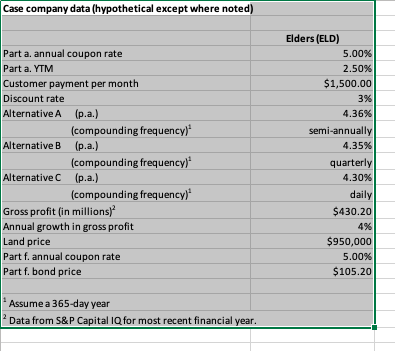
Your case company has an issue of $1,000 par value semi-annual coupon bonds with 7 years remaining until maturity. The annual coupon rate and yield to maturity for these bonds are given in the spreadsheet. What is the price of the bonds?
Your case company is considering a contract in which its customer will make end-of-month payments of the amount shown in the data spreadsheet (see instructions above) for 3 years. Your company’s discount rate is also shown in the spreadsheet. What is the value of the contract to your case company at its commencement?
Your case company needs to invest funds and has several alternatives available to it, A, B and C, all of equal risk. The interest rates for these options are given in the spreadsheet. What is the EAR of the alternative the company should choose if it wishes to maximise value?
Your case company has gross profit as shown in the spreadsheet. Assuming the gross profit grows continuously over time at a given rate (see spreadsheet), what will the gross profit be in 10 years?
Your case company is buying land for the amount given in the spreadsheet. The transaction will be financed by an amortised loan at 4.2% APR, quarterly compounding, with 20 years of end-of-quarter payments. What is the amount of the quarterly payment?
1
Assessment 2 Finance
f. Your case company has an issue of $100 par value annual coupon bonds with 5 years remaining until maturity. The annual coupon rate is given in the spreadsheet, along with the current price of the bonds. What is the YTM of the bonds?
Risk and return estimates (4 marks):
Use CAPM to estimate the expected return for the shares of: i) your case company; and ii) a hypothetical company with a beta of 1.40. To do this, use the yield to maturity of a 10-year Australian Government bond on 29 March 2021 as a proxy for the risk-free rate, assume the market risk premium is 5% and use your case company’s current 5-year beta.
Using the data from part 2a, estimate portfolio expected return and beta, assuming a portfolio with 20% invested in your case company and the remainder invested in the hypothetical company.
Risk and return analysis (15 marks):
a. Interpret and discuss your risk and return measures from parts 2a and 2b.
Homework Answers
Request Answer!
We need at least 10 more requests to produce the answer.
0 / 10 have requested this problem solution
The more requests, the faster the answer.
JB HiFi (JBH) Instalment per month ($’000s) $32.9 Annual total revenue ($millions)1 $7,095.3 Annual growth in...
JB HiFi (JBH) Instalment per month ($’000s) $32.9 Annual total revenue ($millions)1 $7,095.3 Annual growth in total revenue2 16.14% Loan A (APR, compounding frequency) 4.62%, semi- annually Loan B (APR, compounding frequency) 4.52%, quarterly Loan C (APR, compounding frequency) 4.24%, daily3 Property cost $691,000 7 year bond annual coupon rate 5.85% 7 year bond current price $99.95 5 year bond required rate of return 4.85% TVM and bond valuation questions (1 mark each): a. Your case company has just made...
1). TVM and bond valuation questions (1 mark each): COMPANY IS CSL a. Your case company has just ...
 1). TVM and bond valuation questions (1 mark each):
COMPANY IS CSL
a. Your case company has just made a large sale on an instalment
contract. The contract requires the customer to pay your case
company the amount shown in Table 1 (page 4 of this document) at
the end of every month for 4 years. Your case company would like
the cash now for an investment and so has asked its bank to
discount the instalment contract and pay...
1). TVM and bond valuation questions (1 mark each):
COMPANY IS CSL
a. Your case company has just made a large sale on an instalment
contract. The contract requires the customer to pay your case
company the amount shown in Table 1 (page 4 of this document) at
the end of every month for 4 years. Your case company would like
the cash now for an investment and so has asked its bank to
discount the instalment contract and pay...
Can you please show me (step by step) how to solve? 9. You bought one of...
Can you please show me (step by step) how to solve? 9. You bought one of Great White Shark Repellant Co.’s 5.8 percent coupon bonds one year ago for $1,030. These bonds make annual payments and mature 14 years from now. Suppose you decide to sell your bonds today, when the required return on the bonds is 5.1 percent. If the inflation rate was 3.9 percent over the past year, what was your total real return on investment? 10. A...
A financial institution has a portfolio of bonds with a face value of $15 million. The...
A financial institution has a portfolio of bonds with a face value of $15 million. The bonds have an average maturity of 8.5 years and an average annual coupon of 4.375% with semiannual payments. The yield to maturity on the portfolio is 4.90%. The financial institution wants to use 5-year treasury bonds to hedge the interest rate risk associated with the portfolio. The treasury bonds have a face value of $250,000, a 2.875% annual coupon, paid semiannually, and trade at...
Bond valuation—Quarterly interest Calculate the value of a $1,000-par-value bond paying quarterly interest at an annual...
 Bond valuation—Quarterly interest Calculate the value of a $1,000-par-value bond paying quarterly interest at an annual coupon interest rate of 12% and having 14 years until maturity if the required return on similar-risk bonds is currently a 13% annual rate paid quarterly.
1) Your company needs to borrow funds and has several options available to it, Loans A,...
1) Your company needs to borrow funds and has several options available to it, Loans A, B and C. The interest rates (APR) for these options are given below. What is the EAR of the loan option the company should choose? Loan A (APR, compounding frequency) 5.95%, semi-annually // Loan B (APR, compounding frequency) 6.02%, monthly // Loan C (APR, compounding frequency) 5.95%, quarterly 2) Your company has an issue of $100 par value annual coupon bonds with 7 years...
e, payu semiannually. The bonds matu Jul alate Value of $1,000, and a yield-to-maturity of 8.5%. What is the price of t...
 e, payu semiannually. The bonds matu Jul alate Value of $1,000, and a yield-to-maturity of 8.5%. What is the price of the bond 12. The risk-free rate is 5% and the market risk premium is 7%. What is the required risk return of a stod with a beta of 2.0? 13. You pay $1,000 for an investment that returns $1,100 in one year. What is your annual rate of ret 14. Gilligan's bonds currently sell for $1,150. Interest is paid...
Bond valuation--Quarterly interest Calculate the value of a $1,000-par-value bond paying quarterly interest at an annual...
Bond valuation--Quarterly interest Calculate the value of a $1,000-par-value bond paying quarterly interest at an annual coupon interest rate of 9% and having 13 years until maturity if the required return on similar-risk bonds is currently a 12% annual rate paid quarterly e present value of the bond is $ ?
Bond valuationlong dash—Quarterly interest Calculate the value of a $500500-par-value bond paying quarterly interest at an...
Bond valuationlong dash—Quarterly interest Calculate the value of a $500500-par-value bond paying quarterly interest at an annual coupon interest rate of 1414% and having 1414 years until maturity if the required return on similar-risk bonds is currently a 1111% annual rate paid quarterly. The present value of the bond is $nothing.
Hey. I am having trouble with a finance question: ---------------------------------------------------------------------...
Hey. I am having trouble with a finance question: ----------------------------------------------------------------------------------------------------------------------------------------- Consider two bonds. The first is a 6% coupon bond with six years to maturity, and a yield to maturity of 4.5% annual rate, compounded semi-annually. The second bond is a 2% coupon bond with six years to maturity and a yield to maturity of 5.0%, annual rate, compounded semi-annually. Given the data for the first two bonds, now consider a third bond: a zero coupon bond with six years...
 1). TVM and bond valuation questions (1 mark each):
COMPANY IS CSL
a. Your case company has just made a large sale on an instalment
contract. The contract requires the customer to pay your case
company the amount shown in Table 1 (page 4 of this document) at
the end of every month for 4 years. Your case company would like
the cash now for an investment and so has asked its bank to
discount the instalment contract and pay...
1). TVM and bond valuation questions (1 mark each):
COMPANY IS CSL
a. Your case company has just made a large sale on an instalment
contract. The contract requires the customer to pay your case
company the amount shown in Table 1 (page 4 of this document) at
the end of every month for 4 years. Your case company would like
the cash now for an investment and so has asked its bank to
discount the instalment contract and pay...
 Bond valuation—Quarterly interest Calculate the value of a $1,000-par-value bond paying quarterly interest at an annual coupon interest rate of 12% and having 14 years until maturity if the required return on similar-risk bonds is currently a 13% annual rate paid quarterly.
 e, payu semiannually. The bonds matu Jul alate Value of $1,000, and a yield-to-maturity of 8.5%. What is the price of the bond 12. The risk-free rate is 5% and the market risk premium is 7%. What is the required risk return of a stod with a beta of 2.0? 13. You pay $1,000 for an investment that returns $1,100 in one year. What is your annual rate of ret 14. Gilligan's bonds currently sell for $1,150. Interest is paid...
Most questions answered within 3 hours.
-
Where is the error in this code sequence?
String s1 = "Hello";
String s2 = "ello";...
asked 11 months ago -
Financial data for Joel de Paris, Inc., for last year
follow:
Joel de Paris, Inc.
Balance...
asked 11 months ago -
Consider this reaction:
Al2(SO4)3 (aq)+ BaCl3
(aq) Al2Cl6 (aq)- +
3BaSO4(s) . What is the...
asked 11 months ago -
Suppose that Savneet is considering increasing her
recent random sample from 20 car rentals to 40...
asked 11 months ago -
Trucks arrive at an unloading terminal at an average rate of 120
per hour.
Trucks arrive...
asked 11 months ago -
Why are methanol and ethanol completely soluble in water while
octanol is not very little soluble....
asked 11 months ago -
A facilities manager at a university reads in a research report
that the mean amount of...
asked 11 months ago -
When the CuSO4 is rehydrated by adding water to the anhydrous
compound, is this an endothermic...
asked 11 months ago -
A ray of sunlight is passing from diamond into crown glass; the
angle of incidence is...
asked 11 months ago -
A block of mass 0.249 kg is placed on top of a light, vertical
spring of...
asked 11 months ago -
how do the kidneys compensate in the presences of acidosis
a) trigger hyperventilate
b) reserve acid...
asked 11 months ago -
Question 501 pts
The rental rate of capital to the firm increases. Which of the
following...
asked 11 months ago