
Homework Answers


Add Answer to:
22 Convert the following instantaneous currents to phasors, using cos(ot) as the reference. Give your answers...
I have a question with three parts; a, b, and c. I just don't get the...
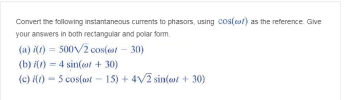 I have a question with three parts; a, b, and c. I just don't
get the part when to add the negative 90 degree. Also, if there is
different cases than the negitive 90 degrees, can anyone please
expose it here.
Convert the following instantaneous currents to phasors, using cos(of) as the reference. Give your answers in both rectangular and polar form. (a) i(1) = 500\/2 cos(a)t-30) (b) i(r) = 4 sin(c)1 + 30) (c) i(1) 5 cos(a)1-15) + 4V2...
I have a question with three parts; a, b, and c. I just don't
get the part when to add the negative 90 degree. Also, if there is
different cases than the negitive 90 degrees, can anyone please
expose it here.
Convert the following instantaneous currents to phasors, using cos(of) as the reference. Give your answers in both rectangular and polar form. (a) i(1) = 500\/2 cos(a)t-30) (b) i(r) = 4 sin(c)1 + 30) (c) i(1) 5 cos(a)1-15) + 4V2...
III) Perform the following complex number conversions (a) convert the complex number Zi- 3+j4 to polar...
 III) Perform the following complex number conversions (a) convert the complex number Zi- 3+j4 to polar form tb) convert the complex number Z2-4 e0 to polar and rectangular form Hint: Z2-rexponential form. form IV What are the phase relationship between the sinusoidal waveforms brelow: v=4sin (wt + 50) i 6 sin (wt + 40) (b) v 2 cos (wt 30) i 5 sin (wt60)
(a) Write the relationship between the instantaneous time voltage i(t) = 1, cos(wt+p) and its phasor...
 (a) Write the relationship between the instantaneous time voltage i(t) = 1, cos(wt+p) and its phasor transform I. Write phasor transforms of the following voltages and currents. All answers should be in the form of AZB where A is a positive number A 20 and B is given in degrees over the range of -180° <B S 180°. Make sure that you include the units. Show all work to receive partial credit. (6) v(t) = VŽ cos(7t + 1/4 -...
2. Write the cosine based phasors in complex number form (a + b) for the following...
 2. Write the cosine based phasors in complex number form (a + b) for the following time functions. a. 10 cos(ot + 90) b. 10 sin(ot +90) c. 10 sin( 30) 3. Determine the time-domain functions associated with each of the following phasors. a. -2-i2 c. 4-i6 Write the mesh equations in matrix form (you do not have to solve them) for the following eircuit, using the phasor approach. (Hint: It helps to write the phasor quantities on the circuit...
Find the product z1z2 and the quotient 21. Express your answers in polar form. 22 21...
 Find the product z1z2 and the quotient 21. Express your answers in polar form. 22 21 = 5 cos = 5(cos(1) + i sin()). 22 = 8(cos(65) + i sin (75)) 2122 = Z1 Z2
Part E - Use phasors to subtract one sinusoid from another sinusoid Suppose you want to...
 Part E - Use phasors to subtract one sinusoid from another sinusoid Suppose you want to find the difference of two sinusoidal currents, given as follows: ¿1(t) = 1; cos(wt+$1) and iz(t) = 12 cos(wt+$2). If you stay in the time domain, you will have to use trigonometric identities to perform the subtraction. But if you transform to the frequency domain, you can simply subtract the phasors I1 and 12 as complex numbers using y calculator. Make sure that all...
2. (Enter your answers in a + bi form.) Let za = 3 (cos 77 +...
 2. (Enter your answers in a + bi form.) Let za = 3 (cos 77 + i sin ??) and 22 = 2(cos 5 + i sin 52). Find 2122 and Zız2 -
1. (i) In a circuit, the voltage is given by: Vs (t) 12 cos(50t10) V (a)...
 1. (i) In a circuit, the voltage is given by: Vs (t) 12 cos(50t10) V (a) What is the amplitude of the voltage? (b) What is the phase of the voltage? (c) What is the angular frequency (radians/sec.) of the voltage? (d) What is the frequency (in cycles/sec.) of the voltage? (e) Determine vs (t) at time t 2.5ms (ii) Given v1(t)cos(50t 50°) V and v2(t) 12 sin(50t 10°) V, determine the phase angle between the two sinusoids and determine...
1. (40 points) Write down the phasor representation for each of the following signals a. (5 pts) ...
 1. (40 points) Write down the phasor representation for each of the following signals a. (5 pts) x, () 12cos(21) b. pts) x(1)-20cos(3t+45) c. (5 pts)x,(t)-10sin(21 + 300) d. (5 pts) x,(t)-35cos(20+22 sinQ2 +45") e. (10 pts) )- d 135cos(21)+22 sin(2i+4')leas ao express the result in the time domain. f (10 pts) ,)-[B5cos(21)+22sin(2r +45°ydr. Please also express the result in the time domain. Notes: Phasors are ideal for steady-state analysis of sinusoidal signals at a fixed frequency, so we cannot...
1. The current through a 0.1-H coil is provided. Find the sinusoidal expression for the voltage...
1. The current through a 0.1-H coil is provided. Find the sinusoidal expression for the voltage across the coil. Sketch the v and i curves. a. i = 10 sin 377t b. i = 7 sin(377t - 70°) 2. The voltage across a 1-micro F capacitor is provided below. What is the sinusoidal expression for the current? Sketch the v and i curves. v = 30 sin 400t 3. For the following pairs of voltages and currents, determine whether the...
 I have a question with three parts; a, b, and c. I just don't
get the part when to add the negative 90 degree. Also, if there is
different cases than the negitive 90 degrees, can anyone please
expose it here.
Convert the following instantaneous currents to phasors, using cos(of) as the reference. Give your answers in both rectangular and polar form. (a) i(1) = 500\/2 cos(a)t-30) (b) i(r) = 4 sin(c)1 + 30) (c) i(1) 5 cos(a)1-15) + 4V2...
I have a question with three parts; a, b, and c. I just don't
get the part when to add the negative 90 degree. Also, if there is
different cases than the negitive 90 degrees, can anyone please
expose it here.
Convert the following instantaneous currents to phasors, using cos(of) as the reference. Give your answers in both rectangular and polar form. (a) i(1) = 500\/2 cos(a)t-30) (b) i(r) = 4 sin(c)1 + 30) (c) i(1) 5 cos(a)1-15) + 4V2...
 III) Perform the following complex number conversions (a) convert the complex number Zi- 3+j4 to polar form tb) convert the complex number Z2-4 e0 to polar and rectangular form Hint: Z2-rexponential form. form IV What are the phase relationship between the sinusoidal waveforms brelow: v=4sin (wt + 50) i 6 sin (wt + 40) (b) v 2 cos (wt 30) i 5 sin (wt60)
 (a) Write the relationship between the instantaneous time voltage i(t) = 1, cos(wt+p) and its phasor transform I. Write phasor transforms of the following voltages and currents. All answers should be in the form of AZB where A is a positive number A 20 and B is given in degrees over the range of -180° <B S 180°. Make sure that you include the units. Show all work to receive partial credit. (6) v(t) = VŽ cos(7t + 1/4 -...
 2. Write the cosine based phasors in complex number form (a + b) for the following time functions. a. 10 cos(ot + 90) b. 10 sin(ot +90) c. 10 sin( 30) 3. Determine the time-domain functions associated with each of the following phasors. a. -2-i2 c. 4-i6 Write the mesh equations in matrix form (you do not have to solve them) for the following eircuit, using the phasor approach. (Hint: It helps to write the phasor quantities on the circuit...
 Find the product z1z2 and the quotient 21. Express your answers in polar form. 22 21 = 5 cos = 5(cos(1) + i sin()). 22 = 8(cos(65) + i sin (75)) 2122 = Z1 Z2
 Part E - Use phasors to subtract one sinusoid from another sinusoid Suppose you want to find the difference of two sinusoidal currents, given as follows: ¿1(t) = 1; cos(wt+$1) and iz(t) = 12 cos(wt+$2). If you stay in the time domain, you will have to use trigonometric identities to perform the subtraction. But if you transform to the frequency domain, you can simply subtract the phasors I1 and 12 as complex numbers using y calculator. Make sure that all...
 2. (Enter your answers in a + bi form.) Let za = 3 (cos 77 + i sin ??) and 22 = 2(cos 5 + i sin 52). Find 2122 and Zız2 -
 1. (i) In a circuit, the voltage is given by: Vs (t) 12 cos(50t10) V (a) What is the amplitude of the voltage? (b) What is the phase of the voltage? (c) What is the angular frequency (radians/sec.) of the voltage? (d) What is the frequency (in cycles/sec.) of the voltage? (e) Determine vs (t) at time t 2.5ms (ii) Given v1(t)cos(50t 50°) V and v2(t) 12 sin(50t 10°) V, determine the phase angle between the two sinusoids and determine...
 1. (40 points) Write down the phasor representation for each of the following signals a. (5 pts) x, () 12cos(21) b. pts) x(1)-20cos(3t+45) c. (5 pts)x,(t)-10sin(21 + 300) d. (5 pts) x,(t)-35cos(20+22 sinQ2 +45") e. (10 pts) )- d 135cos(21)+22 sin(2i+4')leas ao express the result in the time domain. f (10 pts) ,)-[B5cos(21)+22sin(2r +45°ydr. Please also express the result in the time domain. Notes: Phasors are ideal for steady-state analysis of sinusoidal signals at a fixed frequency, so we cannot...
Most questions answered within 3 hours.
-
Where is the error in this code sequence?
String s1 = "Hello";
String s2 = "ello";...
asked 10 months ago -
Financial data for Joel de Paris, Inc., for last year
follow:
Joel de Paris, Inc.
Balance...
asked 10 months ago -
Consider this reaction:
Al2(SO4)3 (aq)+ BaCl3
(aq) Al2Cl6 (aq)- +
3BaSO4(s) . What is the...
asked 10 months ago -
Suppose that Savneet is considering increasing her
recent random sample from 20 car rentals to 40...
asked 10 months ago -
Trucks arrive at an unloading terminal at an average rate of 120
per hour.
Trucks arrive...
asked 10 months ago -
Why are methanol and ethanol completely soluble in water while
octanol is not very little soluble....
asked 10 months ago -
A facilities manager at a university reads in a research report
that the mean amount of...
asked 10 months ago -
When the CuSO4 is rehydrated by adding water to the anhydrous
compound, is this an endothermic...
asked 10 months ago -
A ray of sunlight is passing from diamond into crown glass; the
angle of incidence is...
asked 10 months ago -
A block of mass 0.249 kg is placed on top of a light, vertical
spring of...
asked 10 months ago -
how do the kidneys compensate in the presences of acidosis
a) trigger hyperventilate
b) reserve acid...
asked 10 months ago -
Question 501 pts
The rental rate of capital to the firm increases. Which of the
following...
asked 10 months ago