
Homework Answers
Add Answer to:
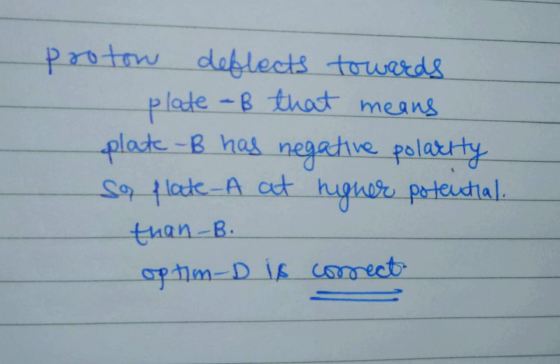
Question 2 5 pts А Q. A beam of protons is deflected as it moves between...
A proton is accelerated initially by applying a potential difference of 10 V in a small...
 A proton is accelerated initially by applying a potential
difference of 10 V in a small area. After the electron leaves the
potential difference with a speed v0, it travels between
two charged plates with distance of 0.6 cm between them. The plates
have a potential difference of ∆V = 50 V across them, with the top
plate being high potential. Inside the plates the proton is
deflected by amount ∆y.
a) What is the initial speed v0 of the...
A proton is accelerated initially by applying a potential
difference of 10 V in a small area. After the electron leaves the
potential difference with a speed v0, it travels between
two charged plates with distance of 0.6 cm between them. The plates
have a potential difference of ∆V = 50 V across them, with the top
plate being high potential. Inside the plates the proton is
deflected by amount ∆y.
a) What is the initial speed v0 of the...
A beam of protons with various speeds is directed in the positive x direction. The beam...
A beam of protons with various speeds is directed in the positive x direction. The beam enters a region with a uniform magnetic field of magnitude 0.49 T pointing into the page, as shown below. It is desired to use a uniform electric field (in addition to the magnetic field) to select from this beam only those protons with a speed of 1.23 105 m/s; that is, only these protons should be undeflected by the two fields. (a) Determine the electric...
2. In Figure 2, a beam of protons moves through a uniform magnetic field with magnitude...
 2. In Figure 2, a beam of protons moves through a uniform magnetic field with magnitude 1.3 T, directed along the positive z axis. The protons have a velocity of magnitude 10ʻ m/s in the x-z plane at an angle of 30° to the positive z axis. Find the force (F) on a proton. Find the radius of the orbital of this charge. The charge of the proton is q=1.6x10⁻¹⁹ C. The mass of the proton is 1.67x10⁻²⁷ kg. (40...
A horizontal beam of electrons initially moving at 3.4 times 10^7 m/s is deflected vertically by...
 A horizontal beam of electrons initially moving at 3.4 times 10^7 m/s is deflected vertically by the vertical electric field between oppositely charged parallel plates as shown in the diagram. The magnitude of the field is 2.20 times 10^4 N/C. What is the direction of the field between the plates? up down right left What is the charge per unit area on the plates? What is the vertical deflection d of the electrons as they leave the plates?
U Question 4 2 pts Problem 3: Proton travelling inside a parallel-plate capacitor. A proton travelling...
 U Question 4 2 pts Problem 3: Proton travelling inside a parallel-plate capacitor. A proton travelling at a speed of 1.0 x 10⁶m/s enters the gap between the plates of a parallel-plate capacitor. The plates are 2.0 cm long in the direction the proton is travelling and the surface charge densities on the plates are 1.0 x 10C/m². Assume the electric field is uniform inside the capacitor and zero outside. The mass of a proton is 1.7 x 10⁻²⁷ kg....
Two facing surfaces of two large parallel conducting plates separated by 12.0 cm have uniform surface...
 Two facing surfaces of two large parallel conducting plates separated by 12.0 cm have uniform surface charge densities such that are equal in magnitude but opposite in sign. The difference in potential between the plates is 490 V. (a) Is the positive or the negative plate at the higher potential? O the pusitive plale O the negative plate (b) What is the magnitude of the electric field between the plates? kV/m (c) An electron is released from rest next to...
A proton, that is accelerated from rest through a potential of 13.0 kV enters the velocity...
 A proton, that is accelerated from rest through a potential of
13.0 kV enters the velocity filter, consisting of a parallel-plate
capacitor and a magnetic field, shown below.
The E-field between the parallel capacitor plates is
3.9·105 N/C. What B-field is required so that the
protons are not deflected? (Ignore relativistic effects for high
velocities.)
A proton, that is accelerated from rest through a potential of
13.0 kV enters the velocity filter, consisting of a parallel-plate
capacitor and a magnetic field, shown below.
The E-field between the parallel capacitor plates is
3.9·105 N/C. What B-field is required so that the
protons are not deflected? (Ignore relativistic effects for high
velocities.)
Two facing surfaces of two large parallel conducting plates separated by 8.5 cm have uniform surface...
 Two facing surfaces of two large parallel conducting plates separated by 8.5 cm have uniform surface charge densities such that are equal in magnitude but opposite in sign. The difference in potential between the plates is 440 V (a) Is the positive or the negative plate at the higher potential? the positive plate the negative plate (b) What is the magnitude of the electric field between the plates? 5.17 kV/mm (c) An electron is released from rest next to the...
A proton moving at v0 = 1.70 ✕ 106 m/s enters the region between two parallel...
 A proton moving at v0 = 1.70 ✕
106 m/s enters the region between two parallel plates
with charge densities of magnitude σ = 2.60 ✕
10−9 C/m2 (see the figure below).
A uniform electric field is produced by two charged horizontal
plates, each of length d, where the positive plate is
above the negative plate. The leftmost side of each plate is at
horizontal position x = 0. The upper plate has charge
density +σ and the lower plate...
A proton moving at v0 = 1.70 ✕
106 m/s enters the region between two parallel plates
with charge densities of magnitude σ = 2.60 ✕
10−9 C/m2 (see the figure below).
A uniform electric field is produced by two charged horizontal
plates, each of length d, where the positive plate is
above the negative plate. The leftmost side of each plate is at
horizontal position x = 0. The upper plate has charge
density +σ and the lower plate...
A negative charge is in the space between two charged plates of potentials 100 and -100...
A negative charge is in the space between two charged plates of potentials 100 and -100 as seen in the figure. What if any, is the direction in which the charge will be accelerated? a. Toward the plate at positive potential b. Toward the plate at negative potential c. Vertically upward d. The particle will experience no acceleration in any direction
 A proton is accelerated initially by applying a potential
difference of 10 V in a small area. After the electron leaves the
potential difference with a speed v0, it travels between
two charged plates with distance of 0.6 cm between them. The plates
have a potential difference of ∆V = 50 V across them, with the top
plate being high potential. Inside the plates the proton is
deflected by amount ∆y.
a) What is the initial speed v0 of the...
A proton is accelerated initially by applying a potential
difference of 10 V in a small area. After the electron leaves the
potential difference with a speed v0, it travels between
two charged plates with distance of 0.6 cm between them. The plates
have a potential difference of ∆V = 50 V across them, with the top
plate being high potential. Inside the plates the proton is
deflected by amount ∆y.
a) What is the initial speed v0 of the...
 2. In Figure 2, a beam of protons moves through a uniform magnetic field with magnitude 1.3 T, directed along the positive z axis. The protons have a velocity of magnitude 10ʻ m/s in the x-z plane at an angle of 30° to the positive z axis. Find the force (F) on a proton. Find the radius of the orbital of this charge. The charge of the proton is q=1.6x10⁻¹⁹ C. The mass of the proton is 1.67x10⁻²⁷ kg. (40...
 A horizontal beam of electrons initially moving at 3.4 times 10^7 m/s is deflected vertically by the vertical electric field between oppositely charged parallel plates as shown in the diagram. The magnitude of the field is 2.20 times 10^4 N/C. What is the direction of the field between the plates? up down right left What is the charge per unit area on the plates? What is the vertical deflection d of the electrons as they leave the plates?
 U Question 4 2 pts Problem 3: Proton travelling inside a parallel-plate capacitor. A proton travelling at a speed of 1.0 x 10⁶m/s enters the gap between the plates of a parallel-plate capacitor. The plates are 2.0 cm long in the direction the proton is travelling and the surface charge densities on the plates are 1.0 x 10C/m². Assume the electric field is uniform inside the capacitor and zero outside. The mass of a proton is 1.7 x 10⁻²⁷ kg....
 Two facing surfaces of two large parallel conducting plates separated by 12.0 cm have uniform surface charge densities such that are equal in magnitude but opposite in sign. The difference in potential between the plates is 490 V. (a) Is the positive or the negative plate at the higher potential? O the pusitive plale O the negative plate (b) What is the magnitude of the electric field between the plates? kV/m (c) An electron is released from rest next to...
 A proton, that is accelerated from rest through a potential of
13.0 kV enters the velocity filter, consisting of a parallel-plate
capacitor and a magnetic field, shown below.
The E-field between the parallel capacitor plates is
3.9·105 N/C. What B-field is required so that the
protons are not deflected? (Ignore relativistic effects for high
velocities.)
A proton, that is accelerated from rest through a potential of
13.0 kV enters the velocity filter, consisting of a parallel-plate
capacitor and a magnetic field, shown below.
The E-field between the parallel capacitor plates is
3.9·105 N/C. What B-field is required so that the
protons are not deflected? (Ignore relativistic effects for high
velocities.)
 Two facing surfaces of two large parallel conducting plates separated by 8.5 cm have uniform surface charge densities such that are equal in magnitude but opposite in sign. The difference in potential between the plates is 440 V (a) Is the positive or the negative plate at the higher potential? the positive plate the negative plate (b) What is the magnitude of the electric field between the plates? 5.17 kV/mm (c) An electron is released from rest next to the...
 A proton moving at v0 = 1.70 ✕
106 m/s enters the region between two parallel plates
with charge densities of magnitude σ = 2.60 ✕
10−9 C/m2 (see the figure below).
A uniform electric field is produced by two charged horizontal
plates, each of length d, where the positive plate is
above the negative plate. The leftmost side of each plate is at
horizontal position x = 0. The upper plate has charge
density +σ and the lower plate...
A proton moving at v0 = 1.70 ✕
106 m/s enters the region between two parallel plates
with charge densities of magnitude σ = 2.60 ✕
10−9 C/m2 (see the figure below).
A uniform electric field is produced by two charged horizontal
plates, each of length d, where the positive plate is
above the negative plate. The leftmost side of each plate is at
horizontal position x = 0. The upper plate has charge
density +σ and the lower plate...
Most questions answered within 3 hours.
-
Where is the error in this code sequence?
String s1 = "Hello";
String s2 = "ello";...
asked 11 months ago -
Financial data for Joel de Paris, Inc., for last year
follow:
Joel de Paris, Inc.
Balance...
asked 11 months ago -
Consider this reaction:
Al2(SO4)3 (aq)+ BaCl3
(aq) Al2Cl6 (aq)- +
3BaSO4(s) . What is the...
asked 11 months ago -
Suppose that Savneet is considering increasing her
recent random sample from 20 car rentals to 40...
asked 11 months ago -
Trucks arrive at an unloading terminal at an average rate of 120
per hour.
Trucks arrive...
asked 11 months ago -
Why are methanol and ethanol completely soluble in water while
octanol is not very little soluble....
asked 11 months ago -
A facilities manager at a university reads in a research report
that the mean amount of...
asked 11 months ago -
When the CuSO4 is rehydrated by adding water to the anhydrous
compound, is this an endothermic...
asked 11 months ago -
A ray of sunlight is passing from diamond into crown glass; the
angle of incidence is...
asked 11 months ago -
A block of mass 0.249 kg is placed on top of a light, vertical
spring of...
asked 11 months ago -
how do the kidneys compensate in the presences of acidosis
a) trigger hyperventilate
b) reserve acid...
asked 11 months ago -
Question 501 pts
The rental rate of capital to the firm increases. Which of the
following...
asked 11 months ago