
Homework Answers
Explanation of the Above code:
In the above algorithm, we are searching a number.
Actually it is a Binary search algorithm
-------------------------------------------------------------------------------------------------------------------------------------------
let's we have the following array:
array = [4, 5,7, 17 , 20] --Sorted Array
Here is the following parameter passed :
index low --> index 0 of the array
index high --> last index of the array i.e. index 4
S[] --> this is the array
number x --> number we are searching let's suppose 17
---------------------------------------------------------------------------------------------------------------------------------
Now , we check if index low is less than high, we calculate mid point
mid = (low + high ) / 2
mid = (0 + 4 ) / 2 = 2
mid = 2
S[mid] = 7
Now , we check if S[mid] == x, we get the result
Otherwise, if x is less than S[mid], then we pass the array from start the one less to the mid
else, if x is greater than S[mid[, then we pass the array from mid+1 to the end.
Just we do it recursively, untill we get the number x in array or the index low becomes greater than high
Add Answer to:
Divide and Conquer & Algorithm Design 5. (20 points) Consider the following algorithm Precondition: S is...
6.3.1 [10] <§6.2> Consider the following binary search algorithm (a classic divide and conquer algorithm) that...
6.3.1 [10] <§6.2> Consider the following binary search algorithm (a classic divide and conquer algorithm) that searches for a value X in a sorted N-element array A and returns the index of matched entry: BinarySearch(A[0..N−1], X) { low = 0 high = N −1 while (low <= high) { mid = (low + high) / 2 if (A[mid] >X) high = mid −1 else if (A[mid] <X) low = mid + 1 else return mid // found } return −1...
1. Design and write a Divide& Conquer algorithm that, given an array A of n distinct...
 1. Design and write a Divide& Conquer algorithm that, given an array A of n distinct integers which is already sorted into ascending order, will find if there is some i such that Ali] in worst-case 0(log n) time.
Please solve and give reasoning 10. Consider the following instance variable and method. private int[l arr;...
 Please solve and give reasoning
10. Consider the following instance variable and method. private int[l arr; /**Precondition: arr contains no duplicates; the elements in arr are in sorted order aparam low 0 slow S arr.length aparam high low - 1 s high < arr.length @param num public int mystery (int low, int high, int num) int mid(low +high) 2i if (low > high) return low else if (arr [mid] < num) return mystery (mid + 1, high, num) else if...
Please solve and give reasoning
10. Consider the following instance variable and method. private int[l arr; /**Precondition: arr contains no duplicates; the elements in arr are in sorted order aparam low 0 slow S arr.length aparam high low - 1 s high < arr.length @param num public int mystery (int low, int high, int num) int mid(low +high) 2i if (low > high) return low else if (arr [mid] < num) return mystery (mid + 1, high, num) else if...
Show that the time complexity for the number of assignments of records for the Mergesort algorithm...
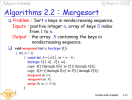 Show that the time complexity for the
number of assignments of records for the Mergesort algorithm
(Algorithms 2.2 and 2.4) is approximated by T (n)
= 2nlgn.
by Mingfu LI, CGUEE Algorithms Algorithms 2.2 : Mergesort O Problem Sort n keys in nondecreasing sequence. Inputs positive integer n, array of keys S index from 1 to n Output the array 5 containing the keys in nondecreasing sequence. void mergesort (int n, keytype S[]) (1 <u)и } keytype UI..h), ИI.m); copy...
Show that the time complexity for the
number of assignments of records for the Mergesort algorithm
(Algorithms 2.2 and 2.4) is approximated by T (n)
= 2nlgn.
by Mingfu LI, CGUEE Algorithms Algorithms 2.2 : Mergesort O Problem Sort n keys in nondecreasing sequence. Inputs positive integer n, array of keys S index from 1 to n Output the array 5 containing the keys in nondecreasing sequence. void mergesort (int n, keytype S[]) (1 <u)и } keytype UI..h), ИI.m); copy...
Using divide and conquer algorithm approach on a binary tree, show how the following list of...
Using divide and conquer algorithm approach on a binary tree, show how the following list of elements in an array can be sorted in ascending order: 38, 27,43,3,9,82,10
Show that the time complexity for the number of assignments of records for the Mergesort algorithm...
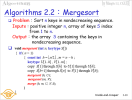 Show that the time complexity for the
number of assignments of records for the Mergesort algorithm
(Algorithms 2.2 and 2.4) is approximated by T (n)
= 2nlgn.
by Mingfu LI, CGUEE Algorithms Algorithms 2.2 : Mergesort O Problem Sort n keys in nondecreasing sequence. Inputs positive integer n, array of keys S index from 1 to n Output the array 5 containing the keys in nondecreasing sequence. void mergesort (int n, keytype S[]) (1 <u)и } keytype UI..h), ИI.m); copy...
Show that the time complexity for the
number of assignments of records for the Mergesort algorithm
(Algorithms 2.2 and 2.4) is approximated by T (n)
= 2nlgn.
by Mingfu LI, CGUEE Algorithms Algorithms 2.2 : Mergesort O Problem Sort n keys in nondecreasing sequence. Inputs positive integer n, array of keys S index from 1 to n Output the array 5 containing the keys in nondecreasing sequence. void mergesort (int n, keytype S[]) (1 <u)и } keytype UI..h), ИI.m); copy...
1. Please write a Divide-and-Conquer Java algorithm solving the following problem: Given an "almost sorted" array...
1. Please write a Divide-and-Conquer Java algorithm solving the following problem: Given an "almost sorted" array of distinct integers, and an integer x, return the index of x in the array. If the element x is not present in the array, return -1. "Almost sorted" means the following. Assume you had a sorted array A[0…N], and then split it into two pieces A[0…M] and A[M+1…N], and move the second piece upfront to get the following: A[M+1]…A[N]A[0]…A[M]. Thus, the "almost sorted"...
Consider the following: Algorithm 1 Smallest (A,q,r) Precondition: A[ q, ... , r] is an array...
Consider the following: Algorithm 1 Smallest (A,q,r) Precondition: A[ q, ... , r] is an array of integers q ≤ r and q,r ∈ N. Postcondition: Returns the smallest element of A[q, ... , r]. 1: function Smallest (A , q , r) 2: if q = r then 3: return A[q] 4: else 5: mid <--- [q+r/2] 6: return min (Smallest(A, q, mid), Smallest (A, mid + 1, r)) 7: end if 8: end function (a) Write a recurrence...
Design a divide-and-conquer algorithm in pseudocode for computing the number of levels in a binary tree....
Design a divide-and-conquer algorithm in pseudocode for computing the number of levels in a binary tree. In particular, your algorithm must return 0 and 1 for the empty and single-node trees, respectively. What is the time efficiency class of your algorithm?
Design a divide-and-conquer algorithm for computing the number of levels in a binary tree. In particular,...
 Design a divide-and-conquer algorithm for computing the number of levels in a binary tree. In particular, the algorithm should return 0 and 1 for the empty and single-node trees respectively. Please provide the pseudocode for your algorithm. What is the running time of your algorithm in the worst case using O() notation? Design a divide-and-conquer algorithm for computing the number of levels in a COMPLETE binary tree. In particular, the algorithm should return 0 and 1 for the empty and...
 1. Design and write a Divide& Conquer algorithm that, given an array A of n distinct integers which is already sorted into ascending order, will find if there is some i such that Ali] in worst-case 0(log n) time.
 Please solve and give reasoning
10. Consider the following instance variable and method. private int[l arr; /**Precondition: arr contains no duplicates; the elements in arr are in sorted order aparam low 0 slow S arr.length aparam high low - 1 s high < arr.length @param num public int mystery (int low, int high, int num) int mid(low +high) 2i if (low > high) return low else if (arr [mid] < num) return mystery (mid + 1, high, num) else if...
Please solve and give reasoning
10. Consider the following instance variable and method. private int[l arr; /**Precondition: arr contains no duplicates; the elements in arr are in sorted order aparam low 0 slow S arr.length aparam high low - 1 s high < arr.length @param num public int mystery (int low, int high, int num) int mid(low +high) 2i if (low > high) return low else if (arr [mid] < num) return mystery (mid + 1, high, num) else if...
 Show that the time complexity for the
number of assignments of records for the Mergesort algorithm
(Algorithms 2.2 and 2.4) is approximated by T (n)
= 2nlgn.
by Mingfu LI, CGUEE Algorithms Algorithms 2.2 : Mergesort O Problem Sort n keys in nondecreasing sequence. Inputs positive integer n, array of keys S index from 1 to n Output the array 5 containing the keys in nondecreasing sequence. void mergesort (int n, keytype S[]) (1 <u)и } keytype UI..h), ИI.m); copy...
Show that the time complexity for the
number of assignments of records for the Mergesort algorithm
(Algorithms 2.2 and 2.4) is approximated by T (n)
= 2nlgn.
by Mingfu LI, CGUEE Algorithms Algorithms 2.2 : Mergesort O Problem Sort n keys in nondecreasing sequence. Inputs positive integer n, array of keys S index from 1 to n Output the array 5 containing the keys in nondecreasing sequence. void mergesort (int n, keytype S[]) (1 <u)и } keytype UI..h), ИI.m); copy...
 Show that the time complexity for the
number of assignments of records for the Mergesort algorithm
(Algorithms 2.2 and 2.4) is approximated by T (n)
= 2nlgn.
by Mingfu LI, CGUEE Algorithms Algorithms 2.2 : Mergesort O Problem Sort n keys in nondecreasing sequence. Inputs positive integer n, array of keys S index from 1 to n Output the array 5 containing the keys in nondecreasing sequence. void mergesort (int n, keytype S[]) (1 <u)и } keytype UI..h), ИI.m); copy...
Show that the time complexity for the
number of assignments of records for the Mergesort algorithm
(Algorithms 2.2 and 2.4) is approximated by T (n)
= 2nlgn.
by Mingfu LI, CGUEE Algorithms Algorithms 2.2 : Mergesort O Problem Sort n keys in nondecreasing sequence. Inputs positive integer n, array of keys S index from 1 to n Output the array 5 containing the keys in nondecreasing sequence. void mergesort (int n, keytype S[]) (1 <u)и } keytype UI..h), ИI.m); copy...
 Design a divide-and-conquer algorithm for computing the number of levels in a binary tree. In particular, the algorithm should return 0 and 1 for the empty and single-node trees respectively. Please provide the pseudocode for your algorithm. What is the running time of your algorithm in the worst case using O() notation? Design a divide-and-conquer algorithm for computing the number of levels in a COMPLETE binary tree. In particular, the algorithm should return 0 and 1 for the empty and...
Most questions answered within 3 hours.
-
Where is the error in this code sequence?
String s1 = "Hello";
String s2 = "ello";...
asked 11 months ago -
Financial data for Joel de Paris, Inc., for last year
follow:
Joel de Paris, Inc.
Balance...
asked 11 months ago -
Consider this reaction:
Al2(SO4)3 (aq)+ BaCl3
(aq) Al2Cl6 (aq)- +
3BaSO4(s) . What is the...
asked 11 months ago -
Suppose that Savneet is considering increasing her
recent random sample from 20 car rentals to 40...
asked 11 months ago -
Trucks arrive at an unloading terminal at an average rate of 120
per hour.
Trucks arrive...
asked 11 months ago -
Why are methanol and ethanol completely soluble in water while
octanol is not very little soluble....
asked 11 months ago -
A facilities manager at a university reads in a research report
that the mean amount of...
asked 11 months ago -
When the CuSO4 is rehydrated by adding water to the anhydrous
compound, is this an endothermic...
asked 11 months ago -
A ray of sunlight is passing from diamond into crown glass; the
angle of incidence is...
asked 11 months ago -
A block of mass 0.249 kg is placed on top of a light, vertical
spring of...
asked 11 months ago -
how do the kidneys compensate in the presences of acidosis
a) trigger hyperventilate
b) reserve acid...
asked 11 months ago -
Question 501 pts
The rental rate of capital to the firm increases. Which of the
following...
asked 11 months ago