
Homework Answers
Will appreciate feedback.
Add Answer to:
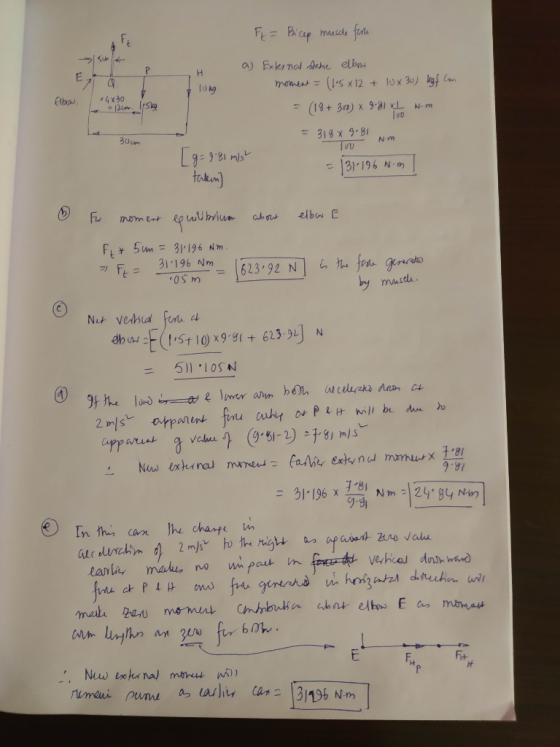
A load of 10 kg is held in one hand, with the lower arm horizontal. The...
Hold your upper arm vertical and your lower arm horizontal with your hand palm-down on a...
 Hold your upper arm vertical and your lower arm horizontal with
your hand palm-down on a table, as shown in the figure. If you now
push down on the table, youll feel that your triceps muscle has
contracted and is trying to pivot your lower arm about the elbow
joint. If a person with the arm dimensions shown pushes down hard
with a 90 N force (about 20 lbs), what force must the triceps
muscle provide? You can ignore the...
Hold your upper arm vertical and your lower arm horizontal with
your hand palm-down on a table, as shown in the figure. If you now
push down on the table, youll feel that your triceps muscle has
contracted and is trying to pivot your lower arm about the elbow
joint. If a person with the arm dimensions shown pushes down hard
with a 90 N force (about 20 lbs), what force must the triceps
muscle provide? You can ignore the...
A standard man holds the upper arm vertical and the lower arm horizontal with an object...
 A standard man holds the upper arm vertical and the lower arm horizontal with an object of mass M = 5 kg resting on the hand, as illustrated in the figure. The mass of the lower arm and hand is one-half the mass of the entire arm. As shown in the figure, there are four forces acting on the lower arm: the force Fexerted by the bones and ligaments of the upper arm at the elbow (fulcrum), the tension T...
Hold your upper arm vertical and your lower arm horizontal with your hand palm-down on a table, as shown in the figur...
 Hold your upper arm vertical and your lower arm horizontal with
your hand palm-down on a table, as shown in the figure. If you now
push down on the table, youll feel that your triceps muscle has
contracted and is trying to pivot your lower arm about the elbow
joint. If a person with the arm dimensions shown pushes down hard
with a 90 N force (about 20 lbs), what force must the triceps
muscle provide? You can ignore the...
Hold your upper arm vertical and your lower arm horizontal with
your hand palm-down on a table, as shown in the figure. If you now
push down on the table, youll feel that your triceps muscle has
contracted and is trying to pivot your lower arm about the elbow
joint. If a person with the arm dimensions shown pushes down hard
with a 90 N force (about 20 lbs), what force must the triceps
muscle provide? You can ignore the...
Constants A 71.0 kg weight lifter is doing arm raises using a 7.50 kg weight in...
 Constants A 71.0 kg weight lifter is doing arm raises using a 7.50 kg weight in her hand. Her arm pivots around the elbow joint, starting 40.0 below the horizontal. (See the figure(Figure 1).) Biometric measurements have shown that both forearms and the hands together account for 6.40 % of a person's weight. Since the upper arm is held vertically, the biceps muscle always acts vertically and is attached to the bones of the forearm 5.50 cm from the elbow...
To develop muscle tone, a woman lifts a 4.50 kg weight held in her hand. She...
To develop muscle tone, a woman lifts a 4.50 kg weight held in her hand. She uses her biceps muscle to flex the lower arm through an angle of 60.0°. a) What is the angular acceleration (in rad/s2) if the weight is 24.0 cm from the elbow joint, her forearm has a moment of inertia of 0.250 kg · m2, and the net force she exerts is 500 N at an effective perpendicular lever arm of 2.20 cm? (Ignore gravity)...
A 75.0 kg weight lifter is doing arm raises using a 7.50 kg weight in her...
 A 75.0 kg weight lifter is doing arm raises using a 7.50 kg weight in her hand. Her arm pivots around the elbow joint, starting 40.0 below the horizontal. (See the figure (Figure 1).) Biometric measurements have shown that both forearms and the hands together account for 5.75% of a person's weight. Since the upper arm is held vertically, the biceps muscle always acts vertically and is attached to the bones of the forearm 5.50 cm from the elbow Part...
Part A A 75.0 kg weight lifter is doing arm raises using a 7.50 kg weight...
 Part A A 75.0 kg weight lifter is doing arm raises using a 7.50 kg weight in her hand. Her arm pivots around the elbow joint, starting 40.0° below the horizontal (See the figure(Figure 1).) Biometric measurements have shown that both forearms and the hands together account for 5.75 % of a person's weight. Since the upper arm is held vertically, the biceps muscle always acts vertically and is attached to the bones of the forearm 5.50 cm from the...
Part A Hold your upper arm vertical and your lower arm horizontal with your hand palm-down...
 Part A Hold your upper arm vertical and your lower arm horizontal with your hand palm-down on a table, as shown in (Figure 1). If you now push down on the table, you'll feel that your triceps muscle has contracted and is trying to pivot your lower arm about the elbow joint. If a person with the arm dimensions shown pushes down hard with a 90 N force, what force must the triceps muscle provide? Ignore the mass of the...
Consider the free-body diagram of a person holding a ball with their arm extended horizontally, as...
 Consider the free-body diagram of a person holding a ball with their arm extended horizontally, as shown below on the left. The ball weighs WB 30 N, and is held at a distance d0.35 m from the elbow (E). The lower arm weighs WA 10N, with the center of mass distance 1- 0.15 m away from E. The biceps muscle applies a vertical upward force B to the lower arm at distance s - 0.03 m from E. a) What...
The diagram above shows a side view of a person’s arm. The forearm and hand together...
 The diagram above shows a side view of a person’s arm. The
forearm and hand together weigh 19N (WFH = 19N). The
center of gravity at point T is located 24cm from
the elbow joint. The person is holding a bowling ball 38cm from the
elbow and the ball weighs 47N (WB = 47N).
(a) Calculate the torque produced by the weight of the forearm
and hand about the elbow joint. Include the direction of the
torque.
(b) Calculate the...
The diagram above shows a side view of a person’s arm. The
forearm and hand together weigh 19N (WFH = 19N). The
center of gravity at point T is located 24cm from
the elbow joint. The person is holding a bowling ball 38cm from the
elbow and the ball weighs 47N (WB = 47N).
(a) Calculate the torque produced by the weight of the forearm
and hand about the elbow joint. Include the direction of the
torque.
(b) Calculate the...
 Hold your upper arm vertical and your lower arm horizontal with
your hand palm-down on a table, as shown in the figure. If you now
push down on the table, youll feel that your triceps muscle has
contracted and is trying to pivot your lower arm about the elbow
joint. If a person with the arm dimensions shown pushes down hard
with a 90 N force (about 20 lbs), what force must the triceps
muscle provide? You can ignore the...
Hold your upper arm vertical and your lower arm horizontal with
your hand palm-down on a table, as shown in the figure. If you now
push down on the table, youll feel that your triceps muscle has
contracted and is trying to pivot your lower arm about the elbow
joint. If a person with the arm dimensions shown pushes down hard
with a 90 N force (about 20 lbs), what force must the triceps
muscle provide? You can ignore the...
 A standard man holds the upper arm vertical and the lower arm horizontal with an object of mass M = 5 kg resting on the hand, as illustrated in the figure. The mass of the lower arm and hand is one-half the mass of the entire arm. As shown in the figure, there are four forces acting on the lower arm: the force Fexerted by the bones and ligaments of the upper arm at the elbow (fulcrum), the tension T...
 Hold your upper arm vertical and your lower arm horizontal with
your hand palm-down on a table, as shown in the figure. If you now
push down on the table, youll feel that your triceps muscle has
contracted and is trying to pivot your lower arm about the elbow
joint. If a person with the arm dimensions shown pushes down hard
with a 90 N force (about 20 lbs), what force must the triceps
muscle provide? You can ignore the...
Hold your upper arm vertical and your lower arm horizontal with
your hand palm-down on a table, as shown in the figure. If you now
push down on the table, youll feel that your triceps muscle has
contracted and is trying to pivot your lower arm about the elbow
joint. If a person with the arm dimensions shown pushes down hard
with a 90 N force (about 20 lbs), what force must the triceps
muscle provide? You can ignore the...
 Constants A 71.0 kg weight lifter is doing arm raises using a 7.50 kg weight in her hand. Her arm pivots around the elbow joint, starting 40.0 below the horizontal. (See the figure(Figure 1).) Biometric measurements have shown that both forearms and the hands together account for 6.40 % of a person's weight. Since the upper arm is held vertically, the biceps muscle always acts vertically and is attached to the bones of the forearm 5.50 cm from the elbow...
 A 75.0 kg weight lifter is doing arm raises using a 7.50 kg weight in her hand. Her arm pivots around the elbow joint, starting 40.0 below the horizontal. (See the figure (Figure 1).) Biometric measurements have shown that both forearms and the hands together account for 5.75% of a person's weight. Since the upper arm is held vertically, the biceps muscle always acts vertically and is attached to the bones of the forearm 5.50 cm from the elbow Part...
 Part A A 75.0 kg weight lifter is doing arm raises using a 7.50 kg weight in her hand. Her arm pivots around the elbow joint, starting 40.0° below the horizontal (See the figure(Figure 1).) Biometric measurements have shown that both forearms and the hands together account for 5.75 % of a person's weight. Since the upper arm is held vertically, the biceps muscle always acts vertically and is attached to the bones of the forearm 5.50 cm from the...
 Part A Hold your upper arm vertical and your lower arm horizontal with your hand palm-down on a table, as shown in (Figure 1). If you now push down on the table, you'll feel that your triceps muscle has contracted and is trying to pivot your lower arm about the elbow joint. If a person with the arm dimensions shown pushes down hard with a 90 N force, what force must the triceps muscle provide? Ignore the mass of the...
 Consider the free-body diagram of a person holding a ball with their arm extended horizontally, as shown below on the left. The ball weighs WB 30 N, and is held at a distance d0.35 m from the elbow (E). The lower arm weighs WA 10N, with the center of mass distance 1- 0.15 m away from E. The biceps muscle applies a vertical upward force B to the lower arm at distance s - 0.03 m from E. a) What...
 The diagram above shows a side view of a person’s arm. The
forearm and hand together weigh 19N (WFH = 19N). The
center of gravity at point T is located 24cm from
the elbow joint. The person is holding a bowling ball 38cm from the
elbow and the ball weighs 47N (WB = 47N).
(a) Calculate the torque produced by the weight of the forearm
and hand about the elbow joint. Include the direction of the
torque.
(b) Calculate the...
The diagram above shows a side view of a person’s arm. The
forearm and hand together weigh 19N (WFH = 19N). The
center of gravity at point T is located 24cm from
the elbow joint. The person is holding a bowling ball 38cm from the
elbow and the ball weighs 47N (WB = 47N).
(a) Calculate the torque produced by the weight of the forearm
and hand about the elbow joint. Include the direction of the
torque.
(b) Calculate the...
Most questions answered within 3 hours.
-
Where is the error in this code sequence?
String s1 = "Hello";
String s2 = "ello";...
asked 11 months ago -
Financial data for Joel de Paris, Inc., for last year
follow:
Joel de Paris, Inc.
Balance...
asked 11 months ago -
Consider this reaction:
Al2(SO4)3 (aq)+ BaCl3
(aq) Al2Cl6 (aq)- +
3BaSO4(s) . What is the...
asked 11 months ago -
Suppose that Savneet is considering increasing her
recent random sample from 20 car rentals to 40...
asked 11 months ago -
Trucks arrive at an unloading terminal at an average rate of 120
per hour.
Trucks arrive...
asked 11 months ago -
Why are methanol and ethanol completely soluble in water while
octanol is not very little soluble....
asked 11 months ago -
A facilities manager at a university reads in a research report
that the mean amount of...
asked 11 months ago -
When the CuSO4 is rehydrated by adding water to the anhydrous
compound, is this an endothermic...
asked 11 months ago -
A ray of sunlight is passing from diamond into crown glass; the
angle of incidence is...
asked 11 months ago -
A block of mass 0.249 kg is placed on top of a light, vertical
spring of...
asked 11 months ago -
how do the kidneys compensate in the presences of acidosis
a) trigger hyperventilate
b) reserve acid...
asked 11 months ago -
Question 501 pts
The rental rate of capital to the firm increases. Which of the
following...
asked 11 months ago