
Homework Answers
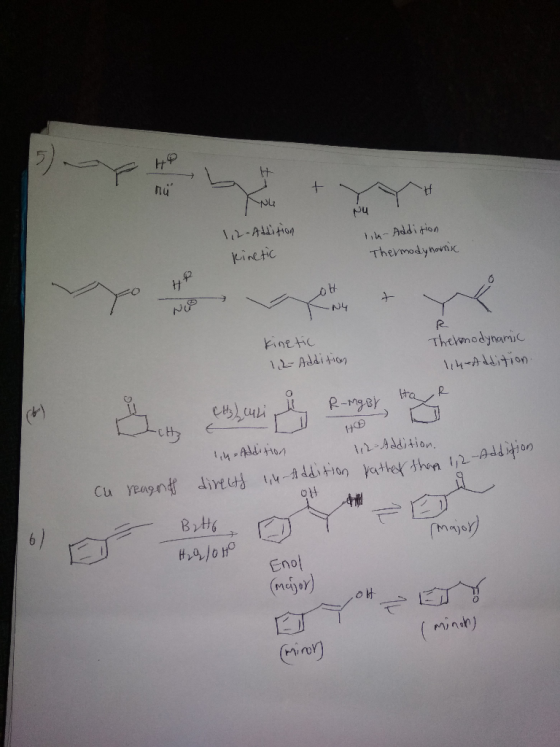
Dialkyl copper reagents add in 1,4-addition while Grignard reagent add in 1,2-addition.
6. Enol gets converted to ketone. And keto group is in conjugation with benzene ring hence first ketone is major.
Add Answer to:
5. a) Draw the major 1,2-addition product and the major 1,4-addition product of each of the...
1. Draw an electrophilic addition that illustrates 1,2-versus 1,4-addition. Using this reaction, explain Kinetic versus Thermodynamic...
1. Draw an electrophilic addition that illustrates 1,2-versus 1,4-addition. Using this reaction, explain Kinetic versus Thermodynamic products. 2. Explain resonance hybrid and draw an example that has at least 3 reasonance forms. 3. Draw a typical Diel-Alder reaction. Show the mechanism for your reaction 4. Use the inscribed polygon techiques to illustrate why benzene is aromatic and cyclopentadiene is not 5. Draw the general mechanism for electrophilic aromatic substitution 6. Explain how substituents on the aromatic ring activate or slow...
Go to your ebook in OWL, and watch the video "1,2 and 1.4 Addition to a...
 Go to your ebook in OWL, and watch the video "1,2 and 1.4 Addition to a Conjugated Diene" For the reaction below, provide a mechanism that explains the formation of the two products, showing all electron movement with arrows and all intermediates. HCI 1,2-addition product 1,4-addition product II. Challenge Problem Consider the addition of HCl to the conjugated diene below. HCI a) The two CEC bonds are not the same in terms of their substitution. Draw all possible cations that...
Draw the major 1,2- and 1,4-addition products obtained in the reaction shown. Assume that both are...
 Draw the major 1,2- and 1,4-addition products obtained in the reaction shown. Assume that both are derived from the most stable carbocation intermediate. +HBr You do not have to consider stereochemistry. You do not have to explicitly draw H atoms. If the 1,2- and 1,4- addition products are the same due to symmetry, only draw one structure. Draw one structure per sketcher. Add additional sketchers using the drop-down menu in the bottom right corner. Separate multiple products using the +...
Draw the major 1,2- and 1,4-addition products obtained in the reaction shown. Assume that both are...
 Draw the major 1,2- and 1,4-addition products obtained in the reaction shown. Assume that both are derived from the most stable carbocation intermediate. HCI
сн, Нас 12-addition products (direct addition) CH2 CH3 Н,с Н-с CH CI HCI CH2 Cн Н.с 1,4-addition products (conjuga...
 сн, Нас 12-addition products (direct addition) CH2 CH3 Н,с Н-с CH CI HCI CH2 Cн Н.с 1,4-addition products (conjugate addition) Cн CH3 Нас Н.С CI Electrophilic addition to an alkene proceeds via Markovnikov regiochemistry due to the formation of the more stable carbocation intermediate. In the case of conjugated dienes, that is dienes that are separated by one sigma bond, the carbocation that is formed is stabilized additionally by resonance. Addition of the nucleophile to the carbocation intermediate can therefore...
7) A nucleophile can attack acrolein either at the terminal carbon or at the carbonyl. Draw...
 7) A nucleophile can attack acrolein either at the terminal carbon or at the carbonyl. Draw a) the mechanism for each addition as labeled, b) the inital intermediate formed, and c) the final product formed after neutralizing aqueous, mild acidic, workup. 1,2-addition a Nob) is also called 1,4-additiona) is also called d) Explicitly state why coulombic or FMO factors determine the course of each reaction. 1,4-addition: 1,2-addition: e) A hydride like NaBH4 would do a 1,4-addition or 1,2-addition? f) A...
What is the major product of the following reaction? (1,2 vs 1,4 addition) HCl 40°C CI...
 What is the major product of the following reaction? (1,2 vs 1,4 addition) HCl 40°C CI OCI
Alder Re? 9. Draw the two major products for the following reaction. a. Identify each as...
 Alder Re? 9. Draw the two major products for the following reaction. a. Identify each as either a 1,2 or 1,4 addition product. b. Write either "thermodynamic" or "kinetic" underneath each one. c. Draw the two resonance structures for the intermediate from which both form H-Br ton nroducts for the following reaction. Draw the the major product or products for the following reaction. Drow the resonance structures for the intermediate from which both form Bra/ hv NBS/ peroxides 11. Give...
ASAP 6.(8) a. The 1,2 addition product of the reaction is shown. Draw the 1,4 addition...
 ASAP
6.(8) a. The 1,2 addition product of the reaction is shown. Draw the 1,4 addition product. HBr 1,2 1,4 b. Which is more stable? Circle one: the 1,2 product, the 1.4 product. c. Which product is favored at low temperatures? Circle one: the 1.2 product, the 14 product d. "The proximity effect is used to account for the formation of which product? Circle one: the 1,2 product, the 1.4 product. 7. (5) The pesticide chlordane, sold starting in 1948,...
ASAP
6.(8) a. The 1,2 addition product of the reaction is shown. Draw the 1,4 addition product. HBr 1,2 1,4 b. Which is more stable? Circle one: the 1,2 product, the 1.4 product. c. Which product is favored at low temperatures? Circle one: the 1.2 product, the 14 product d. "The proximity effect is used to account for the formation of which product? Circle one: the 1,2 product, the 1.4 product. 7. (5) The pesticide chlordane, sold starting in 1948,...
For each addition route of the reaction, draw the structure(s) of the major product(s), including stereochemistry....
 For each addition route of the reaction, draw the structure(s) of the major product(s), including stereochemistry. 1,2-addition: y 1,4-addition:
 Go to your ebook in OWL, and watch the video "1,2 and 1.4 Addition to a Conjugated Diene" For the reaction below, provide a mechanism that explains the formation of the two products, showing all electron movement with arrows and all intermediates. HCI 1,2-addition product 1,4-addition product II. Challenge Problem Consider the addition of HCl to the conjugated diene below. HCI a) The two CEC bonds are not the same in terms of their substitution. Draw all possible cations that...
 Draw the major 1,2- and 1,4-addition products obtained in the reaction shown. Assume that both are derived from the most stable carbocation intermediate. +HBr You do not have to consider stereochemistry. You do not have to explicitly draw H atoms. If the 1,2- and 1,4- addition products are the same due to symmetry, only draw one structure. Draw one structure per sketcher. Add additional sketchers using the drop-down menu in the bottom right corner. Separate multiple products using the +...
 Draw the major 1,2- and 1,4-addition products obtained in the reaction shown. Assume that both are derived from the most stable carbocation intermediate. HCI
 сн, Нас 12-addition products (direct addition) CH2 CH3 Н,с Н-с CH CI HCI CH2 Cн Н.с 1,4-addition products (conjugate addition) Cн CH3 Нас Н.С CI Electrophilic addition to an alkene proceeds via Markovnikov regiochemistry due to the formation of the more stable carbocation intermediate. In the case of conjugated dienes, that is dienes that are separated by one sigma bond, the carbocation that is formed is stabilized additionally by resonance. Addition of the nucleophile to the carbocation intermediate can therefore...
 7) A nucleophile can attack acrolein either at the terminal carbon or at the carbonyl. Draw a) the mechanism for each addition as labeled, b) the inital intermediate formed, and c) the final product formed after neutralizing aqueous, mild acidic, workup. 1,2-addition a Nob) is also called 1,4-additiona) is also called d) Explicitly state why coulombic or FMO factors determine the course of each reaction. 1,4-addition: 1,2-addition: e) A hydride like NaBH4 would do a 1,4-addition or 1,2-addition? f) A...
 What is the major product of the following reaction? (1,2 vs 1,4 addition) HCl 40°C CI OCI
 Alder Re? 9. Draw the two major products for the following reaction. a. Identify each as either a 1,2 or 1,4 addition product. b. Write either "thermodynamic" or "kinetic" underneath each one. c. Draw the two resonance structures for the intermediate from which both form H-Br ton nroducts for the following reaction. Draw the the major product or products for the following reaction. Drow the resonance structures for the intermediate from which both form Bra/ hv NBS/ peroxides 11. Give...
 ASAP
6.(8) a. The 1,2 addition product of the reaction is shown. Draw the 1,4 addition product. HBr 1,2 1,4 b. Which is more stable? Circle one: the 1,2 product, the 1.4 product. c. Which product is favored at low temperatures? Circle one: the 1.2 product, the 14 product d. "The proximity effect is used to account for the formation of which product? Circle one: the 1,2 product, the 1.4 product. 7. (5) The pesticide chlordane, sold starting in 1948,...
ASAP
6.(8) a. The 1,2 addition product of the reaction is shown. Draw the 1,4 addition product. HBr 1,2 1,4 b. Which is more stable? Circle one: the 1,2 product, the 1.4 product. c. Which product is favored at low temperatures? Circle one: the 1.2 product, the 14 product d. "The proximity effect is used to account for the formation of which product? Circle one: the 1,2 product, the 1.4 product. 7. (5) The pesticide chlordane, sold starting in 1948,...
 For each addition route of the reaction, draw the structure(s) of the major product(s), including stereochemistry. 1,2-addition: y 1,4-addition:
Most questions answered within 3 hours.
-
Where is the error in this code sequence?
String s1 = "Hello";
String s2 = "ello";...
asked 11 months ago -
Financial data for Joel de Paris, Inc., for last year
follow:
Joel de Paris, Inc.
Balance...
asked 11 months ago -
Consider this reaction:
Al2(SO4)3 (aq)+ BaCl3
(aq) Al2Cl6 (aq)- +
3BaSO4(s) . What is the...
asked 11 months ago -
Suppose that Savneet is considering increasing her
recent random sample from 20 car rentals to 40...
asked 11 months ago -
Trucks arrive at an unloading terminal at an average rate of 120
per hour.
Trucks arrive...
asked 11 months ago -
Why are methanol and ethanol completely soluble in water while
octanol is not very little soluble....
asked 11 months ago -
A facilities manager at a university reads in a research report
that the mean amount of...
asked 11 months ago -
When the CuSO4 is rehydrated by adding water to the anhydrous
compound, is this an endothermic...
asked 11 months ago -
A ray of sunlight is passing from diamond into crown glass; the
angle of incidence is...
asked 11 months ago -
A block of mass 0.249 kg is placed on top of a light, vertical
spring of...
asked 11 months ago -
how do the kidneys compensate in the presences of acidosis
a) trigger hyperventilate
b) reserve acid...
asked 11 months ago -
Question 501 pts
The rental rate of capital to the firm increases. Which of the
following...
asked 11 months ago