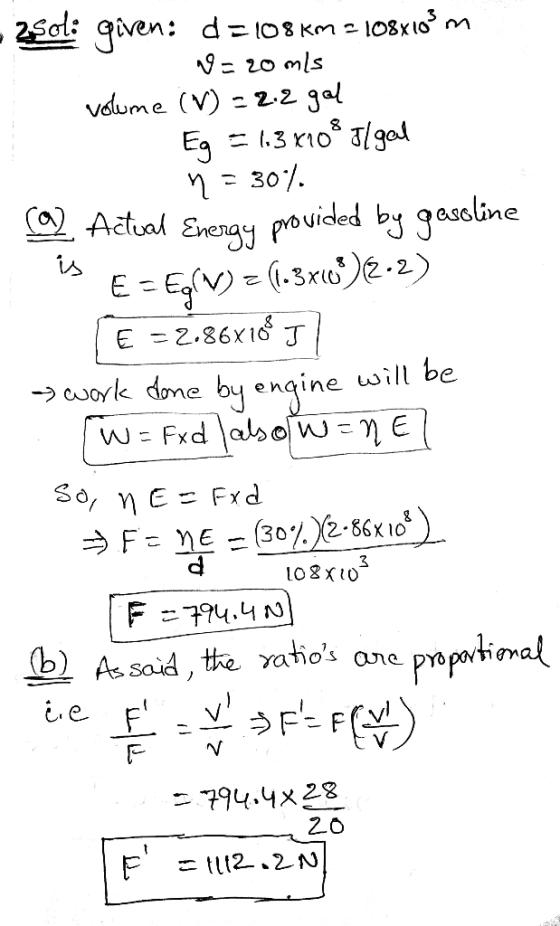
2. Suppose a car travels 108 km at a speed of 20.0 m/s, and uses 2.20...
2. Suppose a car travels 108 km at a speed of 20.0 m/s, and uses 2.20 gallons of gasoline. Only 30% of the gasoline goes into useful work by the force that keeps the car moving at constant speed despite friction. (The energy content of gasoline is 1.3 ✕ 108 J per gallon.)
(a) What is the force exerted to keep the car moving at constant
speed?
N
(b) If the required force is directly proportional to speed, how
many gallons will be used to drive 108 km at a speed of 28.0
m/s?
gallons
3.(a) Calculate the force needed to bring a 900 kg car to rest
from a speed of 95.0 km/h in a distance of 105 m (a fairly typical
distance for a nonpanic stop).
N
(b) Suppose instead the car hits a concrete abutment at full speed
and is brought to a stop in 2.00 m. Calculate the force exerted on
the car and compare it with the force found in part (a), i.e. find
the ratio of the force in part(b) to the force in part(a).
(force in part (b) / force in part (a))
4.A car's bumper is designed to withstand a 6.48-km/h (1.8-m/s)
collision with an immovable object without damage to the body of
the car. The bumper cushions the shock by absorbing the force over
a distance. Calculate the magnitude of the average force on a
bumper that collapses 0.300 m while bringing a 840-kg car to rest
from an initial speed of 1.8 m/s.
N
5.a) How much gravitational potential energy (relative to the
ground on which it is built) is stored in an Egyptian pyramid,
given its mass is about 9 ✕ 109 kg and its center of
mass is 46.0 m above the surrounding ground?
J
(b) What is the ratio of this energy to the daily food intake of a
person (1.2 ✕ 107 J)?
:1
6.In a downhill ski race surprisingly little advantage is gained by getting a running start. This is because the initial kinetic energy is small compared with the gain in gravitational potential energy even on small hills. To demonstrate this, find the final speed and the time taken for a skier who skies 70.0 m along a 35° slope neglecting friction for the following two cases. (Note that this time difference can be very significant in competitive events so it is still worthwhile to get a running start.)
(a) starting from rest
final speed
m/s
time taken
s
(b) starting with an initial speed of 2.50 m/s
final speed
m/s
time taken
s
7.A 3.00 ✕ 105 kg subway train is brought to a stop
from a speed of 0.500 m/s in 0.900 m by a large spring bumper at
the end of its track. What is the force constant k of the
spring?
N/m
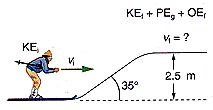
8.A 70.0 kg skier with an initial speed of 10.0 m/s coasts up a
2.50 m high rise as shown in Figure 6.23. Find his final speed at
the top, given that the coefficient of friction between her skis
and the snow is 0.0800. (Hint: Find the distance traveled up the
incline assuming a straight-line path as shown in the
figure.)
m/s
9. A person in good physical condition can put out 100 W of useful power for several hours at a stretch, perhaps by pedaling a mechanism that drives an electric generator. Neglecting any problems of generator efficiency and practical considerations such as resting time:
(a) How many people would it take to run a 4.00 kW electric
clothes dryer?
people
(b) How many people would it take to replace a large electric power
plant that generates 800 MW?
people
10.(a) What is the efficiency of an out-of-condition professor
who does 2.00 ✕ 105 J of useful work while metabolizing
490 kcal of food energy?
%
(b) How many food calories would a well-conditioned athlete
metabolize in doing the same work with an efficiency of 20%?
kcal
Homework Answers

Add Answer to:
2. Suppose a car travels 108 km at a speed of 20.0 m/s, and uses
2.20...
Suppose a car travels 102 km at a speed of 30.5 m/s, and uses 2.1 gal...
Suppose a car travels 102 km at a speed of 30.5 m/s, and uses 2.1 gal of gasoline in the process. Only 30% of the gasoline goes into useful work to keep the car moving at a constant speed. In this problem you may assume that 1 gallon of gasoline produces 1.2 × 10⁸ J of energy. (a) What is the force exerted, in newtons, to keep the car moving at constant speed? (b) If the required force is directly...
Question 5.2a: A 1350-kg car is traveling with an initial speed of 26.0 m/s. Determine the...
Question 5.2a: A 1350-kg car is traveling with an initial speed of 26.0 m/s. Determine the car's speed after ?2.15 ? 105 J of net work is done on the car. m/s Question 5.2b: A 11.6-kg box is sliding across a horizontal floor. It has an initial speed of 1.40 m/s and the only force acting on it is kinetic friction with magnitude fk = 3.00 N. Determine the distance the box will travel before coming to rest. m
A car's bumper is designed to withstand a 6.48-km/h (1.8-m/s) collision with an immovable object without...
A car's bumper is designed to withstand a 6.48-km/h (1.8-m/s) collision with an immovable object without damage to the body of the car. The bumper cushions the shock by absorbing the force over a distance. Calculate the magnitude of the average force on a bumper that collapses 0.180 m while bringing a 940-kg car to rest from an initial speed of 1.8 m/s.
A car's bumper is designed to withstand a 5.04-km/h (1.4-m/s) collision with an immovable object without...
A car's bumper is designed to withstand a 5.04-km/h (1.4-m/s) collision with an immovable object without damage to the body of the car. The bumper cushions the shock by absorbing the force over a distance. Calculate the magnitude of the average force on a bumper that collapses 0.165 m while bringing a 830-kg car to rest from an initial speed of 1.4 m/s. N
A car's bumper is designed to withstand a 6.84-km/h (1.9-m/s) collision with avable object without damage...
 A car's bumper is designed to withstand a 6.84-km/h (1.9-m/s) collision with avable object without damage to the body of the car. The bumper cushions the shock by absorbing the force over a distance. Calculate the magnitude of the average force on a bumper that collapses 0.165 m while bringing a 950-kg car to rest from an initial speed of 1.9 m/s
A car has an initial speed of 118 km/h and climbs up an incline with its...
A car has an initial speed of 118 km/h and climbs up an incline with its engine DISENGAGED (no engine force). DON"T use scientific notation. Angle is 33 degrees. (a) If work done by friction is negligible, How high (the h in the figure) a hill can the car coast up (engine disengaged) before coming to a stop? (b) If, in actuality, a 700-kg car with an initial speed of 118 km/h is observed to coast up a hill to...
The driver of a 840.0 kg car decides to double the speed from 22.4 m/s to...
The driver of a 840.0 kg car decides to double the speed from 22.4 m/s to 44.8 m/s. What effect would this have on the amount of work required to stop the car, that is, on the kinetic energy of the car? KEi= ×105 J KEf= ×105 J (select)3,4,8 or 2 times as much work must be done to stop the car.
A car, traveling due north, has an initial velocity of 18 m/s accelerates for 9 s...
 A car, traveling due north, has an initial velocity of 18 m/s accelerates for 9 s for a distance of 180 m. What is the velocity of the car after the acceleration? (5) A remote controlled car is moving through a parking lot described by the position function r(t) = [2.5 m - (0.015 m/s^2) t^2] i - [0.6 m - (0.1 m/s) t + (0.032 m/s2) t^2] j. What is the speed of the toy car at t =...
A 1000 kg car travels at 25 m/s and then quickly stops in 3.9 s to...
A 1000 kg car travels at 25 m/s and then quickly stops in 3.9 s to avoid an obstacle. What is the Initial Momentum of the car? kg m/s Tries 0/2 What is the Initial Kinetic Energy of the car? J Tries 0/2 What is the magnitude of the impulse needed to stop the car? Kg m/s Tries 0/2 What is the magnitude of the average force in kiloNewtons (kN) that stopped the car? Notice the units! kN Tries 0/2...
A car travels at constant speed around a corner. The cars speed is 35 m/s and...
A car travels at constant speed around a corner. The cars speed is 35 m/s and the radius of the circle is 0.25 km. The coefficient of static friction between the tires and the road is 0.7. What is the frictional force needed for the car to make the turn? What is the maximum force the static friction can produce? Does the car stay on the road? The car is in motion so why is the static friction important?
 A car's bumper is designed to withstand a 6.84-km/h (1.9-m/s) collision with avable object without damage to the body of the car. The bumper cushions the shock by absorbing the force over a distance. Calculate the magnitude of the average force on a bumper that collapses 0.165 m while bringing a 950-kg car to rest from an initial speed of 1.9 m/s
 A car, traveling due north, has an initial velocity of 18 m/s accelerates for 9 s for a distance of 180 m. What is the velocity of the car after the acceleration? (5) A remote controlled car is moving through a parking lot described by the position function r(t) = [2.5 m - (0.015 m/s^2) t^2] i - [0.6 m - (0.1 m/s) t + (0.032 m/s2) t^2] j. What is the speed of the toy car at t =...
Most questions answered within 3 hours.
-
Where is the error in this code sequence?
String s1 = "Hello";
String s2 = "ello";...
asked 11 months ago -
Financial data for Joel de Paris, Inc., for last year
follow:
Joel de Paris, Inc.
Balance...
asked 11 months ago -
Consider this reaction:
Al2(SO4)3 (aq)+ BaCl3
(aq) Al2Cl6 (aq)- +
3BaSO4(s) . What is the...
asked 11 months ago -
Suppose that Savneet is considering increasing her
recent random sample from 20 car rentals to 40...
asked 11 months ago -
Trucks arrive at an unloading terminal at an average rate of 120
per hour.
Trucks arrive...
asked 11 months ago -
Why are methanol and ethanol completely soluble in water while
octanol is not very little soluble....
asked 11 months ago -
A facilities manager at a university reads in a research report
that the mean amount of...
asked 11 months ago -
When the CuSO4 is rehydrated by adding water to the anhydrous
compound, is this an endothermic...
asked 11 months ago -
A ray of sunlight is passing from diamond into crown glass; the
angle of incidence is...
asked 11 months ago -
A block of mass 0.249 kg is placed on top of a light, vertical
spring of...
asked 11 months ago -
how do the kidneys compensate in the presences of acidosis
a) trigger hyperventilate
b) reserve acid...
asked 11 months ago -
Question 501 pts
The rental rate of capital to the firm increases. Which of the
following...
asked 11 months ago