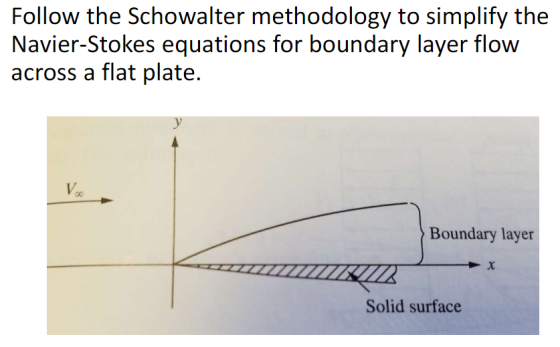
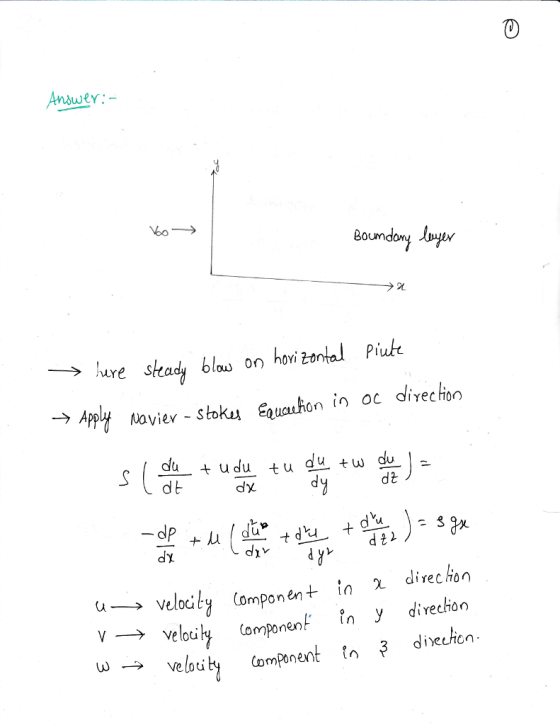
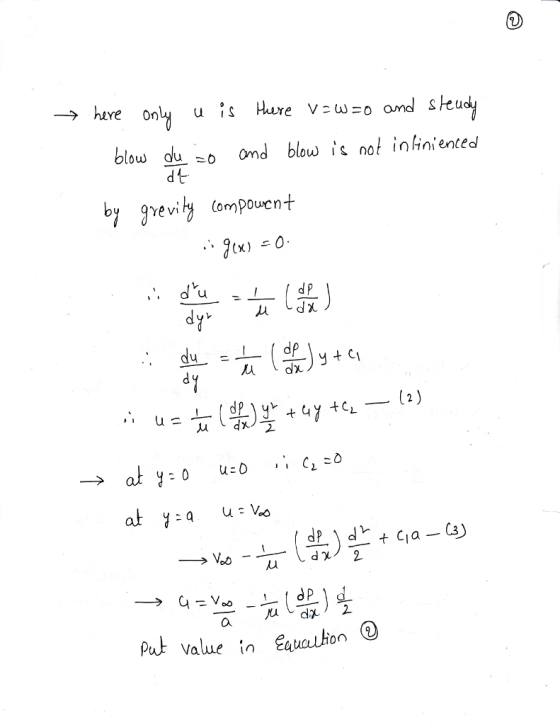
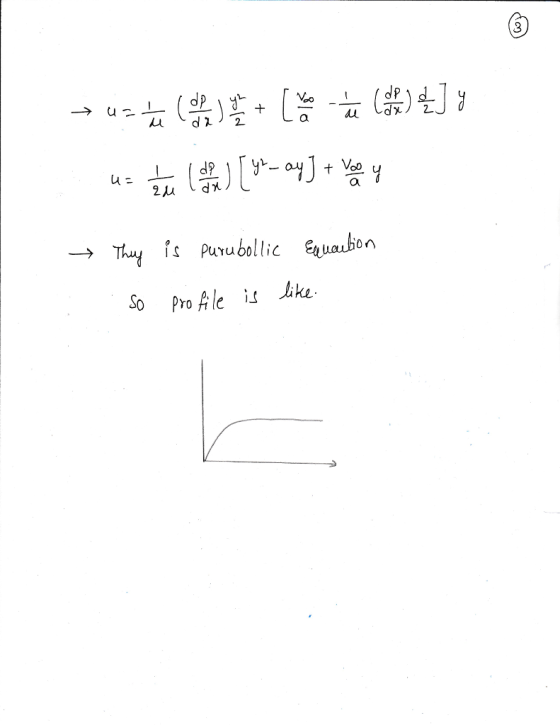
Follow the Schowalter methodology to simplify the Navier-Stokes equations for boundary layer flow across a flat plate.
Homework Answers
Add Answer to:
Follow the Schowalter methodology to simplify the Navier-Stokes
equations for boundary layer flow across a flat...
You have seen an example of solving Navier-Stokes equations for flow in a circular tube of...
 You have seen an example of solving Navier-Stokes equations for flow in a circular tube of radius R (Poiseuille flow). In those instances, the tube is horizontal, and flow is along the horizontal axis (z-axis in cylindrical coordinates). Now imagine if the tube is turned 90° so that the flow is downward and is now parallel to gravity g (A) Start with the Navier-Stokes equations, set up the problem, and clearly indicate what assumptions are used in your simplification of...
(b) For a laminar boundary layer on a flat plate the velocity profile uly) is given...
 (b) For a laminar boundary layer on a flat plate the velocity profile uly) is given by 0-30:48) where U is the free stream velocity, y is the distance measured normal to the surface of the plate and is the boundary layer thickness. Determine equations for (i) the momentum thickness , and (8 marks) (ii) the boundary layer thickness d. (7 marks)
Tutorial 2. Incompressible Navier-Stokes equations 18 September, 4-5 pm in FN2 In Lecture Notes 1 the Navier-Stokes equ...
 Tutorial 2. Incompressible Navier-Stokes equations 18 September, 4-5 pm in FN2 In Lecture Notes 1 the Navier-Stokes equations (momentum balance) for incompressible flow were derived. They were eventually written in the following form dr In this equation, the viscosity μ and the density ρ are constants. We now consider two simple flow configurations. Config. 1. The steady state flow of a liquid in the space between two very large static parallel plates at distance H of each other in the...
JESTION 3 [15 MARKS nsider a flow along a flat plate with a boundary layer profile...
 JESTION 3 [15 MARKS nsider a flow along a flat plate with a boundary layer profile given by: u 3 y ang Von-Karman momentum integral equation method, determine the value of: i. boundary layer momentum thickness, 0/8 ii. boundary layer thickness, 8x iii. boundary layer displacement thickness. 8*x (15
2. For a boundary layer flow with U suction velocity Vo (0 is introduced at the...
 2. For a boundary layer flow with U suction velocity Vo (0 is introduced at the wall to delay flow separation. (a) By integrating the boundary layer equations from porous wall across the boundary layer, show that the integral momentum equation is given by -constant over a porous plate as shown in Figure 1, a Ou where τνν-μ w- 1 оу y-o and (b) obtain the integral energy equation. (c) Perform the dimensionless analysis on the integral equations and discuss...
Use the Cartesian Navier–Stokes equations to approximate the flow through the left ventricle during peak systole....
Use the Cartesian Navier–Stokes equations to approximate the flow through the left ventricle during peak systole. Assume that the gravitational effects on the flow are negligible and that the opening orifice for blood to flow through is 25 mm (aorta). The width of the left ventricle can be approximated as 2 cm and the total length from the apex of the heart to the aortic valve of 4 cm. Determine the maximum velocity at both the aorta and within the...
The Navier-Stokes equations are a system of non-linear, partial-differential equations that describe fluid flows. In the...
 The Navier-Stokes equations are a system of non-linear, partial-differential equations that describe fluid flows. In the incompressible limit, the density of the fluid may be regarded as a constant, and the system of equations becomes, Because of the non-linearities, there are very few exact solutions that are known for these equations. One of the exact solutions is pressure-driven channel (or pipe) flow, also known as Poiseuille flow. In this flow, all solid, no-slip walls are parallel to the x-axis, and...
a) Write the governing equations (continuity and Navier Stokes) for a 1-D steady viscous flow in...
 a) Write the governing equations (continuity and Navier Stokes) for a 1-D steady viscous flow in a rigid pipe. b) A patient who has normal blood pressure (systolic and diastolic also has hardening of the arteries, including the brachial artery in the upper arm. Will this patient's measured blood pressure be larger than the actual value, and why or why not?
Consider laminar flow of an incompressible fluid past a flat plate. The boundary layer velocity profile...
 Consider laminar flow of an incompressible fluid past a flat plate. The boundary layer velocity profile is given as u = U sin () a. Determine the boundary layer thicknesses 8, 8, as a function of x. Express in terms of Reynolds number. b. Using momentum integral theory, determine the wall shear stress tw, as a func. of x. Express in terms of Reynolds number. C. Determine the friction drag coefficient, Cof-
Deduce a set of boundary-layer differential equations (continuity, momentum, energy) for steady f...
 Deduce a set of boundary-layer differential equations
(continuity, momentum, energy) for steady flow of a
constant-property fluid without body forces, and with negligible
viscous dissipation, in a coordinate system suitable for analysis
of the boundary layer on the surface of a rotating disk
Problem # 6 Deduce a set of boundary-layer differential equations (continuity, momentum, energy) for steady flow of a constant-property fluid without body forces, and with negligible viscous dissipation, in a coordinate system suitable for analysis of the...
Deduce a set of boundary-layer differential equations
(continuity, momentum, energy) for steady flow of a
constant-property fluid without body forces, and with negligible
viscous dissipation, in a coordinate system suitable for analysis
of the boundary layer on the surface of a rotating disk
Problem # 6 Deduce a set of boundary-layer differential equations (continuity, momentum, energy) for steady flow of a constant-property fluid without body forces, and with negligible viscous dissipation, in a coordinate system suitable for analysis of the...
 You have seen an example of solving Navier-Stokes equations for flow in a circular tube of radius R (Poiseuille flow). In those instances, the tube is horizontal, and flow is along the horizontal axis (z-axis in cylindrical coordinates). Now imagine if the tube is turned 90° so that the flow is downward and is now parallel to gravity g (A) Start with the Navier-Stokes equations, set up the problem, and clearly indicate what assumptions are used in your simplification of...
 (b) For a laminar boundary layer on a flat plate the velocity profile uly) is given by 0-30:48) where U is the free stream velocity, y is the distance measured normal to the surface of the plate and is the boundary layer thickness. Determine equations for (i) the momentum thickness , and (8 marks) (ii) the boundary layer thickness d. (7 marks)
 Tutorial 2. Incompressible Navier-Stokes equations 18 September, 4-5 pm in FN2 In Lecture Notes 1 the Navier-Stokes equations (momentum balance) for incompressible flow were derived. They were eventually written in the following form dr In this equation, the viscosity μ and the density ρ are constants. We now consider two simple flow configurations. Config. 1. The steady state flow of a liquid in the space between two very large static parallel plates at distance H of each other in the...
 JESTION 3 [15 MARKS nsider a flow along a flat plate with a boundary layer profile given by: u 3 y ang Von-Karman momentum integral equation method, determine the value of: i. boundary layer momentum thickness, 0/8 ii. boundary layer thickness, 8x iii. boundary layer displacement thickness. 8*x (15
 2. For a boundary layer flow with U suction velocity Vo (0 is introduced at the wall to delay flow separation. (a) By integrating the boundary layer equations from porous wall across the boundary layer, show that the integral momentum equation is given by -constant over a porous plate as shown in Figure 1, a Ou where τνν-μ w- 1 оу y-o and (b) obtain the integral energy equation. (c) Perform the dimensionless analysis on the integral equations and discuss...
 The Navier-Stokes equations are a system of non-linear, partial-differential equations that describe fluid flows. In the incompressible limit, the density of the fluid may be regarded as a constant, and the system of equations becomes, Because of the non-linearities, there are very few exact solutions that are known for these equations. One of the exact solutions is pressure-driven channel (or pipe) flow, also known as Poiseuille flow. In this flow, all solid, no-slip walls are parallel to the x-axis, and...
 a) Write the governing equations (continuity and Navier Stokes) for a 1-D steady viscous flow in a rigid pipe. b) A patient who has normal blood pressure (systolic and diastolic also has hardening of the arteries, including the brachial artery in the upper arm. Will this patient's measured blood pressure be larger than the actual value, and why or why not?
 Consider laminar flow of an incompressible fluid past a flat plate. The boundary layer velocity profile is given as u = U sin () a. Determine the boundary layer thicknesses 8, 8, as a function of x. Express in terms of Reynolds number. b. Using momentum integral theory, determine the wall shear stress tw, as a func. of x. Express in terms of Reynolds number. C. Determine the friction drag coefficient, Cof-
 Deduce a set of boundary-layer differential equations
(continuity, momentum, energy) for steady flow of a
constant-property fluid without body forces, and with negligible
viscous dissipation, in a coordinate system suitable for analysis
of the boundary layer on the surface of a rotating disk
Problem # 6 Deduce a set of boundary-layer differential equations (continuity, momentum, energy) for steady flow of a constant-property fluid without body forces, and with negligible viscous dissipation, in a coordinate system suitable for analysis of the...
Deduce a set of boundary-layer differential equations
(continuity, momentum, energy) for steady flow of a
constant-property fluid without body forces, and with negligible
viscous dissipation, in a coordinate system suitable for analysis
of the boundary layer on the surface of a rotating disk
Problem # 6 Deduce a set of boundary-layer differential equations (continuity, momentum, energy) for steady flow of a constant-property fluid without body forces, and with negligible viscous dissipation, in a coordinate system suitable for analysis of the...
Most questions answered within 3 hours.
-
Where is the error in this code sequence?
String s1 = "Hello";
String s2 = "ello";...
asked 10 months ago -
Financial data for Joel de Paris, Inc., for last year
follow:
Joel de Paris, Inc.
Balance...
asked 10 months ago -
Consider this reaction:
Al2(SO4)3 (aq)+ BaCl3
(aq) Al2Cl6 (aq)- +
3BaSO4(s) . What is the...
asked 10 months ago -
Suppose that Savneet is considering increasing her
recent random sample from 20 car rentals to 40...
asked 10 months ago -
Trucks arrive at an unloading terminal at an average rate of 120
per hour.
Trucks arrive...
asked 10 months ago -
Why are methanol and ethanol completely soluble in water while
octanol is not very little soluble....
asked 10 months ago -
A facilities manager at a university reads in a research report
that the mean amount of...
asked 10 months ago -
When the CuSO4 is rehydrated by adding water to the anhydrous
compound, is this an endothermic...
asked 10 months ago -
A ray of sunlight is passing from diamond into crown glass; the
angle of incidence is...
asked 10 months ago -
A block of mass 0.249 kg is placed on top of a light, vertical
spring of...
asked 10 months ago -
how do the kidneys compensate in the presences of acidosis
a) trigger hyperventilate
b) reserve acid...
asked 10 months ago -
Question 501 pts
The rental rate of capital to the firm increases. Which of the
following...
asked 10 months ago