
Homework Answers
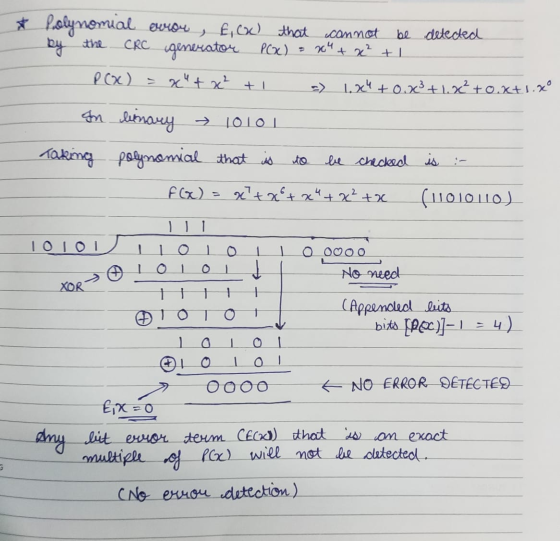
Example of polynomial error E1(x) that cannot be detected by the CRC generator P(x) = x4+x2+1.
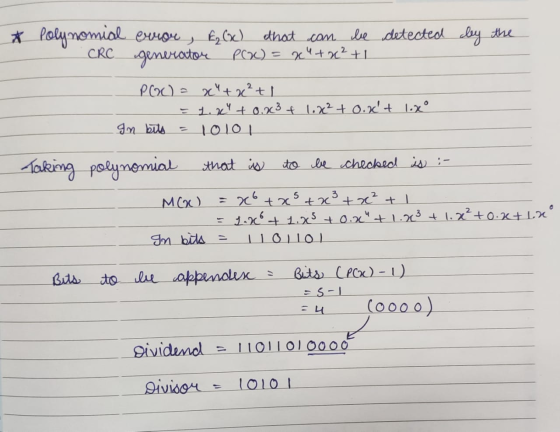
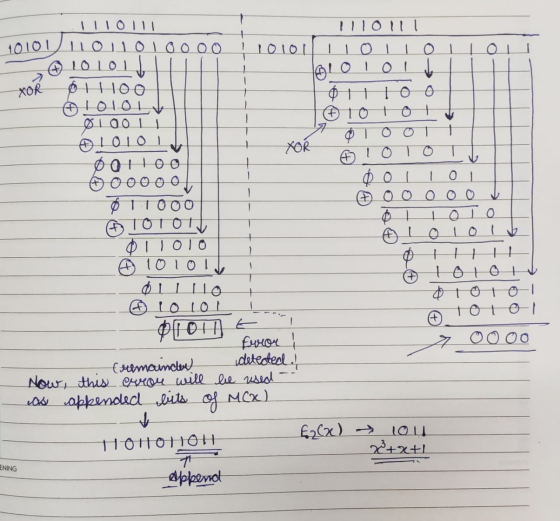
Example of polynomial error E2(x) that can be detected by the CRC generator P(x) = x4+x2+1.
Add Answer to:
Give an example of a polynomial error, E1(X), that cannot be detected and an example of...
Using the polynomial generator: X4+X2+ 1. A shift register encoder is sending the data sequence with polynomial of X4+X3...
Using the polynomial generator: X4+X2+ 1. A shift register encoder is sending the data sequence with polynomial of X4+X3 +x+1 in systematic form. Demonstrate the resulting CRC division using polynomials.
Consider a message D 110100111011001110111. Calculate the CRC code R for that message using a generator-polynomial...
Consider a message D 110100111011001110111. Calculate the CRC code R for that message using a generator-polynomial x4+x+1 (CRC-4-ITU) . Represent in binary code the message to be sent (D and R). Generate 2-bit burst error (erasure error) and show the checking procedure.
The CRC is calculated using the following generator polynomial: x8+x2+x+1 a- Find the CRC bits fo...
The CRC is calculated using the following generator polynomial: x8+x2+x+1 a- Find the CRC bits for the following information bits 1111 0000 0000 0000 b- Can this code detect single errors, double errors, and triple errors? Explain why. c. Draw the shift register division circuit for this generator polynomial.
2. Compute the linear Taylor polynomial for the function exp (x + x4 f (x) at a = 0 and give a reasonable estimate for the error for l 0.01. 2. Compute the linear Taylor polynomial for the f...
 2. Compute the linear Taylor polynomial for the function exp (x + x4 f (x) at a = 0 and give a reasonable estimate for the error for l 0.01.
2. Compute the linear Taylor polynomial for the function exp (x + x4 f (x) at a = 0 and give a reasonable estimate for the error for l 0.01.
2. Compute the linear Taylor polynomial for the function exp (x + x4 f (x) at a = 0 and give a reasonable estimate for the error for l 0.01.
Suppose we want to transmit the message 10011010 and protect it from errors using the CRC...
Suppose we want to transmit the message 10011010 and protect it from errors using the CRC polynomial x^2+1. Encode the data bit sequence using the generator polynomial and give the code word. Using this polynomial, can all single-bit errors be detected? If not, give an example scenario of errors that goes undetected.
Write legibly to receive good rating. Consider a CRC code with a generator polynomial of g(x)...
 Write legibly to receive good rating.
Consider a CRC code with a generator polynomial of g(x) -xSx21 a. (15 points) Show step by step (using the longhand division) how to find the codeword that corresponds to information bits of 10011 b. (15 points) Show the shift-register circuit that implements this CRC code. C. Suppose the codeword length is 10. Answer the following questions, with proper justifications i. (10 points) Give an example of undetectable error burst of length 9 ii....
Write legibly to receive good rating.
Consider a CRC code with a generator polynomial of g(x) -xSx21 a. (15 points) Show step by step (using the longhand division) how to find the codeword that corresponds to information bits of 10011 b. (15 points) Show the shift-register circuit that implements this CRC code. C. Suppose the codeword length is 10. Answer the following questions, with proper justifications i. (10 points) Give an example of undetectable error burst of length 9 ii....
Complete all, especially part c and d (a) Glive the second-order Taylor polynomial T2 ( for the function () about a 16. 4+((X-16)/8)-(1/512) (X-16M2 b) Use Taylor's Theorem to give the Error Term...
 Complete all, especially part c and d
(a) Glive the second-order Taylor polynomial T2 ( for the function () about a 16. 4+((X-16)/8)-(1/512) (X-16M2 b) Use Taylor's Theorem to give the Error Term E2(-f()T2) as a function of z and some z between 16 and az (((3/8) Z(-5/2)) (X-16) 3)/6 c) Estimate the domain of values z for which the error E2 () is less than 0.01. Enter a value p for which E2 ()I 0.01 for all 16 16+p,...
Complete all, especially part c and d
(a) Glive the second-order Taylor polynomial T2 ( for the function () about a 16. 4+((X-16)/8)-(1/512) (X-16M2 b) Use Taylor's Theorem to give the Error Term E2(-f()T2) as a function of z and some z between 16 and az (((3/8) Z(-5/2)) (X-16) 3)/6 c) Estimate the domain of values z for which the error E2 () is less than 0.01. Enter a value p for which E2 ()I 0.01 for all 16 16+p,...
5. In a CRC error-detection scheme, choose P(x)x+x3 x11, a. Encode the bits 10010011011. (5 Marks)...
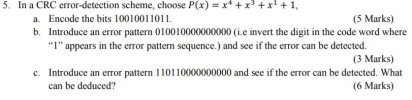 5. In a CRC error-detection scheme, choose P(x)x+x3 x11, a. Encode the bits 10010011011. (5 Marks) b. Introduce an error pattern 010010000000000 (i.e invert the digit in the code word where "" appears in the error pattern sequence.) and see if the error can be detected. (3 Marks) Introduce an error pattern 110110000000000 and see if the error can be detected. What (6 Marks) c. can be deduced?
1. Consider the polynonial Pl (z) of degree 4 interpolating the function f(x) sin(x) on the interval n/4,4 at the e...
 1. Consider the polynonial Pl (z) of degree 4 interpolating the function f(x) sin(x) on the interval n/4,4 at the equidistant points r--r/4, xi =-r/8, x2 = 0, 3 π/8, and x4 = π/4. Estimate the maximum of the interpolation absolute error for x E [-r/4, π/4 , ie, give an upper bound for this absolute error maxsin(x) P(x) s? Remark: you are not asked to give the interpolation polynomial P(r).
1. Consider the polynonial Pl (z) of degree 4...
1. Consider the polynonial Pl (z) of degree 4 interpolating the function f(x) sin(x) on the interval n/4,4 at the equidistant points r--r/4, xi =-r/8, x2 = 0, 3 π/8, and x4 = π/4. Estimate the maximum of the interpolation absolute error for x E [-r/4, π/4 , ie, give an upper bound for this absolute error maxsin(x) P(x) s? Remark: you are not asked to give the interpolation polynomial P(r).
1. Consider the polynonial Pl (z) of degree 4...
Find the quotient Q(x) and remainder R(x) when the polynomial P(x) is divided by the polynomial...
 Find the quotient Q(x) and remainder
R(x) when the polynomial P(x)
is divided by the polynomial D(x).
P(x) =
4x5 + 9x4
− 5x3 +
x2 + x −
25; D(x)
= x4 + x3
− 4x − 5
Q(x) =
R(x) =
Use the Factor Theorem to show that x − c is a
factor of P(x) for the given values of
c.
P(x) =
2x4 −
13x3 −
3x2 + 117x − 135;
c = −3, c = 3...
Find the quotient Q(x) and remainder
R(x) when the polynomial P(x)
is divided by the polynomial D(x).
P(x) =
4x5 + 9x4
− 5x3 +
x2 + x −
25; D(x)
= x4 + x3
− 4x − 5
Q(x) =
R(x) =
Use the Factor Theorem to show that x − c is a
factor of P(x) for the given values of
c.
P(x) =
2x4 −
13x3 −
3x2 + 117x − 135;
c = −3, c = 3...
 2. Compute the linear Taylor polynomial for the function exp (x + x4 f (x) at a = 0 and give a reasonable estimate for the error for l 0.01.
2. Compute the linear Taylor polynomial for the function exp (x + x4 f (x) at a = 0 and give a reasonable estimate for the error for l 0.01.
2. Compute the linear Taylor polynomial for the function exp (x + x4 f (x) at a = 0 and give a reasonable estimate for the error for l 0.01.
 Write legibly to receive good rating.
Consider a CRC code with a generator polynomial of g(x) -xSx21 a. (15 points) Show step by step (using the longhand division) how to find the codeword that corresponds to information bits of 10011 b. (15 points) Show the shift-register circuit that implements this CRC code. C. Suppose the codeword length is 10. Answer the following questions, with proper justifications i. (10 points) Give an example of undetectable error burst of length 9 ii....
Write legibly to receive good rating.
Consider a CRC code with a generator polynomial of g(x) -xSx21 a. (15 points) Show step by step (using the longhand division) how to find the codeword that corresponds to information bits of 10011 b. (15 points) Show the shift-register circuit that implements this CRC code. C. Suppose the codeword length is 10. Answer the following questions, with proper justifications i. (10 points) Give an example of undetectable error burst of length 9 ii....
 Complete all, especially part c and d
(a) Glive the second-order Taylor polynomial T2 ( for the function () about a 16. 4+((X-16)/8)-(1/512) (X-16M2 b) Use Taylor's Theorem to give the Error Term E2(-f()T2) as a function of z and some z between 16 and az (((3/8) Z(-5/2)) (X-16) 3)/6 c) Estimate the domain of values z for which the error E2 () is less than 0.01. Enter a value p for which E2 ()I 0.01 for all 16 16+p,...
Complete all, especially part c and d
(a) Glive the second-order Taylor polynomial T2 ( for the function () about a 16. 4+((X-16)/8)-(1/512) (X-16M2 b) Use Taylor's Theorem to give the Error Term E2(-f()T2) as a function of z and some z between 16 and az (((3/8) Z(-5/2)) (X-16) 3)/6 c) Estimate the domain of values z for which the error E2 () is less than 0.01. Enter a value p for which E2 ()I 0.01 for all 16 16+p,...
 5. In a CRC error-detection scheme, choose P(x)x+x3 x11, a. Encode the bits 10010011011. (5 Marks) b. Introduce an error pattern 010010000000000 (i.e invert the digit in the code word where "" appears in the error pattern sequence.) and see if the error can be detected. (3 Marks) Introduce an error pattern 110110000000000 and see if the error can be detected. What (6 Marks) c. can be deduced?
 1. Consider the polynonial Pl (z) of degree 4 interpolating the function f(x) sin(x) on the interval n/4,4 at the equidistant points r--r/4, xi =-r/8, x2 = 0, 3 π/8, and x4 = π/4. Estimate the maximum of the interpolation absolute error for x E [-r/4, π/4 , ie, give an upper bound for this absolute error maxsin(x) P(x) s? Remark: you are not asked to give the interpolation polynomial P(r).
1. Consider the polynonial Pl (z) of degree 4...
1. Consider the polynonial Pl (z) of degree 4 interpolating the function f(x) sin(x) on the interval n/4,4 at the equidistant points r--r/4, xi =-r/8, x2 = 0, 3 π/8, and x4 = π/4. Estimate the maximum of the interpolation absolute error for x E [-r/4, π/4 , ie, give an upper bound for this absolute error maxsin(x) P(x) s? Remark: you are not asked to give the interpolation polynomial P(r).
1. Consider the polynonial Pl (z) of degree 4...
 Find the quotient Q(x) and remainder
R(x) when the polynomial P(x)
is divided by the polynomial D(x).
P(x) =
4x5 + 9x4
− 5x3 +
x2 + x −
25; D(x)
= x4 + x3
− 4x − 5
Q(x) =
R(x) =
Use the Factor Theorem to show that x − c is a
factor of P(x) for the given values of
c.
P(x) =
2x4 −
13x3 −
3x2 + 117x − 135;
c = −3, c = 3...
Find the quotient Q(x) and remainder
R(x) when the polynomial P(x)
is divided by the polynomial D(x).
P(x) =
4x5 + 9x4
− 5x3 +
x2 + x −
25; D(x)
= x4 + x3
− 4x − 5
Q(x) =
R(x) =
Use the Factor Theorem to show that x − c is a
factor of P(x) for the given values of
c.
P(x) =
2x4 −
13x3 −
3x2 + 117x − 135;
c = −3, c = 3...
Most questions answered within 3 hours.
-
Where is the error in this code sequence?
String s1 = "Hello";
String s2 = "ello";...
asked 10 months ago -
Financial data for Joel de Paris, Inc., for last year
follow:
Joel de Paris, Inc.
Balance...
asked 10 months ago -
Consider this reaction:
Al2(SO4)3 (aq)+ BaCl3
(aq) Al2Cl6 (aq)- +
3BaSO4(s) . What is the...
asked 10 months ago -
Suppose that Savneet is considering increasing her
recent random sample from 20 car rentals to 40...
asked 10 months ago -
Trucks arrive at an unloading terminal at an average rate of 120
per hour.
Trucks arrive...
asked 10 months ago -
Why are methanol and ethanol completely soluble in water while
octanol is not very little soluble....
asked 10 months ago -
A facilities manager at a university reads in a research report
that the mean amount of...
asked 10 months ago -
When the CuSO4 is rehydrated by adding water to the anhydrous
compound, is this an endothermic...
asked 10 months ago -
A ray of sunlight is passing from diamond into crown glass; the
angle of incidence is...
asked 10 months ago -
A block of mass 0.249 kg is placed on top of a light, vertical
spring of...
asked 10 months ago -
how do the kidneys compensate in the presences of acidosis
a) trigger hyperventilate
b) reserve acid...
asked 10 months ago -
Question 501 pts
The rental rate of capital to the firm increases. Which of the
following...
asked 10 months ago