![Using the Ln approximation, express the area under the graph of f(x) = cos(x) over [4, 5] as a limit. Select the correct valu](http://img.homeworklib.com/questions/1624fe90-9aa1-11eb-bfda-61ba925f11c9.png?x-oss-process=image/resize,w_560)
Homework Answers
Add Answer to:
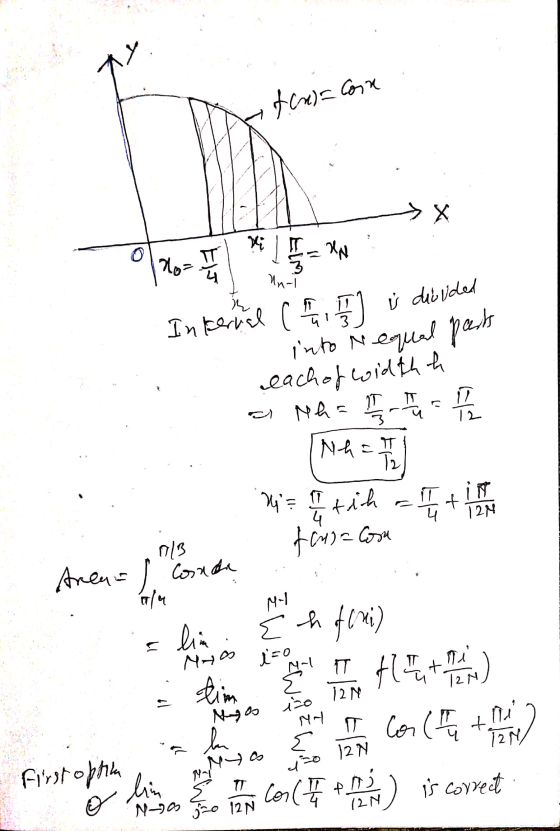
Using the Ln approximation, express the area under the graph of f(x) = cos(x) over [4,...
Approximate the area under a curve using left-endpoint approximation Question Given the graph of the function...
 Approximate the area under a curve using left-endpoint approximation Question Given the graph of the function f(a) below, use a left Riemann sum with 4 rectangles to approximate the integral So f(x) dr. 00 7 6 5 4 3 N 1 2 3 Select the correct answer below: BI Ne
(1 point) Definition: The AREA A of the region that lies under the graph of the...
 (1 point) Definition: The AREA A of the region that lies under the graph of the continuous function f is the limit of the sum of the areas of approximating rectangles A = lim R, = lim [f(x)Ar + f(x2)Ax+... +f(x,y)Ax] 100 Wspacelin (a) Use the above definition to determine which of the following expressions represents the area under the graph of f(x) = x3 from x = 0 to x = 2. 64 A. lim 7100 11 i= B....
send help for these 4 questions, please show steps Definition: The AREA A of the region...
 send help for these 4 questions, please show steps
Definition: The AREA A of the region S that lies under the graph of the continuous function f is the limit of the sum of the areas of approximating rectangles A = lim R, = lim [f(x)Ax +f(x2)Ax+...+f(x)Ax] - 00 Consider the function f(x) = x, 13x < 16. Using the above definition, determine which of the following expressions represents the area under the graph off as a limit. A. lim...
send help for these 4 questions, please show steps
Definition: The AREA A of the region S that lies under the graph of the continuous function f is the limit of the sum of the areas of approximating rectangles A = lim R, = lim [f(x)Ax +f(x2)Ax+...+f(x)Ax] - 00 Consider the function f(x) = x, 13x < 16. Using the above definition, determine which of the following expressions represents the area under the graph off as a limit. A. lim...
Estimate the area under the graph of f(x) rectangles and right endpoints. 1 over the interval...
 Estimate the area under the graph of f(x) rectangles and right endpoints. 1 over the interval [ - 2, 3] using ten approximating +3 RE Repeat the approximation using left endpoints. Ln = Report answers accurate to 4 places. Remember not to round too early in your calculations.
Estimate the area under the graph of f(x)=x^2−2x+4x over the interval [0,8] using eight approximating rectangles...
Estimate the area under the graph of f(x)=x^2−2x+4x over the interval [0,8] using eight approximating rectangles and right endpoints. Rn= Repeat the approximation using left endpoints. Ln=
n Express the limit lim (3 cos” (272,-) + 8)Ac; over (2,6) as an integral. 12...
 n Express the limit lim (3 cos” (272,-) + 8)Ac; over (2,6) as an integral. 12 00 i=1 Provide a, b and f(x) in the expression [ f(e)dr. a = b f()
Find an approximation of the area of the region R under the graph of the function...
Find an approximation of the area of the region R under the graph of the function f on the interval [0, 3]. Use n = 5 subintervals. Choose the representative points to be the midpoints of the subintervals. (Round your answer to one decimal place.) f(x) = 4ex
find an expression for the area of the region under the graphf(x)=x^4 on the interval...
find an expression for the area of the region under the graph f(x)=x^4 on the interval [1,7]. use right-Hand endpoints as sample points choices1. area \(=\lim _{n \rightarrow \infty} \sum_{i=1}^{n}\left(1+\frac{7 i}{n}\right)^{4} \frac{7}{n}\)2. area \(=\lim _{n \rightarrow \infty} \sum_{i=1}^{n}\left(1+\frac{9 i}{n}\right)^{4} \frac{6}{n}\)3. area \(=\lim _{n \rightarrow \infty} \sum_{i=1}^{n}\left(1+\frac{6 i}{n}\right)^{4} \frac{6}{n}\)4. area \(=\lim _{n \rightarrow \infty} \sum_{i=1}^{n}\left(1+\frac{7 i}{n}\right)^{4} \frac{6}{n}\)5. area \(=\lim _{n \rightarrow \infty} \sum_{i=1}^{n}\left(1+\frac{6 i}{n}\right)^{4} \frac{7}{n}\)6. area \(=\lim _{n \rightarrow \infty} \sum_{i=1}^{n}\left(1+\frac{9 i}{n}\right)^{4} \frac{7}{n}\)
Use finite approximation to estimate the area under the graph of f(x) = x² and above...
 Use finite approximation to estimate the area under the graph of f(x) = x² and above the graph of f(x) = 0 from Xo = 0 to x = 4 using i) a lower sum with two rectangles of equal width ii) a lower sum with four rectangles of equal width ii) an upper sum with two rectangles of equal width iv) an upper sum with four rectangles of equal width The estimated area using a lower sum with two...
thankYou Express the limit as a definite integral n lim Σ ( sec c?q)4 Axk, where...
 thankYou
Express the limit as a definite integral n lim Σ ( sec c?q)4 Axk, where P is a partition of [-67, 6x] ||P|| → 0k=1 6 on secx 12x dx 6 1 ов. | | sec x ds oci tan x dx 6 6 00 1 sec ? x dx 6 Use the graph to evaluate the limit. OA. 2 lim f(x) OB. 0 X0 C. - 2 Ay O D. The limit does not exist. 5 4 3...
thankYou
Express the limit as a definite integral n lim Σ ( sec c?q)4 Axk, where P is a partition of [-67, 6x] ||P|| → 0k=1 6 on secx 12x dx 6 1 ов. | | sec x ds oci tan x dx 6 6 00 1 sec ? x dx 6 Use the graph to evaluate the limit. OA. 2 lim f(x) OB. 0 X0 C. - 2 Ay O D. The limit does not exist. 5 4 3...
 Approximate the area under a curve using left-endpoint approximation Question Given the graph of the function f(a) below, use a left Riemann sum with 4 rectangles to approximate the integral So f(x) dr. 00 7 6 5 4 3 N 1 2 3 Select the correct answer below: BI Ne
 (1 point) Definition: The AREA A of the region that lies under the graph of the continuous function f is the limit of the sum of the areas of approximating rectangles A = lim R, = lim [f(x)Ar + f(x2)Ax+... +f(x,y)Ax] 100 Wspacelin (a) Use the above definition to determine which of the following expressions represents the area under the graph of f(x) = x3 from x = 0 to x = 2. 64 A. lim 7100 11 i= B....
 send help for these 4 questions, please show steps
Definition: The AREA A of the region S that lies under the graph of the continuous function f is the limit of the sum of the areas of approximating rectangles A = lim R, = lim [f(x)Ax +f(x2)Ax+...+f(x)Ax] - 00 Consider the function f(x) = x, 13x < 16. Using the above definition, determine which of the following expressions represents the area under the graph off as a limit. A. lim...
send help for these 4 questions, please show steps
Definition: The AREA A of the region S that lies under the graph of the continuous function f is the limit of the sum of the areas of approximating rectangles A = lim R, = lim [f(x)Ax +f(x2)Ax+...+f(x)Ax] - 00 Consider the function f(x) = x, 13x < 16. Using the above definition, determine which of the following expressions represents the area under the graph off as a limit. A. lim...
 Estimate the area under the graph of f(x) rectangles and right endpoints. 1 over the interval [ - 2, 3] using ten approximating +3 RE Repeat the approximation using left endpoints. Ln = Report answers accurate to 4 places. Remember not to round too early in your calculations.
 n Express the limit lim (3 cos” (272,-) + 8)Ac; over (2,6) as an integral. 12 00 i=1 Provide a, b and f(x) in the expression [ f(e)dr. a = b f()
 Use finite approximation to estimate the area under the graph of f(x) = x² and above the graph of f(x) = 0 from Xo = 0 to x = 4 using i) a lower sum with two rectangles of equal width ii) a lower sum with four rectangles of equal width ii) an upper sum with two rectangles of equal width iv) an upper sum with four rectangles of equal width The estimated area using a lower sum with two...
 thankYou
Express the limit as a definite integral n lim Σ ( sec c?q)4 Axk, where P is a partition of [-67, 6x] ||P|| → 0k=1 6 on secx 12x dx 6 1 ов. | | sec x ds oci tan x dx 6 6 00 1 sec ? x dx 6 Use the graph to evaluate the limit. OA. 2 lim f(x) OB. 0 X0 C. - 2 Ay O D. The limit does not exist. 5 4 3...
thankYou
Express the limit as a definite integral n lim Σ ( sec c?q)4 Axk, where P is a partition of [-67, 6x] ||P|| → 0k=1 6 on secx 12x dx 6 1 ов. | | sec x ds oci tan x dx 6 6 00 1 sec ? x dx 6 Use the graph to evaluate the limit. OA. 2 lim f(x) OB. 0 X0 C. - 2 Ay O D. The limit does not exist. 5 4 3...
Most questions answered within 3 hours.
-
Where is the error in this code sequence?
String s1 = "Hello";
String s2 = "ello";...
asked 10 months ago -
Financial data for Joel de Paris, Inc., for last year
follow:
Joel de Paris, Inc.
Balance...
asked 10 months ago -
Consider this reaction:
Al2(SO4)3 (aq)+ BaCl3
(aq) Al2Cl6 (aq)- +
3BaSO4(s) . What is the...
asked 10 months ago -
Suppose that Savneet is considering increasing her
recent random sample from 20 car rentals to 40...
asked 10 months ago -
Trucks arrive at an unloading terminal at an average rate of 120
per hour.
Trucks arrive...
asked 10 months ago -
Why are methanol and ethanol completely soluble in water while
octanol is not very little soluble....
asked 10 months ago -
A facilities manager at a university reads in a research report
that the mean amount of...
asked 10 months ago -
When the CuSO4 is rehydrated by adding water to the anhydrous
compound, is this an endothermic...
asked 10 months ago -
A ray of sunlight is passing from diamond into crown glass; the
angle of incidence is...
asked 10 months ago -
A block of mass 0.249 kg is placed on top of a light, vertical
spring of...
asked 10 months ago -
how do the kidneys compensate in the presences of acidosis
a) trigger hyperventilate
b) reserve acid...
asked 10 months ago -
Question 501 pts
The rental rate of capital to the firm increases. Which of the
following...
asked 10 months ago