consider the Haber process through which fertilizer is made: N2(g) +  
consider the Haber process through which fertilizer is made:
N2(g) + 3 H2(g) Þ 2 NH3
f.w. 28.0 f.w.2.0 f.w. 17.0
If you have 32.0 g of N2 and 8.0 g of H2, which will be the limiting reagent? Support your answer with appropriate calculations.
Homework Answers
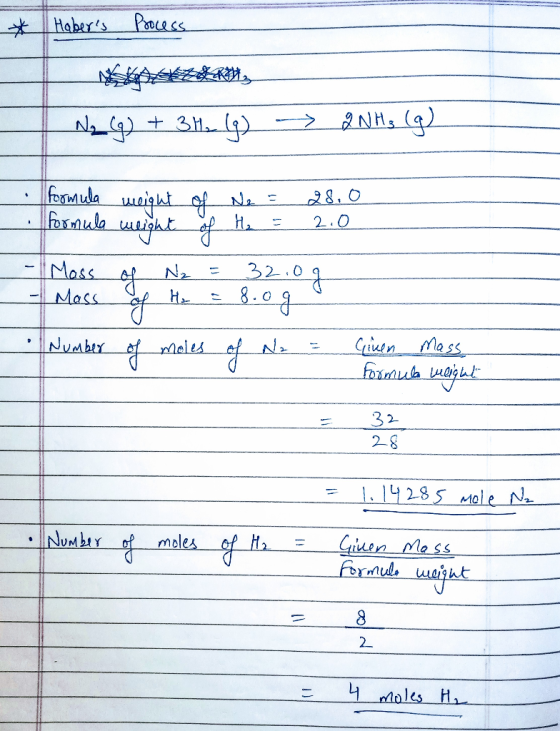

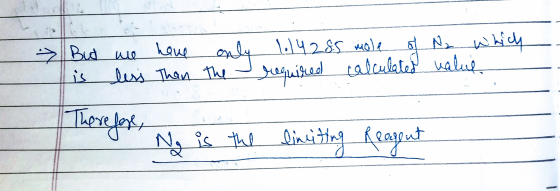
Therefore, N2 will be the limiting reagent.
Thank You.
Add Answer to:
consider the Haber process through
which fertilizer is made:
N2(g)
+  
The Haber process for the production of ammonia involves the equilibrium N2(g) + 3 H2(g) ⇌...
The Haber process for the production of ammonia involves the equilibrium N2(g) + 3 H2(g) ⇌ 2 NH3(g) Assume that Δ H° = -92.38 kJ and ΔS° = -198.3 J/K for this reaction do not change with temperature. a. Without doing calculations, predict the direction in which ΔG° for the reaction changes with increasing temperature. Explain your prediction. b. Calculate ΔG° at 25 °C and 500 °C. c. At what temperature does the Haber ammonia process become nonspontaneous? d. Calculate...
Which is the correct equilibrium constant (K expression) for Haber process? N2 (g) + 3 H2...
Which is the correct equilibrium constant (K expression) for Haber process? N2 (g) + 3 H2 (g) ⇌ 2 NH3 (g) ΔH = –46.19 kJ A. A) K = [P]/[R] = [NH3]/[N2][H2] B. B) K = [P]/[R] = [NH3]2/[N2][H2]3 C. C) K = [P]/[R] = [NH3]2/[H2]3 D. D) K = [P]/[R] = [NH3]/[N2][H2]3 E. E) none of the above
The Haber-Bosch process is a very important industrial process. In the Haber-Bosch process, hydrogen gas reacts...
The Haber-Bosch process is a very important industrial process. In the Haber-Bosch process, hydrogen gas reacts with nitrogen gas to produce ammonia according to the equation 3H2(g)+N2(g)→2NH3(g) The ammonia produced in the Haber-Bosch process has a wide range of uses, from fertilizer to pharmaceuticals. However, the production of ammonia is difficult, resulting in lower yields than those predicted from the chemical equation. 1.26 g H2 is allowed to react with 9.75 g N2, producing 1.63 g NH3. Part A) What...
The Haber-Bosch process is a very important industrial process. In the Haber-Bosch process, hydrogen gas reacts...
The Haber-Bosch process is a very important industrial process. In the Haber-Bosch process, hydrogen gas reacts with nitrogen gas to produce ammonia according to the equation 3H2(g)+N2(g)→2NH3(g) The ammonia produced in the Haber-Bosch process has a wide range of uses, from fertilizer to pharmaceuticals. However, the production of ammonia is difficult, resulting in lower yields than those predicted from the chemical equation. 1.10 g H2 is allowed to react with 9.72 g N2, producing 1.68 g NH3. Part A What...
The Haber-Bosch process is a very important industrial process. In the Haber-Bosch process, hydrogen gas reacts...
The Haber-Bosch process is a very important industrial process. In the Haber-Bosch process, hydrogen gas reacts with nitrogen gas to produce ammonia according to the equation 3H2(g)+N2(g)→2NH3(g) The ammonia produced in the Haber-Bosch process has a wide range of uses, from fertilizer to pharmaceuticals. However, the production of ammonia is difficult, resulting in lower yields than those predicted from the chemical equation. 1.94 g H2 is allowed to react with 10.1 g N2, producing 1.59 g NH3. Part A What...
The Haber-Bosch process is a very important industrial process. In the Haber Process, hydrogen gas reacts...
The Haber-Bosch process is a very important industrial process. In the Haber Process, hydrogen gas reacts with nitrogen gas to produce ammonia according to the equation 3H2(g) + N2(g) ---> 2NH3(g) The ammonia produced in the Haber process has a wide range of uses from fertilizer to pharmaceuticals. However, the production of ammonia is difficult, resulting in lower yields than those predicted from the chemical equation. 1.57 g H2 is allowed to react with 9.87 g N2, producing 1.69 g Nh3....
A) For the Haber process, N2(g) + 3H2(g) <---> 2NH3(g), Kp = 4.34 x 10⁻³ at...
A) For the Haber process, N2(g) + 3H2(g) <---> 2NH3(g), Kp = 4.34 x 10⁻³ at 300oC. Pure NH3 is placed in a 2.00 L flask and is allowed to reach equilibrium at 300oC. There are 3.00 g NH3 in the equilibrium mixture. Calculate the mass (in g) of H2 in the equilibrium mixture. B) The value of Kc for the reaction is 1.2 . The reaction is started with [H2 ]0 = 0.76 M, [N2]0 = 0.60 M and...
The Haber process is the principal method for fixing nitrogen (converting N2 to nitrogen compounds). N2(g)+3H2(g)→2NH3(g)...
The Haber process is the principal method for fixing nitrogen (converting N2 to nitrogen compounds). N2(g)+3H2(g)→2NH3(g) Assume that the reactant gases are completely converted to NH3(g) and that the gases behave ideally. a)What volume of NH3(g) can be produced from 143 L N2(g) and 399 L of H2(g) if the gases are measured at 315∘C and 5.05 atm ? b)What volume of NH3(g) measured at 25∘C and 742 mmHg , can be produced from 143 L N2(g) and 399 L...
Problem #1: Haber-Bosch process. The Haber-Bosch process is an equilibrium-limited catalyzed reaction that converts nitrogen (N2)...
Problem #1: Haber-Bosch process. The Haber-Bosch process is an equilibrium-limited catalyzed reaction that converts nitrogen (N2) and hydrogen (H2) into ammonia (NH3). The process won Haber a Nobel Prize since it provided a way to produce fertilizer for millions of people at the beginning of the 20th century. However, this process typically has very low single pass conversion due to a low equilibrium at the prevailing temperature and therefore a recycle stream is required to achieve a high overall conversion....
The reaction for the Haber process, the industrial production of ammonia, is N2(g) + 3 H2(g)...
 The reaction for the Haber process, the industrial production of ammonia, is N2(g) + 3 H2(g) + 2 NH3(g) Assume that under certain laboratory conditions ammonia is produced at the rate of 2.98 x 10⁻⁵ mol L-15-1. At what rate is nitrogen consumed? At what rate is hydrogen consumed? N2 is consumed at the rate of mol L-15-1 H2 is consumed at the rate of mol L-15-1
 The reaction for the Haber process, the industrial production of ammonia, is N2(g) + 3 H2(g) + 2 NH3(g) Assume that under certain laboratory conditions ammonia is produced at the rate of 2.98 x 10⁻⁵ mol L-15-1. At what rate is nitrogen consumed? At what rate is hydrogen consumed? N2 is consumed at the rate of mol L-15-1 H2 is consumed at the rate of mol L-15-1
Most questions answered within 3 hours.
-
Where is the error in this code sequence?
String s1 = "Hello";
String s2 = "ello";...
asked 10 months ago -
Financial data for Joel de Paris, Inc., for last year
follow:
Joel de Paris, Inc.
Balance...
asked 10 months ago -
Consider this reaction:
Al2(SO4)3 (aq)+ BaCl3
(aq) Al2Cl6 (aq)- +
3BaSO4(s) . What is the...
asked 10 months ago -
Suppose that Savneet is considering increasing her
recent random sample from 20 car rentals to 40...
asked 10 months ago -
Trucks arrive at an unloading terminal at an average rate of 120
per hour.
Trucks arrive...
asked 10 months ago -
Why are methanol and ethanol completely soluble in water while
octanol is not very little soluble....
asked 10 months ago -
A facilities manager at a university reads in a research report
that the mean amount of...
asked 10 months ago -
When the CuSO4 is rehydrated by adding water to the anhydrous
compound, is this an endothermic...
asked 10 months ago -
A ray of sunlight is passing from diamond into crown glass; the
angle of incidence is...
asked 10 months ago -
A block of mass 0.249 kg is placed on top of a light, vertical
spring of...
asked 10 months ago -
how do the kidneys compensate in the presences of acidosis
a) trigger hyperventilate
b) reserve acid...
asked 10 months ago -
Question 501 pts
The rental rate of capital to the firm increases. Which of the
following...
asked 10 months ago