You can observe the following Treasury yields: Maturity Yield 1 year 2.8% 2 years 3.2 3...
You can observe the following Treasury yields:
| Maturity | Yield |
| 1 year | 2.8% |
| 2 years | 3.2 |
| 3 years | 3.7 |
| 4 years | 4.5 |
| 5 years | 4.6 |
| 6 years | 5.0 |
If the pure expectations theory holds, what does the market expect will be the interest rate on two-year securities, four years from now?
Homework Answers
SEE THE IMAGE. ANY DOUBTS, FEEL FREE TO ASK. THUMBS UP
PLEASE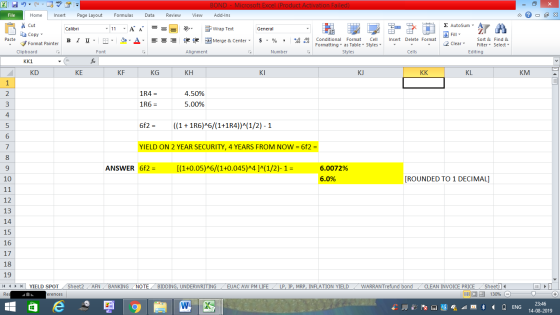
Add Answer to:
You can observe the following Treasury yields:
Maturity
Yield
1 year
2.8%
2 years
3.2
3...
One-year Treasury securities yield 1 percent, 2-year Treasury securities yield 2.8 percent, and 3-year Treasury securities...
One-year Treasury securities yield 1 percent, 2-year Treasury securities yield 2.8 percent, and 3-year Treasury securities yield 5.5 percent. Assume that the expectations theory holds. What does the market expect will be the yield on 1-year Treasury securities two years from now?
6-8 5-9 Expected on page 206.) EXPECTATIONS THEORY One-year Treasury securities yield 4.85%. The market anticipates...
 6-8 5-9 Expected on page 206.) EXPECTATIONS THEORY One-year Treasury securities yield 4.85%. The market anticipates that 1 year from now, 1-year Treasury securities will yield 5.2%. If the pure expectations theory is correct, what is the yield today for 2-year Treasury securities? Calculate the yield using a geometric average. EXPECTATIONS THEORY Interest rates on 4-year Treasury securities are currently 6.7%, while 6-year Treasury securities yield 7.25%. If the pure expectations theory is correct, what does the market believe that...
One-year Treasury securities yield 6%. The market anticipates that 1-year from now 1-year Treasury securities will...
One-year Treasury securities yield 6%. The market anticipates that 1-year from now 1-year Treasury securities will yield 7.5%. If the pure expectations theory is correct, what should be the yield today for 2-year Treasury securities? The real risk-free rate of interest is 1.7%. Inflation is expected to be 5% this year and 6% during the next 2 years. Assume that the maturity risk premiums is zero. What is the yield on 1-year treasury securities? Suppose you and other investors expect...
2. EXPECTED INTEREST RATE The real risk-free rate is 3%. Inflation is expected to be 2% this year and 4% during the next 2 years. Assume that the maturity risk premium is zero. What is the yield o...
2. EXPECTED INTEREST RATE The real risk-free rate is 3 %. Inflation is expected to be 2 % this year and 4 % during the next 2 years. Assume that the maturity risk premium is zero. What is the yield on 2-year Treasury securities? What is the yield on 3 -year Treasury securities?3. MATURITY RISK PREMIUM The real risk-free rate is 3 %, and inflation is expected to be 3 % for the next 2 years. A 2-year Treasury security...
16. Suppose we observe the following rates: Maturity Yield If the pure expectations theory of the...
 16. Suppose we observe the following rates: Maturity Yield If the pure expectations theory of the term structure of interest rates holds, what is the one- year interest rate expected two years from now? One year Two year 696 65% Three year l 7%
One-year Treasury securities yield 5.5 percent. The market anticipates that 1 year from now, 1-year Treasury...
 One-year Treasury securities yield 5.5 percent. The market anticipates that 1 year from now, 1-year Treasury securities will yield 6.5 percent. If the pure expectations theory is correct, what is the yield today for 2-year Treasury securities? 6.5% 6.0% 75% 3.5% 4.5%
Interest rates on 4-year Treasury securities are currently 5.2%, while 6-year Treasury securities yield 7.3%. If...
Interest rates on 4-year Treasury securities are currently 5.2%, while 6-year Treasury securities yield 7.3%. If the pure expectations theory is correct, what does the market believe that 2-year securities will be yielding 4 years from now?
The yield on 1-year Treasury securities is 6%, 2-year securities yield 6.2%, 3-year securities yield 6.3%,...
The yield on 1-year Treasury securities is 6%, 2-year securities yield 6.2%, 3-year securities yield 6.3%, and 4-year securities yield 6.5%. There is no maturity risk premium. Using expectations theory and geometric averages, forecast the yields on the following securities: A 1-year security, 1 year from now? A 1-year security, 2 years from now? A 2-year security, 1 year from now? A 3-year security, 1 year from now?
The real risk-free rate is 2.5% and inflation is expected to be MATURITY RISK PREMIUM 2.75%...
 The real risk-free rate is 2.5% and inflation is expected to be MATURITY RISK PREMIUM 2.75% for the next 2 years. A 2-year Treasury security yields 5.55%. What is the maturity risk premium for the 2-year security? 65 6-6 INFLATION CROSS-PRODUCT An analyst is evaluating securities in a developing nation where the inflation rate is very high. As a result, the analyst has been warned not to ignore the cross-product between the real rate and inflation. If the real risk-free...
Interest rates on 4-year Treasury securities are currently 6.8%, while 6-year Treasury securities yield 7.05%. If...
 Interest rates on 4-year Treasury securities are currently 6.8%, while 6-year Treasury securities yield 7.05%. If the pure expectations theory is correct, what does the market believe that 2-year securities will be yielding 4 years from now? Calculate the yield using a geometric average. Do not round intermediate calculations. Round your answer to two decimal places.
 6-8 5-9 Expected on page 206.) EXPECTATIONS THEORY One-year Treasury securities yield 4.85%. The market anticipates that 1 year from now, 1-year Treasury securities will yield 5.2%. If the pure expectations theory is correct, what is the yield today for 2-year Treasury securities? Calculate the yield using a geometric average. EXPECTATIONS THEORY Interest rates on 4-year Treasury securities are currently 6.7%, while 6-year Treasury securities yield 7.25%. If the pure expectations theory is correct, what does the market believe that...
 16. Suppose we observe the following rates: Maturity Yield If the pure expectations theory of the term structure of interest rates holds, what is the one- year interest rate expected two years from now? One year Two year 696 65% Three year l 7%
 One-year Treasury securities yield 5.5 percent. The market anticipates that 1 year from now, 1-year Treasury securities will yield 6.5 percent. If the pure expectations theory is correct, what is the yield today for 2-year Treasury securities? 6.5% 6.0% 75% 3.5% 4.5%
 The real risk-free rate is 2.5% and inflation is expected to be MATURITY RISK PREMIUM 2.75% for the next 2 years. A 2-year Treasury security yields 5.55%. What is the maturity risk premium for the 2-year security? 65 6-6 INFLATION CROSS-PRODUCT An analyst is evaluating securities in a developing nation where the inflation rate is very high. As a result, the analyst has been warned not to ignore the cross-product between the real rate and inflation. If the real risk-free...
 Interest rates on 4-year Treasury securities are currently 6.8%, while 6-year Treasury securities yield 7.05%. If the pure expectations theory is correct, what does the market believe that 2-year securities will be yielding 4 years from now? Calculate the yield using a geometric average. Do not round intermediate calculations. Round your answer to two decimal places.
Most questions answered within 3 hours.
-
Where is the error in this code sequence?
String s1 = "Hello";
String s2 = "ello";...
asked 10 months ago -
Financial data for Joel de Paris, Inc., for last year
follow:
Joel de Paris, Inc.
Balance...
asked 10 months ago -
Consider this reaction:
Al2(SO4)3 (aq)+ BaCl3
(aq) Al2Cl6 (aq)- +
3BaSO4(s) . What is the...
asked 10 months ago -
Suppose that Savneet is considering increasing her
recent random sample from 20 car rentals to 40...
asked 10 months ago -
Trucks arrive at an unloading terminal at an average rate of 120
per hour.
Trucks arrive...
asked 10 months ago -
Why are methanol and ethanol completely soluble in water while
octanol is not very little soluble....
asked 10 months ago -
A facilities manager at a university reads in a research report
that the mean amount of...
asked 10 months ago -
When the CuSO4 is rehydrated by adding water to the anhydrous
compound, is this an endothermic...
asked 10 months ago -
A ray of sunlight is passing from diamond into crown glass; the
angle of incidence is...
asked 10 months ago -
A block of mass 0.249 kg is placed on top of a light, vertical
spring of...
asked 10 months ago -
how do the kidneys compensate in the presences of acidosis
a) trigger hyperventilate
b) reserve acid...
asked 10 months ago -
Question 501 pts
The rental rate of capital to the firm increases. Which of the
following...
asked 10 months ago