
Homework Answers
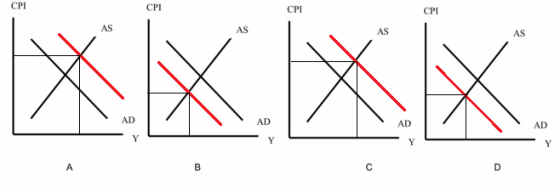
A) When taxes are reduced disposable income is increased which raises consumption and hence, the aggregate spending. This shifts the AD curve to the right raising price and real GDP
B) Appreciated currency will reduce net exports. This would decrease the aggregate spending. This shifts the AD curve to the left reducing price and real GDP
C) Investment is increased when rate of interest is reduced. This would increase the aggregate spending. This shifts the AD curve to the right raising price and real GDP
D) This shifts the AD curve to the left reducing price and real GDP
Add Answer to:
PHILIULUDL. USCL HILTIULI YUL 1 of 1 5. Show what happens to AD, P*, and Y*...
4) What happens to the value of the dollar if the European Central Bank (ECB) tightens...
4) What happens to the value of the dollar if the European Central Bank (ECB) tightens its money supply and raises interest rates? How will this impact the value of the dollar, exports and imports, AD and GDP? 5) What are 5 financial innovations and deregulations that led to the financial crisis in 2008? What are 5 policy responses by the Federal Reserve and the U.S. Government and Treasury department that helped us to get out of the financial crisis?...
According to the IS-LM model, what happens in the short run to the interest rate, income,...
According to the IS-LM model, what happens in the short run to the interest rate, income, consumption, and investment under the following circumstances? a. The central bank increases the money supply. b. The government increases government purchases. c. The government increases taxes. d. The government increases government purchases and taxes by equal amounts.
The sum of currency and bank deposits at the central bank is called: a. the money...
 The sum of currency and bank deposits at the central bank is called: a. the money supply. b. domestic assets. c. the monetary base. d. fractional reserves. Official intervention in the foreign exchange market to defend a fixed exchange rate when the value of the country's currency is under downward pressure causes a. international reserve holdings to rise. b. a downward pressure on the country's interest rates. c.an increase in the liabilities of the central bank. d. the domestic money...
What reference? Name: For each of the following events, use an AD-AS diagram to show the...
 What reference?
Name: For each of the following events, use an AD-AS diagram to show the short-run and long-run effects on output and the price level (inflation rate); identify any output gap. Assume the economy starts in long run equilibrium. (1) The government reduces income taxes AS P AD (2) A decrease in consumer confidence leads to lower consumption spending AS P. AD AD-AS practice assignment.pdf 2/2 (3) The Fed decreases the money supply AS Pe K AD y* (4)...
What reference?
Name: For each of the following events, use an AD-AS diagram to show the short-run and long-run effects on output and the price level (inflation rate); identify any output gap. Assume the economy starts in long run equilibrium. (1) The government reduces income taxes AS P AD (2) A decrease in consumer confidence leads to lower consumption spending AS P. AD AD-AS practice assignment.pdf 2/2 (3) The Fed decreases the money supply AS Pe K AD y* (4)...
onsider the following IS-LM model with a banking system: Consumption: C = 7 + 0.6YD Investment:...
onsider the following IS-LM model with a banking system: Consumption: C = 7 + 0.6YD Investment: I = 0.205Y − i Government expenditure: G = 10 Taxes: T = 10 Money demand: Md/P=Y/i Demand for reserves: Rd = 0.375Dd Demand for deposits: Dd = (1 − 0.2)Md Demand for currency: CUd = 0.2Md This says that consumers hold 20% (c = 0.2) of their money as currency and the required reserve ratio is 37.5% (θ = 0.375). Demand for central...
Y, and AD-AS),.. 81. In the long run, an increase in the supply of money does...
 Y, and AD-AS),.. 81. In the long run, an increase in the supply of money does what? 82. Investment drives the business cycle because 83. The main caus e of cyclical recessions and depressions 84. The growth of GDP with no change in MV would do what to AS, AD, and p? 85. Suppose the U.S. Treasury finances a budget deficit by selling bonds the U.S. public. The money supply will 86. Is a central bank is needed by a...
3. (20 points) Totally differentiate the following IS-LM model and show what happens to the equilibrium...
 3. (20 points) Totally differentiate the following IS-LM model and show what happens to the equilibrium interest rate (*) when the money supply increases, and all other things remain the same. Y = C(Y) + I(i) +G M° = KY +L(i) where total income (Y) and interest rates (i) are endogenous. In this case, I(i) is investment and it decreases when interest rates go up. Let Li) be the demand for 1 cash, which goes down when interest rates go...
1. To stimulate economic activity during a severe recession, the strongest appropriate fiscal policy is: a....
 1. To stimulate economic activity during a severe recession, the strongest appropriate fiscal policy is: a. an increase in taxes and/or an increase in government spending b. an increase in taxes and/or a decrease in government spending! c. a decrease in taxes and/or an increase in government spending d. a decrease in taxes and/or a decrease in government spending e. a decrease in government purchases and/or a decrease in transfer payments 2. An increase in income tax rates: a. makes...
This problem has four parts: (a), (b), (c), and (d). Suppose that the following sets of...
 This problem has four parts: (a), (b), (c), and (d). Suppose that the following sets of equations describe ALL the relevant information about a country's money market and goods market. The Money Market is described as follows: · Money Demand function: Md=Y +2P - 250r • Money Supply: Mº = 4800 · Price Level: P = 152 • Required reserve ratio (rrr) = 18% . Total reserves = required reserves; Excess reserves = 0 The Goods Market is described as...
5. Suppose that instead of following the interest rate rule r=r(Y), the central bank keeps the...
 5. Suppose that instead of following the interest rate rule r=r(Y), the central bank keeps the money supply constant. That is, suppose M = M. In addition, suppose that prices are completely rigid, so that the nominal and the real interest rate are necessarily equal; money-market equilibrium is therefore given by M/= = L(r,Y). a. Suppose that the money market is in equilibrium when r = ro and Yo. Now suppose Y rises to Y). For the money market to...
 The sum of currency and bank deposits at the central bank is called: a. the money supply. b. domestic assets. c. the monetary base. d. fractional reserves. Official intervention in the foreign exchange market to defend a fixed exchange rate when the value of the country's currency is under downward pressure causes a. international reserve holdings to rise. b. a downward pressure on the country's interest rates. c.an increase in the liabilities of the central bank. d. the domestic money...
 What reference?
Name: For each of the following events, use an AD-AS diagram to show the short-run and long-run effects on output and the price level (inflation rate); identify any output gap. Assume the economy starts in long run equilibrium. (1) The government reduces income taxes AS P AD (2) A decrease in consumer confidence leads to lower consumption spending AS P. AD AD-AS practice assignment.pdf 2/2 (3) The Fed decreases the money supply AS Pe K AD y* (4)...
What reference?
Name: For each of the following events, use an AD-AS diagram to show the short-run and long-run effects on output and the price level (inflation rate); identify any output gap. Assume the economy starts in long run equilibrium. (1) The government reduces income taxes AS P AD (2) A decrease in consumer confidence leads to lower consumption spending AS P. AD AD-AS practice assignment.pdf 2/2 (3) The Fed decreases the money supply AS Pe K AD y* (4)...
 Y, and AD-AS),.. 81. In the long run, an increase in the supply of money does what? 82. Investment drives the business cycle because 83. The main caus e of cyclical recessions and depressions 84. The growth of GDP with no change in MV would do what to AS, AD, and p? 85. Suppose the U.S. Treasury finances a budget deficit by selling bonds the U.S. public. The money supply will 86. Is a central bank is needed by a...
 3. (20 points) Totally differentiate the following IS-LM model and show what happens to the equilibrium interest rate (*) when the money supply increases, and all other things remain the same. Y = C(Y) + I(i) +G M° = KY +L(i) where total income (Y) and interest rates (i) are endogenous. In this case, I(i) is investment and it decreases when interest rates go up. Let Li) be the demand for 1 cash, which goes down when interest rates go...
 1. To stimulate economic activity during a severe recession, the strongest appropriate fiscal policy is: a. an increase in taxes and/or an increase in government spending b. an increase in taxes and/or a decrease in government spending! c. a decrease in taxes and/or an increase in government spending d. a decrease in taxes and/or a decrease in government spending e. a decrease in government purchases and/or a decrease in transfer payments 2. An increase in income tax rates: a. makes...
 This problem has four parts: (a), (b), (c), and (d). Suppose that the following sets of equations describe ALL the relevant information about a country's money market and goods market. The Money Market is described as follows: · Money Demand function: Md=Y +2P - 250r • Money Supply: Mº = 4800 · Price Level: P = 152 • Required reserve ratio (rrr) = 18% . Total reserves = required reserves; Excess reserves = 0 The Goods Market is described as...
 5. Suppose that instead of following the interest rate rule r=r(Y), the central bank keeps the money supply constant. That is, suppose M = M. In addition, suppose that prices are completely rigid, so that the nominal and the real interest rate are necessarily equal; money-market equilibrium is therefore given by M/= = L(r,Y). a. Suppose that the money market is in equilibrium when r = ro and Yo. Now suppose Y rises to Y). For the money market to...
Most questions answered within 3 hours.
-
Where is the error in this code sequence?
String s1 = "Hello";
String s2 = "ello";...
asked 11 months ago -
Financial data for Joel de Paris, Inc., for last year
follow:
Joel de Paris, Inc.
Balance...
asked 11 months ago -
Consider this reaction:
Al2(SO4)3 (aq)+ BaCl3
(aq) Al2Cl6 (aq)- +
3BaSO4(s) . What is the...
asked 11 months ago -
Suppose that Savneet is considering increasing her
recent random sample from 20 car rentals to 40...
asked 11 months ago -
Trucks arrive at an unloading terminal at an average rate of 120
per hour.
Trucks arrive...
asked 11 months ago -
Why are methanol and ethanol completely soluble in water while
octanol is not very little soluble....
asked 11 months ago -
A facilities manager at a university reads in a research report
that the mean amount of...
asked 11 months ago -
When the CuSO4 is rehydrated by adding water to the anhydrous
compound, is this an endothermic...
asked 11 months ago -
A ray of sunlight is passing from diamond into crown glass; the
angle of incidence is...
asked 11 months ago -
A block of mass 0.249 kg is placed on top of a light, vertical
spring of...
asked 11 months ago -
how do the kidneys compensate in the presences of acidosis
a) trigger hyperventilate
b) reserve acid...
asked 11 months ago -
Question 501 pts
The rental rate of capital to the firm increases. Which of the
following...
asked 11 months ago