
Homework Answers
Add Answer to:
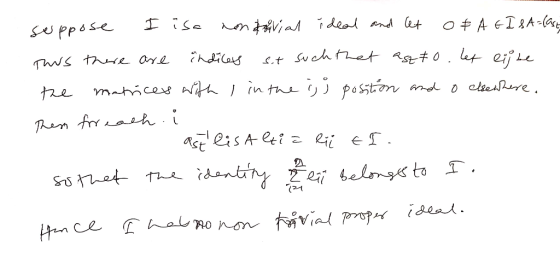
(4) (5 points) Let A be ring of 2 x 2 matrices with real entries. Show...
2. Let M2x2(R) be the vector space consisting of 2 x 2 matrices with real entries....
 2. Let M2x2(R) be the vector space consisting of 2 x 2 matrices with real entries. Let W M2x2 (R) det (A) 0. Show that W is not a subspace of M2x2(R) A E
Problem 5. Let n N. The goal of this problem is to show that if two real n x n matrices are simil...
 Problem 5. Let n N. The goal of this problem is to show that if two real n x n matrices are similar over C, then they are also similar over IK (a) Prove that for all X, y є Rnxn, the function f(t) det (X + ty) is a polynomial in t. (b) Prove that if X and Y are real n × n matrices such that X + ừ is an invertible complex matrix, then there exists a...
Let M4x3 be the vector space of all 4 x 3 matrices with real entries. Note...
 Let M4x3 be the vector space of all 4 x 3 matrices with real entries. Note that M4x3 R12 (M4x3 is isomorphic to R12). Let Z4x3 = {A E M4x3 | all row and column sums of Z are zero}. For example, A= -5 3 2 1 -3 2 1 2 -3 3 -2 -1 is an element of Z4x3. (a) Find a 7 x 12 matrix C whose null space is isomorphic to Z4x3. In other words, find a...
Problem 5 (25 points). Let Mat2x2(R) be the vector space of 2 x 2 matrices with...
 Problem 5 (25 points). Let Mat2x2(R) be the vector space of 2 x 2 matrices with real entries. Recall that (1 0.0 1.000.00 "100'00' (1 001) is the standard basis of Mat2x2(R). Define a transformation T : Mat2x2(R) + R2 by the rule la-36 c+ 3d - (1) (5 points) Show that T is linear. (2) (5 points) Compute the matrix of T with respect to the standard basis in Mat2x2 (R) and R”. Show your work. An answer with...
6.1.3. Consider the set of infinite-by-infinite matrices with real entries that have only finitel...
 6.1.3. Consider the set of infinite-by-infinite matrices with real entries that have only finitely many nonzero entries. (Such a matrix has entries aij, where i and j are natural numbers. For each such matrix, there is a natural number n such that aij 0 ifi-n or j 〉 n.) Show that the set of such matrices is a ring without identity element.
6.1.3. Consider the set of infinite-by-infinite matrices with real entries that have only finitely many nonzero entries. (Such...
6.1.3. Consider the set of infinite-by-infinite matrices with real entries that have only finitely many nonzero entries. (Such a matrix has entries aij, where i and j are natural numbers. For each such matrix, there is a natural number n such that aij 0 ifi-n or j 〉 n.) Show that the set of such matrices is a ring without identity element.
6.1.3. Consider the set of infinite-by-infinite matrices with real entries that have only finitely many nonzero entries. (Such...
Let U be the set of all 2x2 upper triangular matrices with real entries show that...
 Let U be the set of all 2x2 upper triangular matrices with real entries show that B-{[6] [8]} is a linearly indepandewe set mo Explain why B is not a basis for U Include one more matry in B so that this becames a basis for U
QUESTION 4 (a) Let RS be a ring homomorphism with I an ideal of R and...
 QUESTION 4 (a) Let RS be a ring homomorphism with I an ideal of R and J an ideal of S. Define 0(I) = {$(1) I ET) and o-'(J) = {ve R(y) € J} and check as to whether or not (i) °(1) is an ideal of S (6) (ii) o-'() is an ideal of R (6) (Hint: I, J are two-sided ideals and in both cases of (i) and (ii) above, first check the subring conditions) (b) Given a...
Let V = M2x2 be the vector space of 2 x 2 matrices with real number...
 Let V = M2x2 be the vector space of 2 x 2 matrices with real number entries, usual addition and scalar multiplication. Which of the following subsets form a subspace of V? The subset of upper triangular matrices. The subset of all matrices 0b The subset of invertible matrices. The subset of symmetric matrices. Question 6 The set S = {V1, V2,v;} where vi = (-1,1,1), v2 = (1,-1,1), V3 = (1,1,-1) is a basis for R3. The vector w...
5. (a) (5 points) Let R F[x] for a field F. Let f, g E R...
 5. (a) (5 points) Let R F[x] for a field F. Let f, g E R be nonzero. Prove that (f(x)) = (g(x)) if and only if g(x) = af(x) for some constant a E F. (b) (5 points) Let R be any ring. Prove that the nilradical Vo is contained in the intersection of all prime ideals.
4. (5 points) Let A and B ben x n matrices. Prove that if A and...
 4. (5 points) Let A and B ben x n matrices. Prove that if A and B are skew symmetric, then A - B is skew symmetric. Recall C = [cj] is skew symmetric iff Cij =-Cji.
 2. Let M2x2(R) be the vector space consisting of 2 x 2 matrices with real entries. Let W M2x2 (R) det (A) 0. Show that W is not a subspace of M2x2(R) A E
 Problem 5. Let n N. The goal of this problem is to show that if two real n x n matrices are similar over C, then they are also similar over IK (a) Prove that for all X, y є Rnxn, the function f(t) det (X + ty) is a polynomial in t. (b) Prove that if X and Y are real n × n matrices such that X + ừ is an invertible complex matrix, then there exists a...
 Let M4x3 be the vector space of all 4 x 3 matrices with real entries. Note that M4x3 R12 (M4x3 is isomorphic to R12). Let Z4x3 = {A E M4x3 | all row and column sums of Z are zero}. For example, A= -5 3 2 1 -3 2 1 2 -3 3 -2 -1 is an element of Z4x3. (a) Find a 7 x 12 matrix C whose null space is isomorphic to Z4x3. In other words, find a...
 Problem 5 (25 points). Let Mat2x2(R) be the vector space of 2 x 2 matrices with real entries. Recall that (1 0.0 1.000.00 "100'00' (1 001) is the standard basis of Mat2x2(R). Define a transformation T : Mat2x2(R) + R2 by the rule la-36 c+ 3d - (1) (5 points) Show that T is linear. (2) (5 points) Compute the matrix of T with respect to the standard basis in Mat2x2 (R) and R”. Show your work. An answer with...
 6.1.3. Consider the set of infinite-by-infinite matrices with real entries that have only finitely many nonzero entries. (Such a matrix has entries aij, where i and j are natural numbers. For each such matrix, there is a natural number n such that aij 0 ifi-n or j 〉 n.) Show that the set of such matrices is a ring without identity element.
6.1.3. Consider the set of infinite-by-infinite matrices with real entries that have only finitely many nonzero entries. (Such...
6.1.3. Consider the set of infinite-by-infinite matrices with real entries that have only finitely many nonzero entries. (Such a matrix has entries aij, where i and j are natural numbers. For each such matrix, there is a natural number n such that aij 0 ifi-n or j 〉 n.) Show that the set of such matrices is a ring without identity element.
6.1.3. Consider the set of infinite-by-infinite matrices with real entries that have only finitely many nonzero entries. (Such...
 Let U be the set of all 2x2 upper triangular matrices with real entries show that B-{[6] [8]} is a linearly indepandewe set mo Explain why B is not a basis for U Include one more matry in B so that this becames a basis for U
 QUESTION 4 (a) Let RS be a ring homomorphism with I an ideal of R and J an ideal of S. Define 0(I) = {$(1) I ET) and o-'(J) = {ve R(y) € J} and check as to whether or not (i) °(1) is an ideal of S (6) (ii) o-'() is an ideal of R (6) (Hint: I, J are two-sided ideals and in both cases of (i) and (ii) above, first check the subring conditions) (b) Given a...
 Let V = M2x2 be the vector space of 2 x 2 matrices with real number entries, usual addition and scalar multiplication. Which of the following subsets form a subspace of V? The subset of upper triangular matrices. The subset of all matrices 0b The subset of invertible matrices. The subset of symmetric matrices. Question 6 The set S = {V1, V2,v;} where vi = (-1,1,1), v2 = (1,-1,1), V3 = (1,1,-1) is a basis for R3. The vector w...
 5. (a) (5 points) Let R F[x] for a field F. Let f, g E R be nonzero. Prove that (f(x)) = (g(x)) if and only if g(x) = af(x) for some constant a E F. (b) (5 points) Let R be any ring. Prove that the nilradical Vo is contained in the intersection of all prime ideals.
 4. (5 points) Let A and B ben x n matrices. Prove that if A and B are skew symmetric, then A - B is skew symmetric. Recall C = [cj] is skew symmetric iff Cij =-Cji.
Most questions answered within 3 hours.
-
Where is the error in this code sequence?
String s1 = "Hello";
String s2 = "ello";...
asked 10 months ago -
Financial data for Joel de Paris, Inc., for last year
follow:
Joel de Paris, Inc.
Balance...
asked 10 months ago -
Consider this reaction:
Al2(SO4)3 (aq)+ BaCl3
(aq) Al2Cl6 (aq)- +
3BaSO4(s) . What is the...
asked 10 months ago -
Suppose that Savneet is considering increasing her
recent random sample from 20 car rentals to 40...
asked 10 months ago -
Trucks arrive at an unloading terminal at an average rate of 120
per hour.
Trucks arrive...
asked 10 months ago -
Why are methanol and ethanol completely soluble in water while
octanol is not very little soluble....
asked 10 months ago -
A facilities manager at a university reads in a research report
that the mean amount of...
asked 10 months ago -
When the CuSO4 is rehydrated by adding water to the anhydrous
compound, is this an endothermic...
asked 10 months ago -
A ray of sunlight is passing from diamond into crown glass; the
angle of incidence is...
asked 10 months ago -
A block of mass 0.249 kg is placed on top of a light, vertical
spring of...
asked 10 months ago -
how do the kidneys compensate in the presences of acidosis
a) trigger hyperventilate
b) reserve acid...
asked 10 months ago -
Question 501 pts
The rental rate of capital to the firm increases. Which of the
following...
asked 10 months ago