
Homework Answers

Add Answer to:
Question 4 4 pts What is the magnitude of the braking force required to bring a...
A car moving initially at a speed of 52.0 mi/h and weighing 3,000 lb is brought...
A car moving initially at a speed of 52.0 mi/h and weighing 3,000 lb is brought to a stop in a distance of 205 ft. Find (a) the breaking force (b) the time required to stop. Assuming the same braking force find (a) the distance and (d) the time required to stop if the car were going 26.0mi/h initially. (Hint: Convert to SI units)
What average net force is required to bring to rest a 1000 kg car that is...
What average net force is required to bring to rest a 1000 kg car that is initially moving at 100 km / h over a distance of 45.0 m?
20. As a mass of 2,000 k the impulse imparted to bring the car to a...
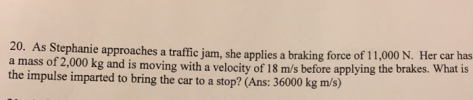 20. As a mass of 2,000 k the impulse imparted to bring the car to a stop? (Ans: 36000 kg m/s) Stephanie approaches a traffic jam, she applies a braking force of 11,000 N. Her car has g and is moving with a velocity of 18 m/s before applying the brakes. What is
QUESTION 1 15 points Save An Calc?late the force (in N) needed to bring a 1000...
 QUESTION 1 15 points Save An Calc?late the force (in N) needed to bring a 1000 kg car to rest from a speed of 90.0 km/h in a distance of 115 m (a fairly typical distance for a non-panic stop).
Calculate the force (in N) needed to bring a 1100 kg car to rest from a...
Calculate the force (in N) needed to bring a 1100 kg car to rest from a speed of 95.0 km/h in a distance of 100 m (a fairly typical distance for a non-panic stop). b) Suppose instead the car hits a concrete abutment at full speed and is brought to a stop in 2.00 m. Calculate the force exerted on the car and compare it with the force found in part (a). force in (b) force in (a)
(a) Calculate the force (in N) needed to bring a 850 kg car to rest from...
(a) Calculate the force (in N) needed to bring a 850 kg car to rest from a speed of 90.0 km/h in a distance of 105 m (a fairly typical distance for a non-panic stop). (b) Suppose instead the car hits a concrete abutment at full speed and is brought to a stop in 2.00 m. Calculate the force exerted on the car and compare it with the force found in part (a).
(a) Calculate the force needed to bring a 1050 kg car to rest from a speed...
(a) Calculate the force needed to bring a 1050 kg car to rest from a speed of 95.0 km/h in a distance of 115 m (a fairly typical distance for a nonpanic stop). (b) Suppose instead the car hits a concrete abutment at full speed and is brought to a stop in 2.00 m. Calculate the force exerted on the car and compare it with the force found in part (a), i.e. find the ratio of the force in part(b)...
A 1590-kg car is traveling with a speed of 15.0 m/s. What is the magnitude of...
A 1590-kg car is traveling with a speed of 15.0 m/s. What is the magnitude of the horizontal net force that is required to bring the car to a halt in a distance of 54.5 m? _______N
Chapter 5 Q:6 A car that weighs 1.2 x 10⁴ N is initially moving at a...
 Chapter 5 Q:6
A car that weighs 1.2 x 10⁴ N is initially moving at a speed of 37 km/h when the brakes are applied and the car is brought to a stop in 20 m. Assuming that the force that stops the car is constant, find (a) the magnitude of that force and (b) the time required for the change in speed. If the initial speed is doubled, and the car experiences the same force during the braking, by...
Chapter 5 Q:6
A car that weighs 1.2 x 10⁴ N is initially moving at a speed of 37 km/h when the brakes are applied and the car is brought to a stop in 20 m. Assuming that the force that stops the car is constant, find (a) the magnitude of that force and (b) the time required for the change in speed. If the initial speed is doubled, and the car experiences the same force during the braking, by...
A test model for a new type of braking system is designed to apply a braking...
 A test model for a new type of braking system is designed to apply a braking force that decays following an exponential function. For an object moving in the (+) x direction (to the right), the force acts in the opposite direction. When the brakes are applied, the velocity change as a function of time in seconds can be approximated by . v=v(t) = V, e-At where Vo is a constant in [m/sec) and A is a constant in [1/sec)....
 20. As a mass of 2,000 k the impulse imparted to bring the car to a stop? (Ans: 36000 kg m/s) Stephanie approaches a traffic jam, she applies a braking force of 11,000 N. Her car has g and is moving with a velocity of 18 m/s before applying the brakes. What is
 QUESTION 1 15 points Save An Calc?late the force (in N) needed to bring a 1000 kg car to rest from a speed of 90.0 km/h in a distance of 115 m (a fairly typical distance for a non-panic stop).
 Chapter 5 Q:6
A car that weighs 1.2 x 10⁴ N is initially moving at a speed of 37 km/h when the brakes are applied and the car is brought to a stop in 20 m. Assuming that the force that stops the car is constant, find (a) the magnitude of that force and (b) the time required for the change in speed. If the initial speed is doubled, and the car experiences the same force during the braking, by...
Chapter 5 Q:6
A car that weighs 1.2 x 10⁴ N is initially moving at a speed of 37 km/h when the brakes are applied and the car is brought to a stop in 20 m. Assuming that the force that stops the car is constant, find (a) the magnitude of that force and (b) the time required for the change in speed. If the initial speed is doubled, and the car experiences the same force during the braking, by...
 A test model for a new type of braking system is designed to apply a braking force that decays following an exponential function. For an object moving in the (+) x direction (to the right), the force acts in the opposite direction. When the brakes are applied, the velocity change as a function of time in seconds can be approximated by . v=v(t) = V, e-At where Vo is a constant in [m/sec) and A is a constant in [1/sec)....
Most questions answered within 3 hours.
-
Where is the error in this code sequence?
String s1 = "Hello";
String s2 = "ello";...
asked 11 months ago -
Financial data for Joel de Paris, Inc., for last year
follow:
Joel de Paris, Inc.
Balance...
asked 11 months ago -
Consider this reaction:
Al2(SO4)3 (aq)+ BaCl3
(aq) Al2Cl6 (aq)- +
3BaSO4(s) . What is the...
asked 11 months ago -
Suppose that Savneet is considering increasing her
recent random sample from 20 car rentals to 40...
asked 11 months ago -
Trucks arrive at an unloading terminal at an average rate of 120
per hour.
Trucks arrive...
asked 11 months ago -
Why are methanol and ethanol completely soluble in water while
octanol is not very little soluble....
asked 11 months ago -
A facilities manager at a university reads in a research report
that the mean amount of...
asked 11 months ago -
When the CuSO4 is rehydrated by adding water to the anhydrous
compound, is this an endothermic...
asked 11 months ago -
A ray of sunlight is passing from diamond into crown glass; the
angle of incidence is...
asked 11 months ago -
A block of mass 0.249 kg is placed on top of a light, vertical
spring of...
asked 11 months ago -
how do the kidneys compensate in the presences of acidosis
a) trigger hyperventilate
b) reserve acid...
asked 11 months ago -
Question 501 pts
The rental rate of capital to the firm increases. Which of the
following...
asked 11 months ago