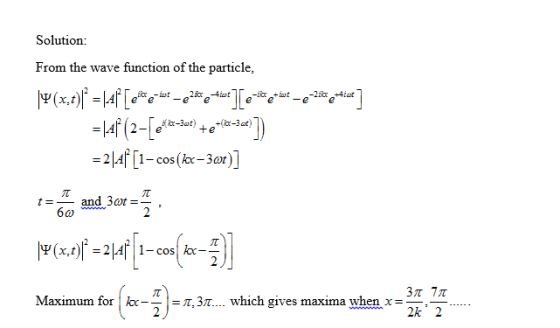
A free particle moving in one dimension has wave function Ψ(x,t)=A[ei(kx−ωt)−ei(2kx−4ωt)] where k and ω are...
A free particle moving in one dimension has wave function
Ψ(x,t)=A[ei(kx−ωt)−ei(2kx−4ωt)]
where k and ω are positive real constants.
At t = π/(6ω) what are the two smallest positive values of x for which the probability function |Ψ(x,t)|2 is a maximum? Express your answer in terms of k.
Homework Answers
Add Answer to:
A free particle moving in one dimension has wave function
Ψ(x,t)=A[ei(kx−ωt)−ei(2kx−4ωt)]
where k and ω are...
Consider a wave that is represented by ψ(x, t) = 4 cos (kx − ωt). where...
Consider a wave that is represented by ψ(x, t) = 4 cos (kx − ωt). where k = 2π/λ and ω = 2πf. The aim of the following exercises is to show that this expression captures many of the intuitive features of waves. a) Consider a snapshot of the wave at t = 0. Use the expression to find the possible values of x at which the crests (maximum points) of the wave are located. By what distance are neighboring...
5. A free particle has the initial wave function, where A and a are positive real...
 5. A free particle has the initial wave function, where A and a are positive real constants. (a) Normalize ψ(x,0). (b) Find φ(k). (c) Construct $(z,t), in the forn of an integral. (d) Discuss the limiting cases (a very large, and a very small).
The initial wave function of a free particle is: Ψ(x,0) = A, for |x| = 0,...
The initial wave function of a free particle is: Ψ(x,0) = A, for |x| = 0, otherwise where a and A are positive real numbers. The particle is in a zero (or constant) potential environment since it is a free particle a) Determine A from normalization. b) Determine φ(p) = Φ(p,0), the time-zero momentum representation of the particle state. What is Φ(p,t)? Sketch φ(p). Locate the global maximum and the zeros of φ(p). Give the expression for the zeros (i.e.,...
A free proton has a wave function Psi (x) = A sin (kx), where k =...
 A free proton has a wave function Psi (x) = A sin (kx), where k = 1.2 times 10^10 m^-1 What is the proton's lambda? What is the proton's momentum? What is the proton's speed? Normalize Psi (x) if the wave only exists inside an infinite square well with width a = 2.1 m, (so that Psi (x) = A sin (kx) between 0 < x < a and Psi (x) = 0 otherwise).
9. 1.66 points Show that the wave function ψ-A ei(kx-at) is a solution to the Schrödinger equation, given below, where k-2π / λ and U-0. 2m dz2 Accomplish by calculating the following quantities. (Us...
 9. 1.66 points Show that the wave function ψ-A ei(kx-at) is a solution to the Schrödinger equation, given below, where k-2π / λ and U-0. 2m dz2 Accomplish by calculating the following quantities. (Use the following as necessary: A, K, x, ,t, h, and m.) momentum Need Help?Read ItTalk to a Tutor
9. 1.66 points Show that the wave function ψ-A ei(kx-at) is a solution to the Schrödinger equation, given below, where k-2π / λ and U-0. 2m dz2 Accomplish...
9. 1.66 points Show that the wave function ψ-A ei(kx-at) is a solution to the Schrödinger equation, given below, where k-2π / λ and U-0. 2m dz2 Accomplish by calculating the following quantities. (Use the following as necessary: A, K, x, ,t, h, and m.) momentum Need Help?Read ItTalk to a Tutor
9. 1.66 points Show that the wave function ψ-A ei(kx-at) is a solution to the Schrödinger equation, given below, where k-2π / λ and U-0. 2m dz2 Accomplish...
Consider a particle confined to one dimension and positive with the wave function Nxear, x20 x<0...
 Consider a particle confined to one dimension and positive with the wave function Nxear, x20 x<0 0 where N is a real normalization constant and α is a real positive constant with units of (length)-1. For the following, express your answers in terms of α: a) Find the normalization constant N. What are the units of your result and do they make sense? b) What is the most probable location to find the particle, or more precisely, at what z...
A particle moving in one dimension is described by the wave function ...
 A particle moving in one dimension is described by the wave function$$ \psi(x)=\left\{\begin{array}{ll} A e^{-\alpha x}, & x \geq 0 \\ B e^{\alpha x}, & x<0 \end{array}\right. $$where \(\alpha=4.00 \mathrm{~m}^{-1}\). (a) Determine the constants \(A\) and \(B\) so that the wave function is continuous and normalized. (b) Calculate the probability of finding the particle in each of the following regions: (i) within \(0.10 \mathrm{~m}\) of the origin, (ii) on the left side of the origin.
transverse sinusoidal wave is moving along a string in the positive direction of an x axis...
transverse sinusoidal wave is moving along a string in the positive direction of an x axis with a speed of 93 m/s. At t= 0, the string particle at x = 0 has a transverse displacement of 4.1 cm from its equilibrium position and is not moving. The maximum transverse speed of the string particle at x = 0 is 19 m/s. (a) What is the frequency of the wave? (b) What is the wavelength of the wave? If the...
1. A free particle of mass m moving from the left in one dimension scatters from...
 1. A free particle of mass m moving from the left in one dimension scatters from the potential V(x) αδ(x). Suppose that the wave number of the particle is k and that α > 0. a. State the general form of the wave function including reflected and transmitted waves. b. Find the amplitude t of the transmitted wave in terms of α, k, m, and h. Find T
A free electron has a wave function ψ(x)= Asin (5x10¹⁰ x) where x is measured in...
 A free electron has a wave function ψ(x)= Asin (5x10¹⁰ x) where x is measured in meters. Find the electron's de Broglie wavelength the electron's momentum a. b, 3. When an electron is confined in the semi-infinite square, its wave function will be in the form Asin kx for0<x<L ψ(x)- Ce for x> L having L = 5 nm and k = 1.7 / nm. a. Find the energy of the state. b. Write down the matching conditions that the...
 5. A free particle has the initial wave function, where A and a are positive real constants. (a) Normalize ψ(x,0). (b) Find φ(k). (c) Construct $(z,t), in the forn of an integral. (d) Discuss the limiting cases (a very large, and a very small).
 A free proton has a wave function Psi (x) = A sin (kx), where k = 1.2 times 10^10 m^-1 What is the proton's lambda? What is the proton's momentum? What is the proton's speed? Normalize Psi (x) if the wave only exists inside an infinite square well with width a = 2.1 m, (so that Psi (x) = A sin (kx) between 0 < x < a and Psi (x) = 0 otherwise).
 9. 1.66 points Show that the wave function ψ-A ei(kx-at) is a solution to the Schrödinger equation, given below, where k-2π / λ and U-0. 2m dz2 Accomplish by calculating the following quantities. (Use the following as necessary: A, K, x, ,t, h, and m.) momentum Need Help?Read ItTalk to a Tutor
9. 1.66 points Show that the wave function ψ-A ei(kx-at) is a solution to the Schrödinger equation, given below, where k-2π / λ and U-0. 2m dz2 Accomplish...
9. 1.66 points Show that the wave function ψ-A ei(kx-at) is a solution to the Schrödinger equation, given below, where k-2π / λ and U-0. 2m dz2 Accomplish by calculating the following quantities. (Use the following as necessary: A, K, x, ,t, h, and m.) momentum Need Help?Read ItTalk to a Tutor
9. 1.66 points Show that the wave function ψ-A ei(kx-at) is a solution to the Schrödinger equation, given below, where k-2π / λ and U-0. 2m dz2 Accomplish...
 Consider a particle confined to one dimension and positive with the wave function Nxear, x20 x<0 0 where N is a real normalization constant and α is a real positive constant with units of (length)-1. For the following, express your answers in terms of α: a) Find the normalization constant N. What are the units of your result and do they make sense? b) What is the most probable location to find the particle, or more precisely, at what z...
 1. A free particle of mass m moving from the left in one dimension scatters from the potential V(x) αδ(x). Suppose that the wave number of the particle is k and that α > 0. a. State the general form of the wave function including reflected and transmitted waves. b. Find the amplitude t of the transmitted wave in terms of α, k, m, and h. Find T
 A free electron has a wave function ψ(x)= Asin (5x10¹⁰ x) where x is measured in meters. Find the electron's de Broglie wavelength the electron's momentum a. b, 3. When an electron is confined in the semi-infinite square, its wave function will be in the form Asin kx for0<x<L ψ(x)- Ce for x> L having L = 5 nm and k = 1.7 / nm. a. Find the energy of the state. b. Write down the matching conditions that the...
Most questions answered within 3 hours.
-
Where is the error in this code sequence?
String s1 = "Hello";
String s2 = "ello";...
asked 10 months ago -
Financial data for Joel de Paris, Inc., for last year
follow:
Joel de Paris, Inc.
Balance...
asked 10 months ago -
Consider this reaction:
Al2(SO4)3 (aq)+ BaCl3
(aq) Al2Cl6 (aq)- +
3BaSO4(s) . What is the...
asked 10 months ago -
Suppose that Savneet is considering increasing her
recent random sample from 20 car rentals to 40...
asked 10 months ago -
Trucks arrive at an unloading terminal at an average rate of 120
per hour.
Trucks arrive...
asked 10 months ago -
Why are methanol and ethanol completely soluble in water while
octanol is not very little soluble....
asked 10 months ago -
A facilities manager at a university reads in a research report
that the mean amount of...
asked 10 months ago -
When the CuSO4 is rehydrated by adding water to the anhydrous
compound, is this an endothermic...
asked 10 months ago -
A ray of sunlight is passing from diamond into crown glass; the
angle of incidence is...
asked 10 months ago -
A block of mass 0.249 kg is placed on top of a light, vertical
spring of...
asked 10 months ago -
how do the kidneys compensate in the presences of acidosis
a) trigger hyperventilate
b) reserve acid...
asked 10 months ago -
Question 501 pts
The rental rate of capital to the firm increases. Which of the
following...
asked 10 months ago