This script will create a dictionary whose keys are all the directories listed in thePATH system...
The script will also print each directory entry sorted by directory name.
The script will use the following five functions to get the required results
- get_environment_variable_value()
- get_dirs_from_path()
- get_file_count()
- get_file_count_for_dir_list()
- print_sorted_dictionary()
get_environment_variable_value()
- The header for this function must be
- This function must accept a shell variable as its only parameter
- The function must return the value of this shell variable
- If the variable is not defined, the function must return the empty string
get_dirs_from_path()
- The header for this function must be
- This function must accept no parameters
- This function returns a list of the directories contained in PATH
get_file_count()
- The header for this function must be
- This function must accept a directory name as a parameter
- The function must return the number of files in this directory
- Sub-directories must not be included in this count
get_file_count_for_dir_list()
- The header for this function must be
- The function must accept a list of directories as its only parameter
- This function must return a dictionary, where the keys are the directory names, and the values are the number of files in each directory.
print_sorted_dictionary(dictionary)
- The header for this function must be
- This function must accept a dictionary as its only parameter
- The function must print out the key and the value for each directory entry
- The key and value must be on a single line of output
- The entries must be printed sorted by their key
Suggestions
- Create headers for all
files.
The body of each function should be the Python statementpass - Import the os module.
There is a variable in the os module that allows you to find the value of any shell variable.
Change the code for get_environment_variable_value by creating an assignment statement to set the value of a variable inside the function to the value of the shell variable whose name is given by the parameter to the function.
Add a print statement inside the function to print the value of this variable.
Add aprintstatement to your test code that calls get_environment_variable_value with the argument 'PATH' and prints the result. - Add an
ifstatement to the code for get_environment_variable_valuethat tests whether the environment variable exist.
If it does, return the value of the variable, otherwise return the empty string.
Change the print statement in the test code section so the argument to the call to get_environment_variable_value is 'XXX. - Remove the extra print
statement you just added to the test code.
Change the body of get_dirs_from_path so that it calls get_environment_variable_value with the argument 'PATH' and assigns that value to a variable.
Print the value of this variable. - Use the split method to create a list from the variable you
created above.
Print this list. - Remove the print statements
from get_dirs_from_path. Add code to
return the list.
Add aprintstatement to the test code that prints the value of path_dirs. - Remove the
printstatement you added to the test code.
Change the code in get_file_count_for_dir_list so it contains a for loop that prints every entry in the list it receives as a parameter. - Create an empty dictionary
before the print statement in get_file_count_for_dir_list.
Before theprintstatement in theforloop add an assignment statement the gives the value 0 to the variablefile_count. - Replace the print statement
in the
forloop with a statement that creates an entry in the dictionary using the directory name as the key and file_count as the value.
Add aprintstatement after theforloop that prints this dictionary. - Remove the
printstatement from get_file_count_for_dir_list and replace it with a statement that returns the dictionary.
Replace the code in print_sorted_dictionary so it prints out the key-value pairs in the dictionary using aforloop. - Change the
forloop in print_sorted_dictionary so it prints the dictionary sorted by directory. - Go back to get_file_count_for_dir_list and replace 0 in the
assignment statement for file_count with
a call to get_file_count with the
directory name as the argument.
Change the code in get_file_count so it sets the variablefile_countto 0 and return this value. - Add a call to an
osmodule function that will change the current directory to the dir_path argument to this function.
When you test this version of your script, it will fail because there is one directory that you cannot enter. - Put the call to the
os module function inside a
try/except/elsestatement.
Both theexceptandelseclauses of this statement should return the value of file_count. - Add an
importstatement to the top of your script for the os.path module.
In theelseclause, use an os module function to set the value of a variable to the list of entries in the current directory.
Print this list. - Remove the
printstatement.
Replace it withforloop that prints each entry in the directory. - There is a function in the
os.path module that will tell you whether
something is a file or not.
Use this function in the print statement along with the entry name, so say whether the entry is a file. - Replace the
printstatement with anifstatement that increases file_countby 1 if the entry is a file. - Make sure you have removed
all
printstatements except the on in print_sorted_dictionary.
Testing Code
The script must contain the following code to test the functionsCopy and past this code into the bottom of your script file.Homework Answers
ScreenShots of code:


dictionary name should not be key as it will override some of the keys, as few directory paths are diffrent but last folder name is same
In the get_file_count_for_dir_list function, I kept both the lines as key for dictionary(key=path key=dictionary name, uncomment this as per your requirement)
SRC CODE FOR EDITING:
##Python 2.7
import os
import collections
def get_environment_variable_value(variable_name):
##This function must accept a shell variable as its only parameter
##The function must return the value of this shell variable
##If the variable is not defined, the function must return the empty string
dirInVariable=""
try:
dirInVariable=os.environ['PATH']
except KeyError:
dirInVariable=""
finally:
return dirInVariable
def get_dirs_from_path():
##This function must accept no parameters
##This function returns a list of the directories contained in PATH
strDirNm=get_environment_variable_value('PATH')
if strDirNm=="":
print('System variable is not available')
else:
return list(set(strDirNm.split(';')))
##get_file_count()
##The header for this function must be
def get_file_count(dir_path):
##This function must accept a directory name as a parameter
##The function must return the number of files in this directory
##Sub-directories must not be included in this count
try:
return len([name for name in os.listdir(dir_path) if not os.path.isdir(name)])
except WindowsError:
return 'Path not found'
def get_file_count_for_dir_list(dir_list):
##The function must accept a list of directories as its only parameter
##This function must return a dictionary, where the keys are the directory names, and the values are the number of files in each directory.
dir_dtl={}
for dir_path in dir_list:
##Please read
##If we keep directory name as key then some of the file count is overwritten, as there are few path where directory name is same
##eg.C:\Program Files (x86)\Microsoft SQL Server\130\Tools\Binn\,C:\Program Files (x86)\Microsoft SQL Server\120\DTS\Binn\ Binn
## dir_dtl[os.path.basename(os.path.normpath(dir_path))]=get_file_count(dir_path)
dir_dtl[dir_path]=get_file_count(dir_path)
return dir_dtl
pass
def print_sorted_dictionary(dict):
##This function must accept a dictionary as its only parameter
##The function must print out the key and the value for each directory entry
##The key and value must be on a single line of output
##The entries must be printed sorted by their key
od=collections.OrderedDict(sorted(dict.items()))
for keyval in od:
print(keyval,od[keyval])
##Testing Code
##The script must contain the following code to test the functions
if __name__=='__main__':
path_dirs = get_dirs_from_path()
dir_count = get_file_count_for_dir_list(path_dirs)
print_sorted_dictionary(dir_count)
Add Answer to:
This script will create a dictionary whose keys are all the
directories listed in thePATH system...
LINUX 140U Create a file named script1.sh that contains a bash script that: Accepts NO command...
LINUX 140U Create a file named script1.sh that contains a bash script that: Accepts NO command line arguments and does NOT use the read command. I will give you no credit if your bash script includes a read command. Also, you need to have at least one for..in loop in your code even if there may be other ways to do this problem. The script will go through a list of entries in the current directory (do not process subdirectories):...
PYTHON Hello can someone create the following functions? I'm not sure how to start on them....
PYTHON Hello can someone create the following functions? I'm not sure how to start on them. makeDictionary Define a function named makeDictionary with two parameters. The first argument passed the function must be a list of strings to be used as keys, while the second is a list of the same length containing values (of some type). This function must return a dictionary consisting of the keys paired with the corresponding values. For example, makeDictionary(['apno','value'],['REP-12','450']) must return this dictionary: {'apno':...
the same problem: We picked the variable name user_dictionary because it will be a dictionary that...
 the same problem:
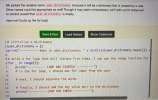
We picked the variable name user_dictionary because it will be a dictionary that is created by a user. Other names could be appropriate as well! Though it may seem unnecessary, we'll add a print statement to remind ourself that user_dictionary is empty. Next we'll build up the for loop! Save & Run Load History Show CodeLens 1 # initialize a dictionary 2 user_dictionary - {} 3 print("--- keys in user_dictionary: " + str(list(user_dictionary.keys()) + 5 # write...
the same problem:
We picked the variable name user_dictionary because it will be a dictionary that is created by a user. Other names could be appropriate as well! Though it may seem unnecessary, we'll add a print statement to remind ourself that user_dictionary is empty. Next we'll build up the for loop! Save & Run Load History Show CodeLens 1 # initialize a dictionary 2 user_dictionary - {} 3 print("--- keys in user_dictionary: " + str(list(user_dictionary.keys()) + 5 # write...
Create a Python script file called hw12.py. Add your name at the top as a comment,...
 Create a Python script file called hw12.py. Add your name at the top as a comment, along with the class name and date. Ex. 1. a. Texting Shortcuts When people are texting, they use shortcuts for faster typing. Consider the following list of shortcuts: For example, the sentence "see you before class" can be written as "c u b4 class". To encode a text using these shortcuts, we need to perform a replace of the text on the left with...
Add JavaScript code in the “find_primeV2.js” to allow users to enter a number, and then based...
Add JavaScript code in the “find_primeV2.js” to allow users to enter a number, and then based on the number of user enters, to find out how many prime numbers there are up to and including the user inputted number and then display them on the web page. The following are the detailed steps to complete this assignment: Step 1. [30 points] In “find_primeV2.js”, complete isPrime() function by (1) Adding one parameter in function header. That parameter is used to accept...
Write a Perl script that accepts exactly 2 integer arguments where the first argument must...
 Write a Perl script that accepts exactly 2 integer arguments
where the first argument must be less than the second argument. The
script will print a comma separated list of integers starting with
the first argument up through the second argument.
The last printed value should be the second command line
argument not be followed by a comma.
The script should also be able to handle the following
errorsituations:
o incorrect number of arguments
o the first...
Write a Perl script that accepts exactly 2 integer arguments
where the first argument must be less than the second argument. The
script will print a comma separated list of integers starting with
the first argument up through the second argument.
The last printed value should be the second command line
argument not be followed by a comma.
The script should also be able to handle the following
errorsituations:
o incorrect number of arguments
o the first...
Functionality to build (4 functions) read_csv_header Define a function named read_csv_header with one parameter. This parameter...
Functionality to build (4 functions) read_csv_header Define a function named read_csv_header with one parameter. This parameter will be a csv reader object (e.g., the value returned when calling the function csv.reader). The first row read using the parameter is the file's header row. The header row contains the keys for the data stored in the CSV file. This function must return a list containing the strings from that header row. The function parameter will be a csv reader object and...
Write code on best Python style and with appropriate indentation. 1. Given that you have function...
Write code on best Python style and with appropriate indentation. 1. Given that you have function f that accepts a kwargs argument and does not have a return. You also have a variable d that has been assigned a dictionary. Write a line of code that passes variable d to function f. 2a) Complete the following code to build the states dictionary. The USPresidents.txt file has a number of lines of data, with each line containing two pieces of data:...
Lab 3 Step One First, create an empty directory for lab3. There is no starter code...
Lab 3 Step One First, create an empty directory for lab3. There is no starter code for this lab. You will be throwing and catching exceptions in this exercise. Create a file called RuntimeException.h and put the following code in it. #include <string> class RuntimeException { private: string errorMsg; public: RuntimeException(const string& err) { errorMsg = err; } string getMessage() const { return errorMsg; } } Step Two In a new .cpp file in your directory, write a main function...
Lab 3 Step One First, create an empty directory for lab3. There is no starter code for this lab. You will be throwing an...
Lab 3 Step One First, create an empty directory for lab3. There is no starter code for this lab. You will be throwing and catching exceptions in this exercise. Create a file called RuntimeException.h and put the following code in it. #include <string> class RuntimeException { private: string errorMsg; public: RuntimeException(const string& err) { errorMsg = err; } string getMessage() const { return errorMsg; } } Step Two In a new .cpp file in your directory, write a main function...
 the same problem:
We picked the variable name user_dictionary because it will be a dictionary that is created by a user. Other names could be appropriate as well! Though it may seem unnecessary, we'll add a print statement to remind ourself that user_dictionary is empty. Next we'll build up the for loop! Save & Run Load History Show CodeLens 1 # initialize a dictionary 2 user_dictionary - {} 3 print("--- keys in user_dictionary: " + str(list(user_dictionary.keys()) + 5 # write...
the same problem:
We picked the variable name user_dictionary because it will be a dictionary that is created by a user. Other names could be appropriate as well! Though it may seem unnecessary, we'll add a print statement to remind ourself that user_dictionary is empty. Next we'll build up the for loop! Save & Run Load History Show CodeLens 1 # initialize a dictionary 2 user_dictionary - {} 3 print("--- keys in user_dictionary: " + str(list(user_dictionary.keys()) + 5 # write...
 Create a Python script file called hw12.py. Add your name at the top as a comment, along with the class name and date. Ex. 1. a. Texting Shortcuts When people are texting, they use shortcuts for faster typing. Consider the following list of shortcuts: For example, the sentence "see you before class" can be written as "c u b4 class". To encode a text using these shortcuts, we need to perform a replace of the text on the left with...
 Write a Perl script that accepts exactly 2 integer arguments
where the first argument must be less than the second argument. The
script will print a comma separated list of integers starting with
the first argument up through the second argument.
The last printed value should be the second command line
argument not be followed by a comma.
The script should also be able to handle the following
errorsituations:
o incorrect number of arguments
o the first...
Write a Perl script that accepts exactly 2 integer arguments
where the first argument must be less than the second argument. The
script will print a comma separated list of integers starting with
the first argument up through the second argument.
The last printed value should be the second command line
argument not be followed by a comma.
The script should also be able to handle the following
errorsituations:
o incorrect number of arguments
o the first...
Most questions answered within 3 hours.
-
Where is the error in this code sequence?
String s1 = "Hello";
String s2 = "ello";...
asked 11 months ago -
Financial data for Joel de Paris, Inc., for last year
follow:
Joel de Paris, Inc.
Balance...
asked 11 months ago -
Consider this reaction:
Al2(SO4)3 (aq)+ BaCl3
(aq) Al2Cl6 (aq)- +
3BaSO4(s) . What is the...
asked 11 months ago -
Suppose that Savneet is considering increasing her
recent random sample from 20 car rentals to 40...
asked 11 months ago -
Trucks arrive at an unloading terminal at an average rate of 120
per hour.
Trucks arrive...
asked 11 months ago -
Why are methanol and ethanol completely soluble in water while
octanol is not very little soluble....
asked 11 months ago -
A facilities manager at a university reads in a research report
that the mean amount of...
asked 11 months ago -
When the CuSO4 is rehydrated by adding water to the anhydrous
compound, is this an endothermic...
asked 11 months ago -
A ray of sunlight is passing from diamond into crown glass; the
angle of incidence is...
asked 11 months ago -
A block of mass 0.249 kg is placed on top of a light, vertical
spring of...
asked 11 months ago -
how do the kidneys compensate in the presences of acidosis
a) trigger hyperventilate
b) reserve acid...
asked 11 months ago -
Question 501 pts
The rental rate of capital to the firm increases. Which of the
following...
asked 11 months ago