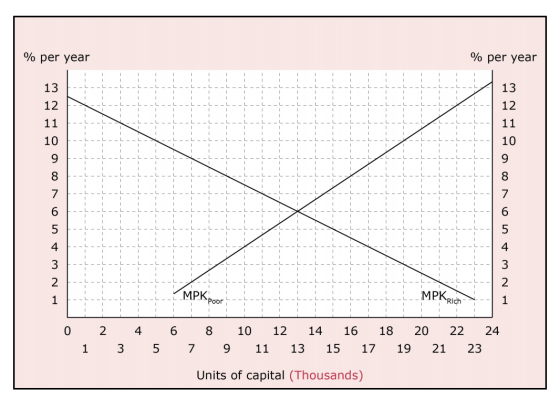
Assume factor price equalization does not hold. The world has 24,000 units of capital and two countries, Rich and Poor. The diagram above shows the marginal product of capital in each country. The horizontal axis shows the allocation of the 24,000 units of capital to Rich from left to right and to Poor from right to left. So, for example, if Rich has 14,000 units of capital, Poor has 24,000 - 14,000 = 10,000 units of capital.
Suppose initially that Rich and Poor prohibit international investment. Rich has 19,000 units of capital.
a. What will be the interest rate in Poor? In Rich? Briefly explain.
Suppose Rich and Poor remove all restrictions on international investment between them and investors in both countries are interested only in maximizing the return on their investments.
b. How much (net) international investment will there be over time, between Rich and Poor? Does capital flow from Poor to Rich or from Rich to Poor. Briefly explain.
c. Identify the area in the graph that corresponds to (i) the net increase in Poor’s income that results from the international investment you described in part (b). (ii) the net increase in Rich’s income that results from the international investment you described in part (b).
Homework Answers
Points to note:
1)The diagram above shows the marginal product of capital in each country. (MPK poor)represents poor country & (MPK Rich) represents Rich country
2.The horizontal axis shows the allocation of the 24,000 units of capital to Rich from left to right and to Poor from right to left. So, for example, if Rich has 14,000 units of capital, Poor has 24,000 - 14,000 = 10,000 units of capital.
Ans a) When International Investent is prohibited and Rich has 19000 units of capital it means Poor countrty is left with 24000 - 19000 = 5000. At 5000 units of capital interest will be calculated corresponding to the point on MPK poor curve. Calulating 5000 i.e coresponding to 24000 - 5000 = 19000 from left to right the point corresponding will be at 10 % rate of return. at the same level inerest for Rich Country corresponding to point on (MPK Rich) curve will be 3 % . This is because Marginal productivity of capital for Poor country At 5000 level is high and for Rich country at 19000 is lower.
b) when Rich and Poor remove all restrictions on international investment between them and investors in both countries are interested only in maximizing the return on their investments then movement of capital will start from a country which has surplus capital which in this case is Rich. The movement of capital from Rich Country will continue to poor country till Marginal product of capital and Rate of Interest for each country becomes equal i.e Corresponding to 13000 units. ie there will be movement of 19000 - 13000 = 6000 units of capital from rich to poor making 11000 units of capital invested in poor country.
c)
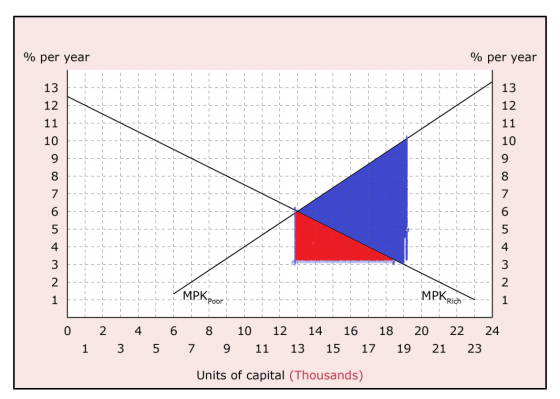
1. Blue Area represents gain to poor country
2. Red area represents gain to rich country
Add Answer to:
Assume factor price equalization does not hold. The
world has 24,000 units of capital and two...
can someone please help me! I am so lost AutoSave $ u- Capital Budgeting Assignment FNCE...
 can someone please help me! I
am so lost
AutoSave $ u- Capital Budgeting Assignment FNCE 301 119 template-Saved to my Mac Home Insert Draw Page Layout Formulas Data Review View Developer Share Comments 2! Insert Times New Roman 10 A A = = = D 2Wraa Text General E AY-O. 4 Delete 2 Conditional Format Call Sort & Sensitivity Pesce Find & a Ideas B B IU E E B Merge & Center A $ - % Formatting as...
can someone please help me! I
am so lost
AutoSave $ u- Capital Budgeting Assignment FNCE 301 119 template-Saved to my Mac Home Insert Draw Page Layout Formulas Data Review View Developer Share Comments 2! Insert Times New Roman 10 A A = = = D 2Wraa Text General E AY-O. 4 Delete 2 Conditional Format Call Sort & Sensitivity Pesce Find & a Ideas B B IU E E B Merge & Center A $ - % Formatting as...
 can someone please help me! I
am so lost
AutoSave $ u- Capital Budgeting Assignment FNCE 301 119 template-Saved to my Mac Home Insert Draw Page Layout Formulas Data Review View Developer Share Comments 2! Insert Times New Roman 10 A A = = = D 2Wraa Text General E AY-O. 4 Delete 2 Conditional Format Call Sort & Sensitivity Pesce Find & a Ideas B B IU E E B Merge & Center A $ - % Formatting as...
can someone please help me! I
am so lost
AutoSave $ u- Capital Budgeting Assignment FNCE 301 119 template-Saved to my Mac Home Insert Draw Page Layout Formulas Data Review View Developer Share Comments 2! Insert Times New Roman 10 A A = = = D 2Wraa Text General E AY-O. 4 Delete 2 Conditional Format Call Sort & Sensitivity Pesce Find & a Ideas B B IU E E B Merge & Center A $ - % Formatting as...
Most questions answered within 3 hours.
-
Where is the error in this code sequence?
String s1 = "Hello";
String s2 = "ello";...
asked 10 months ago -
Financial data for Joel de Paris, Inc., for last year
follow:
Joel de Paris, Inc.
Balance...
asked 10 months ago -
Consider this reaction:
Al2(SO4)3 (aq)+ BaCl3
(aq) Al2Cl6 (aq)- +
3BaSO4(s) . What is the...
asked 10 months ago -
Suppose that Savneet is considering increasing her
recent random sample from 20 car rentals to 40...
asked 10 months ago -
Trucks arrive at an unloading terminal at an average rate of 120
per hour.
Trucks arrive...
asked 10 months ago -
Why are methanol and ethanol completely soluble in water while
octanol is not very little soluble....
asked 10 months ago -
A facilities manager at a university reads in a research report
that the mean amount of...
asked 10 months ago -
When the CuSO4 is rehydrated by adding water to the anhydrous
compound, is this an endothermic...
asked 10 months ago -
A ray of sunlight is passing from diamond into crown glass; the
angle of incidence is...
asked 10 months ago -
A block of mass 0.249 kg is placed on top of a light, vertical
spring of...
asked 10 months ago -
how do the kidneys compensate in the presences of acidosis
a) trigger hyperventilate
b) reserve acid...
asked 10 months ago -
Question 501 pts
The rental rate of capital to the firm increases. Which of the
following...
asked 10 months ago