
Homework Answers
 if
you have any doubts ask me...please upvote me...tq...have a nice
day
if
you have any doubts ask me...please upvote me...tq...have a nice
day
Add Answer to:
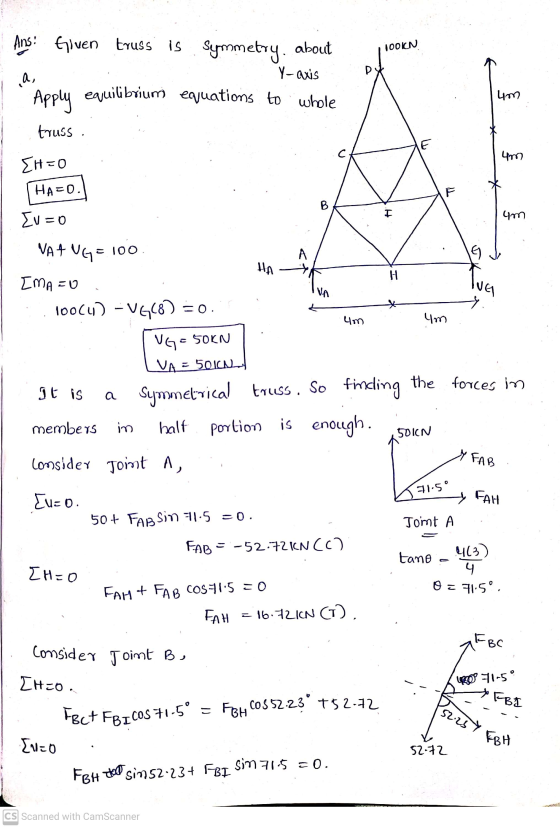
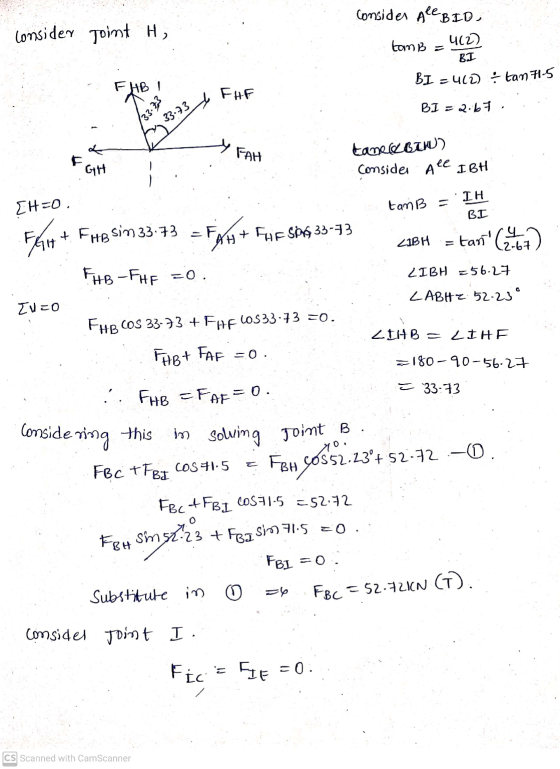
Problem No. 1: For the truss shown a) Determine the support reactions at A and G...
In the truss shown in the figure: 1. Determine the support reactions at supports A and...
 In the truss shown in the figure: 1. Determine the support reactions at supports A and F. (10 points) 2. Determine the force in members BC, IC, and IH of the truss using method of joints. Explain and justify if the members are in tension or compression. (20 points) 3. Draw FBD for each step of 1 and 2. (10 points) 60KN 40 kN -2 m -2 m -2 m E D 1.5 m F с O -30 kN H...
Q1. Consider a truss shown in Fig.1. Joint A sits on a pin support and I...
 Q1. Consider a truss shown in Fig.1. Joint A sits on a pin support and I on a roller support. () Determine the forces on members CD, FG and Hl, using two different methods (a) and (b). Identify the forces as Tension or Compression. (ii) Determine the member that carries maximum tension. (a) method of Joints, and (b) method of Sections 200 kN 200 kN 200 kN 200 kN 200 kN 4 m 3 m -5 m Fig.1 Truss
Problem 5 Determine the reactions at the supports and the force in all the members of...
 Problem 5 Determine the reactions at the supports and the force in all the members of the truss, indicate whether the force is in tension or compression. The values shown on the table apply. P1 0 P2 1000 N 15ºb 350 N a 3m 3 m c 1m D P2 Ha + 6+4 P1 Problem 6 Determine the following for the frame: a) The reactions at fixed support A. b) The reactions at pins C and E for member AE....
A. Determine the force in member DE of the truss and state if the member is...
 A. Determine the force in
member DE of the truss and state if the member is in tension or
compression.
B. Determine the force in member DC of the truss and state if
the member is in tension or compression.
C. Determine the force in member EA of the truss and state if
the member is in tension or compression.
D. Determine the force in member EC of the truss and state if
the members are in tension or compression....
A. Determine the force in
member DE of the truss and state if the member is in tension or
compression.
B. Determine the force in member DC of the truss and state if
the member is in tension or compression.
C. Determine the force in member EA of the truss and state if
the member is in tension or compression.
D. Determine the force in member EC of the truss and state if
the members are in tension or compression....
Consider the truss shown in (Figure 1). Suppose that F = 3.5 kN. Assume all members...
 Consider the truss shown in (Figure 1). Suppose that F = 3.5 kN.
Assume all members are pin connected.
Part A: Determine the force in member GC of the truss and state
if the member is in tension or compression.
Part B: Determine the force in member BC of the truss and state
if the member is in tension or compression.
Part C: Determine the force in member GF of the truss and state
if the member is in tension...
Consider the truss shown in (Figure 1). Suppose that F = 3.5 kN.
Assume all members are pin connected.
Part A: Determine the force in member GC of the truss and state
if the member is in tension or compression.
Part B: Determine the force in member BC of the truss and state
if the member is in tension or compression.
Part C: Determine the force in member GF of the truss and state
if the member is in tension...
Problem No. 2 (100 points) For the Baltimore bridge truss shown below answer the following questions:...
 Problem No. 2 (100 points) For the Baltimore bridge truss shown below answer the following questions: 1) Calculate Reaction Forces (FBD is already drawn assuming a pin support at A and a roller support at I) (10) 2) What is status of the Truss (determinate or indeterminate)? (10) 3) Obtain ALL the Zero force member (30) 4) Using method of Joints, find force in member PF and PG specify if these forces are in Tension or Compression? (25) 5) Using...
The truss shown is used to support the floor deck. The uniform load on the deck...
 The truss shown is used to support the floor deck. The uniform load on the deck is 3k/ft. This load is transferred from the deck to the floor beams which rest on the top joints of the truss Determine the force in cach member of the truss, and state if the members are in tension or compression Assume all members are pin connected 16 I1 12 m 12 1 12 n
Problem 1 Determine the force in each member of the truss and state if the members...
 Problem 1 Determine the force in each member of the truss and state if the members are in tension or compression. (Please use Method of Joint) Given: P, = 500 lb P, = 1500 lb a=10 ft b=10 ft Problem 2 Problem 3 Determine the force in members CD, CF, and GF of the truss. State if these members are in tension or compression. (Please use Method of Section) 5 kN 4 kN 4 kN 3 kN 2 kN (...
Homework Problem H 7.E Consider the truss shown below with the loading on joints D, K, S and U. Given: Find: For this p...
 Homework Problem H 7.E Consider the truss shown below with the loading on joints D, K, S and U. Given: Find: For this problem: a) Determine the external reactions acting on the truss at supports A and H b) Identify all zero-force members in the truss. c) Determine the load carried by members BC, CJ and MN. Identify each member as either being in tension, in compression or carrying zero load. For this problem, use the following parameters: h 30...
Problem 2 For the truss shown in the figure, a) Identify the zero-force members. b) Determine...
 Problem 2 For the truss shown in the figure, a) Identify the zero-force members. b) Determine the forces in members ij & ih by the k 200N 100N Method of Joints c) Determine the force in member df by the Method of Sections. (Specify whether Tension or Compression). 3 m 3m
 In the truss shown in the figure: 1. Determine the support reactions at supports A and F. (10 points) 2. Determine the force in members BC, IC, and IH of the truss using method of joints. Explain and justify if the members are in tension or compression. (20 points) 3. Draw FBD for each step of 1 and 2. (10 points) 60KN 40 kN -2 m -2 m -2 m E D 1.5 m F с O -30 kN H...
 Q1. Consider a truss shown in Fig.1. Joint A sits on a pin support and I on a roller support. () Determine the forces on members CD, FG and Hl, using two different methods (a) and (b). Identify the forces as Tension or Compression. (ii) Determine the member that carries maximum tension. (a) method of Joints, and (b) method of Sections 200 kN 200 kN 200 kN 200 kN 200 kN 4 m 3 m -5 m Fig.1 Truss
 Problem 5 Determine the reactions at the supports and the force in all the members of the truss, indicate whether the force is in tension or compression. The values shown on the table apply. P1 0 P2 1000 N 15ºb 350 N a 3m 3 m c 1m D P2 Ha + 6+4 P1 Problem 6 Determine the following for the frame: a) The reactions at fixed support A. b) The reactions at pins C and E for member AE....
 A. Determine the force in
member DE of the truss and state if the member is in tension or
compression.
B. Determine the force in member DC of the truss and state if
the member is in tension or compression.
C. Determine the force in member EA of the truss and state if
the member is in tension or compression.
D. Determine the force in member EC of the truss and state if
the members are in tension or compression....
A. Determine the force in
member DE of the truss and state if the member is in tension or
compression.
B. Determine the force in member DC of the truss and state if
the member is in tension or compression.
C. Determine the force in member EA of the truss and state if
the member is in tension or compression.
D. Determine the force in member EC of the truss and state if
the members are in tension or compression....
 Consider the truss shown in (Figure 1). Suppose that F = 3.5 kN.
Assume all members are pin connected.
Part A: Determine the force in member GC of the truss and state
if the member is in tension or compression.
Part B: Determine the force in member BC of the truss and state
if the member is in tension or compression.
Part C: Determine the force in member GF of the truss and state
if the member is in tension...
Consider the truss shown in (Figure 1). Suppose that F = 3.5 kN.
Assume all members are pin connected.
Part A: Determine the force in member GC of the truss and state
if the member is in tension or compression.
Part B: Determine the force in member BC of the truss and state
if the member is in tension or compression.
Part C: Determine the force in member GF of the truss and state
if the member is in tension...
 Problem No. 2 (100 points) For the Baltimore bridge truss shown below answer the following questions: 1) Calculate Reaction Forces (FBD is already drawn assuming a pin support at A and a roller support at I) (10) 2) What is status of the Truss (determinate or indeterminate)? (10) 3) Obtain ALL the Zero force member (30) 4) Using method of Joints, find force in member PF and PG specify if these forces are in Tension or Compression? (25) 5) Using...
 The truss shown is used to support the floor deck. The uniform load on the deck is 3k/ft. This load is transferred from the deck to the floor beams which rest on the top joints of the truss Determine the force in cach member of the truss, and state if the members are in tension or compression Assume all members are pin connected 16 I1 12 m 12 1 12 n
 Problem 1 Determine the force in each member of the truss and state if the members are in tension or compression. (Please use Method of Joint) Given: P, = 500 lb P, = 1500 lb a=10 ft b=10 ft Problem 2 Problem 3 Determine the force in members CD, CF, and GF of the truss. State if these members are in tension or compression. (Please use Method of Section) 5 kN 4 kN 4 kN 3 kN 2 kN (...
 Homework Problem H 7.E Consider the truss shown below with the loading on joints D, K, S and U. Given: Find: For this problem: a) Determine the external reactions acting on the truss at supports A and H b) Identify all zero-force members in the truss. c) Determine the load carried by members BC, CJ and MN. Identify each member as either being in tension, in compression or carrying zero load. For this problem, use the following parameters: h 30...
 Problem 2 For the truss shown in the figure, a) Identify the zero-force members. b) Determine the forces in members ij & ih by the k 200N 100N Method of Joints c) Determine the force in member df by the Method of Sections. (Specify whether Tension or Compression). 3 m 3m
Most questions answered within 3 hours.
-
Where is the error in this code sequence?
String s1 = "Hello";
String s2 = "ello";...
asked 10 months ago -
Financial data for Joel de Paris, Inc., for last year
follow:
Joel de Paris, Inc.
Balance...
asked 10 months ago -
Consider this reaction:
Al2(SO4)3 (aq)+ BaCl3
(aq) Al2Cl6 (aq)- +
3BaSO4(s) . What is the...
asked 10 months ago -
Suppose that Savneet is considering increasing her
recent random sample from 20 car rentals to 40...
asked 10 months ago -
Trucks arrive at an unloading terminal at an average rate of 120
per hour.
Trucks arrive...
asked 10 months ago -
Why are methanol and ethanol completely soluble in water while
octanol is not very little soluble....
asked 10 months ago -
A facilities manager at a university reads in a research report
that the mean amount of...
asked 10 months ago -
When the CuSO4 is rehydrated by adding water to the anhydrous
compound, is this an endothermic...
asked 10 months ago -
A ray of sunlight is passing from diamond into crown glass; the
angle of incidence is...
asked 10 months ago -
A block of mass 0.249 kg is placed on top of a light, vertical
spring of...
asked 10 months ago -
how do the kidneys compensate in the presences of acidosis
a) trigger hyperventilate
b) reserve acid...
asked 10 months ago -
Question 501 pts
The rental rate of capital to the firm increases. Which of the
following...
asked 10 months ago