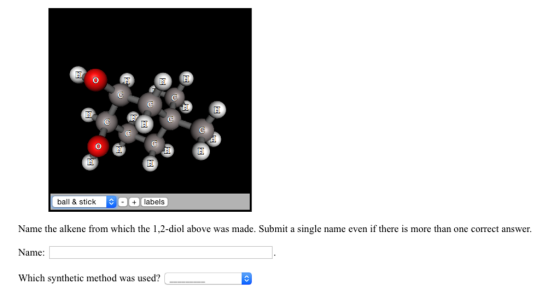
Name the alkene from which the 1,2-diol above was made. Submit a single name even if...
Name the alkene from which the 1,2-diol above was made. Submit a single name even if there is more than one correct answer. please and thank you! :)
Homework Answers
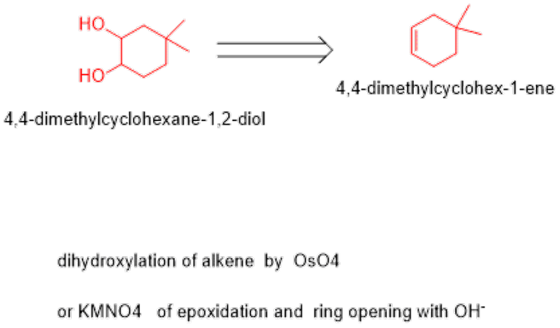
Add Answer to:
Name the alkene from which the 1,2-diol above was made. Submit a
single name even if...
e O ball & stick -labels Name the alkene from which the 1,2-diol above was made....
 e O ball & stick -labels Name the alkene from which the 1,2-diol above was made. Submit a single name even if there is more than one correct answer. Name Which synthetic method was used?
ball & stick + labels Name an alkene that would yield the alcohol above on hydration....
 ball & stick + labels Name an alkene that would yield the alcohol above on hydration. (Submit a single name even if there is more than one correct answer. Ignore double bond stereochemistry.) Name: Specify whether you would use hydroboration/oxidation or oxymercuration.
ball & stick + labels Name an alkene that would yield the alcohol above on hydration....
 ball & stick + labels Name an alkene that would yield the alcohol above on hydration. (Submit a single name even if there is more than one correct answer. Ignore double bond stereochemistry.) Name: 2-methylpentane Specify whether you would use hydroboration/oxidation or oxymercuration. hydroboration/oxidation
Name the alkenes. History Bookmarks People Window Help hing and X Name an alkene that would...
 Name the alkenes.
History Bookmarks People Window Help hing and X Name an alkene that would yie This question has multiple parts. Work all the parts to get the most points Name an alkene that would yield the alcohol above on hydration. (Submit a single name even if there is more than one correct answer. Ignore double bond stereochemistry.) Specify whether you would use hydroboration/oxidation or oxymercuratior Submit either method
Name the alkenes.
History Bookmarks People Window Help hing and X Name an alkene that would yie This question has multiple parts. Work all the parts to get the most points Name an alkene that would yield the alcohol above on hydration. (Submit a single name even if there is more than one correct answer. Ignore double bond stereochemistry.) Specify whether you would use hydroboration/oxidation or oxymercuratior Submit either method
This question has multiple parts. Work all the parts to get the most points. ball &...
 This question has multiple parts. Work all the parts to get the most points. ball & stick labels Name an alkene that would yield the alcohol above on hydration. (Submit a single name even if there is more than one correct answer. Ignore double bond stereochemistry.) Name: Specify whether you would use hydroboration/oxidation or oxymercuration.
13. The correct name for the alkyl group above is a. ethyl b. propyl c. isopropyl...
13. The correct name for the alkyl group above is a. ethyl b. propyl c. isopropyl d. isobutyl 14. What is the correct IUPAC name for the alkane represented by the following carbon-skeleton formula? a. 2-ethyl-3,4-dimethylbutane b. 3,4-dimethylhexane c. 2-ethyl-3-methylpentane d. 3-ethyl-1,2-dimethylbutane e. no correct response 15. Which of the following is a correct IUPAC name? a. 2-ethylpentane b. 2,2-dimethylbutane c. 1-bromo-2-methylhexane d. more than one response is correct
Which of the following are inter-convertible by rotation around single bonds? cis- & trans-alkene b. Constitutional...
 Which of the following are inter-convertible by rotation around single bonds? cis- & trans-alkene b. Constitutional isomers c. chair & boat cyclohexane d. enantiomers d. More than one of the above a. Which of the following objects is/are chiral? Circle all possible answers. a. c. Human nose d. Human ear a fork b. a spoon e. a ball Which of the following isomers do not have the same connectivity? a. Stereoisomers b. Chair and boat conformations of cyclohexane c. Constitutionl...
(References) Draw structures for the alkene (or alkenes) that gives the following reaction product. Br CH3CH2CHCCHCH3...
 (References) Draw structures for the alkene (or alkenes) that gives the following reaction product. Br CH3CH2CHCCHCH3 Br CH3 • You do not have to consider stereochemistry. • Submit more than one structure only if the str&ctures are constitutional isomers. • Draw one structure per sketcher. Add additional sketchers using the drop-down menu in the • Separate structures with + signs from the drop-down menu. C-- -O0O- [" ChemDoodle Draw the structure for an alkene that gives the following reaction product....
Draw structures for the alkene (or alkenes) that gives the following reaction product. H3C ? H/Pd...
 Draw structures for the alkene (or alkenes) that gives the following reaction product. H3C ? H/Pd CH2CH3 H3C CH3 • You do not have to consider stereochemistry. • Submit more than one structure only if the structures are constitutional isomers. • Draw one structure per sketcher. Add additional sketchers using the drop-down menu in the bottom right corner. • Separate structures with + signs from the drop-down menu. С P opy este *** [+ Draw the structure for an alkene...
A crystal lattice made of identical atoms is sketched below, seen from directly above. Atoms in...
 A crystal lattice made of identical atoms is sketched below, seen from directly above. Atoms in the top layer are colored red, atoms in the second layer are colored green, and atoms in the third layer are colored blue. By dragging the slider you can shrink the atoms in the top layer so that you can see past them to the second layer. By dragging the slider even more you can shrink the atoms in the second layer, too, so...
 e O ball & stick -labels Name the alkene from which the 1,2-diol above was made. Submit a single name even if there is more than one correct answer. Name Which synthetic method was used?
 ball & stick + labels Name an alkene that would yield the alcohol above on hydration. (Submit a single name even if there is more than one correct answer. Ignore double bond stereochemistry.) Name: Specify whether you would use hydroboration/oxidation or oxymercuration.
 ball & stick + labels Name an alkene that would yield the alcohol above on hydration. (Submit a single name even if there is more than one correct answer. Ignore double bond stereochemistry.) Name: 2-methylpentane Specify whether you would use hydroboration/oxidation or oxymercuration. hydroboration/oxidation
 Name the alkenes.
History Bookmarks People Window Help hing and X Name an alkene that would yie This question has multiple parts. Work all the parts to get the most points Name an alkene that would yield the alcohol above on hydration. (Submit a single name even if there is more than one correct answer. Ignore double bond stereochemistry.) Specify whether you would use hydroboration/oxidation or oxymercuratior Submit either method
Name the alkenes.
History Bookmarks People Window Help hing and X Name an alkene that would yie This question has multiple parts. Work all the parts to get the most points Name an alkene that would yield the alcohol above on hydration. (Submit a single name even if there is more than one correct answer. Ignore double bond stereochemistry.) Specify whether you would use hydroboration/oxidation or oxymercuratior Submit either method
 This question has multiple parts. Work all the parts to get the most points. ball & stick labels Name an alkene that would yield the alcohol above on hydration. (Submit a single name even if there is more than one correct answer. Ignore double bond stereochemistry.) Name: Specify whether you would use hydroboration/oxidation or oxymercuration.
 Which of the following are inter-convertible by rotation around single bonds? cis- & trans-alkene b. Constitutional isomers c. chair & boat cyclohexane d. enantiomers d. More than one of the above a. Which of the following objects is/are chiral? Circle all possible answers. a. c. Human nose d. Human ear a fork b. a spoon e. a ball Which of the following isomers do not have the same connectivity? a. Stereoisomers b. Chair and boat conformations of cyclohexane c. Constitutionl...
 (References) Draw structures for the alkene (or alkenes) that gives the following reaction product. Br CH3CH2CHCCHCH3 Br CH3 • You do not have to consider stereochemistry. • Submit more than one structure only if the str&ctures are constitutional isomers. • Draw one structure per sketcher. Add additional sketchers using the drop-down menu in the • Separate structures with + signs from the drop-down menu. C-- -O0O- [" ChemDoodle Draw the structure for an alkene that gives the following reaction product....
 Draw structures for the alkene (or alkenes) that gives the following reaction product. H3C ? H/Pd CH2CH3 H3C CH3 • You do not have to consider stereochemistry. • Submit more than one structure only if the structures are constitutional isomers. • Draw one structure per sketcher. Add additional sketchers using the drop-down menu in the bottom right corner. • Separate structures with + signs from the drop-down menu. С P opy este *** [+ Draw the structure for an alkene...
 A crystal lattice made of identical atoms is sketched below, seen from directly above. Atoms in the top layer are colored red, atoms in the second layer are colored green, and atoms in the third layer are colored blue. By dragging the slider you can shrink the atoms in the top layer so that you can see past them to the second layer. By dragging the slider even more you can shrink the atoms in the second layer, too, so...
Most questions answered within 3 hours.
-
Where is the error in this code sequence?
String s1 = "Hello";
String s2 = "ello";...
asked 10 months ago -
Financial data for Joel de Paris, Inc., for last year
follow:
Joel de Paris, Inc.
Balance...
asked 10 months ago -
Consider this reaction:
Al2(SO4)3 (aq)+ BaCl3
(aq) Al2Cl6 (aq)- +
3BaSO4(s) . What is the...
asked 10 months ago -
Suppose that Savneet is considering increasing her
recent random sample from 20 car rentals to 40...
asked 10 months ago -
Trucks arrive at an unloading terminal at an average rate of 120
per hour.
Trucks arrive...
asked 10 months ago -
Why are methanol and ethanol completely soluble in water while
octanol is not very little soluble....
asked 10 months ago -
A facilities manager at a university reads in a research report
that the mean amount of...
asked 10 months ago -
When the CuSO4 is rehydrated by adding water to the anhydrous
compound, is this an endothermic...
asked 10 months ago -
A ray of sunlight is passing from diamond into crown glass; the
angle of incidence is...
asked 10 months ago -
A block of mass 0.249 kg is placed on top of a light, vertical
spring of...
asked 10 months ago -
how do the kidneys compensate in the presences of acidosis
a) trigger hyperventilate
b) reserve acid...
asked 10 months ago -
Question 501 pts
The rental rate of capital to the firm increases. Which of the
following...
asked 10 months ago