Economics for the build environment
Explain the meaning of ‘scarce resources’ and ‘opportunity cost’, illustrating these concepts with examples from the housing market in a country of your choice
Homework Answers
Request Answer!
We need at least 10 more requests to produce the answer.
0 / 10 have requested this problem solution
The more requests, the faster the answer.
Explain briefly but clearly the concepts of scarcity and opportunity cost. Provide an example of opportunity...
Explain briefly but clearly the concepts of scarcity and opportunity cost. Provide an example of opportunity cost from either your personal or professional experiences. Remember to include explicit costs (able to be measured) and also implicit costs. Then provide an example of an opportunity cost a whole country experiences when society or the government has made a choice. Please answer in 150 words or more.
Economic models are used to reflect make assumptions about both consumer and producer behavior and in...
 Economic models are used to reflect make assumptions about both consumer and producer behavior and in the case of the Production Possibilities Frontier (PPF) to show the concepts of opportunity cost, trade-offs, and scarcity. Please reflect on and explain a "real-world" application of the PPF for your scarce resources associated with a scenario where you could spend your time (labor input), equipment (physical capital), and natural resources to allocate resources between two production options. For example, on page 32 of...
Explain the following concepts (opportunity cost, scarcity, choice and scale of Preference using appropriate examples and...
Explain the following concepts (opportunity cost, scarcity, choice and scale of Preference using appropriate examples and tables where necessary.
In the following concepts of economics provide a discussion of the meaning as well as the...
In the following concepts of economics provide a discussion of the meaning as well as the relevance of the concept to the decision making process: incentives, scarcity, opportunity cost. Discuss what value you think these concepts provide as well as any deficiencies.
1. Economics can best be defined as the study of how a. Society decides to use...
 1. Economics can best be defined as the study of how a. Society decides to use its scarce resources in an attempt to satisfy unlimited wants b. The government should deal with the problems of unemployment and inflation C. To make money in the stock market d. The government should eliminate the problem of scarce resources 2. What you give up to obtain an item is called your a. True cost b. explicit cost c. opportunity cost d. direct cost...
True/False and Explain Your Answer: (3 points each) _If the price of a good goes up,...
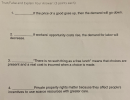 True/False and Explain Your Answer: (3 points each) _If the price of a good goes up, then the demand will go down. _If workers' opportunity costs rise, the demand for labor will decrease. "There is no such thing as a free lunch" means that choices are present and a real cost is incurred when a choice is made. Present and are Private property rights matter because they affect people's incentives to use scarce resources with greater care.
Using your own community as a frame of reference, develop examples illustrating the concepts of community,...
Using your own community as a frame of reference, develop examples illustrating the concepts of community, community client, community health and partnership for health. Discuss community cohesion, available resources and motivation to fix identified problems in your community.
1. Use examples from your country or countries of your choice to explain the internationalization of...
1. Use examples from your country or countries of your choice to explain the internationalization of microfinance. 2, explain the credit market dor small and microenterprises in a country with which you are familiar. 3. What is Financial Literacy in relation to microfinance? Explain with examples. 4. Explain the concept; " microfinance is the best tool to use for poverty eradication.
Complete the following questions: use specific examples to support your answers. If exports increase and imports...
Complete the following questions: use specific examples to support your answers. If exports increase and imports decrease in the U.S., what happens to the trade deficit? Will this help or hurt the U.S.? In what ways is a bigger trade deficit a problem for the country? What good is the deficit? Hint: Use the currency market supply and demand to determine the exchange rate. In what ways is the trade between countries increasing? Is trade good or bad for U.S.?...
please with every false statement can you write the true statement of it ? 4) When...
 please with every false statement can you write the true
statement of it ?
4) When two people trade, one must lose for the other to win. Answer: FALSE DIE 2 Topic: Scarcity. Choice, and Opportunity Cost Skill Comertual AACSB: Reflective Thinking 5) Economic growth shifts a society's production possibility frontier toward the origin. Answer: FALSE DIE 1 Topic: Scarcity, Choice, and Opportunity Cost Skill Conceptual AACSB: Reflective Thinking 6) A society's production possibility frontier is bowed out from the...
please with every false statement can you write the true
statement of it ?
4) When two people trade, one must lose for the other to win. Answer: FALSE DIE 2 Topic: Scarcity. Choice, and Opportunity Cost Skill Comertual AACSB: Reflective Thinking 5) Economic growth shifts a society's production possibility frontier toward the origin. Answer: FALSE DIE 1 Topic: Scarcity, Choice, and Opportunity Cost Skill Conceptual AACSB: Reflective Thinking 6) A society's production possibility frontier is bowed out from the...
 Economic models are used to reflect make assumptions about both consumer and producer behavior and in the case of the Production Possibilities Frontier (PPF) to show the concepts of opportunity cost, trade-offs, and scarcity. Please reflect on and explain a "real-world" application of the PPF for your scarce resources associated with a scenario where you could spend your time (labor input), equipment (physical capital), and natural resources to allocate resources between two production options. For example, on page 32 of...
 1. Economics can best be defined as the study of how a. Society decides to use its scarce resources in an attempt to satisfy unlimited wants b. The government should deal with the problems of unemployment and inflation C. To make money in the stock market d. The government should eliminate the problem of scarce resources 2. What you give up to obtain an item is called your a. True cost b. explicit cost c. opportunity cost d. direct cost...
 True/False and Explain Your Answer: (3 points each) _If the price of a good goes up, then the demand will go down. _If workers' opportunity costs rise, the demand for labor will decrease. "There is no such thing as a free lunch" means that choices are present and a real cost is incurred when a choice is made. Present and are Private property rights matter because they affect people's incentives to use scarce resources with greater care.
 please with every false statement can you write the true
statement of it ?
4) When two people trade, one must lose for the other to win. Answer: FALSE DIE 2 Topic: Scarcity. Choice, and Opportunity Cost Skill Comertual AACSB: Reflective Thinking 5) Economic growth shifts a society's production possibility frontier toward the origin. Answer: FALSE DIE 1 Topic: Scarcity, Choice, and Opportunity Cost Skill Conceptual AACSB: Reflective Thinking 6) A society's production possibility frontier is bowed out from the...
please with every false statement can you write the true
statement of it ?
4) When two people trade, one must lose for the other to win. Answer: FALSE DIE 2 Topic: Scarcity. Choice, and Opportunity Cost Skill Comertual AACSB: Reflective Thinking 5) Economic growth shifts a society's production possibility frontier toward the origin. Answer: FALSE DIE 1 Topic: Scarcity, Choice, and Opportunity Cost Skill Conceptual AACSB: Reflective Thinking 6) A society's production possibility frontier is bowed out from the...
Most questions answered within 3 hours.
-
Where is the error in this code sequence?
String s1 = "Hello";
String s2 = "ello";...
asked 11 months ago -
Financial data for Joel de Paris, Inc., for last year
follow:
Joel de Paris, Inc.
Balance...
asked 11 months ago -
Consider this reaction:
Al2(SO4)3 (aq)+ BaCl3
(aq) Al2Cl6 (aq)- +
3BaSO4(s) . What is the...
asked 11 months ago -
Suppose that Savneet is considering increasing her
recent random sample from 20 car rentals to 40...
asked 11 months ago -
Trucks arrive at an unloading terminal at an average rate of 120
per hour.
Trucks arrive...
asked 11 months ago -
Why are methanol and ethanol completely soluble in water while
octanol is not very little soluble....
asked 11 months ago -
A facilities manager at a university reads in a research report
that the mean amount of...
asked 11 months ago -
When the CuSO4 is rehydrated by adding water to the anhydrous
compound, is this an endothermic...
asked 11 months ago -
A ray of sunlight is passing from diamond into crown glass; the
angle of incidence is...
asked 11 months ago -
A block of mass 0.249 kg is placed on top of a light, vertical
spring of...
asked 11 months ago -
how do the kidneys compensate in the presences of acidosis
a) trigger hyperventilate
b) reserve acid...
asked 11 months ago -
Question 501 pts
The rental rate of capital to the firm increases. Which of the
following...
asked 11 months ago