Homework Answers
Request Answer!
We need at least 10 more requests to produce the answer.
0 / 10 have requested this problem solution
The more requests, the faster the answer.
Numerical analysis

Numerical Analysis
Consider the same five-data pair (x, y) and- Find the first and second derivatives exactly at x = c. (c is any x in your data!)- Obtain the three-point forward difference formula for the second order derivative with a remainder by using the Taylor series expansion. Calculate f¢¢(c) by using this formula for the data given.- Obtain the three-point backward difference formula for the second order derivative with a remainder by using the Taylor series expansion. Calculate f¢¢(c) by using this formula for the data given.- Obtain the three-point central difference formula for the second order derivative with a remainder by using the Taylor series expansion. Calculate f¢¢(c) by using this formula for the data given.You can choose any five data pair.
Numerical Analysis
Find numerical Jacobian for the following function of two variables at (N1, N1+2) using centered finite difference formulas. Choose appropriate step-size to minimize errors. F(x,y)=[ ?? ? + ?? 2 ln(?) ] ? 2 + ? −2 log2(x?)
numerical analysis
(−1,f(−1)=2),(0,f(0)=5)(−1,f(−1)=2),(0,f(0)=5)Select one:
this is numerical analysis. please do a and b 1. This problem is concerned with solving...
 this is numerical analysis. please do a and b
1. This problem is concerned with solving the equation f(x) = 0 using Newton's method, assuming f is a smooth (Cº) function. (a) Write the iteration representing Newton's method for solving f(x) = 0 and briefly state under what conditions the iteration makes sense, (b) Write Newton's method for solving the equation x"" = 0, where m > 2 is an integer. Show that the convergence is linear, not quadratic, and...
this is numerical analysis. please do a and b
1. This problem is concerned with solving the equation f(x) = 0 using Newton's method, assuming f is a smooth (Cº) function. (a) Write the iteration representing Newton's method for solving f(x) = 0 and briefly state under what conditions the iteration makes sense, (b) Write Newton's method for solving the equation x"" = 0, where m > 2 is an integer. Show that the convergence is linear, not quadratic, and...
I need proof of this numerical analysis theorem. This theorem is from Burden's Numerical analysis book....
 I need proof of this numerical analysis theorem. This theorem is
from Burden's Numerical analysis book. Please give me the detailed
solution of this theorem.
Theorem If {00, ... , ºn} is an orthogonal set of functions on an interval [a, b] with respect to the weight function w, then the least squares approximation to f on [a, b] with respect to w is 11 P(x) = a;°;(x), j=0 where, for each j = 0, 1, ... ,n, cb aj...
I need proof of this numerical analysis theorem. This theorem is
from Burden's Numerical analysis book. Please give me the detailed
solution of this theorem.
Theorem If {00, ... , ºn} is an orthogonal set of functions on an interval [a, b] with respect to the weight function w, then the least squares approximation to f on [a, b] with respect to w is 11 P(x) = a;°;(x), j=0 where, for each j = 0, 1, ... ,n, cb aj...
Numerical problem!
An unknown metal M reacts with S to form a compound with a formula M2S3. If 3.12g of m reacts with exactly 2.88g of sulfur, what are the names of metal M and compound M2S3?
NUMERICAL ANALYSIS ASSIGNMENT 1(MTH603)
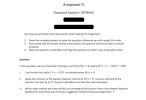 Question:In this question, we are interested in finding x such that f(x) = 0, where f(x) = x − 𝑠in(x) − 0.01i. Use the fact that 𝑠in(x) ≈ x− x3/3! to estimate when f(x) = 0.ii. Apply two iteration of the Newton Raphson method to f(x) = 0. Use your estimate of the solution from part (i) as x^0. Do your calculation to at least four decimal places.iii. Which other method you have studied can converge to the solution faster...
numerical analysis question 3. For the matrix in problem 1, apply the Householder transformation to transform...
 numerical analysis question
3. For the matrix in problem 1, apply the Householder transformation to transform A into an upper triangular matrix R. Express all the Householder transformation matrices p(1), p() explicitly. Based on the orthogonal matrices p(1), p(2) and the upper triangular matrix R, obtain the QR decomposition of the matrix A. A = | 1 4 il 2 3 2 -2 2 1
numerical analysis question
3. For the matrix in problem 1, apply the Householder transformation to transform A into an upper triangular matrix R. Express all the Householder transformation matrices p(1), p() explicitly. Based on the orthogonal matrices p(1), p(2) and the upper triangular matrix R, obtain the QR decomposition of the matrix A. A = | 1 4 il 2 3 2 -2 2 1
this is numerical analysis. please do a and b 2. Consider the non-standard interpolation problem: Given...
 this is numerical analysis. please do a and b
2. Consider the non-standard interpolation problem: Given three numbers A, B, C and a fixed node & € R, find a quadratic polynomial 9(x) = 40 +213 + azra so that 9(-1) = A, d'(E) - B, 9(1) = C. (1) (a) Show that if & = 0, the problem is not well-posed, that is, there are numbers A, B, C for which the interpolation problem (1) has no solution (b)...
this is numerical analysis. please do a and b
2. Consider the non-standard interpolation problem: Given three numbers A, B, C and a fixed node & € R, find a quadratic polynomial 9(x) = 40 +213 + azra so that 9(-1) = A, d'(E) - B, 9(1) = C. (1) (a) Show that if & = 0, the problem is not well-posed, that is, there are numbers A, B, C for which the interpolation problem (1) has no solution (b)...

 this is numerical analysis. please do a and b
1. This problem is concerned with solving the equation f(x) = 0 using Newton's method, assuming f is a smooth (Cº) function. (a) Write the iteration representing Newton's method for solving f(x) = 0 and briefly state under what conditions the iteration makes sense, (b) Write Newton's method for solving the equation x"" = 0, where m > 2 is an integer. Show that the convergence is linear, not quadratic, and...
this is numerical analysis. please do a and b
1. This problem is concerned with solving the equation f(x) = 0 using Newton's method, assuming f is a smooth (Cº) function. (a) Write the iteration representing Newton's method for solving f(x) = 0 and briefly state under what conditions the iteration makes sense, (b) Write Newton's method for solving the equation x"" = 0, where m > 2 is an integer. Show that the convergence is linear, not quadratic, and...
 I need proof of this numerical analysis theorem. This theorem is
from Burden's Numerical analysis book. Please give me the detailed
solution of this theorem.
Theorem If {00, ... , ºn} is an orthogonal set of functions on an interval [a, b] with respect to the weight function w, then the least squares approximation to f on [a, b] with respect to w is 11 P(x) = a;°;(x), j=0 where, for each j = 0, 1, ... ,n, cb aj...
I need proof of this numerical analysis theorem. This theorem is
from Burden's Numerical analysis book. Please give me the detailed
solution of this theorem.
Theorem If {00, ... , ºn} is an orthogonal set of functions on an interval [a, b] with respect to the weight function w, then the least squares approximation to f on [a, b] with respect to w is 11 P(x) = a;°;(x), j=0 where, for each j = 0, 1, ... ,n, cb aj...
 numerical analysis question
3. For the matrix in problem 1, apply the Householder transformation to transform A into an upper triangular matrix R. Express all the Householder transformation matrices p(1), p() explicitly. Based on the orthogonal matrices p(1), p(2) and the upper triangular matrix R, obtain the QR decomposition of the matrix A. A = | 1 4 il 2 3 2 -2 2 1
numerical analysis question
3. For the matrix in problem 1, apply the Householder transformation to transform A into an upper triangular matrix R. Express all the Householder transformation matrices p(1), p() explicitly. Based on the orthogonal matrices p(1), p(2) and the upper triangular matrix R, obtain the QR decomposition of the matrix A. A = | 1 4 il 2 3 2 -2 2 1
 this is numerical analysis. please do a and b
2. Consider the non-standard interpolation problem: Given three numbers A, B, C and a fixed node & € R, find a quadratic polynomial 9(x) = 40 +213 + azra so that 9(-1) = A, d'(E) - B, 9(1) = C. (1) (a) Show that if & = 0, the problem is not well-posed, that is, there are numbers A, B, C for which the interpolation problem (1) has no solution (b)...
this is numerical analysis. please do a and b
2. Consider the non-standard interpolation problem: Given three numbers A, B, C and a fixed node & € R, find a quadratic polynomial 9(x) = 40 +213 + azra so that 9(-1) = A, d'(E) - B, 9(1) = C. (1) (a) Show that if & = 0, the problem is not well-posed, that is, there are numbers A, B, C for which the interpolation problem (1) has no solution (b)...
Most questions answered within 3 hours.
-
Where is the error in this code sequence?
String s1 = "Hello";
String s2 = "ello";...
asked 11 months ago -
Financial data for Joel de Paris, Inc., for last year
follow:
Joel de Paris, Inc.
Balance...
asked 11 months ago -
Consider this reaction:
Al2(SO4)3 (aq)+ BaCl3
(aq) Al2Cl6 (aq)- +
3BaSO4(s) . What is the...
asked 11 months ago -
Suppose that Savneet is considering increasing her
recent random sample from 20 car rentals to 40...
asked 11 months ago -
Trucks arrive at an unloading terminal at an average rate of 120
per hour.
Trucks arrive...
asked 11 months ago -
Why are methanol and ethanol completely soluble in water while
octanol is not very little soluble....
asked 11 months ago -
A facilities manager at a university reads in a research report
that the mean amount of...
asked 11 months ago -
When the CuSO4 is rehydrated by adding water to the anhydrous
compound, is this an endothermic...
asked 11 months ago -
A ray of sunlight is passing from diamond into crown glass; the
angle of incidence is...
asked 11 months ago -
A block of mass 0.249 kg is placed on top of a light, vertical
spring of...
asked 11 months ago -
how do the kidneys compensate in the presences of acidosis
a) trigger hyperventilate
b) reserve acid...
asked 11 months ago -
Question 501 pts
The rental rate of capital to the firm increases. Which of the
following...
asked 11 months ago