Please help!!!!!!
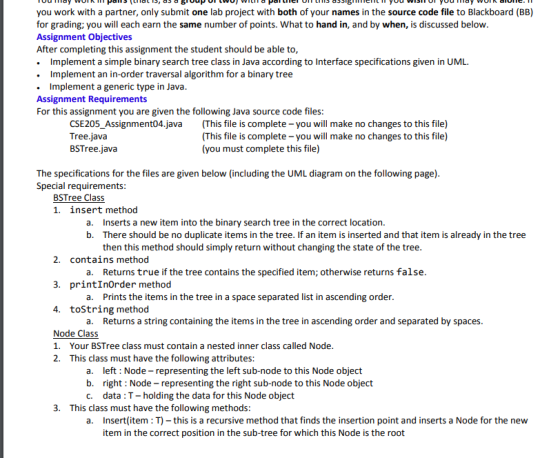
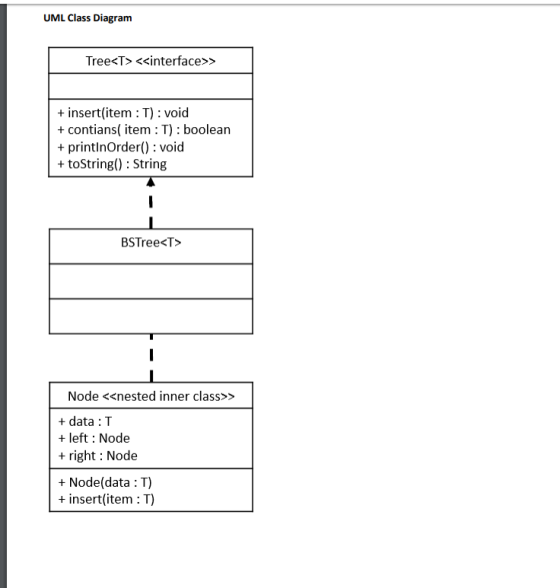
import java.util.Random;

public class CSE205_Assignment04 {
        private static Random rnd = new Random();

        public static void main(String[] args) {
                Tree_ctor_test();
                Tree_insert1_test();
                Tree_insert3_test();
                Tree_insertMany1_test();
                Tree_insertMany2_test();
                Tree_insertMany3_test();
                Tree_insertMany4_test();
        }

        public static void Tree_ctor_test()
        {
                Tree<Integer> t = new BSTree<Integer>();

                assertEqual("", t.toString(), "Tree_ctor_test: toString", false);
                assertEqual(false, t.contains(0), "Tree_ctor_test: contains", false);
        }

        public static void Tree_insert1_test()
        {
                Tree<Integer> t = new BSTree<Integer>();
                t.insert(1);

                assertEqual("1 ", t.toString(), "Tree_insert1_test: toString", false);
                assertEqual(false, t.contains(0), "Tree_insert1_test: contains", false);
                assertEqual(true, t.contains(1), "Tree_insert1_test: contains", false);
        }

        public static void Tree_insert3_test()
        {
                Tree<Integer> t = new BSTree<Integer>();
                t.insert(2);t.insert(1);t.insert(3);

                assertEqual("1 2 3 ", t.toString(), "Tree_insert3_test: toString", false);
                assertEqual(false, t.contains(0), "Tree_insert3_test: contains", false);
                assertEqual(true, t.contains(1), "Tree_insert3_test: contains", false);
                assertEqual(true, t.contains(2), "Tree_insert3_test: contains", false);
                assertEqual(true, t.contains(3), "Tree_insert3_test: contains", false);
        }

        public static void Tree_insertMany1_test()
        {
                Tree<Integer> t = new BSTree<Integer>();
                int[] arr = {1,2,3,4,5,6,7,8,9,10};
                for (int n : arr)
                        t.insert(n);

                assertEqual("1 2 3 4 5 6 7 8 9 10 ", t.toString(), "Tree_insertMany1_test: toString", false);
                assertEqual(false, t.contains(0), "Tree_insertMany1_test: contains", false);
                assertEqual(false, t.contains(11), "Tree_insertMany1_test: contains", false);
                assertEqual(true, t.contains(1), "Tree_insertMany1_test: contains", false);
                assertEqual(true, t.contains(10), "Tree_insertMany1_test: contains", false);
        }

        public static void Tree_insertMany2_test()
        {
                Tree<Integer> t = new BSTree<Integer>();
                int[] arr = {10,9,8,7,6,5,4,3,2,1};
                for (int n : arr)
                        t.insert(n);

                assertEqual("1 2 3 4 5 6 7 8 9 10 ", t.toString(), "Tree_insertMany2_test: toString", false);
                assertEqual(false, t.contains(0), "Tree_insertMany2_test: contains", false);
                assertEqual(false, t.contains(11), "Tree_insertMany2_test: contains", false);
                assertEqual(true, t.contains(1), "Tree_insertMany2_test: contains", false);
                assertEqual(true, t.contains(10), "Tree_insertMany2_test: contains", false);
        }

        public static void Tree_insertMany3_test()
        {
                Tree<Integer> t = new BSTree<Integer>();
                int[] arr = {5,3,7,2,9,1,6,10,4,8};
                for (int n : arr)
                        t.insert(n);

                assertEqual("1 2 3 4 5 6 7 8 9 10 ", t.toString(), "Tree_insertMany3_test: toString", false);
                assertEqual(false, t.contains(0), "Tree_insertMany3_test: contains", false);
                assertEqual(false, t.contains(11), "Tree_insertMany3_test: contains", false);
                assertEqual(true, t.contains(1), "Tree_insertMany3_test: contains", false);
                assertEqual(true, t.contains(10), "Tree_insertMany3_test: contains", false);
        }

        public static void Tree_insertMany4_test()
        {
                Tree<Integer> t = new BSTree<Integer>();
                int[] arr = {5,3,7,2,9,1,6,10,4,8,1,2,3,4,5,6,7,8,9,10};
                for (int n : arr)
                        t.insert(n);

                assertEqual("1 2 3 4 5 6 7 8 9 10 ", t.toString(), "Tree_insertMany4_test: toString", false);
                assertEqual(false, t.contains(0), "Tree_insertMany4_test: contains", false);
                assertEqual(false, t.contains(11), "Tree_insertMany4_test: contains", false);
                assertEqual(true, t.contains(1), "Tree_insertMany4_test: contains", false);
                assertEqual(true, t.contains(10), "Tree_insertMany4_test: contains", false);
        }

        public static void assertEqual(int expected, int actual, String message, boolean silentPass)
        {
                if (expected == actual && ! silentPass)
                        System.out.printf("--- PASSED: %s\n", message);
                if (expected != actual)
                        System.out.printf("*** FAILED: (expected: %d, actual: %d) %s\n", expected, actual, message);

        }

        public static void assertEqual(boolean expected, boolean actual, String message, boolean silentPass)
        {
                if (expected == actual && ! silentPass)
                        System.out.printf("--- PASSED: %s\n", message);
                if (expected != actual)
                        System.out.printf("*** FAILED: (expected: %s, actual: %s) %s\n", expected, actual, message);

        }

        public static void assertEqual(String expected, String actual, String message, boolean silentPass)
        {
                if (expected.equals(actual) && ! silentPass)
                        System.out.printf("--- PASSED: %s\n", message);
                if (! expected.equals(actual))
                        System.out.printf("*** FAILED: (expected: %s, actual: %s) %s\n", expected, actual, message);

        }
}
public interface Tree <T extends Comparable <T> >{
        public void insert(T item);
        public boolean contains(T item);
        public void printInOrder();
        public String toString();
}
public class BSTree<T extends Comparable <T>> implements Tree<T>{

}Homework Answers
import java.util.Collection;
import java.util.Comparator;
import java.util.Random;
public class CSE205_Assignment04 {
private static Random rnd = new Random();
public static void main(String[] args) {
Tree_ctor_test();
Tree_insert1_test();
Tree_insert3_test();
Tree_insertMany1_test();
Tree_insertMany2_test();
Tree_insertMany3_test();
Tree_insertMany4_test();
}
public static void Tree_ctor_test()
{
Tree<Integer> t = new BSTree<Integer>();
assertEqual("", t.toString(), "Tree_ctor_test: toString", false);
assertEqual(false, t.contains(0), "Tree_ctor_test: contains", false);
}
public static void Tree_insert1_test()
{
Tree<Integer> t = new BSTree<Integer>();
t.insert(1);
assertEqual("1 ", t.toString(), "Tree_insert1_test: toString", false);
assertEqual(false, t.contains(0), "Tree_insert1_test: contains", false);
assertEqual(true, t.contains(1), "Tree_insert1_test: contains", false);
}
public static void Tree_insert3_test()
{
Tree<Integer> t = new BSTree<Integer>();
t.insert(2);t.insert(1);t.insert(3);
assertEqual("1 2 3 ", t.toString(), "Tree_insert3_test: toString", false);
assertEqual(false, t.contains(0), "Tree_insert3_test: contains", false);
assertEqual(true, t.contains(1), "Tree_insert3_test: contains", false);
assertEqual(true, t.contains(2), "Tree_insert3_test: contains", false);
assertEqual(true, t.contains(3), "Tree_insert3_test: contains", false);
}
public static void Tree_insertMany1_test()
{
Tree<Integer> t = new BSTree<Integer>();
int[] arr = {1,2,3,4,5,6,7,8,9,10};
for (int n : arr)
t.insert(n);
assertEqual("1 2 3 4 5 6 7 8 9 10 ", t.toString(), "Tree_insertMany1_test: toString", false);
assertEqual(false, t.contains(0), "Tree_insertMany1_test: contains", false);
assertEqual(false, t.contains(11), "Tree_insertMany1_test: contains", false);
assertEqual(true, t.contains(1), "Tree_insertMany1_test: contains", false);
assertEqual(true, t.contains(10), "Tree_insertMany1_test: contains", false);
}
public static void Tree_insertMany2_test()
{
Tree<Integer> t = new BSTree<Integer>();
int[] arr = {10,9,8,7,6,5,4,3,2,1};
for (int n : arr)
t.insert(n);
assertEqual("1 2 3 4 5 6 7 8 9 10 ", t.toString(), "Tree_insertMany2_test: toString", false);
assertEqual(false, t.contains(0), "Tree_insertMany2_test: contains", false);
assertEqual(false, t.contains(11), "Tree_insertMany2_test: contains", false);
assertEqual(true, t.contains(1), "Tree_insertMany2_test: contains", false);
assertEqual(true, t.contains(10), "Tree_insertMany2_test: contains", false);
}
public static void Tree_insertMany3_test()
{
Tree<Integer> t = new BSTree<Integer>();
int[] arr = {5,3,7,2,9,1,6,10,4,8};
for (int n : arr)
t.insert(n);
assertEqual("1 2 3 4 5 6 7 8 9 10 ", t.toString(), "Tree_insertMany3_test: toString", false);
assertEqual(false, t.contains(0), "Tree_insertMany3_test: contains", false);
assertEqual(false, t.contains(11), "Tree_insertMany3_test: contains", false);
assertEqual(true, t.contains(1), "Tree_insertMany3_test: contains", false);
assertEqual(true, t.contains(10), "Tree_insertMany3_test: contains", false);
}
public static void Tree_insertMany4_test()
{
Tree<Integer> t = new BSTree<Integer>();
int[] arr = {5,3,7,2,9,1,6,10,4,8,1,2,3,4,5,6,7,8,9,10};
for (int n : arr)
t.insert(n);
assertEqual("1 2 3 4 5 6 7 8 9 10 ", t.toString(), "Tree_insertMany4_test: toString", false);
assertEqual(false, t.contains(0), "Tree_insertMany4_test: contains", false);
assertEqual(false, t.contains(11), "Tree_insertMany4_test: contains", false);
assertEqual(true, t.contains(1), "Tree_insertMany4_test: contains", false);
assertEqual(true, t.contains(10), "Tree_insertMany4_test: contains", false);
}
public static void assertEqual(int expected, int actual, String message, boolean silentPass)
{
if (expected == actual && ! silentPass)
System.out.printf("--- PASSED: %s\n", message);
if (expected != actual)
System.out.printf("*** FAILED: (expected: %d, actual: %d) %s\n", expected, actual, message);
}
public static void assertEqual(boolean expected, boolean actual, String message, boolean silentPass)
{
if (expected == actual && ! silentPass)
System.out.printf("--- PASSED: %s\n", message);
if (expected != actual)
System.out.printf("*** FAILED: (expected: %s, actual: %s) %s\n", expected, actual, message);
}
public static void assertEqual(String expected, String actual, String message, boolean silentPass)
{
if (expected.equals(actual) && ! silentPass)
System.out.printf("--- PASSED: %s\n", message);
if (! expected.equals(actual))
System.out.printf("*** FAILED: (expected: %s, actual: %s) %s\n", expected, actual, message);
}
}
//BSTree
class BSTree<T extends Comparable <T>> implements Tree<T>{
private BinaryTreeNode<T> root;
private Comparator<T> comparator;
public BSTree() {
root = null;
comparator = null;
}
private int compare(T x, T y) {
if (comparator == null)
return x.compareTo(y);
else
return comparator.compare(x, y);
}
private BinaryTreeNode<T> insert(BinaryTreeNode<T> root, T toInsert) {
if (root == null)
return new BinaryTreeNode<T>(toInsert);
if (compare(toInsert, root.getData()) == 0)
return root;
if (compare(toInsert, root.getData()) <= 0)
root.left = insert(root.getLeft(), toInsert);
else
root.right = insert(root.right, toInsert);
return root;
}
@Override
public void insert(T item) {
// TODO Auto-generated method stub
// if(contains(item))
// return;
root = insert(root, item);
}
private boolean find(BinaryTreeNode<T> root, T key) {
if (root == null)
return false;
else if (compare(key, root.data) == 0)
return true;
else if (compare(key, root.data) < 0)
return find(root.left, key);
else
return find(root.right, key);
}
@Override
public boolean contains(T item) {
// TODO Auto-generated method stub
return find(root, item);
}
private void inOrderHelper(BinaryTreeNode<T> root) {
if (root != null) {
inOrderHelper(root.getLeft());
//System.out.print(root.getData() + " ");
inOrderHelper(root.getRight());
}
}
@Override
public void printInOrder() {
// TODO Auto-generated method stub
inOrderHelper(root);
}
public static String ret = "";
private void inOrder(BinaryTreeNode<T> root) {
if (root != null) {
inOrder(root.getLeft());
ret = ret + root.getData() + " ";
inOrder(root.getRight());
}
}
@Override
public String toString(){
ret = "";
inOrder(root);
return ret;
}
}
//package BinaryTree;
class BinaryTreeNode<T extends Comparable<T>> {
public BinaryTreeNode<T> left; // the left child
public BinaryTreeNode<T> right; // the right child
public T data; // the data in this node
public BinaryTreeNode() {
this(null, null, null);
}
public BinaryTreeNode(T theData) {
this(theData, null, null);
}
public BinaryTreeNode(T theData, BinaryTreeNode<T> leftChild, BinaryTreeNode<T> rightChild) {
data = theData;
left = leftChild;
right = rightChild;
}
public T getData() {
return data;
}
public BinaryTreeNode<T> getLeft() {
return left;
}
public BinaryTreeNode<T> getRight() {
return right;
}
public void setLeft(BinaryTreeNode<T> newLeft) {
left = newLeft;
}
public void setRight(BinaryTreeNode<T> newRight) {
right = newRight;
}
public void setData(T newData) {
data = newData;
}
public void preOrder() {
System.out.println(data);
if (left != null) {
left.preOrder();
}
if (right != null) {
right.preOrder();
}
}
public int height() {
int leftHeight = 0; // Height of the left subtree
int rightHeight = 0; // Height of the right subtree
int height = 0; // The height of this subtree
// If we have a left subtree, determine its height
if (left != null) {
leftHeight = left.height();
}
// If we have a right subtree, determine its height
if (right != null) {
rightHeight = right.height();
}
// The height of the tree rooted at this node is one more than the
// height of the 'taller' of its children.
if (leftHeight > rightHeight) {
height = 1 + leftHeight;
} else {
height = 1 + rightHeight;
}
// Return the answer
return height;
}
/**
* @param pathString
* @return the tree nodes in pre-order traversal
*/
public String toStringPreOrder(String pathString) {
String treeString = pathString + " : " + data + "\n";
if (left != null) {
treeString += left.toStringPreOrder(pathString + "L");
}
if (right != null) {
treeString += right.toStringPreOrder(pathString + "R");
}
return treeString;
}
}
// Tree
interface Tree <T extends Comparable <T> >{
public void insert(T item);
public boolean contains(T item);
public void printInOrder();
public String toString();
}
======================
Did Everything, All the test passed.
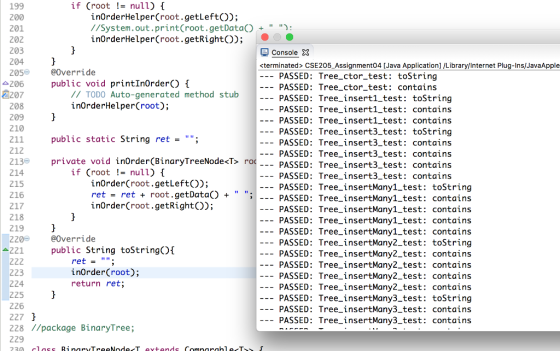
THANKS, please rate . Let me know if there is any doubts. PLEASE
COMMENT
Add Answer to:
Please help!!!!!!
import java.util.Random;
public class CSE205_Assignment04 {
private static Random rnd = new Random();
public...
import java.util.Random; import java.util.ArrayList; /** * */ public class hw5_task8 { public static void main(String[] args)...
import java.util.Random; import java.util.ArrayList; /** * */ public class hw5_task8 { public static void main(String[] args) { int[] grades = randomIntArr(10); printIntArray("grades", grades); ArrayList<Integer> indexesF_AL = selectIndexes_1(grades); System.out.println(" indexesF_AL: " + indexesF_AL); int[] indexesF_Arr = selectIndexes_2(grades); printIntArray("indexesF_Arr",indexesF_Arr); } public static int[] randomIntArr(int N){ int[] res = new int[N]; Random r = new Random(0); for(int i = 0; i < res.length; i++){ res[i] = r.nextInt(101); // r.nextInt(101) returns an in in range [0, 100] } return res; } public static void...
JAVA programming 9.9 Ch 9, Part 2: ArrayList Searching import java.util.ArrayList; public class ArrayListSet { ...
JAVA programming 9.9 Ch 9, Part 2: ArrayList Searching import java.util.ArrayList; public class ArrayListSet { /** * Searches through the ArrayList arr, from the first index to the last, returning an ArrayList * containing all the indexes of Strings in arr that match String s. For this method, two Strings, * p and q, match when p.equals(q) returns true or if both of the compared references are null. * * @param s The string...
complete this in java import java.io.File; import java.io.FileNotFoundException; import java.util.ArrayList; import java.util.Random; import java.util.Scanner; public class...
complete this in java import java.io.File; import java.io.FileNotFoundException; import java.util.ArrayList; import java.util.Random; import java.util.Scanner; public class WordDetective { /** * Picks the first unguessed word to show. * Updates the guessed array indicating the selected word is shown. * * @param wordSet The set of words. * @param guessed Whether a word has been guessed. * @return The word to show or null if all have been guessed. */ public static String pickWordToShow(ArrayList<String> wordSet, boolean []guessed) { return null;...
Please implement a right rotation funtion: private Node rightRotate(Node root) { } Remember to return the...
Please implement a right rotation funtion: private Node rightRotate(Node root) { } Remember to return the new root of the subtree to the parent so the parent can set it to be its child package trees; public class BinaryTree> { private Node root; //private int size; public static int sumTree(Node root) { if(root== null) { return 0; } int center = 0; if( root.item % 2 == 0) { center = root.item; } int left = sumTree(root.left); int right =...
Java help! Please help complete the min method below in bold. import java.util.Arrays; import java.util.ArrayList; import...
Java help! Please help complete the min method below in bold. import java.util.Arrays; import java.util.ArrayList; import java.util.Collections; import java.util.Iterator; import java.util.List; /** * Provides an implementation of a binary search tree * with no balance constraints, implemented with linked nodes. * * * */ public class Bst<T extends Comparable<T>> implements Iterable<T> { ////////////////////////////////////////////////////////////////// // I M P L E M E N T T H E M I N M E T H O D B E L O W...
Java: Return an array of booleans in a directed graph. Please complete the TODO section in...
Java: Return an array of booleans in a directed graph. Please complete the TODO section in the mark(int s) function import algs13.Bag; import java.util.HashSet; // See instructions below public class MyDigraph { static class Node { private String key; private Bag<Node> adj; public Node (String key) { this.key = key; this.adj = new Bag<> (); } public String toString () { return key; } public void addEdgeTo (Node n) { adj.add (n); } public Bag<Node> adj () { return adj;...
Why am I getting compile errors. rowPuzzle.java:9: error: class, interface, or enum expected public static boolean...
Why am I getting compile errors. rowPuzzle.java:9: error: class, interface, or enum expected public static boolean rowPuzzle(ArrayList<Integer> squares, int index, ArrayList<Boolean> visited) ^ rowPuzzle.java:16: error: class, interface, or enum expected } //Java Program import java.util.*; // rowPuzzle helper function implementation // File: rowPuzzle.cpp // Header files section // function prototypes public static boolean rowPuzzle(ArrayList<Integer> squares, int index, ArrayList<Boolean> visited) { // base case // return true if the puzzle is solvable if (index == squares.size() - 1) { return...
Complete LinkedListCollection.java with following methods: public LinkedListCollection(); public LinkedListCollection(int size); public boolean isEmpty(); public int size();...
Complete LinkedListCollection.java with following methods: public LinkedListCollection(); public LinkedListCollection(int size); public boolean isEmpty(); public int size(); // Return number of elements in the Collection. public String toString(); public boolean add(T element); // Add an element into the Collection, return true if successful public boolean remove(T target); // Remove the target from Collection, return true if successful public boolean removeAll(T target); // Remove all occurrences of Target, return if successful public void removeDuplicate(); // Remove duplicated element(s) public boolean equals(LinkedListCollection that);...
I need a java flowchart for the following code: import java.util.*; public class Main { ...
I need a java flowchart for the following code: import java.util.*; public class Main { public static void main(String[] args) { Scanner sc=new Scanner(System.in); System.out.print("Enter the input size: "); int n=sc.nextInt(); int arr[]=new int[n]; System.out.print("Enter the sequence: "); for(int i=0;i<n;i++) arr[i]=sc.nextInt(); if(isConsecutiveFour(arr)) { System.out.print("yes the array contain consecutive number:"); for(int i=0;i<n;i++) System.out.print(arr[i]+" "); ...
I need help with todo line please public class LinkedList { private Node head; public LinkedList()...
I need help with todo line please public class LinkedList { private Node head; public LinkedList() { head = null; } public boolean isEmpty() { return head == null; } public int size() { int count = 0; Node current = head; while (current != null) { count++; current = current.getNext(); } return count; } public void add(int data) { Node newNode = new Node(data); newNode.setNext(head); head = newNode; } public void append(int data) { Node newNode = new Node(data);...
Most questions answered within 3 hours.
-
Where is the error in this code sequence?
String s1 = "Hello";
String s2 = "ello";...
asked 10 months ago -
Financial data for Joel de Paris, Inc., for last year
follow:
Joel de Paris, Inc.
Balance...
asked 10 months ago -
Consider this reaction:
Al2(SO4)3 (aq)+ BaCl3
(aq) Al2Cl6 (aq)- +
3BaSO4(s) . What is the...
asked 10 months ago -
Suppose that Savneet is considering increasing her
recent random sample from 20 car rentals to 40...
asked 10 months ago -
Trucks arrive at an unloading terminal at an average rate of 120
per hour.
Trucks arrive...
asked 10 months ago -
Why are methanol and ethanol completely soluble in water while
octanol is not very little soluble....
asked 10 months ago -
A facilities manager at a university reads in a research report
that the mean amount of...
asked 10 months ago -
When the CuSO4 is rehydrated by adding water to the anhydrous
compound, is this an endothermic...
asked 10 months ago -
A ray of sunlight is passing from diamond into crown glass; the
angle of incidence is...
asked 10 months ago -
A block of mass 0.249 kg is placed on top of a light, vertical
spring of...
asked 10 months ago -
how do the kidneys compensate in the presences of acidosis
a) trigger hyperventilate
b) reserve acid...
asked 10 months ago -
Question 501 pts
The rental rate of capital to the firm increases. Which of the
following...
asked 10 months ago