
Homework Answers

Add Answer to:
(2 pts) The mechanism for formation of the product X is: Step 1 Step 2 A...
4. Below is a proposed mechanism for a reaction: Step 1. Step 2. C+E-F Step 3....
 4. Below is a proposed mechanism for a reaction: Step 1. Step 2. C+E-F Step 3. F G A B C+D Fast equilibrium Slow Fast A. (2 points) What is the overall stoichiometry for this reaction? B. (2 points) Which step is the rate determining step? C. (6 points) If this mechanism is correct, what should the rate equation for this reaction be? (Make sure you include the fast equilibrium)
8. The enthalpy of formation of 02(g) is: Select one: a. negative b. impossible to tell...
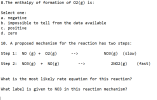 8. The enthalpy of formation of 02(g) is: Select one: a. negative b. impossible to tell from the data available c. positive d. zero 10. A proposed mechanism for the reaction has two steps: Step 1: NO (g) + O2(g) Step 2: NO3(g) + NO(g) NO3(g) (slow) 2NO2(g) (fast) --> What is the most likely rate equation for this reaction? What label is given to No3 in this reaction mechanism?
2. Consider this two step mechanism for a reaction… Step 1 NO2 + O3 --> NO3 ...
2. Consider this two step mechanism for a reaction… Step 1 NO2 + O3 --> NO3 + O2 slow; rate determining step Step 2 NO3 + NO2 --> N2O5 fast a. What is the overall reaction? b. Identify the intermediates in the mechanism. c. Write the rate law expression for each step of the mechanism including any reversible reactions. c. What is the predicted rate law expression? Be sure to only list reactants from the overall equation and not intermediates...
Rates of Non-elementary reactions Class Activity Consider the following mechanism: 2NO N202 k-1 N...
 step by step
Rates of Non-elementary reactions Class Activity Consider the following mechanism: 2NO N202 k-1 NzOz + C12-2+2 NOCI a. What is the net reaction? b. Which of the above species is an intermediate? Why? c. Find the rate of the overall reaction using the steady-state approximation. d. Repeat part (c) using the rate-determining step method, assuming the first-step is fast and at equilibrium and the second step is slow. 2NO N,02 (ast,at equilibrium) k-1 N202 + Cl2-22 NOCI...
step by step
Rates of Non-elementary reactions Class Activity Consider the following mechanism: 2NO N202 k-1 NzOz + C12-2+2 NOCI a. What is the net reaction? b. Which of the above species is an intermediate? Why? c. Find the rate of the overall reaction using the steady-state approximation. d. Repeat part (c) using the rate-determining step method, assuming the first-step is fast and at equilibrium and the second step is slow. 2NO N,02 (ast,at equilibrium) k-1 N202 + Cl2-22 NOCI...
#13 Interpreting Mechanisms 1. Consider the following mechanism: Step 1 Br2  
#13 Interpreting Mechanisms 1. Consider the following mechanism: Step 1 Br2 2Br fast Step 2 Br + H2 H2Br fast Step 3 H2Br + Br 2HBr slow a. What is the overall equation? b. Identify the intermediate(s) if any. c. What is the molecularity and the rate law for each step including any reversible steps? d. What is the predicted rate law expression for this reaction. Be sure to only list reactants from the overall equation and...
4. (22 pts) Consider the following exothermic reaction: H2O2 +2t + 2H' → 12 + 2H20...
 4. (22 pts) Consider the following exothermic reaction: H2O2 +2t + 2H' → 12 + 2H20 Consider the following mechanism for this reaction H,02 + r-* Hol + OH' Hol + r- 12 + он. 20H 2H2 H20 slow fast fast a) What species are intermediates in the above mechanism? Any catalysts? b) Sketch an energy versus reaction progress plot for the three step mechanism and clearly label the rate determining step in your diagram. c) What rate law would...
For a reaction that proceeds by the following two-step mechanism A2 ⇄ 2A (fast) A +...
For a reaction that proceeds by the following two-step mechanism A2 ⇄ 2A (fast) A + B → C (slow) Which of the following statements is/are correct? 1) The reaction is first order in the concentration of A2. 2) B is a reaction intermediate. 3) The rate-determining step is bimolecular. 4) The units of the specific rate constant are mol1/2L-1/2s-1
What is the molecularity of the rate determining step in this mechanism? CH3COOC2H5 + H2O →...
What is the molecularity of the rate determining step in this mechanism? CH3COOC2H5 + H2O → CH3COOC2H6+ + OH- (Slow) CH3COOC2H6+ → CH3COOH + C2H5+ (Fast) C2H5+ + OH- → C2H5OH (Fast) A. unimolecular B. tetramolecular C. bimolecular D. termolecular E. need additional information
Question 14 5 pts For this reaction: H2O* The mechanism ha ✓ [Select ] step(s). The...
 Question 14 5 pts For this reaction: H2O* The mechanism ha ✓ [Select ] step(s). The slow step is the step. Question 14 5 pts For this reaction: افلہ ح The mechanism has (Select] steps). The slow step is th step. [Select ] first second third fourth fifth
Quest. 3 (10 pts). Examine the following mechanism Step 1 2N2O2(g) Step 2 2N2O(g) + 2H2...
 Quest. 3 (10 pts). Examine the following mechanism Step 1 2N2O2(g) Step 2 2N2O(g) + 2H2 (g) → → 2N2O(g) + O2(g) 2N2 (g) + 2H2O(g) (kl; slow) (k2; fast) a) (2 pts) Write the overall equation for the reaction. b) (2 pts) Identify the intermediate(s) and/or catalyst(s) if any. c) (2 pts) Write the rate law for the overall reaction. d) (1 pts) State the order of the reaction e) (2 pts) Write the integrated rate equation f) (1...
 4. Below is a proposed mechanism for a reaction: Step 1. Step 2. C+E-F Step 3. F G A B C+D Fast equilibrium Slow Fast A. (2 points) What is the overall stoichiometry for this reaction? B. (2 points) Which step is the rate determining step? C. (6 points) If this mechanism is correct, what should the rate equation for this reaction be? (Make sure you include the fast equilibrium)
 8. The enthalpy of formation of 02(g) is: Select one: a. negative b. impossible to tell from the data available c. positive d. zero 10. A proposed mechanism for the reaction has two steps: Step 1: NO (g) + O2(g) Step 2: NO3(g) + NO(g) NO3(g) (slow) 2NO2(g) (fast) --> What is the most likely rate equation for this reaction? What label is given to No3 in this reaction mechanism?
 step by step
Rates of Non-elementary reactions Class Activity Consider the following mechanism: 2NO N202 k-1 NzOz + C12-2+2 NOCI a. What is the net reaction? b. Which of the above species is an intermediate? Why? c. Find the rate of the overall reaction using the steady-state approximation. d. Repeat part (c) using the rate-determining step method, assuming the first-step is fast and at equilibrium and the second step is slow. 2NO N,02 (ast,at equilibrium) k-1 N202 + Cl2-22 NOCI...
step by step
Rates of Non-elementary reactions Class Activity Consider the following mechanism: 2NO N202 k-1 NzOz + C12-2+2 NOCI a. What is the net reaction? b. Which of the above species is an intermediate? Why? c. Find the rate of the overall reaction using the steady-state approximation. d. Repeat part (c) using the rate-determining step method, assuming the first-step is fast and at equilibrium and the second step is slow. 2NO N,02 (ast,at equilibrium) k-1 N202 + Cl2-22 NOCI...
 4. (22 pts) Consider the following exothermic reaction: H2O2 +2t + 2H' → 12 + 2H20 Consider the following mechanism for this reaction H,02 + r-* Hol + OH' Hol + r- 12 + он. 20H 2H2 H20 slow fast fast a) What species are intermediates in the above mechanism? Any catalysts? b) Sketch an energy versus reaction progress plot for the three step mechanism and clearly label the rate determining step in your diagram. c) What rate law would...
 Question 14 5 pts For this reaction: H2O* The mechanism ha ✓ [Select ] step(s). The slow step is the step. Question 14 5 pts For this reaction: افلہ ح The mechanism has (Select] steps). The slow step is th step. [Select ] first second third fourth fifth
 Quest. 3 (10 pts). Examine the following mechanism Step 1 2N2O2(g) Step 2 2N2O(g) + 2H2 (g) → → 2N2O(g) + O2(g) 2N2 (g) + 2H2O(g) (kl; slow) (k2; fast) a) (2 pts) Write the overall equation for the reaction. b) (2 pts) Identify the intermediate(s) and/or catalyst(s) if any. c) (2 pts) Write the rate law for the overall reaction. d) (1 pts) State the order of the reaction e) (2 pts) Write the integrated rate equation f) (1...
Most questions answered within 3 hours.
-
Where is the error in this code sequence?
String s1 = "Hello";
String s2 = "ello";...
asked 11 months ago -
Financial data for Joel de Paris, Inc., for last year
follow:
Joel de Paris, Inc.
Balance...
asked 11 months ago -
Consider this reaction:
Al2(SO4)3 (aq)+ BaCl3
(aq) Al2Cl6 (aq)- +
3BaSO4(s) . What is the...
asked 11 months ago -
Suppose that Savneet is considering increasing her
recent random sample from 20 car rentals to 40...
asked 11 months ago -
Trucks arrive at an unloading terminal at an average rate of 120
per hour.
Trucks arrive...
asked 11 months ago -
Why are methanol and ethanol completely soluble in water while
octanol is not very little soluble....
asked 11 months ago -
A facilities manager at a university reads in a research report
that the mean amount of...
asked 11 months ago -
When the CuSO4 is rehydrated by adding water to the anhydrous
compound, is this an endothermic...
asked 11 months ago -
A ray of sunlight is passing from diamond into crown glass; the
angle of incidence is...
asked 11 months ago -
A block of mass 0.249 kg is placed on top of a light, vertical
spring of...
asked 11 months ago -
how do the kidneys compensate in the presences of acidosis
a) trigger hyperventilate
b) reserve acid...
asked 11 months ago -
Question 501 pts
The rental rate of capital to the firm increases. Which of the
following...
asked 11 months ago