
Homework Answers
Add Answer to:
Extra Credit: It is a fact that any three-dimensional vector field F can be of vector...
Extra Credit: It is a fact that any three-dimensional vector field F can be expressed as a sum of...
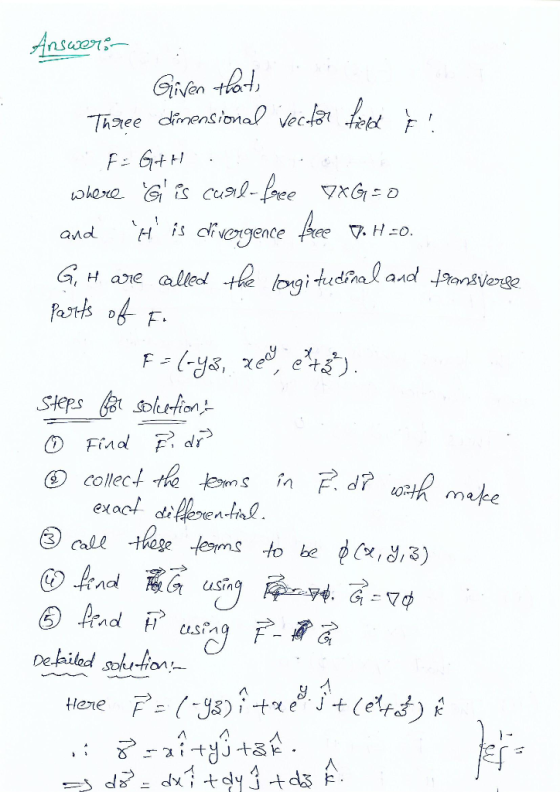
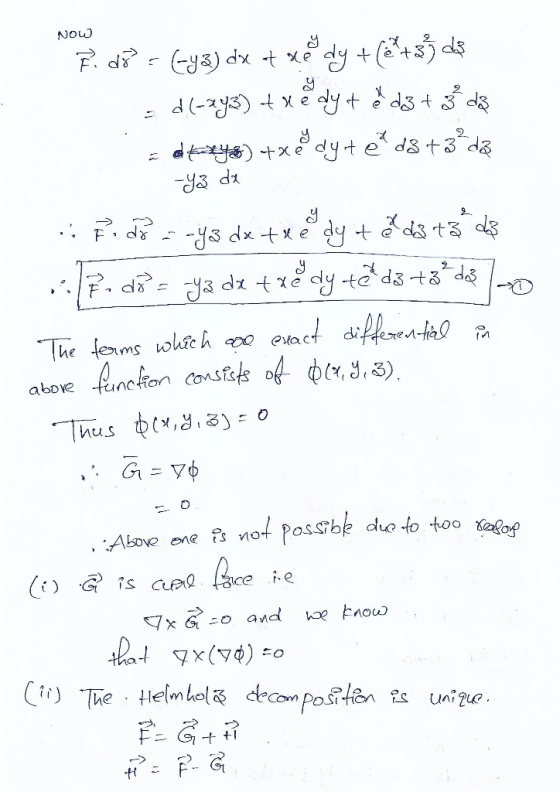
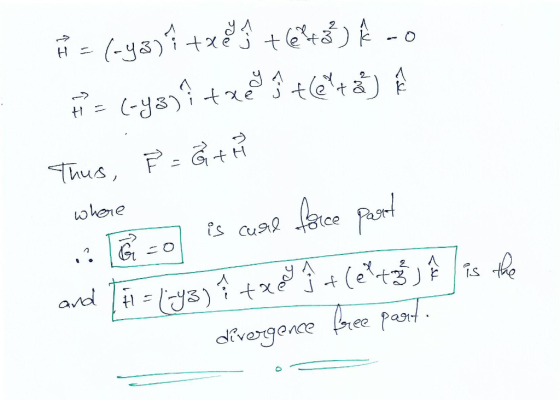
 Extra Credit: It is a fact that any three-dimensional vector field F can be expressed as a sum of vector fields F- G+H where G is curl-free (i.e. V x G 0) and H is divergence-free (i.e. H O. G and H are respectively called the longitudinal and tranverse parts of F. This is known as the Helmholz decomposition. It is important in electromagnetic theory. At any point in space the longitudinal part of the electric field describes the part...
ems (1 point) A) Consider the vector field F(x, y, z) = (6yz, -7zz, zy). Find...
 ems (1 point) A) Consider the vector field F(x, y, z) = (6yz, -7zz, zy). Find the divergence and curl of F. div(F) = V.F= curl(F) = V F =( ). 5 (5x?, 2(x + y), -7(x + y + x)) 7 B) Consider the vector field F(x, y, z) Find the divergence and curl of F. div(F) = V.P= curl(F) = V XF =( 8 9 10 )
Consider the following region R and the vector field F. a. Compute the two-dimensional divergence of...
 Consider the following region R and the vector field F. a. Compute the two-dimensional divergence of the vector field. b. Evaluate both integrals in the flux form of Green's Theorem and check for consistency. c. State whether the vector field is source free. F = (8xy,9x2 - 4y?); R is the region bounded by y = x(6 - x) and y=0. .- a. The two-dimensional divergence is 0 b. Set up the integral over the region. dy dx 0 Set...
(1) Let G(,y, z) = (x,y, z). Show that there exists no vector field A : R3 -> R3 such that curl(A) Hint: compute its...
 (1) Let G(,y, z) = (x,y, z). Show that there exists no vector field A : R3 -> R3 such that curl(A) Hint: compute its divergence G. (2) Let H R3 -> R3 be given as H(x,y, z) = (1,2,3). Find a vector potential A : R3 -> R3 such that curl(A) smooth function = H. Show that if A is a vector potential for H, then so is A+ Vf, for any f : R5 -> R (3) Let...
Consider the following region R and the vector field F a. Compute the two-dimensional curl of the vector field. b. Evaluate both integrals in the circulation form of Green's Theorem and check for...
 Consider the following region R and the vector field F a. Compute the two-dimensional curl of the vector field. b. Evaluate both integrals in the circulation form of Green's Theorem and check for consistency. c. State whether the vector field is conservative. F-3y,3x); R is the triangle with vertices (0, 0), (1, 0), and (0, 1) a. The two-dimensional curl is D (Type an exact answer, using π as needed.) b. Set up the integral over the region R. dy...
Full working out and answers please. Vector Fields A vector field has a more complicated derivative,...
 Full working out and answers please.
Vector Fields A vector field has a more complicated derivative, because as you go from point to point in the field, you find that not only the magnitude of the vector can be changing, but also its direction Think of a vector field v(..); for instance, the flow velocity of a turbulent gas through some part of space. At each point, v has a certain magnitude and direction. Alternatively, we can split v up...
Full working out and answers please.
Vector Fields A vector field has a more complicated derivative, because as you go from point to point in the field, you find that not only the magnitude of the vector can be changing, but also its direction Think of a vector field v(..); for instance, the flow velocity of a turbulent gas through some part of space. At each point, v has a certain magnitude and direction. Alternatively, we can split v up...
6. Consider the vector field F = (x + sin y) î + y²z + x2...
 6. Consider the vector field F = (x + sin y) î + y²z + x2 î. (a) Compute the divergence of for the point (2, -3,1). (7 points) (b) Consider F as the velocity field for fluid flow. Imagine a small drop of dye placed at the point (2, -3,1). Describe how the volume of the drop will change (instanta- neously) as the dye particles move with the flow. (3 points) (c) Compute the curl of F for the...
please give some explanation to each step 15 Total Question 3 Let F: R3R3 be any...
 please give some explanation to each step
15 Total Question 3 Let F: R3R3 be any C2 vector field. 3(a). Prove that the divergence of the curl of F is zero. /4 marks 3(b). For F as defined above, a misguided professor claims that for any closed curve C, F dr 0 because of the argument: (x F)ds F-dr div (eurl F) dV X 0-APO by using Stokes' theorem, the divergence theorem, and then part (a) for an appropriately chosen...
please give some explanation to each step
15 Total Question 3 Let F: R3R3 be any C2 vector field. 3(a). Prove that the divergence of the curl of F is zero. /4 marks 3(b). For F as defined above, a misguided professor claims that for any closed curve C, F dr 0 because of the argument: (x F)ds F-dr div (eurl F) dV X 0-APO by using Stokes' theorem, the divergence theorem, and then part (a) for an appropriately chosen...
Please answer without using previously posted answers. Thanks Let F(x, y) be a two-dimensional vector field. Spose further that there exists a scalar function, o, such that Then, F(x,y) is called a g...
 Please answer without using previously posted answers.
Thanks
Let F(x, y) be a two-dimensional vector field. Spose further that there exists a scalar function, o, such that Then, F(x,y) is called a gradient field, and φ s called a potential function. Ideal Fluid Flow Let F represent the two-dimensional velocity field of an inviscid fluid that is incompressible, ie. . F-0 (or divergence-free). F can be represented by (1), where ф is called the velocity potential-show that o is harmonic....
Please answer without using previously posted answers.
Thanks
Let F(x, y) be a two-dimensional vector field. Spose further that there exists a scalar function, o, such that Then, F(x,y) is called a gradient field, and φ s called a potential function. Ideal Fluid Flow Let F represent the two-dimensional velocity field of an inviscid fluid that is incompressible, ie. . F-0 (or divergence-free). F can be represented by (1), where ф is called the velocity potential-show that o is harmonic....
Solve all parts thanks <Extra Credit 2 Force Vector Directed along a Line Three-dimensional Cartesian force...
 Solve all parts
thanks
<Extra Credit 2 Force Vector Directed along a Line Three-dimensional Cartesian force vectors are used throughout engineering mechanics. The generic force vector is represented as follows: F= F,i+Fyj + F kwhere F is the force vector and Fr, Fy, and F, are the vector's i, j, and k components, respectively. The force vector has a magnitude F F2 +F3 + F2. The vector's I 1 Figure < 1 of 2 > C 13/12 5 F =...
Solve all parts
thanks
<Extra Credit 2 Force Vector Directed along a Line Three-dimensional Cartesian force vectors are used throughout engineering mechanics. The generic force vector is represented as follows: F= F,i+Fyj + F kwhere F is the force vector and Fr, Fy, and F, are the vector's i, j, and k components, respectively. The force vector has a magnitude F F2 +F3 + F2. The vector's I 1 Figure < 1 of 2 > C 13/12 5 F =...
 Extra Credit: It is a fact that any three-dimensional vector field F can be expressed as a sum of vector fields F- G+H where G is curl-free (i.e. V x G 0) and H is divergence-free (i.e. H O. G and H are respectively called the longitudinal and tranverse parts of F. This is known as the Helmholz decomposition. It is important in electromagnetic theory. At any point in space the longitudinal part of the electric field describes the part...
 ems (1 point) A) Consider the vector field F(x, y, z) = (6yz, -7zz, zy). Find the divergence and curl of F. div(F) = V.F= curl(F) = V F =( ). 5 (5x?, 2(x + y), -7(x + y + x)) 7 B) Consider the vector field F(x, y, z) Find the divergence and curl of F. div(F) = V.P= curl(F) = V XF =( 8 9 10 )
 Consider the following region R and the vector field F. a. Compute the two-dimensional divergence of the vector field. b. Evaluate both integrals in the flux form of Green's Theorem and check for consistency. c. State whether the vector field is source free. F = (8xy,9x2 - 4y?); R is the region bounded by y = x(6 - x) and y=0. .- a. The two-dimensional divergence is 0 b. Set up the integral over the region. dy dx 0 Set...
 (1) Let G(,y, z) = (x,y, z). Show that there exists no vector field A : R3 -> R3 such that curl(A) Hint: compute its divergence G. (2) Let H R3 -> R3 be given as H(x,y, z) = (1,2,3). Find a vector potential A : R3 -> R3 such that curl(A) smooth function = H. Show that if A is a vector potential for H, then so is A+ Vf, for any f : R5 -> R (3) Let...
 Consider the following region R and the vector field F a. Compute the two-dimensional curl of the vector field. b. Evaluate both integrals in the circulation form of Green's Theorem and check for consistency. c. State whether the vector field is conservative. F-3y,3x); R is the triangle with vertices (0, 0), (1, 0), and (0, 1) a. The two-dimensional curl is D (Type an exact answer, using π as needed.) b. Set up the integral over the region R. dy...
 Full working out and answers please.
Vector Fields A vector field has a more complicated derivative, because as you go from point to point in the field, you find that not only the magnitude of the vector can be changing, but also its direction Think of a vector field v(..); for instance, the flow velocity of a turbulent gas through some part of space. At each point, v has a certain magnitude and direction. Alternatively, we can split v up...
Full working out and answers please.
Vector Fields A vector field has a more complicated derivative, because as you go from point to point in the field, you find that not only the magnitude of the vector can be changing, but also its direction Think of a vector field v(..); for instance, the flow velocity of a turbulent gas through some part of space. At each point, v has a certain magnitude and direction. Alternatively, we can split v up...
 6. Consider the vector field F = (x + sin y) î + y²z + x2 î. (a) Compute the divergence of for the point (2, -3,1). (7 points) (b) Consider F as the velocity field for fluid flow. Imagine a small drop of dye placed at the point (2, -3,1). Describe how the volume of the drop will change (instanta- neously) as the dye particles move with the flow. (3 points) (c) Compute the curl of F for the...
 please give some explanation to each step
15 Total Question 3 Let F: R3R3 be any C2 vector field. 3(a). Prove that the divergence of the curl of F is zero. /4 marks 3(b). For F as defined above, a misguided professor claims that for any closed curve C, F dr 0 because of the argument: (x F)ds F-dr div (eurl F) dV X 0-APO by using Stokes' theorem, the divergence theorem, and then part (a) for an appropriately chosen...
please give some explanation to each step
15 Total Question 3 Let F: R3R3 be any C2 vector field. 3(a). Prove that the divergence of the curl of F is zero. /4 marks 3(b). For F as defined above, a misguided professor claims that for any closed curve C, F dr 0 because of the argument: (x F)ds F-dr div (eurl F) dV X 0-APO by using Stokes' theorem, the divergence theorem, and then part (a) for an appropriately chosen...
 Please answer without using previously posted answers.
Thanks
Let F(x, y) be a two-dimensional vector field. Spose further that there exists a scalar function, o, such that Then, F(x,y) is called a gradient field, and φ s called a potential function. Ideal Fluid Flow Let F represent the two-dimensional velocity field of an inviscid fluid that is incompressible, ie. . F-0 (or divergence-free). F can be represented by (1), where ф is called the velocity potential-show that o is harmonic....
Please answer without using previously posted answers.
Thanks
Let F(x, y) be a two-dimensional vector field. Spose further that there exists a scalar function, o, such that Then, F(x,y) is called a gradient field, and φ s called a potential function. Ideal Fluid Flow Let F represent the two-dimensional velocity field of an inviscid fluid that is incompressible, ie. . F-0 (or divergence-free). F can be represented by (1), where ф is called the velocity potential-show that o is harmonic....
 Solve all parts
thanks
<Extra Credit 2 Force Vector Directed along a Line Three-dimensional Cartesian force vectors are used throughout engineering mechanics. The generic force vector is represented as follows: F= F,i+Fyj + F kwhere F is the force vector and Fr, Fy, and F, are the vector's i, j, and k components, respectively. The force vector has a magnitude F F2 +F3 + F2. The vector's I 1 Figure < 1 of 2 > C 13/12 5 F =...
Solve all parts
thanks
<Extra Credit 2 Force Vector Directed along a Line Three-dimensional Cartesian force vectors are used throughout engineering mechanics. The generic force vector is represented as follows: F= F,i+Fyj + F kwhere F is the force vector and Fr, Fy, and F, are the vector's i, j, and k components, respectively. The force vector has a magnitude F F2 +F3 + F2. The vector's I 1 Figure < 1 of 2 > C 13/12 5 F =...
Most questions answered within 3 hours.
-
Where is the error in this code sequence?
String s1 = "Hello";
String s2 = "ello";...
asked 10 months ago -
Financial data for Joel de Paris, Inc., for last year
follow:
Joel de Paris, Inc.
Balance...
asked 10 months ago -
Consider this reaction:
Al2(SO4)3 (aq)+ BaCl3
(aq) Al2Cl6 (aq)- +
3BaSO4(s) . What is the...
asked 10 months ago -
Suppose that Savneet is considering increasing her
recent random sample from 20 car rentals to 40...
asked 10 months ago -
Trucks arrive at an unloading terminal at an average rate of 120
per hour.
Trucks arrive...
asked 10 months ago -
Why are methanol and ethanol completely soluble in water while
octanol is not very little soluble....
asked 10 months ago -
A facilities manager at a university reads in a research report
that the mean amount of...
asked 10 months ago -
When the CuSO4 is rehydrated by adding water to the anhydrous
compound, is this an endothermic...
asked 10 months ago -
A ray of sunlight is passing from diamond into crown glass; the
angle of incidence is...
asked 10 months ago -
A block of mass 0.249 kg is placed on top of a light, vertical
spring of...
asked 10 months ago -
how do the kidneys compensate in the presences of acidosis
a) trigger hyperventilate
b) reserve acid...
asked 10 months ago -
Question 501 pts
The rental rate of capital to the firm increases. Which of the
following...
asked 10 months ago