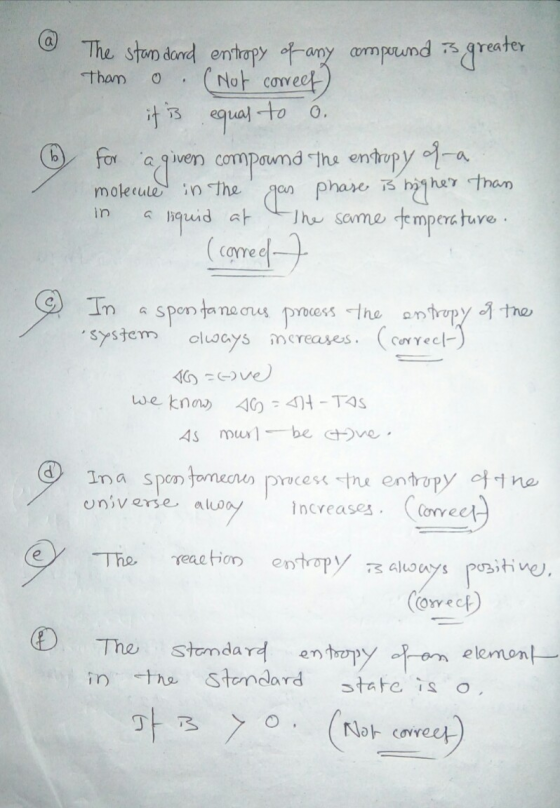
Which of the following statements are true (select ALL that apply) (a) The standard entropy of...
Homework Answers
Add Answer to:
Which of the following statements are true (select ALL that
apply)
(a) The standard entropy of...
Classify each of the statements as true or false. True False Answer Bank The entropy of...
 Classify each of the statements as true or false. True False Answer Bank The entropy of a substance increases when a liquid vaporizes to a gas at any temperature. Entropy decreases as the temperature increases. An exothermic reaction is always spontaneous. Product formation is always favored in a reaction with a negative AH° and a negative AS. For an endothermic reaction, a decrease in temperature results in a decrease in the equilibrium constant. A reaction will have an equilibrium constant...
2. Decide whether each of the following statements is true or false. If false, rewrite it...
 2. Decide whether each of the following statements is true or false. If false, rewrite it to make it true. a. Entropy of the universe increases in all spontaneous reactions. wo False If entropy is bw enough it con be spontaneous, b. Reactions with a negative free energy change (A-Gº <0) are product-favored and occur with rapid transformation of reactants to products. True c. An exothermic reaction will always be spontaneous. I NO when AH is negative the reaction can...
20. Which of the following statements is FALSE? A. The entropy of the universe increases during...
 20. Which of the following statements is FALSE? A. The entropy of the universe increases during spontaneous processes. B. During chemical and physical changes, energy is conserved. C. The entropy of H2O liquid is greater than the entropy of H2O solid at 0°C. D. The entropy of O2(g) should be greater than the entropy of CO2(g) when at the same temperature, E. The absolute entropy of a substance generally decreases when temperature decreases.
Which of the following statements about the standard molar entropy (S°) is true? Select one: a....
Which of the following statements about the standard molar entropy (S°) is true? Select one: a. The standard molar entropies for a substance are determined from the heat capacity b. The standard molar entropies for elements in their standard states is zero c. S° for F2(g) is less than S° for Br2(g) because F2 is lighter than Br2 d. S° generally increases with the size of the molecule (I.e. the number of atoms) e. None of the above
Which of the following statements concerning entropy is NOT correct? a. The dispersal of matter, such...
Which of the following statements concerning entropy is NOT correct? a. The dispersal of matter, such as the spontaneous expansion of a gas, cannot be explained by an increase in entropy. b. The entropy of a system is proportional to the natural log of the number of microstates. c. The entropy of a system increases as the number of available microstates increases. d. In a spontaneous process, ΔS(universe) indicates the extent to which energy is dispersed. e. Entropy is a...
Which of the following statements are true? [Select all that apply.] The average kinetic energy of...
 Which of the following statements are true? [Select all that apply.] The average kinetic energy of a gas increases as temperature increases. The average kinetic energy of a gas depends on the masses of the gas molecules. The average kinetic energy of a gas depends on the temperature of the gas. The average kinetic energy of a gas depends on the identity of the gas. A sample of carbon dioxide and a sample of hellum would have the same average...
CHANGES IN ENTROPY OF UNIVERSE VS SYSTEM. Evaluating Spontaneity Considering both Entropy and Enthalpy 7. In...
 CHANGES IN ENTROPY OF UNIVERSE VS SYSTEM. Evaluating Spontaneity Considering both Entropy and Enthalpy 7. In a spontaneous process, which of the following always increases? a. the entropy of the system b. the entropy of the surroundings c. the entropy of the universe d. the entropy of the system and the universe c. the entropy of the system, surroundings and the universe (Hand S refer to the system), a. AH>0 8. Processes are always spontaneous, regardless of temperature, when and...
Which of the following statements about red giant stars are true? (Select all that apply.) Red...
Which of the following statements about red giant stars are true? (Select all that apply.) Red giant stars are less luminous than main sequence stars of the same temperature. Red giant stars tend to be more luminous than main sequence stars of the same temperatures because they are larger in size. Red giant stars are less luminous than main sequence stars because fusion happens more rapidly in main sequence stars. A red giant star of a given temperature is more...
Which of the following statements are true? Check all that apply. A. The entropy of a...
Which of the following statements are true? Check all that apply. A. The entropy of a system can not increase in a reversible adiabatic process. B. The entropy of the surroundings can not increase in a reversible adiabatic process. C. The entropy of the surroundings can not increase in an adiabatic process. D. The entropy of a system can not increase in an adiabatic process.
Which of the following statements are true about the relationship between C P,mand CV, m? Check all that apply. o C...
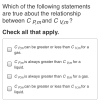 Which of the following statements are true about the relationship between C P,mand CV, m? Check all that apply. o CP,m can be greater or less than C v.m for a gas. CP.mis always greater than C V.m for a liquid. CP,mis always greater than C v,m for a gas. CP,m can be greater or less than C v,m for a liquid.
 Classify each of the statements as true or false. True False Answer Bank The entropy of a substance increases when a liquid vaporizes to a gas at any temperature. Entropy decreases as the temperature increases. An exothermic reaction is always spontaneous. Product formation is always favored in a reaction with a negative AH° and a negative AS. For an endothermic reaction, a decrease in temperature results in a decrease in the equilibrium constant. A reaction will have an equilibrium constant...
 2. Decide whether each of the following statements is true or false. If false, rewrite it to make it true. a. Entropy of the universe increases in all spontaneous reactions. wo False If entropy is bw enough it con be spontaneous, b. Reactions with a negative free energy change (A-Gº <0) are product-favored and occur with rapid transformation of reactants to products. True c. An exothermic reaction will always be spontaneous. I NO when AH is negative the reaction can...
 20. Which of the following statements is FALSE? A. The entropy of the universe increases during spontaneous processes. B. During chemical and physical changes, energy is conserved. C. The entropy of H2O liquid is greater than the entropy of H2O solid at 0°C. D. The entropy of O2(g) should be greater than the entropy of CO2(g) when at the same temperature, E. The absolute entropy of a substance generally decreases when temperature decreases.
 Which of the following statements are true? [Select all that apply.] The average kinetic energy of a gas increases as temperature increases. The average kinetic energy of a gas depends on the masses of the gas molecules. The average kinetic energy of a gas depends on the temperature of the gas. The average kinetic energy of a gas depends on the identity of the gas. A sample of carbon dioxide and a sample of hellum would have the same average...
 CHANGES IN ENTROPY OF UNIVERSE VS SYSTEM. Evaluating Spontaneity Considering both Entropy and Enthalpy 7. In a spontaneous process, which of the following always increases? a. the entropy of the system b. the entropy of the surroundings c. the entropy of the universe d. the entropy of the system and the universe c. the entropy of the system, surroundings and the universe (Hand S refer to the system), a. AH>0 8. Processes are always spontaneous, regardless of temperature, when and...
 Which of the following statements are true about the relationship between C P,mand CV, m? Check all that apply. o CP,m can be greater or less than C v.m for a gas. CP.mis always greater than C V.m for a liquid. CP,mis always greater than C v,m for a gas. CP,m can be greater or less than C v,m for a liquid.
Most questions answered within 3 hours.
-
Where is the error in this code sequence?
String s1 = "Hello";
String s2 = "ello";...
asked 11 months ago -
Financial data for Joel de Paris, Inc., for last year
follow:
Joel de Paris, Inc.
Balance...
asked 11 months ago -
Consider this reaction:
Al2(SO4)3 (aq)+ BaCl3
(aq) Al2Cl6 (aq)- +
3BaSO4(s) . What is the...
asked 11 months ago -
Suppose that Savneet is considering increasing her
recent random sample from 20 car rentals to 40...
asked 11 months ago -
Trucks arrive at an unloading terminal at an average rate of 120
per hour.
Trucks arrive...
asked 11 months ago -
Why are methanol and ethanol completely soluble in water while
octanol is not very little soluble....
asked 11 months ago -
A facilities manager at a university reads in a research report
that the mean amount of...
asked 11 months ago -
When the CuSO4 is rehydrated by adding water to the anhydrous
compound, is this an endothermic...
asked 11 months ago -
A ray of sunlight is passing from diamond into crown glass; the
angle of incidence is...
asked 11 months ago -
A block of mass 0.249 kg is placed on top of a light, vertical
spring of...
asked 11 months ago -
how do the kidneys compensate in the presences of acidosis
a) trigger hyperventilate
b) reserve acid...
asked 11 months ago -
Question 501 pts
The rental rate of capital to the firm increases. Which of the
following...
asked 11 months ago