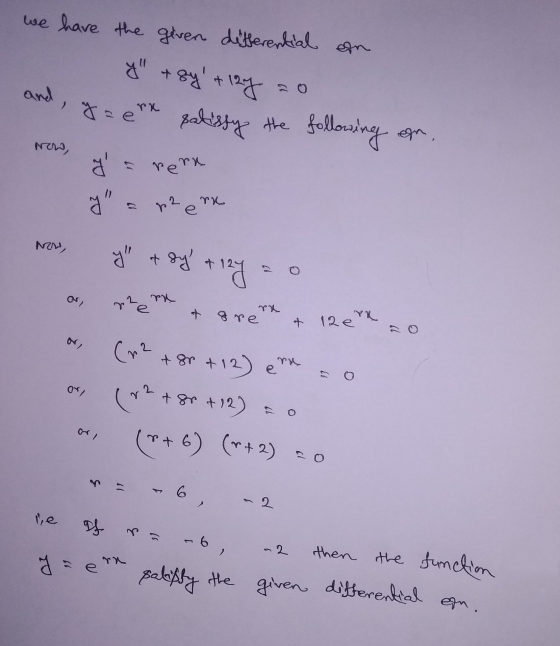
For what values of r does the function y = e^rx satisfy the following equation? (Enter...
For what values of r does the function y = e^rx satisfy the following equation? (Enter your answers from smallest to largest.) y'' + 8y' + 12y = 0
Homework Answers
Add Answer to:
For what values of r does the function y = e^rx satisfy the
following equation? (Enter...
For what values of k does the function y = cos(kt) satisfy the differential equation 1217"...
 For what values of k does the function y = cos(kt) satisfy the differential equation 1217" - -167? (smaller value) (larger value) uten vloer en the timestan acons set dienas cenato 2016 - 2017
With steps 5) Does the function f(xy) -x+ y satisfy the two dimensional Laplace's equation? Does...
 With steps
5) Does the function f(xy) -x+ y satisfy the two dimensional Laplace's equation? Does the function g(x,y)-x2-y2 ? Sketch g(x,y) roughly. And then calculate the gradient of g(x,y) at points (x,y)- (0,1), (1,0), (0, -1) and (-1,0) and indicate by little arrows the directions in which these gradient vectors point.
With steps
5) Does the function f(xy) -x+ y satisfy the two dimensional Laplace's equation? Does the function g(x,y)-x2-y2 ? Sketch g(x,y) roughly. And then calculate the gradient of g(x,y) at points (x,y)- (0,1), (1,0), (0, -1) and (-1,0) and indicate by little arrows the directions in which these gradient vectors point.
(1 point) Let y" + ly' – 12y=0. a. Try a solution of the form y=e",...
 (1 point) Let y" + ly' – 12y=0. a. Try a solution of the form y=e", for some unknown constant r, by substituting it into the differential equation. = 0. help (formulas) b. Simplify and factor your equation in the previous part as much as possible. Be sure to divide out any factors guaranteed to be nonzero. = 0. help (formulas) c. Find all values of r such that y=e" satisfies the differential equation. If there is more than one...
2. -133.33 points Find the exact extreme values of the function :-} (x,y) - (- 6)...
 2. -133.33 points Find the exact extreme values of the function :-} (x,y) - (- 6) + (y-2) + 50 subject to the following constraints: OS:5 18 OSS 13 Start by listing all nine candidates, including their z values, in the form (X,Y.2): First, list the four corner points and order your answers from smallest to largest x, then from smallest to largest y. 3) Next find the critical point. Lastly, find the four boundary points and order your answers...
Problem #15: Find the two values of x that satisfy the following equation. 2x - 10e*...
 Problem #15: Find the two values of x that satisfy the following equation. 2x - 10e* +21 = 0 Problem #15 Enter your answer symbolically, as in these examples Separate your answers with a comma.
<C. Problem 1. For all x E R prove that r = 0 if V(e> 0) : Problem 2. For each of the below properties, name a function f: IRR that does not satisfy the property and prove your answer. (d)...
 <C. Problem 1. For all x E R prove that r = 0 if V(e> 0) : Problem 2. For each of the below properties, name a function f: IRR that does not satisfy the property and prove your answer. (d) 3(e>0)
0) : Problem 2. For each of the below properties, name a function f: IRR that does not satisfy the property and prove your answer. (d) 3(e>0)
<C. Problem 1. For all x E R prove that r = 0 if V(e> 0) : Problem 2. For each of the below properties, name a function f: IRR that does not satisfy the property and prove your answer. (d) 3(e>0)
0) : Problem 2. For each of the below properties, name a function f: IRR that does not satisfy the property and prove your answer. (d) 3(e>0)
5. Given to the right is the graph of the function f(r, y) ye/2 on the...
 5. Given to the right is the graph of the function f(r, y) ye/2 on the domain 0r4 and 0 ys 4 (a) Use the graph to the right to rank the follow ing quantities in order from smallest to largest: f(3,2), f(1,2), f,(3,2), f,(1,2), 0 (b) Use algebra to calculate the numerical values of the four derivatives from part (a) and confirm that your answer to part (a) is correct.
5. Given to the right is the graph of...
5. Given to the right is the graph of the function f(r, y) ye/2 on the domain 0r4 and 0 ys 4 (a) Use the graph to the right to rank the follow ing quantities in order from smallest to largest: f(3,2), f(1,2), f,(3,2), f,(1,2), 0 (b) Use algebra to calculate the numerical values of the four derivatives from part (a) and confirm that your answer to part (a) is correct.
5. Given to the right is the graph of...
Find the points of inflection of the graph of the function.
Find the points of inflection of the graph of the function. (Order your answers from smallest to largest x, then from smallest to largest y. If an answer does not exist, enterf(x) = x + cos(x), [0. 2π]Describe the concavity. (Enter your answers using interval notation. If an answer does not exist, enter DNE.)
For two different values of r, the function y(t)= t' satisfies the differential equation ty" –...
 For two different values of r, the function y(t)= t' satisfies the differential equation ty" – 4 ty' + 6 y = 0 What are the two values of r ? Separate the numbers with a comma, e.g. 1,2
Find the local maximum and minimum values and saddle point(s) of the function. If you have three dimensional graphing software, graph the function with a domain and viewpoint that reveal all the impo...
 Find the local maximum and minimum values and saddle point(s) of the function. If you have three dimensional graphing software, graph the function with a domain and viewpoint that reveal all the important aspects of the function. (Enter NONE in any unused answer blanks.) rx, y) = (x2 + y Jep.x2 maximum (smaller x value) (larger x value) minimum (smaller x value) (larger x value) saddle points ) (smallest x value ) (largest x value)
Find the local maximum and...
Find the local maximum and minimum values and saddle point(s) of the function. If you have three dimensional graphing software, graph the function with a domain and viewpoint that reveal all the important aspects of the function. (Enter NONE in any unused answer blanks.) rx, y) = (x2 + y Jep.x2 maximum (smaller x value) (larger x value) minimum (smaller x value) (larger x value) saddle points ) (smallest x value ) (largest x value)
Find the local maximum and...
 For what values of k does the function y = cos(kt) satisfy the differential equation 1217" - -167? (smaller value) (larger value) uten vloer en the timestan acons set dienas cenato 2016 - 2017
 With steps
5) Does the function f(xy) -x+ y satisfy the two dimensional Laplace's equation? Does the function g(x,y)-x2-y2 ? Sketch g(x,y) roughly. And then calculate the gradient of g(x,y) at points (x,y)- (0,1), (1,0), (0, -1) and (-1,0) and indicate by little arrows the directions in which these gradient vectors point.
With steps
5) Does the function f(xy) -x+ y satisfy the two dimensional Laplace's equation? Does the function g(x,y)-x2-y2 ? Sketch g(x,y) roughly. And then calculate the gradient of g(x,y) at points (x,y)- (0,1), (1,0), (0, -1) and (-1,0) and indicate by little arrows the directions in which these gradient vectors point.
 (1 point) Let y" + ly' – 12y=0. a. Try a solution of the form y=e", for some unknown constant r, by substituting it into the differential equation. = 0. help (formulas) b. Simplify and factor your equation in the previous part as much as possible. Be sure to divide out any factors guaranteed to be nonzero. = 0. help (formulas) c. Find all values of r such that y=e" satisfies the differential equation. If there is more than one...
 2. -133.33 points Find the exact extreme values of the function :-} (x,y) - (- 6) + (y-2) + 50 subject to the following constraints: OS:5 18 OSS 13 Start by listing all nine candidates, including their z values, in the form (X,Y.2): First, list the four corner points and order your answers from smallest to largest x, then from smallest to largest y. 3) Next find the critical point. Lastly, find the four boundary points and order your answers...
 Problem #15: Find the two values of x that satisfy the following equation. 2x - 10e* +21 = 0 Problem #15 Enter your answer symbolically, as in these examples Separate your answers with a comma.
 <C. Problem 1. For all x E R prove that r = 0 if V(e> 0) : Problem 2. For each of the below properties, name a function f: IRR that does not satisfy the property and prove your answer. (d) 3(e>0)
0) : Problem 2. For each of the below properties, name a function f: IRR that does not satisfy the property and prove your answer. (d) 3(e>0)
<C. Problem 1. For all x E R prove that r = 0 if V(e> 0) : Problem 2. For each of the below properties, name a function f: IRR that does not satisfy the property and prove your answer. (d) 3(e>0)
0) : Problem 2. For each of the below properties, name a function f: IRR that does not satisfy the property and prove your answer. (d) 3(e>0)
 5. Given to the right is the graph of the function f(r, y) ye/2 on the domain 0r4 and 0 ys 4 (a) Use the graph to the right to rank the follow ing quantities in order from smallest to largest: f(3,2), f(1,2), f,(3,2), f,(1,2), 0 (b) Use algebra to calculate the numerical values of the four derivatives from part (a) and confirm that your answer to part (a) is correct.
5. Given to the right is the graph of...
5. Given to the right is the graph of the function f(r, y) ye/2 on the domain 0r4 and 0 ys 4 (a) Use the graph to the right to rank the follow ing quantities in order from smallest to largest: f(3,2), f(1,2), f,(3,2), f,(1,2), 0 (b) Use algebra to calculate the numerical values of the four derivatives from part (a) and confirm that your answer to part (a) is correct.
5. Given to the right is the graph of...
 For two different values of r, the function y(t)= t' satisfies the differential equation ty" – 4 ty' + 6 y = 0 What are the two values of r ? Separate the numbers with a comma, e.g. 1,2
 Find the local maximum and minimum values and saddle point(s) of the function. If you have three dimensional graphing software, graph the function with a domain and viewpoint that reveal all the important aspects of the function. (Enter NONE in any unused answer blanks.) rx, y) = (x2 + y Jep.x2 maximum (smaller x value) (larger x value) minimum (smaller x value) (larger x value) saddle points ) (smallest x value ) (largest x value)
Find the local maximum and...
Find the local maximum and minimum values and saddle point(s) of the function. If you have three dimensional graphing software, graph the function with a domain and viewpoint that reveal all the important aspects of the function. (Enter NONE in any unused answer blanks.) rx, y) = (x2 + y Jep.x2 maximum (smaller x value) (larger x value) minimum (smaller x value) (larger x value) saddle points ) (smallest x value ) (largest x value)
Find the local maximum and...
Most questions answered within 3 hours.
-
Where is the error in this code sequence?
String s1 = "Hello";
String s2 = "ello";...
asked 10 months ago -
Financial data for Joel de Paris, Inc., for last year
follow:
Joel de Paris, Inc.
Balance...
asked 10 months ago -
Consider this reaction:
Al2(SO4)3 (aq)+ BaCl3
(aq) Al2Cl6 (aq)- +
3BaSO4(s) . What is the...
asked 10 months ago -
Suppose that Savneet is considering increasing her
recent random sample from 20 car rentals to 40...
asked 10 months ago -
Trucks arrive at an unloading terminal at an average rate of 120
per hour.
Trucks arrive...
asked 10 months ago -
Why are methanol and ethanol completely soluble in water while
octanol is not very little soluble....
asked 10 months ago -
A facilities manager at a university reads in a research report
that the mean amount of...
asked 10 months ago -
When the CuSO4 is rehydrated by adding water to the anhydrous
compound, is this an endothermic...
asked 10 months ago -
A ray of sunlight is passing from diamond into crown glass; the
angle of incidence is...
asked 10 months ago -
A block of mass 0.249 kg is placed on top of a light, vertical
spring of...
asked 10 months ago -
how do the kidneys compensate in the presences of acidosis
a) trigger hyperventilate
b) reserve acid...
asked 10 months ago -
Question 501 pts
The rental rate of capital to the firm increases. Which of the
following...
asked 10 months ago