

Homework Answers
Add Answer to:
The
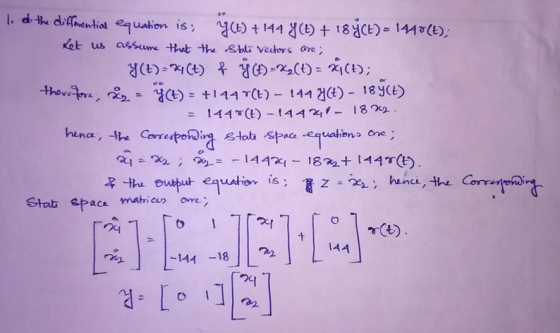
second picture is the equation given. The question is the first
picture.
j. Calculate (by...
PARTS: a-c Problem 1 (40 points) The rotational system shown in this diagram has a single...
 PARTS: a-c
Problem 1 (40 points) The rotational system shown in this diagram has a single torque input, T(t), and a single angular displacement output, (t). Also shown are the shaft polar moment of inertia, J, torsional spring constant, k, and rotational viscous damping coefficient, c. From the law of rotation (sum of the moments equal to polar moment of inertia times angular acceleration), we obtain: jä(t) + c)(t) + ko(t) = T(t). This ordinary differential equation is second-order, linear...
PARTS: a-c
Problem 1 (40 points) The rotational system shown in this diagram has a single torque input, T(t), and a single angular displacement output, (t). Also shown are the shaft polar moment of inertia, J, torsional spring constant, k, and rotational viscous damping coefficient, c. From the law of rotation (sum of the moments equal to polar moment of inertia times angular acceleration), we obtain: jä(t) + c)(t) + ko(t) = T(t). This ordinary differential equation is second-order, linear...
Rewrite the second order differential equation, as a system of a first order differential equation. (see...
 Rewrite the second order differential equation, as a system of
a first order differential equation. (see picture)
det + sin(a) = 0, 6(0) = el 10) = 0, += [0, 1] 2012 0, t=
Rewrite the second order differential equation, as a system of
a first order differential equation. (see picture)
det + sin(a) = 0, 6(0) = el 10) = 0, += [0, 1] 2012 0, t=
Consider a second order linear time invariant system represented by the following ordinary differential equation: 4....
 Consider a second order linear time invariant system represented by the following ordinary differential equation: 4. dx(t) dt dt dt Y (s) X(s) a. Find the transfer function H(s) of the system. (5 Points)
Find a first-order system of ordinary differential equations equivalent to the second-order nonlinear ordinary differential equation...
 Find a first-order system of ordinary differential equations
equivalent to the second-order nonlinear ordinary differential
equation y ^-- = 3y 0 + (y 3 − y)
(3 points) Find a first-order system of ordinary differential equations equivalent to the second-order nonlinear ordinary differential equation y" = 3y' +(y3 – y).
Find a first-order system of ordinary differential equations
equivalent to the second-order nonlinear ordinary differential
equation y ^-- = 3y 0 + (y 3 − y)
(3 points) Find a first-order system of ordinary differential equations equivalent to the second-order nonlinear ordinary differential equation y" = 3y' +(y3 – y).
Engineering Mathematics 1 Page 3 of 10 2. Consider the nonhomogeneous ordinary differential equation ry" 2(r...
 Engineering Mathematics 1 Page 3 of 10 2. Consider the nonhomogeneous ordinary differential equation ry" 2(r (x - 2)y 1, (2) r> 0. (a) Use the substitution y(x) = u(x)/x to show that the associated homogeneous equation ry" 2(r (x - 2)y 0 transforms into a linear constant-coefficient ODE for u(r) (b) Solve the linear constant-coefficient ODE obtained in Part (a) for u(x). Hence show that yeand y2= are solutions of the associated homogeneous ODE of equation (2). (c) Use...
Problem 5. Consider the following second order linear differential equation f"(t)-f'(t) +f(t) kt ...
 Problem 5. Consider the following second order linear differential equation f"(t)-f'(t) +f(t) kt which models a forced oscillation in a damping material. For example, imagine moving your hand back and forth underwater. Write this equation as a set of coupled first order equations by doing the following: ·Define a new function g = f'(t). This gives you one of the two coupled equations. . Use the given ODE, g, and its derivatives to write the second first order equation. Both...
A nonhomogeneous second-order linear equation and a complementary function ye are given below. Use the method...
 A nonhomogeneous second-order linear equation and a complementary function ye are given below. Use the method of variation of parameters to find a particular solution of the given differential equation. Before applying the method of variation of parameters, divide the equation by its leading coefficient x2 to rewrite it in the standard form, y" + P(x)y'+Q(x)y = f(x) x2y"xy'y Inx; y c1 cos (In x) + c2 sin (In x) The particular solution is yo (x)
A linear equation. Differentiate the first-order equation 1 (2- a2) (3.123) a2 linear, second-order differential equati...
 A linear equation. Differentiate the first-order equation 1 (2- a2) (3.123) a2 linear, second-order differential equation with respect to c to derive Solve for the general solution to this ODE and show that it contains three arbitrary constants a Use equation (3.123) to eliminate one constant and rederive the catenary of equation y(x) a cosh
A linear equation. Differentiate the first-order equation 1 (2- a2) (3.123) a2 linear, second-order differential equation with respect to c to derive Solve for the...
A linear equation. Differentiate the first-order equation 1 (2- a2) (3.123) a2 linear, second-order differential equation with respect to c to derive Solve for the general solution to this ODE and show that it contains three arbitrary constants a Use equation (3.123) to eliminate one constant and rederive the catenary of equation y(x) a cosh
A linear equation. Differentiate the first-order equation 1 (2- a2) (3.123) a2 linear, second-order differential equation with respect to c to derive Solve for the...
Q1 State a first order non-linear and non-homogeneous differential equation. Solve using - Exact Equation Approach Q2 State a second order linear and non-homogeneous differential equation. Solve using...
Q1 State a first order non-linear and non-homogeneous differential equation. Solve using - Exact Equation Approach Q2 State a second order linear and non-homogeneous differential equation. Solve using - Undetermined Coefficient Approach Please state the DE and solve it , as I want to know how you answer it , then i can practice with the real DE given by the question
1) Question. Solve this constant coefficient linear second order heterogeneous difference equation and conduct a ve...
 1) Question. Solve this constant coefficient linear second order heterogeneous difference equation and conduct a verification: yj+13y-10y;-1 = 10. 2) Question. Solve this constant coefficient linear second order heterogeneous differential equation and conduct a verification: y"-y2y 4a Discretionary hint: use the undetermined coefficients method in relation to the inhomo geneous part, that is, try yp = ax2 + bx + c, plug it into the differential equation and solve for parameters a, b and c, matching their associated arguments.
1)...
1) Question. Solve this constant coefficient linear second order heterogeneous difference equation and conduct a verification: yj+13y-10y;-1 = 10. 2) Question. Solve this constant coefficient linear second order heterogeneous differential equation and conduct a verification: y"-y2y 4a Discretionary hint: use the undetermined coefficients method in relation to the inhomo geneous part, that is, try yp = ax2 + bx + c, plug it into the differential equation and solve for parameters a, b and c, matching their associated arguments.
1)...
 PARTS: a-c
Problem 1 (40 points) The rotational system shown in this diagram has a single torque input, T(t), and a single angular displacement output, (t). Also shown are the shaft polar moment of inertia, J, torsional spring constant, k, and rotational viscous damping coefficient, c. From the law of rotation (sum of the moments equal to polar moment of inertia times angular acceleration), we obtain: jä(t) + c)(t) + ko(t) = T(t). This ordinary differential equation is second-order, linear...
PARTS: a-c
Problem 1 (40 points) The rotational system shown in this diagram has a single torque input, T(t), and a single angular displacement output, (t). Also shown are the shaft polar moment of inertia, J, torsional spring constant, k, and rotational viscous damping coefficient, c. From the law of rotation (sum of the moments equal to polar moment of inertia times angular acceleration), we obtain: jä(t) + c)(t) + ko(t) = T(t). This ordinary differential equation is second-order, linear...
 Rewrite the second order differential equation, as a system of
a first order differential equation. (see picture)
det + sin(a) = 0, 6(0) = el 10) = 0, += [0, 1] 2012 0, t=
Rewrite the second order differential equation, as a system of
a first order differential equation. (see picture)
det + sin(a) = 0, 6(0) = el 10) = 0, += [0, 1] 2012 0, t=
 Consider a second order linear time invariant system represented by the following ordinary differential equation: 4. dx(t) dt dt dt Y (s) X(s) a. Find the transfer function H(s) of the system. (5 Points)
 Find a first-order system of ordinary differential equations
equivalent to the second-order nonlinear ordinary differential
equation y ^-- = 3y 0 + (y 3 − y)
(3 points) Find a first-order system of ordinary differential equations equivalent to the second-order nonlinear ordinary differential equation y" = 3y' +(y3 – y).
Find a first-order system of ordinary differential equations
equivalent to the second-order nonlinear ordinary differential
equation y ^-- = 3y 0 + (y 3 − y)
(3 points) Find a first-order system of ordinary differential equations equivalent to the second-order nonlinear ordinary differential equation y" = 3y' +(y3 – y).
 Engineering Mathematics 1 Page 3 of 10 2. Consider the nonhomogeneous ordinary differential equation ry" 2(r (x - 2)y 1, (2) r> 0. (a) Use the substitution y(x) = u(x)/x to show that the associated homogeneous equation ry" 2(r (x - 2)y 0 transforms into a linear constant-coefficient ODE for u(r) (b) Solve the linear constant-coefficient ODE obtained in Part (a) for u(x). Hence show that yeand y2= are solutions of the associated homogeneous ODE of equation (2). (c) Use...
 Problem 5. Consider the following second order linear differential equation f"(t)-f'(t) +f(t) kt which models a forced oscillation in a damping material. For example, imagine moving your hand back and forth underwater. Write this equation as a set of coupled first order equations by doing the following: ·Define a new function g = f'(t). This gives you one of the two coupled equations. . Use the given ODE, g, and its derivatives to write the second first order equation. Both...
 A nonhomogeneous second-order linear equation and a complementary function ye are given below. Use the method of variation of parameters to find a particular solution of the given differential equation. Before applying the method of variation of parameters, divide the equation by its leading coefficient x2 to rewrite it in the standard form, y" + P(x)y'+Q(x)y = f(x) x2y"xy'y Inx; y c1 cos (In x) + c2 sin (In x) The particular solution is yo (x)
 A linear equation. Differentiate the first-order equation 1 (2- a2) (3.123) a2 linear, second-order differential equation with respect to c to derive Solve for the general solution to this ODE and show that it contains three arbitrary constants a Use equation (3.123) to eliminate one constant and rederive the catenary of equation y(x) a cosh
A linear equation. Differentiate the first-order equation 1 (2- a2) (3.123) a2 linear, second-order differential equation with respect to c to derive Solve for the...
A linear equation. Differentiate the first-order equation 1 (2- a2) (3.123) a2 linear, second-order differential equation with respect to c to derive Solve for the general solution to this ODE and show that it contains three arbitrary constants a Use equation (3.123) to eliminate one constant and rederive the catenary of equation y(x) a cosh
A linear equation. Differentiate the first-order equation 1 (2- a2) (3.123) a2 linear, second-order differential equation with respect to c to derive Solve for the...
 1) Question. Solve this constant coefficient linear second order heterogeneous difference equation and conduct a verification: yj+13y-10y;-1 = 10. 2) Question. Solve this constant coefficient linear second order heterogeneous differential equation and conduct a verification: y"-y2y 4a Discretionary hint: use the undetermined coefficients method in relation to the inhomo geneous part, that is, try yp = ax2 + bx + c, plug it into the differential equation and solve for parameters a, b and c, matching their associated arguments.
1)...
1) Question. Solve this constant coefficient linear second order heterogeneous difference equation and conduct a verification: yj+13y-10y;-1 = 10. 2) Question. Solve this constant coefficient linear second order heterogeneous differential equation and conduct a verification: y"-y2y 4a Discretionary hint: use the undetermined coefficients method in relation to the inhomo geneous part, that is, try yp = ax2 + bx + c, plug it into the differential equation and solve for parameters a, b and c, matching their associated arguments.
1)...
Most questions answered within 3 hours.
-
Where is the error in this code sequence?
String s1 = "Hello";
String s2 = "ello";...
asked 10 months ago -
Financial data for Joel de Paris, Inc., for last year
follow:
Joel de Paris, Inc.
Balance...
asked 10 months ago -
Consider this reaction:
Al2(SO4)3 (aq)+ BaCl3
(aq) Al2Cl6 (aq)- +
3BaSO4(s) . What is the...
asked 10 months ago -
Suppose that Savneet is considering increasing her
recent random sample from 20 car rentals to 40...
asked 10 months ago -
Trucks arrive at an unloading terminal at an average rate of 120
per hour.
Trucks arrive...
asked 10 months ago -
Why are methanol and ethanol completely soluble in water while
octanol is not very little soluble....
asked 10 months ago -
A facilities manager at a university reads in a research report
that the mean amount of...
asked 10 months ago -
When the CuSO4 is rehydrated by adding water to the anhydrous
compound, is this an endothermic...
asked 10 months ago -
A ray of sunlight is passing from diamond into crown glass; the
angle of incidence is...
asked 10 months ago -
A block of mass 0.249 kg is placed on top of a light, vertical
spring of...
asked 10 months ago -
how do the kidneys compensate in the presences of acidosis
a) trigger hyperventilate
b) reserve acid...
asked 10 months ago -
Question 501 pts
The rental rate of capital to the firm increases. Which of the
following...
asked 10 months ago