show that the countable collection B={(a,b):a<b,a and b rational} is the basis that generates the standard...
show that the countable collection B={(a,b):a<b,a and b rational} is the basis that generates the standard topology on R
Homework Answers
Given that
B = { (a, b)| a < b, a, b ∈ Q }.
Note that the standard topology on R is generated by open intervals (a, b) where a, b ∈ R. So by definition of a topology generated by a basis, for any open set U and any x ∈ U,
we have x ∈ (a, b) ⊂ U,
for some a, b ∈ R. Now, by density of Q in R, there exist c, d ∈
Q such that a ≤ c < x and x < d ≤ b, or,
in other words:
x ∈ (c, d) ⊂ (a, b) ⊂ U and c, d ∈ Q.
Since by Lemma
(X be a topological space. Suppose that C is a collection of open sets of X such that for each open set U of X and each x in U, there is an element C of C such that x ∈ C ⊂ U.Then C is a basis for the topology of X).
the above B is a basis for the standard topology on R.
Add Answer to:
show that the countable collection B={(a,b):a<b,a and b
rational} is the basis that generates the standard...
1. Show that if A and B are countable sets, then AUB is countable. 2. Show...
 1. Show that if A and B are countable sets, then AUB is countable. 2. Show that if An are finite sets indexed by positive integers, then Un An is countable. 3. Show that if A and B are countable sets, then A x B is countable. 4. Show that any open set in R is a countable union of open intervals. 5. Show that any function on R can have at most countable many local maximals. Us
please explain in detail, for each part, especially for parts (g)-(i). *Here is the information about...
 please explain in detail, for each part, especially for parts
(g)-(i).
*Here is the information about the basis for (h) and (i), it is
the basis that generates the vertical interval topology on R^2:
-5 JO1 Sewn 2.1 (2.1. Determine Int(A) and Cl(A) in each case. (a) A = (0, 1] in the lower limit topology on R. (b) A = {a} in X = {a,b,c} with topology {X, Ø, {a}, {a, b}}. A = {a,c} in X = {a,b,c}...
please explain in detail, for each part, especially for parts
(g)-(i).
*Here is the information about the basis for (h) and (i), it is
the basis that generates the vertical interval topology on R^2:
-5 JO1 Sewn 2.1 (2.1. Determine Int(A) and Cl(A) in each case. (a) A = (0, 1] in the lower limit topology on R. (b) A = {a} in X = {a,b,c} with topology {X, Ø, {a}, {a, b}}. A = {a,c} in X = {a,b,c}...
Show: Let A1, A2, ... be a infinitely countable collection of events, then P lim P...
 Show:
Let A1, A2, ... be a infinitely countable collection of events, then P lim P (UA m+00 i=1
Show:
Let A1, A2, ... be a infinitely countable collection of events, then P lim P (UA m+00 i=1
Exercise 5.5: Show that the collection of all half-open intervals [a, b) where a, bER form a base...
 Exercise 5.5 please
Exercise 5.5: Show that the collection of all half-open intervals [a, b) where a, bER form a base for the half-open interval topology for R from Theorem 2.20. Theorem 2.20: Let H ={v I v=ø or for each xeV there is a half-open interval interval topology.
Exercise 5.5: Show that the collection of all half-open intervals [a, b) where a, bER form a base for the half-open interval topology for R from Theorem 2.20. Theorem 2.20: Let...
Exercise 5.5 please
Exercise 5.5: Show that the collection of all half-open intervals [a, b) where a, bER form a base for the half-open interval topology for R from Theorem 2.20. Theorem 2.20: Let H ={v I v=ø or for each xeV there is a half-open interval interval topology.
Exercise 5.5: Show that the collection of all half-open intervals [a, b) where a, bER form a base for the half-open interval topology for R from Theorem 2.20. Theorem 2.20: Let...
Find a collection Ano, (different from the one on the book) where An is countable for...
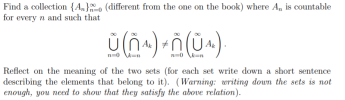 Find a collection Ano, (different from the one on the book) where An is countable for every n and such that 0(14) (04) # n=0 krn / n=0 krn Reflect on the meaning of the two sets (for each set write down a short sentence describing the elements that belong to it). (Warning: writing down the sets is not enough, you need to show that they satisfy the above relation).
Prove that the open balls (disks) in R^2 form a basis for the standard (product) topology.
Prove that the open balls (disks) in R^2 form a basis for the standard (product) topology.
Topology (b) Let S denote the subset of co consisting of sequences with rational entries of which at most finitely many are nonzero. (i) Show that S is dense in co with the sup norm. [Hint: Show that...
 Topology
(b) Let S denote the subset of co consisting of sequences with rational entries of which at most finitely many are nonzero. (i) Show that S is dense in co with the sup norm. [Hint: Show that for every r E co and every ε > 0, there exists y S such that llx-yI100 < ε.j (ii) Conclude that (co, ll . 114) is separable (only quote relevant results) (iii) Show that the closed unit ball in (a-II ·...
Topology
(b) Let S denote the subset of co consisting of sequences with rational entries of which at most finitely many are nonzero. (i) Show that S is dense in co with the sup norm. [Hint: Show that for every r E co and every ε > 0, there exists y S such that llx-yI100 < ε.j (ii) Conclude that (co, ll . 114) is separable (only quote relevant results) (iii) Show that the closed unit ball in (a-II ·...
9. Show that the set C N × a, b is countable by constructing a bijection...
 9. Show that the set C N × a, b is countable by constructing a bijection between N and C.
Topology b) Let S denote the subset of co consisting of sequences with rational entries of...
 Topology
b) Let S denote the subset of co consisting of sequences with rational entries of which at most finitely many are nonzero. (i) Show that S is dense in co with the sup norm. [Hint: Show that for every r E co and every e >0, there exists y E S such that llr- yllle (ii) Conclude that (co, l is separable (only quote relevant results) (ii) Show that the closed unit ball in (coIl lis not compact. [Hint:...
Topology
b) Let S denote the subset of co consisting of sequences with rational entries of which at most finitely many are nonzero. (i) Show that S is dense in co with the sup norm. [Hint: Show that for every r E co and every e >0, there exists y E S such that llr- yllle (ii) Conclude that (co, l is separable (only quote relevant results) (ii) Show that the closed unit ball in (coIl lis not compact. [Hint:...
Let X be a set and let T be the family of subsets U of X such that X\U (the complement of U) is at most countable, together with the empty set. a) Prove that T is a topology for X. b) Describe the con...
 Let X be a set and let T be the family of subsets U of X such
that X\U (the complement of U) is at most countable, together with
the empty set. a) Prove that T is a topology for X. b) Describe the
convergent sequences in X with respect to this topology. Prove that
if X is uncountable, then there is a subset S of X whose closure
contains points that are not limits of the sequences in S....
Let X be a set and let T be the family of subsets U of X such
that X\U (the complement of U) is at most countable, together with
the empty set. a) Prove that T is a topology for X. b) Describe the
convergent sequences in X with respect to this topology. Prove that
if X is uncountable, then there is a subset S of X whose closure
contains points that are not limits of the sequences in S....
 1. Show that if A and B are countable sets, then AUB is countable. 2. Show that if An are finite sets indexed by positive integers, then Un An is countable. 3. Show that if A and B are countable sets, then A x B is countable. 4. Show that any open set in R is a countable union of open intervals. 5. Show that any function on R can have at most countable many local maximals. Us
 please explain in detail, for each part, especially for parts
(g)-(i).
*Here is the information about the basis for (h) and (i), it is
the basis that generates the vertical interval topology on R^2:
-5 JO1 Sewn 2.1 (2.1. Determine Int(A) and Cl(A) in each case. (a) A = (0, 1] in the lower limit topology on R. (b) A = {a} in X = {a,b,c} with topology {X, Ø, {a}, {a, b}}. A = {a,c} in X = {a,b,c}...
please explain in detail, for each part, especially for parts
(g)-(i).
*Here is the information about the basis for (h) and (i), it is
the basis that generates the vertical interval topology on R^2:
-5 JO1 Sewn 2.1 (2.1. Determine Int(A) and Cl(A) in each case. (a) A = (0, 1] in the lower limit topology on R. (b) A = {a} in X = {a,b,c} with topology {X, Ø, {a}, {a, b}}. A = {a,c} in X = {a,b,c}...
 Show:
Let A1, A2, ... be a infinitely countable collection of events, then P lim P (UA m+00 i=1
Show:
Let A1, A2, ... be a infinitely countable collection of events, then P lim P (UA m+00 i=1
 Exercise 5.5 please
Exercise 5.5: Show that the collection of all half-open intervals [a, b) where a, bER form a base for the half-open interval topology for R from Theorem 2.20. Theorem 2.20: Let H ={v I v=ø or for each xeV there is a half-open interval interval topology.
Exercise 5.5: Show that the collection of all half-open intervals [a, b) where a, bER form a base for the half-open interval topology for R from Theorem 2.20. Theorem 2.20: Let...
Exercise 5.5 please
Exercise 5.5: Show that the collection of all half-open intervals [a, b) where a, bER form a base for the half-open interval topology for R from Theorem 2.20. Theorem 2.20: Let H ={v I v=ø or for each xeV there is a half-open interval interval topology.
Exercise 5.5: Show that the collection of all half-open intervals [a, b) where a, bER form a base for the half-open interval topology for R from Theorem 2.20. Theorem 2.20: Let...
 Find a collection Ano, (different from the one on the book) where An is countable for every n and such that 0(14) (04) # n=0 krn / n=0 krn Reflect on the meaning of the two sets (for each set write down a short sentence describing the elements that belong to it). (Warning: writing down the sets is not enough, you need to show that they satisfy the above relation).
 Topology
(b) Let S denote the subset of co consisting of sequences with rational entries of which at most finitely many are nonzero. (i) Show that S is dense in co with the sup norm. [Hint: Show that for every r E co and every ε > 0, there exists y S such that llx-yI100 < ε.j (ii) Conclude that (co, ll . 114) is separable (only quote relevant results) (iii) Show that the closed unit ball in (a-II ·...
Topology
(b) Let S denote the subset of co consisting of sequences with rational entries of which at most finitely many are nonzero. (i) Show that S is dense in co with the sup norm. [Hint: Show that for every r E co and every ε > 0, there exists y S such that llx-yI100 < ε.j (ii) Conclude that (co, ll . 114) is separable (only quote relevant results) (iii) Show that the closed unit ball in (a-II ·...
 9. Show that the set C N × a, b is countable by constructing a bijection between N and C.
 Topology
b) Let S denote the subset of co consisting of sequences with rational entries of which at most finitely many are nonzero. (i) Show that S is dense in co with the sup norm. [Hint: Show that for every r E co and every e >0, there exists y E S such that llr- yllle (ii) Conclude that (co, l is separable (only quote relevant results) (ii) Show that the closed unit ball in (coIl lis not compact. [Hint:...
Topology
b) Let S denote the subset of co consisting of sequences with rational entries of which at most finitely many are nonzero. (i) Show that S is dense in co with the sup norm. [Hint: Show that for every r E co and every e >0, there exists y E S such that llr- yllle (ii) Conclude that (co, l is separable (only quote relevant results) (ii) Show that the closed unit ball in (coIl lis not compact. [Hint:...
 Let X be a set and let T be the family of subsets U of X such
that X\U (the complement of U) is at most countable, together with
the empty set. a) Prove that T is a topology for X. b) Describe the
convergent sequences in X with respect to this topology. Prove that
if X is uncountable, then there is a subset S of X whose closure
contains points that are not limits of the sequences in S....
Let X be a set and let T be the family of subsets U of X such
that X\U (the complement of U) is at most countable, together with
the empty set. a) Prove that T is a topology for X. b) Describe the
convergent sequences in X with respect to this topology. Prove that
if X is uncountable, then there is a subset S of X whose closure
contains points that are not limits of the sequences in S....
Most questions answered within 3 hours.
-
Where is the error in this code sequence?
String s1 = "Hello";
String s2 = "ello";...
asked 10 months ago -
Financial data for Joel de Paris, Inc., for last year
follow:
Joel de Paris, Inc.
Balance...
asked 10 months ago -
Consider this reaction:
Al2(SO4)3 (aq)+ BaCl3
(aq) Al2Cl6 (aq)- +
3BaSO4(s) . What is the...
asked 10 months ago -
Suppose that Savneet is considering increasing her
recent random sample from 20 car rentals to 40...
asked 10 months ago -
Trucks arrive at an unloading terminal at an average rate of 120
per hour.
Trucks arrive...
asked 10 months ago -
Why are methanol and ethanol completely soluble in water while
octanol is not very little soluble....
asked 10 months ago -
A facilities manager at a university reads in a research report
that the mean amount of...
asked 10 months ago -
When the CuSO4 is rehydrated by adding water to the anhydrous
compound, is this an endothermic...
asked 10 months ago -
A ray of sunlight is passing from diamond into crown glass; the
angle of incidence is...
asked 10 months ago -
A block of mass 0.249 kg is placed on top of a light, vertical
spring of...
asked 10 months ago -
how do the kidneys compensate in the presences of acidosis
a) trigger hyperventilate
b) reserve acid...
asked 10 months ago -
Question 501 pts
The rental rate of capital to the firm increases. Which of the
following...
asked 10 months ago