Explain how the peaks in NMR spectrum correspond to the structure of isopentyl acetate.
Explain how the peaks in NMR spectrum correspond to the structure of isopentyl acetate.

Homework Answers
The concept used in this problem is based on Nuclear magnetic resonance spectroscopy. The peaks in the spectrum are used to identify the structure of the compound.
First, identify the number of signals of isopentyl acetate. After that assign the values of the chemical shift to identified signals.
Principle of spectroscopy:
The principle of is that when the external magnetic field is applied, the energy is transferred from ground state to higher energy level and when the spin returns to ground state absorbed radiofrequency is emitted at the same frequency, that radiofrequency give the spectrum of the nucleus.
Chemical shift:
It is the difference between the resonance frequency of observed proton and tetramethylsilane . is used as a reference in spectroscopy. The chemical shift of is .
Spin multiplicity:
The formula to calculate spin multiplicity is , here is a number of hydrogens of neighboring carbon.
Interpretation of the spectrum:
• Firstly identify the different type of signals (protons).
• Look at the multiplicity, it tells the number of protons of neighboring carbon.
• Then see the position of the peaks, identify the chemical shift.
Some of the values of the chemical shift of are given as follows:
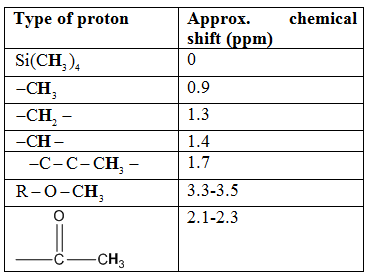
The structure of isopentyl acetate is as follows:
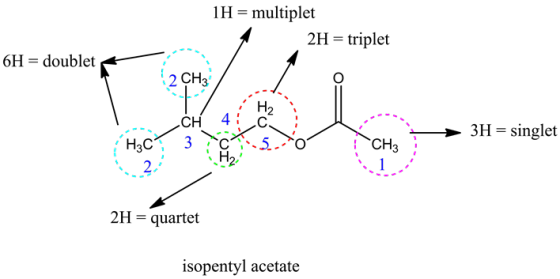
The peaks of corresponding to different protons of isopentyl acetate are as follows.
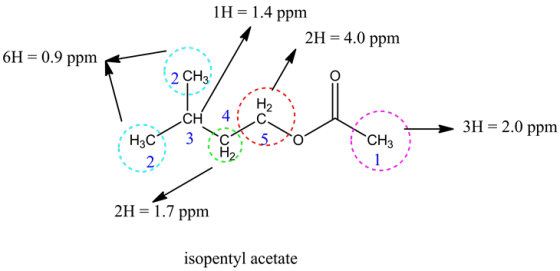
The carbon is directly attached to oxygen, so it is more deshielded. The value of the chemical shift of protons is upfield to . The carbon is directly attached to the carbonyl group, so it is also deshielded. The value of the chemical shift of protons is upfield to .
Ans:The peaks of corresponding to different protons of isopentyl acetate are as follows:
Add Answer to:
Explain how the peaks in NMR spectrum correspond to the
structure of isopentyl acetate.
Could anyone please assign the peaks for the 1HNMR of isopentyl acetate, and explain how you...
 Could anyone please assign the peaks for the 1HNMR of
isopentyl acetate, and explain how you can use this
1HNMR spectrum to characterize the product of a reaction
between acetic acid and isopentyl alcohol? Thank you so much for
the help!
F1 (IH) SI= 65 536 SF= 300.19 SP 6103.516 ppm]
Could anyone please assign the peaks for the 1HNMR of
isopentyl acetate, and explain how you can use this
1HNMR spectrum to characterize the product of a reaction
between acetic acid and isopentyl alcohol? Thank you so much for
the help!
F1 (IH) SI= 65 536 SF= 300.19 SP 6103.516 ppm]
please mark the peaks on this literature nmr spectra of isopentyl acetate. -List its splitting pattern in the peaks (sin...
 please mark the peaks on this literature nmr spectra
of isopentyl acetate.
-List its splitting pattern in the peaks (singlet,
doublet, multiplet, etc.
-please list the integration number of each peak as
well.
SDBS-13C NMRSDBS No. 1935CDS-05-880 CH₂4 0₂ isopentyl acetate 15.09 MHz 0.25 ml : 0.75 ml CDC13 80 60 40 20 0 120 160 140 200 180 CDS-05-880 100 ppm -- 0- -2- -3- ppm Int. Assign. 171.08 222 63.13 887 37.48 645 25.18 635 22.51 1000 20.96...
please mark the peaks on this literature nmr spectra
of isopentyl acetate.
-List its splitting pattern in the peaks (singlet,
doublet, multiplet, etc.
-please list the integration number of each peak as
well.
SDBS-13C NMRSDBS No. 1935CDS-05-880 CH₂4 0₂ isopentyl acetate 15.09 MHz 0.25 ml : 0.75 ml CDC13 80 60 40 20 0 120 160 140 200 180 CDS-05-880 100 ppm -- 0- -2- -3- ppm Int. Assign. 171.08 222 63.13 887 37.48 645 25.18 635 22.51 1000 20.96...
Label 1H NMR peaks for Isoamyl acetate? Here is the 1H NMR spectrum I have for...
 Label 1H NMR peaks for Isoamyl acetate?
Here is the 1H NMR spectrum I have for isoamyl acetate. The
question says to clearly assign all peaks. Any help would be
greatly appreciated. Thanks!
Label 1H NMR peaks for Isoamyl acetate?
Here is the 1H NMR spectrum I have for isoamyl acetate. The
question says to clearly assign all peaks. Any help would be
greatly appreciated. Thanks!
Isopentyl Acetate (Banana Oil)- IR Spectrum I need help in assigning the following IR peaks: alkane...
 Isopentyl Acetate (Banana Oil)- IR Spectrum
I need help in assigning the following IR peaks: alkane C–H
stretch, C=O stretch, alkane CH2 bend and C–O stretch . Thanks.
Isopentyl Acetate (Banana Oil)- IR Spectrum
I need help in assigning the following IR peaks: alkane C–H
stretch, C=O stretch, alkane CH2 bend and C–O stretch . Thanks.
what is the structure from this NMR? how is it different from isopentyl acetate? 1.80 -...
 what is the structure from this NMR? how is it different from
isopentyl acetate?
1.80 - 4.105 2.5 2.0 -2.050 -1.700 1.539 < 1.5 1.522 -- -0.926 0.5 0.0 ppm
what is the structure from this NMR? how is it different from
isopentyl acetate?
1.80 - 4.105 2.5 2.0 -2.050 -1.700 1.539 < 1.5 1.522 -- -0.926 0.5 0.0 ppm
IR spectrum of isopentyl acetate and impure isopentyl acetate - please label frequencies with bon...
 IR spectrum of isopentyl acetate and impure isopentyl
acetate - please label frequencies with bond-vibration
responsible
IR spectrum of isopentyl acetate 110 100 58.96 1743.28 2871.64 1239.55 146791 2000 3000 4000 Wavenumbers (cm-1) cetic acia) R pectrum af mpure kopenty oeta(coa E 15 10 146602 \ 124757 1247.57 3222.33 2960.19 -10 1000 2000 3000 4000 Wavenumbers (cm-1)
IR spectrum of isopentyl acetate 110 100 58.96 1743.28 2871.64 1239.55 146791 2000 3000 4000 Wavenumbers (cm-1) cetic acia) R pectrum af mpure...
IR spectrum of isopentyl acetate and impure isopentyl
acetate - please label frequencies with bond-vibration
responsible
IR spectrum of isopentyl acetate 110 100 58.96 1743.28 2871.64 1239.55 146791 2000 3000 4000 Wavenumbers (cm-1) cetic acia) R pectrum af mpure kopenty oeta(coa E 15 10 146602 \ 124757 1247.57 3222.33 2960.19 -10 1000 2000 3000 4000 Wavenumbers (cm-1)
IR spectrum of isopentyl acetate 110 100 58.96 1743.28 2871.64 1239.55 146791 2000 3000 4000 Wavenumbers (cm-1) cetic acia) R pectrum af mpure...
explain the questions very well. Thanks! the spectrum as to how they correspond to the structure...
 explain the questions very well. Thanks!
the spectrum as to how they correspond to the structure of the given compound. Br 2. IR spectroscopy: Consider the following compound, Circle the IR spectrum that best corresponds to this compound. Label at least two pieces of information the in the spectrum as to how they correspond to the structure of the given compound.
explain the questions very well. Thanks!
the spectrum as to how they correspond to the structure of the given compound. Br 2. IR spectroscopy: Consider the following compound, Circle the IR spectrum that best corresponds to this compound. Label at least two pieces of information the in the spectrum as to how they correspond to the structure of the given compound.
5) Assign the peaks in the 'H NMR spectrum of your product. Draw your structure on...
 5) Assign the peaks in the 'H NMR spectrum of your product. Draw your structure on the NMR spectrum and label each set of inequivalent protons. Use these labels in assigning the peaks. In some cases the aromatic peaks may overlap, so it is OK to assign groups of protons to a series of overlapping peaks if necessary. Try to be as specific as possible in your assignment, though. Discuss in detail how the NMR spectrum is only consistent with...
1) Predict and assign in the major peaks in the IR spectrum of a) n-propyl acetate,...
1) Predict and assign in the major peaks in the IR spectrum of a) n-propyl acetate, CH3COOCH2CH2CH3 and b) 2-methyl-1-propyl acetate, CH3COOCH2CH(CH3)2 2) Predict and assign in the major peaks in the 1H NMR spectrum of a) n-propyl acetate, CH3COOCH2CH2CH3 and b) 2-methyl-1-propyl acetate, CH3COOCH2CH(CH3)2 3) Predict the appearance of the 1H NMR spectrum of a) methyl acetate, CH3COOCH3 and b) ethyl propionate, CH3CH2COOCH2CH3 Thank you!
Spectroscopy. The following NMRwas obtained froma student's final isopentyl acetate product, revealing a small amount of...
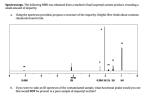 Spectroscopy. The following NMRwas obtained froma student's final isopentyl acetate product, revealing a small amount of impurity Using the spectrum provided, propose a structure of the impurity. Helpful Hint: think about common chemicals found in lab. a. S d S m m PPM 2H 0.48H 0.29H 3H 1H 2H 6H b. If you were to take an IR spectrum of the contaminated sample, what functional peaks would you see that would NOT be present in a pure sample of isopentyl...
 Could anyone please assign the peaks for the 1HNMR of
isopentyl acetate, and explain how you can use this
1HNMR spectrum to characterize the product of a reaction
between acetic acid and isopentyl alcohol? Thank you so much for
the help!
F1 (IH) SI= 65 536 SF= 300.19 SP 6103.516 ppm]
Could anyone please assign the peaks for the 1HNMR of
isopentyl acetate, and explain how you can use this
1HNMR spectrum to characterize the product of a reaction
between acetic acid and isopentyl alcohol? Thank you so much for
the help!
F1 (IH) SI= 65 536 SF= 300.19 SP 6103.516 ppm]
 please mark the peaks on this literature nmr spectra
of isopentyl acetate.
-List its splitting pattern in the peaks (singlet,
doublet, multiplet, etc.
-please list the integration number of each peak as
well.
SDBS-13C NMRSDBS No. 1935CDS-05-880 CH₂4 0₂ isopentyl acetate 15.09 MHz 0.25 ml : 0.75 ml CDC13 80 60 40 20 0 120 160 140 200 180 CDS-05-880 100 ppm -- 0- -2- -3- ppm Int. Assign. 171.08 222 63.13 887 37.48 645 25.18 635 22.51 1000 20.96...
please mark the peaks on this literature nmr spectra
of isopentyl acetate.
-List its splitting pattern in the peaks (singlet,
doublet, multiplet, etc.
-please list the integration number of each peak as
well.
SDBS-13C NMRSDBS No. 1935CDS-05-880 CH₂4 0₂ isopentyl acetate 15.09 MHz 0.25 ml : 0.75 ml CDC13 80 60 40 20 0 120 160 140 200 180 CDS-05-880 100 ppm -- 0- -2- -3- ppm Int. Assign. 171.08 222 63.13 887 37.48 645 25.18 635 22.51 1000 20.96...
 Label 1H NMR peaks for Isoamyl acetate?
Here is the 1H NMR spectrum I have for isoamyl acetate. The
question says to clearly assign all peaks. Any help would be
greatly appreciated. Thanks!
Label 1H NMR peaks for Isoamyl acetate?
Here is the 1H NMR spectrum I have for isoamyl acetate. The
question says to clearly assign all peaks. Any help would be
greatly appreciated. Thanks!
 Isopentyl Acetate (Banana Oil)- IR Spectrum
I need help in assigning the following IR peaks: alkane C–H
stretch, C=O stretch, alkane CH2 bend and C–O stretch . Thanks.
Isopentyl Acetate (Banana Oil)- IR Spectrum
I need help in assigning the following IR peaks: alkane C–H
stretch, C=O stretch, alkane CH2 bend and C–O stretch . Thanks.
 what is the structure from this NMR? how is it different from
isopentyl acetate?
1.80 - 4.105 2.5 2.0 -2.050 -1.700 1.539 < 1.5 1.522 -- -0.926 0.5 0.0 ppm
what is the structure from this NMR? how is it different from
isopentyl acetate?
1.80 - 4.105 2.5 2.0 -2.050 -1.700 1.539 < 1.5 1.522 -- -0.926 0.5 0.0 ppm
 IR spectrum of isopentyl acetate and impure isopentyl
acetate - please label frequencies with bond-vibration
responsible
IR spectrum of isopentyl acetate 110 100 58.96 1743.28 2871.64 1239.55 146791 2000 3000 4000 Wavenumbers (cm-1) cetic acia) R pectrum af mpure kopenty oeta(coa E 15 10 146602 \ 124757 1247.57 3222.33 2960.19 -10 1000 2000 3000 4000 Wavenumbers (cm-1)
IR spectrum of isopentyl acetate 110 100 58.96 1743.28 2871.64 1239.55 146791 2000 3000 4000 Wavenumbers (cm-1) cetic acia) R pectrum af mpure...
IR spectrum of isopentyl acetate and impure isopentyl
acetate - please label frequencies with bond-vibration
responsible
IR spectrum of isopentyl acetate 110 100 58.96 1743.28 2871.64 1239.55 146791 2000 3000 4000 Wavenumbers (cm-1) cetic acia) R pectrum af mpure kopenty oeta(coa E 15 10 146602 \ 124757 1247.57 3222.33 2960.19 -10 1000 2000 3000 4000 Wavenumbers (cm-1)
IR spectrum of isopentyl acetate 110 100 58.96 1743.28 2871.64 1239.55 146791 2000 3000 4000 Wavenumbers (cm-1) cetic acia) R pectrum af mpure...
 explain the questions very well. Thanks!
the spectrum as to how they correspond to the structure of the given compound. Br 2. IR spectroscopy: Consider the following compound, Circle the IR spectrum that best corresponds to this compound. Label at least two pieces of information the in the spectrum as to how they correspond to the structure of the given compound.
explain the questions very well. Thanks!
the spectrum as to how they correspond to the structure of the given compound. Br 2. IR spectroscopy: Consider the following compound, Circle the IR spectrum that best corresponds to this compound. Label at least two pieces of information the in the spectrum as to how they correspond to the structure of the given compound.
 5) Assign the peaks in the 'H NMR spectrum of your product. Draw your structure on the NMR spectrum and label each set of inequivalent protons. Use these labels in assigning the peaks. In some cases the aromatic peaks may overlap, so it is OK to assign groups of protons to a series of overlapping peaks if necessary. Try to be as specific as possible in your assignment, though. Discuss in detail how the NMR spectrum is only consistent with...
 Spectroscopy. The following NMRwas obtained froma student's final isopentyl acetate product, revealing a small amount of impurity Using the spectrum provided, propose a structure of the impurity. Helpful Hint: think about common chemicals found in lab. a. S d S m m PPM 2H 0.48H 0.29H 3H 1H 2H 6H b. If you were to take an IR spectrum of the contaminated sample, what functional peaks would you see that would NOT be present in a pure sample of isopentyl...
Most questions answered within 3 hours.
-
Where is the error in this code sequence?
String s1 = "Hello";
String s2 = "ello";...
asked 10 months ago -
Financial data for Joel de Paris, Inc., for last year
follow:
Joel de Paris, Inc.
Balance...
asked 10 months ago -
Consider this reaction:
Al2(SO4)3 (aq)+ BaCl3
(aq) Al2Cl6 (aq)- +
3BaSO4(s) . What is the...
asked 10 months ago -
Suppose that Savneet is considering increasing her
recent random sample from 20 car rentals to 40...
asked 10 months ago -
Trucks arrive at an unloading terminal at an average rate of 120
per hour.
Trucks arrive...
asked 10 months ago -
Why are methanol and ethanol completely soluble in water while
octanol is not very little soluble....
asked 10 months ago -
A facilities manager at a university reads in a research report
that the mean amount of...
asked 10 months ago -
When the CuSO4 is rehydrated by adding water to the anhydrous
compound, is this an endothermic...
asked 10 months ago -
A ray of sunlight is passing from diamond into crown glass; the
angle of incidence is...
asked 10 months ago -
A block of mass 0.249 kg is placed on top of a light, vertical
spring of...
asked 10 months ago -
how do the kidneys compensate in the presences of acidosis
a) trigger hyperventilate
b) reserve acid...
asked 10 months ago -
Question 501 pts
The rental rate of capital to the firm increases. Which of the
following...
asked 10 months ago