
Homework Answers
![Solution- write the equation for the entoropy change as follows: asen[Comch)- ]. - Here, - as is entropy change, cp is heat c](http://img.homeworklib.com/questions/c6ca0060-9e29-11eb-9fff-6b4d348c9b91.png?x-oss-process=image/resize,w_560)
![Woney - n RT ** 7 (495)*-*] -6 Y-1 Herre, Woren is work done for reversible process. whese, Y = Cp P osts 7 78 79 SR12 - 1.4](http://img.homeworklib.com/questions/c8dfc0f0-9e29-11eb-a004-ffcbcbbc8b90.png?x-oss-process=image/resize,w_560)
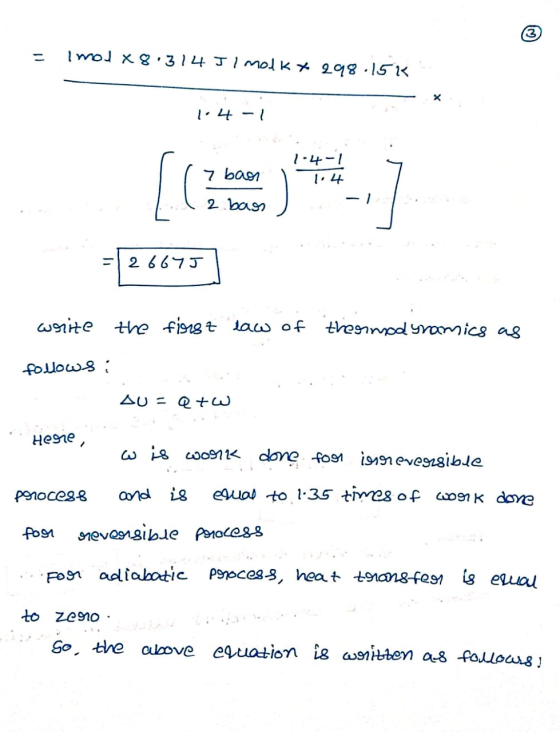
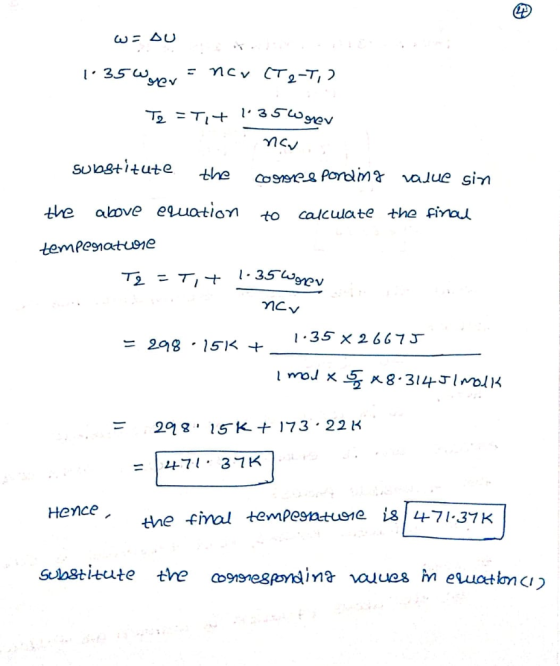
![to calculate the entropy change as follows: OS - NR -19 ***** [2m(7) -(52] = imod C8313 / maiK> [ 33 km/ 41137* )- 2981K = (8](http://img.homeworklib.com/questions/cb2d05e0-9e29-11eb-b70a-6fd2e108f800.png?x-oss-process=image/resize,w_560)
Add Answer to:
2. One mole of an ideal gas, CP - (7/2)R and CV - (5/2)R, is compressed...
Two mole of ideal gas, is compressed adiabatically in a piston/cylinder device from 2 bar and...
Two mole of ideal gas, is compressed adiabatically in a piston/cylinder device from 2 bar and 25oC to 7 bar. The process is irreversible and requires 25% more work than a reversible, adiabatic compression from the same initial state to the same final pressure. What is the entropy change of the gas? Assume Cv=(5/2)R in this calculation.
**PLEASE ANSWER ALL SUB-QUESTIONS AND EXPLAIN STEP BY STEP. THANK YOU!** QUESTION 6 One mole of an ideal gas is compres...
 **PLEASE ANSWER ALL SUB-QUESTIONS AND EXPLAIN STEP BY STEP.
THANK YOU!**
QUESTION 6 One mole of an ideal gas is compressed isothermally but irreversibly at 130 oC from 2.5 bar to 6.5 bar in a piston/cylinder device. The work required is 30 % greater than the work of reversible, isothermal compression. The heat transferred from the gas during compression flows to a heat reservoir at 25 °C. Calculate the entropy changes of the gas, the heat reservoir, and AStotal
QUESTION...
**PLEASE ANSWER ALL SUB-QUESTIONS AND EXPLAIN STEP BY STEP.
THANK YOU!**
QUESTION 6 One mole of an ideal gas is compressed isothermally but irreversibly at 130 oC from 2.5 bar to 6.5 bar in a piston/cylinder device. The work required is 30 % greater than the work of reversible, isothermal compression. The heat transferred from the gas during compression flows to a heat reservoir at 25 °C. Calculate the entropy changes of the gas, the heat reservoir, and AStotal
QUESTION...
One mole of an ideal gas with CP = (7/2)R and CV = (5/2)R expands from...
One mole of an ideal gas with CP = (7/2)R and CV = (5/2)R expands from P1 = 8 bar and T1 = 630 K to P2 = 1 bar. Take the value of R as 8.314 J·mol-1·k-1. At constant volume (assume mechanical reversibility), find the value of W, Q, ΔU, and ΔH? rt.)
I. (30 pts.) One mole of an ideal gas with constant heat capacities and ? 5/3...
 I. (30 pts.) One mole of an ideal gas with constant heat capacities and ? 5/3 is compressed adiabatically in a piston-cylinder device from T1-300 K, pi = 1 bar to p2 = 10 bar at a constant external pressure Pext"- P2 -10 bar. Calculate the final temperature, T2, and W, Q. AU, AH for this process. 2. (20 pts.) Repeat problem 1 for an adiabatic and reversible compression. 3. (20 pts.) A rigid, insulated tank is divided into two...
**PLEASE ANSWER ALL SUB-QUESTIONS AND EXPLAIN STEP BY STEP. THANK YOU!** QUESTION 6 One mole of...
 **PLEASE ANSWER ALL SUB-QUESTIONS AND EXPLAIN STEP BY STEP.
THANK YOU!**
QUESTION 6 One mole of an ideal gas is compressed isothermally but irreversibly at 130 oC from 2.5 bar to 6.5 bar in a piston/cylinder device. The work required is 30 % greater than the work of reversible, isothermal compression. The heat transferred from the gas during compression flows to a heat reservoir at 25 °C. Calculate the entropy changes of the gas, the heat reservoir, and AStotal
**PLEASE ANSWER ALL SUB-QUESTIONS AND EXPLAIN STEP BY STEP.
THANK YOU!**
QUESTION 6 One mole of an ideal gas is compressed isothermally but irreversibly at 130 oC from 2.5 bar to 6.5 bar in a piston/cylinder device. The work required is 30 % greater than the work of reversible, isothermal compression. The heat transferred from the gas during compression flows to a heat reservoir at 25 °C. Calculate the entropy changes of the gas, the heat reservoir, and AStotal
Problem 6.030 SI Air is compressed adiabatically in a piston-cylinder assembly from 1 bar, 300 K...
 Problem 6.030 SI Air is compressed adiabatically in a piston-cylinder assembly from 1 bar, 300 K to 4 bar, 600 K. The air can be modeled as an ideal gas and kinetic and potential energy effects are negligible. Determine the amount of entropy produced, in kJ/K per kg of air, for the compression. What is the minimum theoretical work input, in kj per kg of air, for an adiabatic compression from the given initial state to a final pressure of...
One mole of ideal diatmic gas with Cv,m= 2.5 R at 27 C and .100 MPA...
One mole of ideal diatmic gas with Cv,m= 2.5 R at 27 C and .100 MPA is compressed adiabatically and reversibly to a final pressure of 1.00 MPa. Calculate the final temp, q,w, Delta U, and Delta H, and Delta S for the process.
Question 2 One mole of an ideal gas, initially at 30 C and 1 bar is...
 Question 2 One mole of an ideal gas, initially at 30 C and 1 bar is changed to 130 °C and 10 bar by using two different mechanically reversible processes: 2.1 The gas is first heated at constant pressure until its temperature is 130 °C and then compressed isothermally to 10 bar. 2.2 The gas is first compressed isothermally to 10 bar and then heated at constant pressure to 13°C Calculate Q, W, AU, and AH for each case. Take...
Consider a reversible adiabetic compression of an ideal gas with CV,m = 3R/2 and CP,m =...
Consider a reversible adiabetic compression of an ideal gas with CV,m = 3R/2 and CP,m = 5R/2. 3.0 mol of this ideal gas with a volume of 30.0 L changes from an initial temperature of 300 K to a final temperature of 600 K. For this process, compute the final volume.
(3). A sample of 1.00 mol ideal gas molecules with Cp, m = 7/2 R is...
(3). A sample of 1.00 mol ideal gas molecules with Cp, m = 7/2 R is initially at p = 1.00 bar and V = 22.44 L and then put thought the following cycle in reversible processes: (a) constant-pressure expansion to twice its initial volume, (b) constant-volume cooling to its initial temperature, (c) isothermal-compression back to 1.00 bar. Calculate q, w, ΔU, ΔH, ΔS for each process and for the whole cycle. (20 pts)
 **PLEASE ANSWER ALL SUB-QUESTIONS AND EXPLAIN STEP BY STEP.
THANK YOU!**
QUESTION 6 One mole of an ideal gas is compressed isothermally but irreversibly at 130 oC from 2.5 bar to 6.5 bar in a piston/cylinder device. The work required is 30 % greater than the work of reversible, isothermal compression. The heat transferred from the gas during compression flows to a heat reservoir at 25 °C. Calculate the entropy changes of the gas, the heat reservoir, and AStotal
QUESTION...
**PLEASE ANSWER ALL SUB-QUESTIONS AND EXPLAIN STEP BY STEP.
THANK YOU!**
QUESTION 6 One mole of an ideal gas is compressed isothermally but irreversibly at 130 oC from 2.5 bar to 6.5 bar in a piston/cylinder device. The work required is 30 % greater than the work of reversible, isothermal compression. The heat transferred from the gas during compression flows to a heat reservoir at 25 °C. Calculate the entropy changes of the gas, the heat reservoir, and AStotal
QUESTION...
 I. (30 pts.) One mole of an ideal gas with constant heat capacities and ? 5/3 is compressed adiabatically in a piston-cylinder device from T1-300 K, pi = 1 bar to p2 = 10 bar at a constant external pressure Pext"- P2 -10 bar. Calculate the final temperature, T2, and W, Q. AU, AH for this process. 2. (20 pts.) Repeat problem 1 for an adiabatic and reversible compression. 3. (20 pts.) A rigid, insulated tank is divided into two...
 **PLEASE ANSWER ALL SUB-QUESTIONS AND EXPLAIN STEP BY STEP.
THANK YOU!**
QUESTION 6 One mole of an ideal gas is compressed isothermally but irreversibly at 130 oC from 2.5 bar to 6.5 bar in a piston/cylinder device. The work required is 30 % greater than the work of reversible, isothermal compression. The heat transferred from the gas during compression flows to a heat reservoir at 25 °C. Calculate the entropy changes of the gas, the heat reservoir, and AStotal
**PLEASE ANSWER ALL SUB-QUESTIONS AND EXPLAIN STEP BY STEP.
THANK YOU!**
QUESTION 6 One mole of an ideal gas is compressed isothermally but irreversibly at 130 oC from 2.5 bar to 6.5 bar in a piston/cylinder device. The work required is 30 % greater than the work of reversible, isothermal compression. The heat transferred from the gas during compression flows to a heat reservoir at 25 °C. Calculate the entropy changes of the gas, the heat reservoir, and AStotal
 Problem 6.030 SI Air is compressed adiabatically in a piston-cylinder assembly from 1 bar, 300 K to 4 bar, 600 K. The air can be modeled as an ideal gas and kinetic and potential energy effects are negligible. Determine the amount of entropy produced, in kJ/K per kg of air, for the compression. What is the minimum theoretical work input, in kj per kg of air, for an adiabatic compression from the given initial state to a final pressure of...
 Question 2 One mole of an ideal gas, initially at 30 C and 1 bar is changed to 130 °C and 10 bar by using two different mechanically reversible processes: 2.1 The gas is first heated at constant pressure until its temperature is 130 °C and then compressed isothermally to 10 bar. 2.2 The gas is first compressed isothermally to 10 bar and then heated at constant pressure to 13°C Calculate Q, W, AU, and AH for each case. Take...
Most questions answered within 3 hours.
-
Where is the error in this code sequence?
String s1 = "Hello";
String s2 = "ello";...
asked 11 months ago -
Financial data for Joel de Paris, Inc., for last year
follow:
Joel de Paris, Inc.
Balance...
asked 11 months ago -
Consider this reaction:
Al2(SO4)3 (aq)+ BaCl3
(aq) Al2Cl6 (aq)- +
3BaSO4(s) . What is the...
asked 11 months ago -
Suppose that Savneet is considering increasing her
recent random sample from 20 car rentals to 40...
asked 11 months ago -
Trucks arrive at an unloading terminal at an average rate of 120
per hour.
Trucks arrive...
asked 11 months ago -
Why are methanol and ethanol completely soluble in water while
octanol is not very little soluble....
asked 11 months ago -
A facilities manager at a university reads in a research report
that the mean amount of...
asked 11 months ago -
When the CuSO4 is rehydrated by adding water to the anhydrous
compound, is this an endothermic...
asked 11 months ago -
A ray of sunlight is passing from diamond into crown glass; the
angle of incidence is...
asked 11 months ago -
A block of mass 0.249 kg is placed on top of a light, vertical
spring of...
asked 11 months ago -
how do the kidneys compensate in the presences of acidosis
a) trigger hyperventilate
b) reserve acid...
asked 11 months ago -
Question 501 pts
The rental rate of capital to the firm increases. Which of the
following...
asked 11 months ago