vProblem: A possible model for a sprinter's velocity is given by Vx=a(1-e^(-bt))where t is in seconds,...
vProblem: A possible model for a sprinter's velocity is given by Vx=a(1-e^(-bt))where t is in seconds, vx is in m/s, and the constants a and b are characteristic of the sprinter. Assume Sprinter A runs the 100-meter dash following this prescription with a = 11.81 m/s and b = 0.6887 s-1. a) Find an expression for Sprinter A’s acceleration as a function of time t. b) Find an expression for the distance traveled by Sprinter A as w.r.t. time t. c) Plot Sprinter A’s position, velocity and acceleration as a function of time. d) What was Sprinter A’s acceleration at t = 0s? e) What was Sprinter A’s acceleration at t = 2.30s? f) How long does it take Sprinter A to complete the race? g) What is Sprinter A’s final velocity? RACETIME: Another sprinter (let’s call them Sprinter X) is set to challenge Sprinter A’s time in 100-meter dash. Sprinter X’s motion is modeled using a constant acceleration of 2.5 m/s2 for the entire race. h) How far from the start are the racers when the eventual winner takes the lead? i) Who completes the dash in the shortest time? By how much shorter? j) Plot the positon versus time curve for both racers together on single plot. k) Which is the more realistic model for a sprinter’s velocity and why?
Homework Answers
The time taken by the sprinter to finish the race can be only found by hit and trial as we cannot solve distance equation for t. We will have to guess the value of t and solve for S(t) and see if the distance is coming around 100 m .


Add Answer to:
vProblem: A possible model for a sprinter's velocity is given by
Vx=a(1-e^(-bt))where t is in seconds,...
l Review Careful measurements have been made of Olympic sprinters in the 100- meter dash. A...
 l Review Careful measurements have been made of Olympic sprinters in the 100- meter dash. A quite realistic model is that the sprinter's velocity is given by a(1-eR) where t is in s, vx is in m/s, and the constants a and b are characteristic of the sprinter. Sprinter Carl Lewis's run at the 1987 World Championships is modeled with a -11.81m/s and b -0.6887s , Part D Find an expression for the distance traveled at time t Express your...
l Review What was Lewis's acceleration at t 4.20 s Careful measurements have been made of...
 l Review What was Lewis's acceleration at t 4.20 s Careful measurements have been made of Olympic sprinters in the 100- Express your answer using four significant figures meter dash. A quite realistic model is that the sprinter's velocity is givern by a(1-e) where t is in s·L4 is in m/s, and the constants a and b are characteristic of the sprinter. Sprinter Carl Lewis's run at the 1987 World Championships is modeled with a 11.81m/s and b 0.6887s1 im...
Revieww Correct Careful measurements have been made of Olympic sprinters in the 100-meter dash. A quite...
 Revieww Correct Careful measurements have been made of Olympic sprinters in the 100-meter dash. A quite realistic model is that the sprinter's velocity is given by ▼ Part B where t is in s, vx is in m/s, and the constants a and b are characteristic of the sprinter Sprinter Carl Lewis's run at the 1987 World Championships is modeled with a 11.81m/s and b 0.6887s-1 What was Lewis's acceleration at t 2.10 s? Express your answer using four significant...
l Review What was Lewis's acceleration at t 4.20 s Careful measurements have been made of...
 l Review What was Lewis's acceleration at t 4.20 s Careful measurements have been made of Olympic sprinters in the 100- Express your answer using four significant figures meter dash. A quite realistic model is that the sprinter's velocity is givern by a(1-e) where t is in s·L4 is in m/s, and the constants a and b are characteristic of the sprinter. Sprinter Carl Lewis's run at the 1987 World Championships is modeled with a 11.81m/s and b 0.6887s1 im...
suppose the x-velocity vx of the car at any time t is given by the equation:...
suppose the x-velocity vx of the car at any time t is given by the equation: vx=10m/s + (1.50m/s) t*square* a) find the average x-acceleration in the time interval t1= 1 s and t2= 2.5 s b) derive an expression for the instantaneous acceleration as a function of time, and use it to find ax at t=1 s and t=2.5 s
Review Careful measurements have been made of Olympic sprinters in the 100-meter dash. A quite realistic...
 Review Careful measurements have been made of Olympic sprinters in the 100-meter dash. A quite realistic model is that the sprinter's velocity is given by Ua(1-e- where t is in s, Ux is in m/s, and the constants a and b are characteristic of the sprinter. Sprinter Carl Lewis's run at the 1987 World Championships is modeled with a - 11.81m/s and b- 0.68875 Part A What was Lewis's acceleration at t0s? Express your answer using four significant figures Submit...
1. The position of a particle is given by: x(t)= At^3 +Bt^-2 Where A = 1...
1. The position of a particle is given by: x(t)= At^3 +Bt^-2 Where A = 1 m / s3 and B = 1 m (s^2) a) Find the average speed between one second and four seconds. b) Find the instantaneous velocity at a time t. c) Find the instantaneous velocity at t = 0.5 s d) At what time does the speed become zero? e) Find the instantaneous acceleration at a time t. f) Find the acceleration at t =...
2.53 CALC The acceleration of a motorcycle is given by az(t) = At - Bt?, where...
 2.53 CALC The acceleration of a motorcycle is given by az(t) = At - Bt?, where A = 1.50 m/s and B = 0.120 m/s4. The motorcycle is at rest at the origin at time t = 0. (a) Find its position and velocity as functions of time (b) Calculate the maxi- mum velocity it attains.
A particle's velocity is given by the function vx (2.6 m/s)sin(Tt), where t is in s....
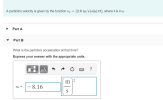 A particle's velocity is given by the function vx (2.6 m/s)sin(Tt), where t is in s. Part A Part B What is the particle's acceleration at that time? Express your answer with the appropriate units. Im | a,- |-8.16 az-
For the above particle, if at t=0s, vx=-4 m/s, what is the velocity at t=20s? With...
 For the above particle, if at t=0s, vx=-4 m/s, what is the
velocity at t=20s?
With the same condition as in previous problem, what is the
average velocity in time interval 0 to 20 s?
Yet still for the same setting, what is the average speed in
time interval 0 to 20 s?
The answer for the average speed is 9.5 m/s not 9.1 m/s like the
average velocity is and I can't firgure out why that is.
2 (1...
For the above particle, if at t=0s, vx=-4 m/s, what is the
velocity at t=20s?
With the same condition as in previous problem, what is the
average velocity in time interval 0 to 20 s?
Yet still for the same setting, what is the average speed in
time interval 0 to 20 s?
The answer for the average speed is 9.5 m/s not 9.1 m/s like the
average velocity is and I can't firgure out why that is.
2 (1...
 l Review Careful measurements have been made of Olympic sprinters in the 100- meter dash. A quite realistic model is that the sprinter's velocity is given by a(1-eR) where t is in s, vx is in m/s, and the constants a and b are characteristic of the sprinter. Sprinter Carl Lewis's run at the 1987 World Championships is modeled with a -11.81m/s and b -0.6887s , Part D Find an expression for the distance traveled at time t Express your...
 l Review What was Lewis's acceleration at t 4.20 s Careful measurements have been made of Olympic sprinters in the 100- Express your answer using four significant figures meter dash. A quite realistic model is that the sprinter's velocity is givern by a(1-e) where t is in s·L4 is in m/s, and the constants a and b are characteristic of the sprinter. Sprinter Carl Lewis's run at the 1987 World Championships is modeled with a 11.81m/s and b 0.6887s1 im...
 Revieww Correct Careful measurements have been made of Olympic sprinters in the 100-meter dash. A quite realistic model is that the sprinter's velocity is given by ▼ Part B where t is in s, vx is in m/s, and the constants a and b are characteristic of the sprinter Sprinter Carl Lewis's run at the 1987 World Championships is modeled with a 11.81m/s and b 0.6887s-1 What was Lewis's acceleration at t 2.10 s? Express your answer using four significant...
 l Review What was Lewis's acceleration at t 4.20 s Careful measurements have been made of Olympic sprinters in the 100- Express your answer using four significant figures meter dash. A quite realistic model is that the sprinter's velocity is givern by a(1-e) where t is in s·L4 is in m/s, and the constants a and b are characteristic of the sprinter. Sprinter Carl Lewis's run at the 1987 World Championships is modeled with a 11.81m/s and b 0.6887s1 im...
 Review Careful measurements have been made of Olympic sprinters in the 100-meter dash. A quite realistic model is that the sprinter's velocity is given by Ua(1-e- where t is in s, Ux is in m/s, and the constants a and b are characteristic of the sprinter. Sprinter Carl Lewis's run at the 1987 World Championships is modeled with a - 11.81m/s and b- 0.68875 Part A What was Lewis's acceleration at t0s? Express your answer using four significant figures Submit...
 2.53 CALC The acceleration of a motorcycle is given by az(t) = At - Bt?, where A = 1.50 m/s and B = 0.120 m/s4. The motorcycle is at rest at the origin at time t = 0. (a) Find its position and velocity as functions of time (b) Calculate the maxi- mum velocity it attains.
 A particle's velocity is given by the function vx (2.6 m/s)sin(Tt), where t is in s. Part A Part B What is the particle's acceleration at that time? Express your answer with the appropriate units. Im | a,- |-8.16 az-
 For the above particle, if at t=0s, vx=-4 m/s, what is the
velocity at t=20s?
With the same condition as in previous problem, what is the
average velocity in time interval 0 to 20 s?
Yet still for the same setting, what is the average speed in
time interval 0 to 20 s?
The answer for the average speed is 9.5 m/s not 9.1 m/s like the
average velocity is and I can't firgure out why that is.
2 (1...
For the above particle, if at t=0s, vx=-4 m/s, what is the
velocity at t=20s?
With the same condition as in previous problem, what is the
average velocity in time interval 0 to 20 s?
Yet still for the same setting, what is the average speed in
time interval 0 to 20 s?
The answer for the average speed is 9.5 m/s not 9.1 m/s like the
average velocity is and I can't firgure out why that is.
2 (1...
Most questions answered within 3 hours.
-
Where is the error in this code sequence?
String s1 = "Hello";
String s2 = "ello";...
asked 10 months ago -
Financial data for Joel de Paris, Inc., for last year
follow:
Joel de Paris, Inc.
Balance...
asked 10 months ago -
Consider this reaction:
Al2(SO4)3 (aq)+ BaCl3
(aq) Al2Cl6 (aq)- +
3BaSO4(s) . What is the...
asked 10 months ago -
Suppose that Savneet is considering increasing her
recent random sample from 20 car rentals to 40...
asked 10 months ago -
Trucks arrive at an unloading terminal at an average rate of 120
per hour.
Trucks arrive...
asked 10 months ago -
Why are methanol and ethanol completely soluble in water while
octanol is not very little soluble....
asked 10 months ago -
A facilities manager at a university reads in a research report
that the mean amount of...
asked 10 months ago -
When the CuSO4 is rehydrated by adding water to the anhydrous
compound, is this an endothermic...
asked 10 months ago -
A ray of sunlight is passing from diamond into crown glass; the
angle of incidence is...
asked 10 months ago -
A block of mass 0.249 kg is placed on top of a light, vertical
spring of...
asked 10 months ago -
how do the kidneys compensate in the presences of acidosis
a) trigger hyperventilate
b) reserve acid...
asked 10 months ago -
Question 501 pts
The rental rate of capital to the firm increases. Which of the
following...
asked 10 months ago