
Homework Answers
Add Answer to:
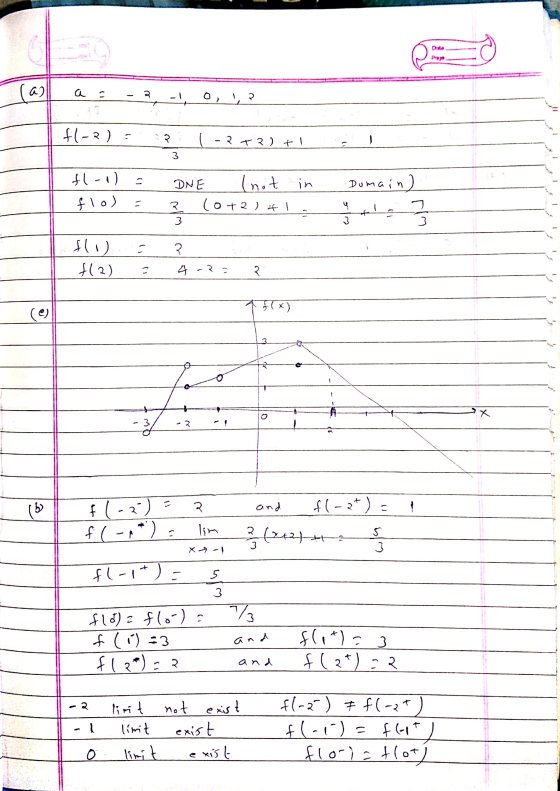
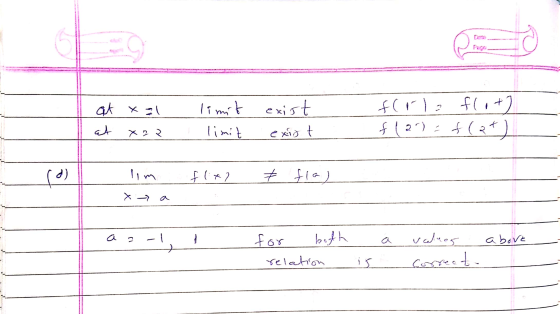
1. Suppose the a function g(x) is defined according to the formula f(c) 3(x + 2)...
Suppose that the piecewise function J is defined by f(2)= {**** -1<<3 - 3x2 + 2x...
 Suppose that the piecewise function J is defined by f(2)= {**** -1<<3 - 3x2 + 2x + 23, 2> 3 Determine which of the following statements are true. Select the correct answer below: O f() is not continuous at I = 3 because it is not defined at I = 3. Of() is not continuous at 2 = 3 because lim f(x) does not exist. f() is not continuous at I = 3 because lim f() f(3). ->3 f(x) is...
9. Graph the function defined by f(x) = 2 x +1 -3. Parent function: f(x) =...
 9. Graph the function defined by f(x) = 2 x +1 -3. Parent function: f(x) = x 1. f(x) = 2x +1 -3 Shift the graph to the left 1 unit 2. f(x) = 2 x +1 -3 Apply a vertical stretch multiply the y-values by 2) 3. f(x) = 2x+1-3 Shift the graph downward 3 units. 10. Graph the function defined by = (x) = -V3- x. Parent function y = x
6) If lim f(x)=L and lim g(x)= M, then find: a) lim(/(x)+g(x)) b) lim 7) Sketch...
 6) If lim f(x)=L and lim g(x)= M, then find: a) lim(/(x)+g(x)) b) lim 7) Sketch one possible graph of a function that satisfies the conditions, f(2)=5 lim f(x)=1 lim f(x)=5 8) fx+8 if x 50 Let f be the function defined by: f(x)={x2-5 if x > 0 a) Find: lim f(x) b) Find: lim f(x) c) Find: lim f(x) 9) Find each of the following limits. band a) lim b) lim
(g) The function f is defined for all real numbers except -7 and 3 and has the following properti...
 (g) The function f is defined for all real numbers except -7 and 3 and has the following properties. i·f(-2)=1 10 AT 2010, Section 012 April 7, 2019 -20(x + 2) 3 1. vii, lim f(x)=-oo Sketch the graph of the function f, showing » The line tangent to f at the point (-2,1), intervals of increase and decrease. ● concavity, and » all asymptotes
(g) The function f is defined for all real numbers except -7 and 3 and...
(g) The function f is defined for all real numbers except -7 and 3 and has the following properties. i·f(-2)=1 10 AT 2010, Section 012 April 7, 2019 -20(x + 2) 3 1. vii, lim f(x)=-oo Sketch the graph of the function f, showing » The line tangent to f at the point (-2,1), intervals of increase and decrease. ● concavity, and » all asymptotes
(g) The function f is defined for all real numbers except -7 and 3 and...
1. Sketch a few of the level curves of the function f(x, y) = surface z...
 1. Sketch a few of the level curves of the function f(x, y) = surface z = y2 and then use these to graph the f (x, y) 2. Evaluate the following limits if they exist. If they don't, explain why not. (a lim (x,y)(0,0) + 4y2 x4-y4 (b lim (x,y)(0,0) x2 + y2 cos 2 y2) - 1 lim (c (z,y)(0,0 2ry (x, y)(0,0) Is the function f(x, y) continuous at (0,0)? 3 = (х, у) — (0,0) 2x2y...
Determine if the following piecewise defined function is differentiable at x = 0. x20 f(x) =...
 Determine if the following piecewise defined function is differentiable at x = 0. x20 f(x) = 4x-2, x2 + 4x-2, x<0 What is the right-hand derivative of the given function? f(0+h)-f(0) lim (Type an integer or a simplified fraction. I h h+0+
In each part of this problem, the function f is defined by the formula f(x) =...
 In each part of this problem, the function f is defined by the formula f(x) = V[x]. (Ⓡ) Pay close attention to the domain of the function in each part and consider the statement lim f(x) = v2. ( x2 Does statement (@) make sense for the given domain? If not, why not? If statement (%) does make sense, then either prove or disprove it directly from the ε-8 definition of a limit. (a) f :R → R. (b) f...
4 -2 2. The function f is defined on the closed interval [-4,9]. The graph of...
 4 -2 2. The function f is defined on the closed interval [-4,9]. The graph of f consists of a semicircle, a quarter circle, and three linear segments, as shown in the figure above. Let g be the function defined by g(x) = 3x + f(t) dt. (a) Find g(8) and g'(8). (b) Find the value of x in the closed interval (-4,9] at which g attains its maximum value. Justify your answer. (c) Find lim f'(x), or state that...
Suppose that the function f is defined, for all real numbers, as follows. f(x) = x-2...
 Suppose that the function f is defined, for all real numbers, as follows. f(x) = x-2 ifx#2 4 if x=2 Find f(-3), f(2), and f(5). s(-3) = 0 s(2) = 0 r(s) = 1 Suppose that the function g is defined, for all real numbers, as follows. if x -2 8(x)= 1-4 if x=-2 Find g(-5), g(-2), and g(4). $(-5) = 0 DO s(-2) = 1 8(4) = 1
Problem 2 Suppose C is a curve of length (, and f(x, y) is a continuous function that is defined on a region D that contains C and f(x,y) < M for all (x, y) E D. Show that f(x, y)ds 3 Me Hint: Use...
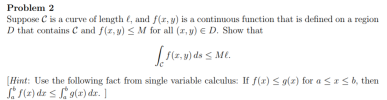 Problem 2 Suppose C is a curve of length (, and f(x, y) is a continuous function that is defined on a region D that contains C and f(x,y) < M for all (x, y) E D. Show that f(x, y)ds 3 Me Hint: Use the following fact from single variable calculus: If f(x) g(x) for a KrS b, then (x)dJ() dr.
Problem 2 Suppose C is a curve of length (, and f(x, y) is a continuous function that...
Problem 2 Suppose C is a curve of length (, and f(x, y) is a continuous function that is defined on a region D that contains C and f(x,y) < M for all (x, y) E D. Show that f(x, y)ds 3 Me Hint: Use the following fact from single variable calculus: If f(x) g(x) for a KrS b, then (x)dJ() dr.
Problem 2 Suppose C is a curve of length (, and f(x, y) is a continuous function that...
 Suppose that the piecewise function J is defined by f(2)= {**** -1<<3 - 3x2 + 2x + 23, 2> 3 Determine which of the following statements are true. Select the correct answer below: O f() is not continuous at I = 3 because it is not defined at I = 3. Of() is not continuous at 2 = 3 because lim f(x) does not exist. f() is not continuous at I = 3 because lim f() f(3). ->3 f(x) is...
 9. Graph the function defined by f(x) = 2 x +1 -3. Parent function: f(x) = x 1. f(x) = 2x +1 -3 Shift the graph to the left 1 unit 2. f(x) = 2 x +1 -3 Apply a vertical stretch multiply the y-values by 2) 3. f(x) = 2x+1-3 Shift the graph downward 3 units. 10. Graph the function defined by = (x) = -V3- x. Parent function y = x
 6) If lim f(x)=L and lim g(x)= M, then find: a) lim(/(x)+g(x)) b) lim 7) Sketch one possible graph of a function that satisfies the conditions, f(2)=5 lim f(x)=1 lim f(x)=5 8) fx+8 if x 50 Let f be the function defined by: f(x)={x2-5 if x > 0 a) Find: lim f(x) b) Find: lim f(x) c) Find: lim f(x) 9) Find each of the following limits. band a) lim b) lim
 (g) The function f is defined for all real numbers except -7 and 3 and has the following properties. i·f(-2)=1 10 AT 2010, Section 012 April 7, 2019 -20(x + 2) 3 1. vii, lim f(x)=-oo Sketch the graph of the function f, showing » The line tangent to f at the point (-2,1), intervals of increase and decrease. ● concavity, and » all asymptotes
(g) The function f is defined for all real numbers except -7 and 3 and...
(g) The function f is defined for all real numbers except -7 and 3 and has the following properties. i·f(-2)=1 10 AT 2010, Section 012 April 7, 2019 -20(x + 2) 3 1. vii, lim f(x)=-oo Sketch the graph of the function f, showing » The line tangent to f at the point (-2,1), intervals of increase and decrease. ● concavity, and » all asymptotes
(g) The function f is defined for all real numbers except -7 and 3 and...
 1. Sketch a few of the level curves of the function f(x, y) = surface z = y2 and then use these to graph the f (x, y) 2. Evaluate the following limits if they exist. If they don't, explain why not. (a lim (x,y)(0,0) + 4y2 x4-y4 (b lim (x,y)(0,0) x2 + y2 cos 2 y2) - 1 lim (c (z,y)(0,0 2ry (x, y)(0,0) Is the function f(x, y) continuous at (0,0)? 3 = (х, у) — (0,0) 2x2y...
 Determine if the following piecewise defined function is differentiable at x = 0. x20 f(x) = 4x-2, x2 + 4x-2, x<0 What is the right-hand derivative of the given function? f(0+h)-f(0) lim (Type an integer or a simplified fraction. I h h+0+
 In each part of this problem, the function f is defined by the formula f(x) = V[x]. (Ⓡ) Pay close attention to the domain of the function in each part and consider the statement lim f(x) = v2. ( x2 Does statement (@) make sense for the given domain? If not, why not? If statement (%) does make sense, then either prove or disprove it directly from the ε-8 definition of a limit. (a) f :R → R. (b) f...
 4 -2 2. The function f is defined on the closed interval [-4,9]. The graph of f consists of a semicircle, a quarter circle, and three linear segments, as shown in the figure above. Let g be the function defined by g(x) = 3x + f(t) dt. (a) Find g(8) and g'(8). (b) Find the value of x in the closed interval (-4,9] at which g attains its maximum value. Justify your answer. (c) Find lim f'(x), or state that...
 Suppose that the function f is defined, for all real numbers, as follows. f(x) = x-2 ifx#2 4 if x=2 Find f(-3), f(2), and f(5). s(-3) = 0 s(2) = 0 r(s) = 1 Suppose that the function g is defined, for all real numbers, as follows. if x -2 8(x)= 1-4 if x=-2 Find g(-5), g(-2), and g(4). $(-5) = 0 DO s(-2) = 1 8(4) = 1
 Problem 2 Suppose C is a curve of length (, and f(x, y) is a continuous function that is defined on a region D that contains C and f(x,y) < M for all (x, y) E D. Show that f(x, y)ds 3 Me Hint: Use the following fact from single variable calculus: If f(x) g(x) for a KrS b, then (x)dJ() dr.
Problem 2 Suppose C is a curve of length (, and f(x, y) is a continuous function that...
Problem 2 Suppose C is a curve of length (, and f(x, y) is a continuous function that is defined on a region D that contains C and f(x,y) < M for all (x, y) E D. Show that f(x, y)ds 3 Me Hint: Use the following fact from single variable calculus: If f(x) g(x) for a KrS b, then (x)dJ() dr.
Problem 2 Suppose C is a curve of length (, and f(x, y) is a continuous function that...
Most questions answered within 3 hours.
-
Where is the error in this code sequence?
String s1 = "Hello";
String s2 = "ello";...
asked 10 months ago -
Financial data for Joel de Paris, Inc., for last year
follow:
Joel de Paris, Inc.
Balance...
asked 10 months ago -
Consider this reaction:
Al2(SO4)3 (aq)+ BaCl3
(aq) Al2Cl6 (aq)- +
3BaSO4(s) . What is the...
asked 10 months ago -
Suppose that Savneet is considering increasing her
recent random sample from 20 car rentals to 40...
asked 10 months ago -
Trucks arrive at an unloading terminal at an average rate of 120
per hour.
Trucks arrive...
asked 10 months ago -
Why are methanol and ethanol completely soluble in water while
octanol is not very little soluble....
asked 10 months ago -
A facilities manager at a university reads in a research report
that the mean amount of...
asked 10 months ago -
When the CuSO4 is rehydrated by adding water to the anhydrous
compound, is this an endothermic...
asked 10 months ago -
A ray of sunlight is passing from diamond into crown glass; the
angle of incidence is...
asked 10 months ago -
A block of mass 0.249 kg is placed on top of a light, vertical
spring of...
asked 10 months ago -
how do the kidneys compensate in the presences of acidosis
a) trigger hyperventilate
b) reserve acid...
asked 10 months ago -
Question 501 pts
The rental rate of capital to the firm increases. Which of the
following...
asked 10 months ago