
Homework Answers
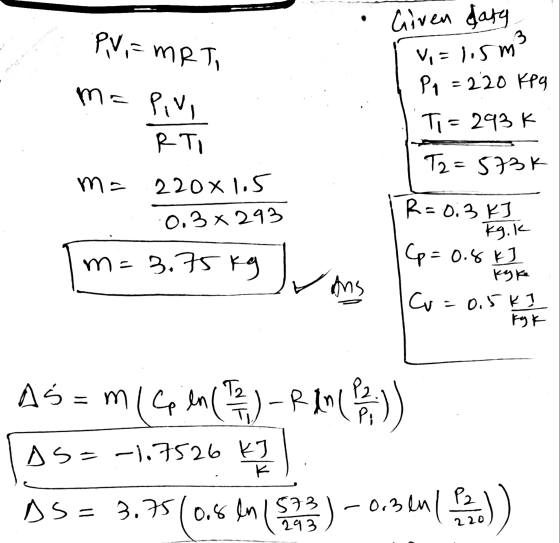
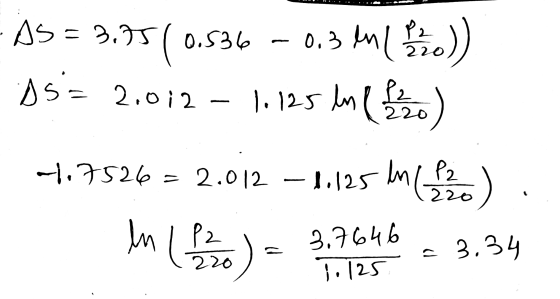
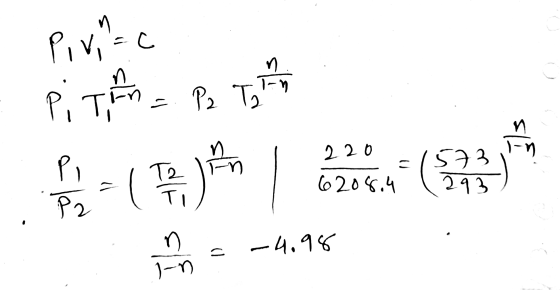
![na) - n 4.98 1-t=0.2 n=1.25 Work Transfer= MR (Ti-T2) n-l W = 2.75*0.3(293-5 -533) 1.25-1 W 1260 K Work Transfer is 1260k] An](http://img.homeworklib.com/questions/e7fa5e10-9ef4-11eb-9aed-4bb5c5348143.png?x-oss-process=image/resize,w_560)
I hope this solution would help you to clear your doubts.
If you have any queries regarding this solution Let me know in comment section I will definitely help you.
Good luck and Thanks ?
Add Answer to:
A gas in a cylinder piston system occupies V, - 15 mºat P. = 220 kPa...
Nitrogen in a piston cylinder device occupies 0.5 m3 at 100 kPa and 20 °C. It undergoes a compres...
 Nitrogen in a piston cylinder device occupies 0.5 m3 at 100 kPa and 20 °C. It undergoes a compression process (during which PV1.30-constant) to a final state where the temperature is 200 °C. The specific heats are assumed to be constant while Tsur - 15 C a) Prove that the gas, at state 1, can be treated as an ideal gas. b) Find the pressure and volume at state 2 c) Find the heat transfer, in kJ. d) Find the...
Check my work 6 10 A piston-cylinder device contains 0.63 kg of nitrogen gas at 140...
 Check my work 6 10 A piston-cylinder device contains 0.63 kg of nitrogen gas at 140 kPa and 37°C. The gas is now compressed slowly in a polytropic process during which PV1.3 = constant. The process ends when the volume is reduced by one-half. Determine the entropy change of nitrogen during this process. The gas constant of nitrogen is R = 0.2968 kJ/kg.K. The constant volume specific heat of nitrogen at room temperature is cy" 0.743 kJ/kg.K. (Round the final...
A piston-cylinder device contains 0.78 kg of nitrogen gas at 140 kPa and 37°C. The gas...
 A piston-cylinder device contains 0.78 kg of nitrogen gas at 140 kPa and 37°C. The gas is now compressed slowly in a polytropic process during which PV1.3 = constant. The process ends when the volume is reduced by one-half. Determine the entropy change of nitrogen during this process. The gas constant of nitrogen is R= 0.2968 kJ/kg-K. The constant volume specific heat of nitrogen at room temperature is Cr=0.743 kJ/kg-K. (Round the final answer to five decimal places.) The entropy...
Air in an insulated piston-cylinder assembly undergoes a compression process from 100 kPa, 300 K to...
 Air in an insulated piston-cylinder assembly undergoes a compression process from 100 kPa, 300 K to a second state at 600 K and 1 MPa. How much entropy is produced, in kJ/kgK? You can assume that the air is modeled as an ideal gas. Rair 0.287 kJ/kgK
A piston-cylinder device contains 0.63 kg of nitrogen gas at 140 kPa and 37°C. The gas...
 A piston-cylinder device contains 0.63 kg of nitrogen gas at 140 kPa and 37°C. The gas is now compressed slowly in a polytropic process during which PV1.3. constant. The process ends when the volume is reduced by one-halt. Determine the entropy change of nitrogen during this process. The gas constant of nitrogen is R-0.2968 kJ/kg K. The constant volume specific heat of nitrogen at room temperature is C -0.743 kJ/kg K. (Round the final answer to five decimal places.) The...
A piston-cylinder assembly initially contains 0.8 kg of air at 100 kPa and 300 K. It...
 A piston-cylinder assembly initially contains 0.8 kg of air at 100 kPa and 300 K. It is then compressed in a polytropic process PV3 = C to half the original volume. Assuming the ideal gas model for air and specific heat ratio is constant, k=1.4, determine (a) the final temperature, (b) work and heat transfer, each in kJ. R= 0.287 kJ/kg K. W, 82
Air goes through a polytropic process in a piston/cylinder setup. The polytropic index is n. The...
Air goes through a polytropic process in a piston/cylinder setup. The polytropic index is n. The process starts at P1 kPa, T1 oC, and ends with a pressure of P2 kPa. Answer Questions 6-8 about this process, considering the given information in Question 6. Assume air to be an ideal gas. Let, n=1.5 P1=2.3 MPa T1= 8.9 ×10² °C P2=2.1 ×10² kPa Cp = 1.004 kJ/kg-K, Cv = 0.717 kJ/kg-K, R = 0.287 kJ/kg-K Find the final temperature, in oC...
A piston-cylinder device containing carbon-dioxide gas undergoes an isobaric process from 103.4 kPa and 300 K...
A piston-cylinder device containing carbon-dioxide gas undergoes an isobaric process from 103.4 kPa and 300 K to 366 K. Determine the work and heat transfer associated with this process in kJ/kg.
Problem 1 A piston-cylinder system contains a paddle stirrer (a paddle with blades that can stir...
Problem 1 A piston-cylinder system contains a paddle stirrer (a paddle with blades that can stir the contents of the cylinder). The cylinder contains a gas that is initially at 150 kPa and occupies a volume of 0.196 m3 . The piston is unrestrained and has a cross-sectional area of 0.196 m2 . 20 kJ of electrical energy is supplied to the paddle stirrer, resulting in the piston moving up by 0.2 m. During this process, 5.27 kJ of heat...
Two kg of air as an ideal gas with constant properties expands inside a piston-cylinder device...
 Two kg of air as an ideal gas with constant properties expands inside a piston-cylinder device from an initial state where P. - 200 kPa. T-7°C to a state where P2 - 100 kPa and T2- 327° (Assume cp = 1.003 kJ/Kg.K.cv -0.716 kJ/kg.K. and R=0.287 kJ/Kg.K). 3. The change in internal energy, in kJ, between the specified states is most nearly: -483 460 - 166 -241 -322 120 . 231 144
 Nitrogen in a piston cylinder device occupies 0.5 m3 at 100 kPa and 20 °C. It undergoes a compression process (during which PV1.30-constant) to a final state where the temperature is 200 °C. The specific heats are assumed to be constant while Tsur - 15 C a) Prove that the gas, at state 1, can be treated as an ideal gas. b) Find the pressure and volume at state 2 c) Find the heat transfer, in kJ. d) Find the...
 Check my work 6 10 A piston-cylinder device contains 0.63 kg of nitrogen gas at 140 kPa and 37°C. The gas is now compressed slowly in a polytropic process during which PV1.3 = constant. The process ends when the volume is reduced by one-half. Determine the entropy change of nitrogen during this process. The gas constant of nitrogen is R = 0.2968 kJ/kg.K. The constant volume specific heat of nitrogen at room temperature is cy" 0.743 kJ/kg.K. (Round the final...
 A piston-cylinder device contains 0.78 kg of nitrogen gas at 140 kPa and 37°C. The gas is now compressed slowly in a polytropic process during which PV1.3 = constant. The process ends when the volume is reduced by one-half. Determine the entropy change of nitrogen during this process. The gas constant of nitrogen is R= 0.2968 kJ/kg-K. The constant volume specific heat of nitrogen at room temperature is Cr=0.743 kJ/kg-K. (Round the final answer to five decimal places.) The entropy...
 Air in an insulated piston-cylinder assembly undergoes a compression process from 100 kPa, 300 K to a second state at 600 K and 1 MPa. How much entropy is produced, in kJ/kgK? You can assume that the air is modeled as an ideal gas. Rair 0.287 kJ/kgK
 A piston-cylinder device contains 0.63 kg of nitrogen gas at 140 kPa and 37°C. The gas is now compressed slowly in a polytropic process during which PV1.3. constant. The process ends when the volume is reduced by one-halt. Determine the entropy change of nitrogen during this process. The gas constant of nitrogen is R-0.2968 kJ/kg K. The constant volume specific heat of nitrogen at room temperature is C -0.743 kJ/kg K. (Round the final answer to five decimal places.) The...
 A piston-cylinder assembly initially contains 0.8 kg of air at 100 kPa and 300 K. It is then compressed in a polytropic process PV3 = C to half the original volume. Assuming the ideal gas model for air and specific heat ratio is constant, k=1.4, determine (a) the final temperature, (b) work and heat transfer, each in kJ. R= 0.287 kJ/kg K. W, 82
 Two kg of air as an ideal gas with constant properties expands inside a piston-cylinder device from an initial state where P. - 200 kPa. T-7°C to a state where P2 - 100 kPa and T2- 327° (Assume cp = 1.003 kJ/Kg.K.cv -0.716 kJ/kg.K. and R=0.287 kJ/Kg.K). 3. The change in internal energy, in kJ, between the specified states is most nearly: -483 460 - 166 -241 -322 120 . 231 144
Most questions answered within 3 hours.
-
Where is the error in this code sequence?
String s1 = "Hello";
String s2 = "ello";...
asked 11 months ago -
Financial data for Joel de Paris, Inc., for last year
follow:
Joel de Paris, Inc.
Balance...
asked 11 months ago -
Consider this reaction:
Al2(SO4)3 (aq)+ BaCl3
(aq) Al2Cl6 (aq)- +
3BaSO4(s) . What is the...
asked 11 months ago -
Suppose that Savneet is considering increasing her
recent random sample from 20 car rentals to 40...
asked 11 months ago -
Trucks arrive at an unloading terminal at an average rate of 120
per hour.
Trucks arrive...
asked 11 months ago -
Why are methanol and ethanol completely soluble in water while
octanol is not very little soluble....
asked 11 months ago -
A facilities manager at a university reads in a research report
that the mean amount of...
asked 11 months ago -
When the CuSO4 is rehydrated by adding water to the anhydrous
compound, is this an endothermic...
asked 11 months ago -
A ray of sunlight is passing from diamond into crown glass; the
angle of incidence is...
asked 11 months ago -
A block of mass 0.249 kg is placed on top of a light, vertical
spring of...
asked 11 months ago -
how do the kidneys compensate in the presences of acidosis
a) trigger hyperventilate
b) reserve acid...
asked 11 months ago -
Question 501 pts
The rental rate of capital to the firm increases. Which of the
following...
asked 11 months ago