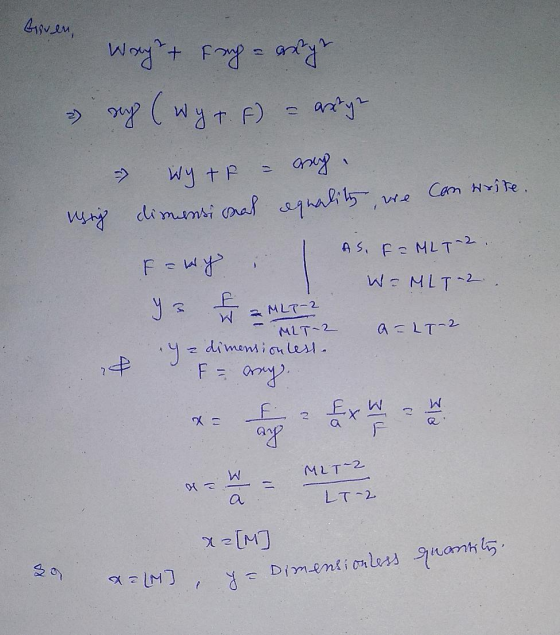
In the following homogeneous equation, determine the dimensions of x and y:
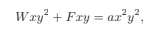
where W is the weight, F is the force, and a is the acceleration.
Homework Answers
Add Answer to:
In the following homogeneous equation, determine the dimensions
of x and y:
where W is the...
Exercise 1 Obtain expressions for the dimensions of the following quantities using both (1) the absolute...
 Exercise 1 Obtain expressions for the dimensions of the following quantities using both (1) the absolute dimensional system, and, (2) the gravitational dimensional system Here, x, x1, and x2 represent lengths , t is time, m is a constant mass, <a represents acceleration, g is a constant acceleration, and F represents force E is an unknown constant quantity drr2(t) dt C2 E mg 「x(t) dt Exercise 2 Given that F is a force. is a displacement. θ is an angle,...
1. Determine if the differential equation x^2y′=y(x+y) is homogeneous or Bernouilli or both. Give a solution...
1. Determine if the differential equation x^2y′=y(x+y) is homogeneous or Bernouilli or both. Give a solution using any method that applies. 2. Solve the differential equation y′= 2x(y+y^2) using the method of Bernouilli equation. Also give a solution for the same differential equation using the method of separable DE. 3. Consider the differential equation y′′= (y′)^2. It is has both x and y variable missing.Give solutions to the DE using the two different methods corresponding t ox-variable missing, and y-variable...
Consider the homogeneous linear third order equation A) xy'''−xy'' + y'−y = 0 Given...
Consider the homogeneous linear third order equation A) xy'''−xy'' + y'−y = 0 Given that y1(x) = e^x is a solution. Use the substitution y = u*y1 to reduce this third order equation to a homogeneous linear second order equation in the variable w = u'. You do not need to solve this second order equation. B.) xy''' + (1−x)y'' + xy'−y = 0. Given that y1(x) = x is a solution. Use the substitution y =...
8. Determine the appropriate form of the particular solution for the following non-homogeneous linear differential equation...
 8. Determine the appropriate form of the particular solution for the following non-homogeneous linear differential equation with constant coefficients. (8 Puan y(4) +9y" = 5+ &'(x-3) + 4sin (3x). none of these O Ar? + Bx cos(3x) + Cx sin(3x) + De' + Exet Ar + B + C sin(3x) + D cos(3x) + Exe" A + Bre-3x + Crer + De + Exet O Ar? + Bxe- + Crex + Det + Exe! A + B sin(3x) + Cxsin(3x)...
(8 pts) In this problem you will solve the non-homogeneous differential equation y" + 9y =...
 (8 pts) In this problem you will solve the non-homogeneous differential equation y" + 9y = sec (3x) (1) Let C and C2 be arbitrary constants. The general solution to the related homogeneous differential equation y" + 9y = 0 is the function yn (x) = C1 yı(2) + C2 y2(x) = C1 +C2 NOTE: The order in which you enter the answers is important; that is, Cif(x) + C2g(x) + C19(x) + C2 f(x). (2) The particular solution yp(x)...
4. Consider the homogeneous differential equation dy d y dy-y=0 dx3 + dx2 dx - y...
 4. Consider the homogeneous differential equation dy d y dy-y=0 dx3 + dx2 dx - y (a) Show that 01 (C) = e is a solution. (b) Show that 02 (2) = e-* is a solution. (c) Show that 03 (x) = xe-" is a solution. (d) Determine the general solution to this homogeneous differential equation. (e) Show that p (2) = xe" is a particular solution to the differential equation dy dy dy dx3 d.x2 - y = 4e*...
Solve both 3+4 please 3. Solve the exact equation. Solve the Homogeneous equation 4. yar+(y-x)dy = 0. 3. Solve the exact equation. Solve the Homogeneous equation 4. yar+(y-x)dy = 0.
 Solve both 3+4 please
3. Solve the exact equation. Solve the Homogeneous equation 4. yar+(y-x)dy = 0.
3. Solve the exact equation. Solve the Homogeneous equation 4. yar+(y-x)dy = 0.
Solve both 3+4 please
3. Solve the exact equation. Solve the Homogeneous equation 4. yar+(y-x)dy = 0.
3. Solve the exact equation. Solve the Homogeneous equation 4. yar+(y-x)dy = 0.
Given yı(x) = x4 satisfies the corresponding homogeneous equation of x+y" + 3xy' – 24y =...
 Given yı(x) = x4 satisfies the corresponding homogeneous equation of x+y" + 3xy' – 24y = 21x + 48, x > 0 Then the general solution to the non-homogeneous equation can be written in the form y(x) = Ax4 + Bx" + Yp. Use reduction of order to find the general solution in this form (your answer will involve A, B, and x) y(x) = Preview
(10) 2. Solve the homogeneous equation by making the substitution y = xv y' x +...
 (10) 2. Solve the homogeneous equation by making the substitution y = xv y' x + 2y 2x + y' > 0.
Use the method for solving homogeneous equations to solve the following differential equation. 9(x2 + y2)...
 Use the method for solving homogeneous equations to solve the following differential equation. 9(x2 + y2) dx + 4xy dy = 0 Ignoring lost solutions, if any, an implicit solution in the form F(x,y)=C is = C, where is an arbitrary constant (Type an expression using x and y as the variables.)
 Exercise 1 Obtain expressions for the dimensions of the following quantities using both (1) the absolute dimensional system, and, (2) the gravitational dimensional system Here, x, x1, and x2 represent lengths , t is time, m is a constant mass, <a represents acceleration, g is a constant acceleration, and F represents force E is an unknown constant quantity drr2(t) dt C2 E mg 「x(t) dt Exercise 2 Given that F is a force. is a displacement. θ is an angle,...
 8. Determine the appropriate form of the particular solution for the following non-homogeneous linear differential equation with constant coefficients. (8 Puan y(4) +9y" = 5+ &'(x-3) + 4sin (3x). none of these O Ar? + Bx cos(3x) + Cx sin(3x) + De' + Exet Ar + B + C sin(3x) + D cos(3x) + Exe" A + Bre-3x + Crer + De + Exet O Ar? + Bxe- + Crex + Det + Exe! A + B sin(3x) + Cxsin(3x)...
 (8 pts) In this problem you will solve the non-homogeneous differential equation y" + 9y = sec (3x) (1) Let C and C2 be arbitrary constants. The general solution to the related homogeneous differential equation y" + 9y = 0 is the function yn (x) = C1 yı(2) + C2 y2(x) = C1 +C2 NOTE: The order in which you enter the answers is important; that is, Cif(x) + C2g(x) + C19(x) + C2 f(x). (2) The particular solution yp(x)...
 4. Consider the homogeneous differential equation dy d y dy-y=0 dx3 + dx2 dx - y (a) Show that 01 (C) = e is a solution. (b) Show that 02 (2) = e-* is a solution. (c) Show that 03 (x) = xe-" is a solution. (d) Determine the general solution to this homogeneous differential equation. (e) Show that p (2) = xe" is a particular solution to the differential equation dy dy dy dx3 d.x2 - y = 4e*...
 Solve both 3+4 please
3. Solve the exact equation. Solve the Homogeneous equation 4. yar+(y-x)dy = 0.
3. Solve the exact equation. Solve the Homogeneous equation 4. yar+(y-x)dy = 0.
Solve both 3+4 please
3. Solve the exact equation. Solve the Homogeneous equation 4. yar+(y-x)dy = 0.
3. Solve the exact equation. Solve the Homogeneous equation 4. yar+(y-x)dy = 0.
 Given yı(x) = x4 satisfies the corresponding homogeneous equation of x+y" + 3xy' – 24y = 21x + 48, x > 0 Then the general solution to the non-homogeneous equation can be written in the form y(x) = Ax4 + Bx" + Yp. Use reduction of order to find the general solution in this form (your answer will involve A, B, and x) y(x) = Preview
 (10) 2. Solve the homogeneous equation by making the substitution y = xv y' x + 2y 2x + y' > 0.
 Use the method for solving homogeneous equations to solve the following differential equation. 9(x2 + y2) dx + 4xy dy = 0 Ignoring lost solutions, if any, an implicit solution in the form F(x,y)=C is = C, where is an arbitrary constant (Type an expression using x and y as the variables.)
Most questions answered within 3 hours.
-
Where is the error in this code sequence?
String s1 = "Hello";
String s2 = "ello";...
asked 10 months ago -
Financial data for Joel de Paris, Inc., for last year
follow:
Joel de Paris, Inc.
Balance...
asked 10 months ago -
Consider this reaction:
Al2(SO4)3 (aq)+ BaCl3
(aq) Al2Cl6 (aq)- +
3BaSO4(s) . What is the...
asked 10 months ago -
Suppose that Savneet is considering increasing her
recent random sample from 20 car rentals to 40...
asked 10 months ago -
Trucks arrive at an unloading terminal at an average rate of 120
per hour.
Trucks arrive...
asked 10 months ago -
Why are methanol and ethanol completely soluble in water while
octanol is not very little soluble....
asked 10 months ago -
A facilities manager at a university reads in a research report
that the mean amount of...
asked 10 months ago -
When the CuSO4 is rehydrated by adding water to the anhydrous
compound, is this an endothermic...
asked 10 months ago -
A ray of sunlight is passing from diamond into crown glass; the
angle of incidence is...
asked 10 months ago -
A block of mass 0.249 kg is placed on top of a light, vertical
spring of...
asked 10 months ago -
how do the kidneys compensate in the presences of acidosis
a) trigger hyperventilate
b) reserve acid...
asked 10 months ago -
Question 501 pts
The rental rate of capital to the firm increases. Which of the
following...
asked 10 months ago