
Homework Answers
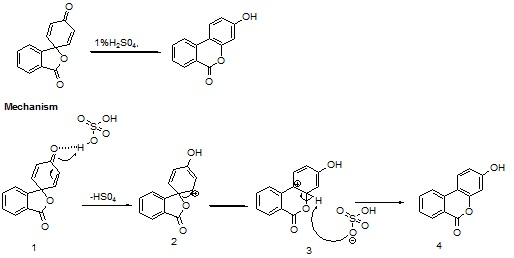
in this mechanism there is formation of six membered ring from 5 embered ring , this is becous steric reason 5-membered ring is less stable than the the six membere ring. hence molecule get to stable by releasing energy hence the process is exothrmic process.
in this 1 on reacting with 1% H2S04 the ketonic carbonyl get protonated which can accept the electron density from the ring and carbocation is generated on same tome nearest 0-C bond break and which can attack on the carbocation hence ring get expanded to 6 membered 2. Finaly the ring get aromatise 3 by accepting proton by HS04- ion .To obtained the product 4.
Add Answer to:
2. (5 pts) Provide a mechanism for this rearrangement. Include all intermediates. Show all electron pushing....
4. Provide a stepwise mechanism. Include all intermediates, resonance structures, and electron pushing arrows.(ALL OR NOTHING)...
 4. Provide a stepwise mechanism. Include all intermediates, resonance structures, and electron pushing arrows.(ALL OR NOTHING) HEC CH3 AICI D. HCI 5. (Provide the product(s) or reagent(s) for the following reactions. COM ????? ON 77277 HON C ?????
Draw the complete mechanism for the reaction: acetaldehyde —HCl—> trans-but-2-enal include all intermediates and electron pushing...
Draw the complete mechanism for the reaction: acetaldehyde —HCl—> trans-but-2-enal include all intermediates and electron pushing arrows. thanks!
Provide a mechanism for the following reaction. Show arrow pushing and any intermediates. 6. Provide a...
 Provide a mechanism for the following reaction. Show arrow pushing
and any intermediates.
6. Provide a mechanism for the following reaction. Show arrow pushing a n for the following reaction. Show arrow pushing and any intermediates. OCH3 CH3 methanol OH sulfuric acid (catalyst)
Provide a mechanism for the following reaction. Show arrow pushing
and any intermediates.
6. Provide a mechanism for the following reaction. Show arrow pushing a n for the following reaction. Show arrow pushing and any intermediates. OCH3 CH3 methanol OH sulfuric acid (catalyst)
Organic Chemistry Provide mechanism for reaction while using electron pushing arrows showing all possible intermediates and...
 Organic Chemistry
Provide mechanism for reaction while using electron pushing
arrows showing all possible intermediates and include the most
stable resonance.
SbCl5 t-BuCI /t-BuOH CF3 CF3 e:o. :O NH3 reflux NH 2 b) Ci: CO CF3 CF3
Organic Chemistry
Provide mechanism for reaction while using electron pushing
arrows showing all possible intermediates and include the most
stable resonance.
SbCl5 t-BuCI /t-BuOH CF3 CF3 e:o. :O NH3 reflux NH 2 b) Ci: CO CF3 CF3
Please provide the mechanism for this reaction, and include all intermediates and arrows to represent electron...
 Please provide the mechanism for this reaction, and include all
intermediates and arrows to represent electron movement.
H2SO4 (cat.), CH30H
Please provide the mechanism for this reaction, and include all
intermediates and arrows to represent electron movement.
H2SO4 (cat.), CH30H
explain the mechanism in words c Draw the full electron-pushing mechanism (using proper electron-pushing arrows, intermediates,...
 explain the mechanism in words
c Draw the full electron-pushing mechanism (using proper electron-pushing arrows, intermediates, and structures) for the synthesis of phenolphthalein from phenol and phthalic anhydride. It's an electrophilic aromatic substitution reaction!
c Draw the full electron-pushing mechanism (using proper electron-pushing arrows, intermediates, and structures) for the synthesis of phenolphthalein from phenol and phthalic anhydride. It's an electrophilic aromatic substitution reaction!
explain the mechanism in words
c Draw the full electron-pushing mechanism (using proper electron-pushing arrows, intermediates, and structures) for the synthesis of phenolphthalein from phenol and phthalic anhydride. It's an electrophilic aromatic substitution reaction!
c Draw the full electron-pushing mechanism (using proper electron-pushing arrows, intermediates, and structures) for the synthesis of phenolphthalein from phenol and phthalic anhydride. It's an electrophilic aromatic substitution reaction!
1) Provide a detailed electron pushing mechanism for the below transformation. Show ALL relevant resonance structures...
 1) Provide a detailed electron pushing mechanism for the below transformation. Show ALL relevant resonance structures to help explain why the para product is the major organic product. (Note: your electron pushing mechanism should include formation of the electrophile) (4 points) Cl AICl3
Draw the complete electron-pushing mechanism for each of the reactions. Please draw the reactants, intermediates (with...
 Draw the complete electron-pushing mechanism for each of the
reactions. Please draw the reactants, intermediates (with formal
charges), products, and electron-pushing arrows.
1. Draw the complete electron-pushing mechanism for each of the reactions. Please draw the reactants, intermediates (with formal charges), products, and electron-pushing arrows. (6 pts) 2 OH H2O HCI
Draw the complete electron-pushing mechanism for each of the
reactions. Please draw the reactants, intermediates (with formal
charges), products, and electron-pushing arrows.
1. Draw the complete electron-pushing mechanism for each of the reactions. Please draw the reactants, intermediates (with formal charges), products, and electron-pushing arrows. (6 pts) 2 OH H2O HCI
Provide a full mechanism for the following reaction. Include intermediates, formal charges, and curved arrows to...
 Provide a full mechanism for the following reaction. Include
intermediates, formal charges, and curved arrows to show electron
flow.
Provide a full mechanism for the following reaction. Include intermediates, formal charges, and curved arrows to show electron flow. H20, H о нон, он вме OH HN
Provide a full mechanism for the following reaction. Include
intermediates, formal charges, and curved arrows to show electron
flow.
Provide a full mechanism for the following reaction. Include intermediates, formal charges, and curved arrows to show electron flow. H20, H о нон, он вме OH HN
Notes: A ‘detailed’ mechanism should illustrate all intermediates, by-products, and electron-pushing arrows. The marking scheme is...
Notes: A ‘detailed’ mechanism should illustrate all intermediates, by-products, and electron-pushing arrows. The marking scheme is given for each question as a guide; It is subject to minor changes. In class, we learned how to synthesize epoxides from alkenes using meta-chloroperbenzoic acid (mCPBA). Epoxides, like bromonium ions and mercuronium ions, can be ring-opened with various nucleophiles. The stereochemistry of the product depends on if the ring-opening occurs under acidic or basic conditions. The following two reactions – ring opening of...
 4. Provide a stepwise mechanism. Include all intermediates, resonance structures, and electron pushing arrows.(ALL OR NOTHING) HEC CH3 AICI D. HCI 5. (Provide the product(s) or reagent(s) for the following reactions. COM ????? ON 77277 HON C ?????
 Provide a mechanism for the following reaction. Show arrow pushing
and any intermediates.
6. Provide a mechanism for the following reaction. Show arrow pushing a n for the following reaction. Show arrow pushing and any intermediates. OCH3 CH3 methanol OH sulfuric acid (catalyst)
Provide a mechanism for the following reaction. Show arrow pushing
and any intermediates.
6. Provide a mechanism for the following reaction. Show arrow pushing a n for the following reaction. Show arrow pushing and any intermediates. OCH3 CH3 methanol OH sulfuric acid (catalyst)
 Organic Chemistry
Provide mechanism for reaction while using electron pushing
arrows showing all possible intermediates and include the most
stable resonance.
SbCl5 t-BuCI /t-BuOH CF3 CF3 e:o. :O NH3 reflux NH 2 b) Ci: CO CF3 CF3
Organic Chemistry
Provide mechanism for reaction while using electron pushing
arrows showing all possible intermediates and include the most
stable resonance.
SbCl5 t-BuCI /t-BuOH CF3 CF3 e:o. :O NH3 reflux NH 2 b) Ci: CO CF3 CF3
 Please provide the mechanism for this reaction, and include all
intermediates and arrows to represent electron movement.
H2SO4 (cat.), CH30H
Please provide the mechanism for this reaction, and include all
intermediates and arrows to represent electron movement.
H2SO4 (cat.), CH30H
 explain the mechanism in words
c Draw the full electron-pushing mechanism (using proper electron-pushing arrows, intermediates, and structures) for the synthesis of phenolphthalein from phenol and phthalic anhydride. It's an electrophilic aromatic substitution reaction!
c Draw the full electron-pushing mechanism (using proper electron-pushing arrows, intermediates, and structures) for the synthesis of phenolphthalein from phenol and phthalic anhydride. It's an electrophilic aromatic substitution reaction!
explain the mechanism in words
c Draw the full electron-pushing mechanism (using proper electron-pushing arrows, intermediates, and structures) for the synthesis of phenolphthalein from phenol and phthalic anhydride. It's an electrophilic aromatic substitution reaction!
c Draw the full electron-pushing mechanism (using proper electron-pushing arrows, intermediates, and structures) for the synthesis of phenolphthalein from phenol and phthalic anhydride. It's an electrophilic aromatic substitution reaction!
 1) Provide a detailed electron pushing mechanism for the below transformation. Show ALL relevant resonance structures to help explain why the para product is the major organic product. (Note: your electron pushing mechanism should include formation of the electrophile) (4 points) Cl AICl3
 Draw the complete electron-pushing mechanism for each of the
reactions. Please draw the reactants, intermediates (with formal
charges), products, and electron-pushing arrows.
1. Draw the complete electron-pushing mechanism for each of the reactions. Please draw the reactants, intermediates (with formal charges), products, and electron-pushing arrows. (6 pts) 2 OH H2O HCI
Draw the complete electron-pushing mechanism for each of the
reactions. Please draw the reactants, intermediates (with formal
charges), products, and electron-pushing arrows.
1. Draw the complete electron-pushing mechanism for each of the reactions. Please draw the reactants, intermediates (with formal charges), products, and electron-pushing arrows. (6 pts) 2 OH H2O HCI
 Provide a full mechanism for the following reaction. Include
intermediates, formal charges, and curved arrows to show electron
flow.
Provide a full mechanism for the following reaction. Include intermediates, formal charges, and curved arrows to show electron flow. H20, H о нон, он вме OH HN
Provide a full mechanism for the following reaction. Include
intermediates, formal charges, and curved arrows to show electron
flow.
Provide a full mechanism for the following reaction. Include intermediates, formal charges, and curved arrows to show electron flow. H20, H о нон, он вме OH HN
Most questions answered within 3 hours.
-
Where is the error in this code sequence?
String s1 = "Hello";
String s2 = "ello";...
asked 10 months ago -
Financial data for Joel de Paris, Inc., for last year
follow:
Joel de Paris, Inc.
Balance...
asked 10 months ago -
Consider this reaction:
Al2(SO4)3 (aq)+ BaCl3
(aq) Al2Cl6 (aq)- +
3BaSO4(s) . What is the...
asked 10 months ago -
Suppose that Savneet is considering increasing her
recent random sample from 20 car rentals to 40...
asked 10 months ago -
Trucks arrive at an unloading terminal at an average rate of 120
per hour.
Trucks arrive...
asked 10 months ago -
Why are methanol and ethanol completely soluble in water while
octanol is not very little soluble....
asked 10 months ago -
A facilities manager at a university reads in a research report
that the mean amount of...
asked 10 months ago -
When the CuSO4 is rehydrated by adding water to the anhydrous
compound, is this an endothermic...
asked 10 months ago -
A ray of sunlight is passing from diamond into crown glass; the
angle of incidence is...
asked 10 months ago -
A block of mass 0.249 kg is placed on top of a light, vertical
spring of...
asked 10 months ago -
how do the kidneys compensate in the presences of acidosis
a) trigger hyperventilate
b) reserve acid...
asked 10 months ago -
Question 501 pts
The rental rate of capital to the firm increases. Which of the
following...
asked 10 months ago