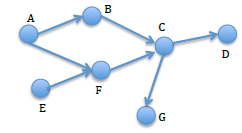
For the network in the figure, apply the max-min flow control algorithm to assign sessions for the following network. Three different flows each with offering Poisson arrivals streams are sharing the links in this network. The link capacities (equivalent with the transmission rates for each transmission line) are marked in the figure. The service times for a transmission line are assumed to be exponentially distributed.
The session flow 1 has the path A -> B -> C -> D; Flow 2: A, F, C, D; Flow 3: E,F,C,G
Link capacities: CD=6; AB=8; BC=5; EF=10; FC = 5; CG=9;AF=10;
Assign maximum allowable throughputs for each session according to the max-min flow control algorithm, such as the time delay in each queue (including service time) for a transmission line should not exceed T = 4 seconds.
Homework Answers
a) Flow 1
A,B,C,D
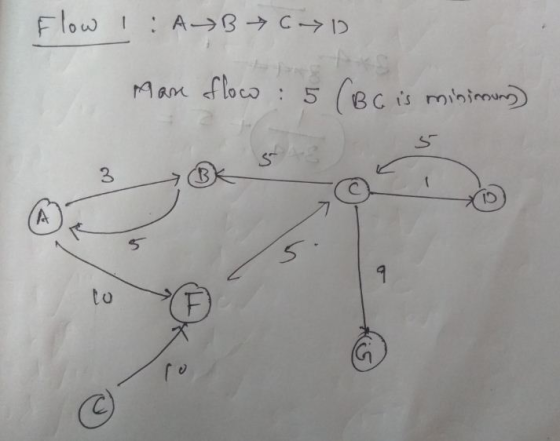
Let Transmission rate = Max flow
Throughput = Transmission rate - (1/(Number of Transmission lines * Service Time) ) = 5-
= ( 5- 0.083) = 4.917
b)
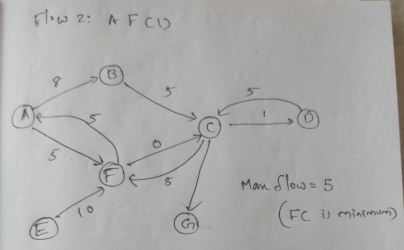
Throughput = Transmission rate - (1/(Number of Transmission lines * Service Time) ) = 5-
= ( 5- 0.083) = 4.917
c)
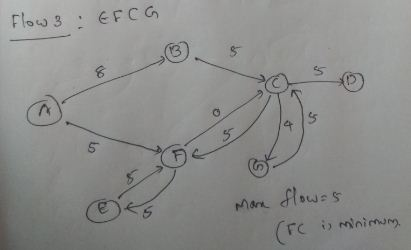
Throughput = Transmission rate - (1/(Number of Transmission lines * Service Time) ) = 5-
= ( 5- 0.083) = 4.917
Add Answer to:
For the network in the figure, apply the max-min flow control
algorithm to assign sessions for...
10 points) Use the Max Flow algorithm to find the maximum flow through the network shown...
 10 points) Use the Max Flow algorithm to find the maximum flow through the network shown below and also give a minimum cut to verify that is the correct value. A (4,0) B (5,0) (3,0) (5,0) (4,0) E S (13,0) (6.0) D (4,0) (6,0) (3,0) (14,0) (6.0) (12,0) (2,0) с (3,0) (5,0) F
Show the execution of the Edmonds-Karp algorithm on the flow network of Figure 26.1(a). A flow...
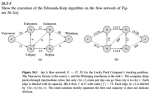 Show the execution of the Edmonds-Karp algorithm on the flow network of Figure 26.1(a). A flow network G = (V, E) for the Lucky Puck Company's trucking problem. The Vancouver factory is the source s, and the Winnipeg warehouse is the sink t. The company ships pucks through intermediate cities, but only c(u, v) crates per day can go from city u to city v. Each edge is labeled with its capacity. (b) A flow f in G with value...
4) Consider the network flow graph below, where each arc is labeled with the maximum capacity...
 4) Consider the network flow graph below, where each arc is labeled with the maximum capacity of that link in the flow network. A 25C 15 - 10,- -* YD 15 35 20 40 10 X 2 (a) Use the Ford-Fulkerson Algorithm to determine the maximum total flow from source to sink in this network. Start with the path s B DA Ct and list (in order) the remaining paths added and the total flow after each path is added....
1. For TCP end-to-end flow control, suppose the capacity of the receiver buffer is 10 packets. Su...
 1. For TCP end-to-end flow control, suppose the capacity of the
receiver buffer is 10 packets. Suppose the packets that are being
queued in the receiver buffer are packets 4, 5, 6, 7, 8, 10, 11.
What is the advertised window size the receiver sent to the sender?
Suppose packet 12 is the last packet sent by the sender. What’s the
effective window size at the sender? Can the sender send out packet
13 at this moment? How about packet...
1. For TCP end-to-end flow control, suppose the capacity of the
receiver buffer is 10 packets. Suppose the packets that are being
queued in the receiver buffer are packets 4, 5, 6, 7, 8, 10, 11.
What is the advertised window size the receiver sent to the sender?
Suppose packet 12 is the last packet sent by the sender. What’s the
effective window size at the sender? Can the sender send out packet
13 at this moment? How about packet...
Run the Dijkstra’s algorithm on the directed graph of the following figure 24.6, using vertex t...
 Run the Dijkstra’s algorithm on the directed graph of the
following figure 24.6, using vertex t as
the source. In the style of Figure 24.6, show the d and
? values and the vertices in set S after each iteration of
the while loop.
1 8 10 I 10 14 4 6 4 6 2 3 2 3 4 6 5 5 2 (a) (c) 1 10 13 4 6 (d) (e) Figure 24.6 The execution of Dijkstra's algorithm. The...
Run the Dijkstra’s algorithm on the directed graph of the
following figure 24.6, using vertex t as
the source. In the style of Figure 24.6, show the d and
? values and the vertices in set S after each iteration of
the while loop.
1 8 10 I 10 14 4 6 4 6 2 3 2 3 4 6 5 5 2 (a) (c) 1 10 13 4 6 (d) (e) Figure 24.6 The execution of Dijkstra's algorithm. The...
check my answers for Networking I came up with these answers, can check my answers Question...
check my answers for Networking I came up with these answers, can check my answers Question 1: General What data rate is needed to transmit an uncompressed 4" x 6" photograph every second with a resolution of 1200 dots per inch and 24 bits per dot (pixel)? 691,200 kb/s 28.8 kb/s 8.29 Mb/s 829 Mb/s Question 2: Layering "Layering" is commonly used in computer networks because (check all that apply): -It forces all network software to be written in ‘C’....
CS 215 Program Design, Abstraction, and Problem Solving Programming Project #3 INTRODUCTION The goal of this...
CS 215 Program Design, Abstraction, and Problem Solving Programming Project #3 INTRODUCTION The goal of this programming project is to enable the student to practice designing a program that solves a problem using a class and a linked-list and developing a C++ program to implement the solution. PROJECT TASKS 1. Read the problem definition below and then analyze it before designing a solution. You will produce a document (external documentation) of this definition, analysis, and design. 2. Write a C++...
 10 points) Use the Max Flow algorithm to find the maximum flow through the network shown below and also give a minimum cut to verify that is the correct value. A (4,0) B (5,0) (3,0) (5,0) (4,0) E S (13,0) (6.0) D (4,0) (6,0) (3,0) (14,0) (6.0) (12,0) (2,0) с (3,0) (5,0) F
 Show the execution of the Edmonds-Karp algorithm on the flow network of Figure 26.1(a). A flow network G = (V, E) for the Lucky Puck Company's trucking problem. The Vancouver factory is the source s, and the Winnipeg warehouse is the sink t. The company ships pucks through intermediate cities, but only c(u, v) crates per day can go from city u to city v. Each edge is labeled with its capacity. (b) A flow f in G with value...
 4) Consider the network flow graph below, where each arc is labeled with the maximum capacity of that link in the flow network. A 25C 15 - 10,- -* YD 15 35 20 40 10 X 2 (a) Use the Ford-Fulkerson Algorithm to determine the maximum total flow from source to sink in this network. Start with the path s B DA Ct and list (in order) the remaining paths added and the total flow after each path is added....
 1. For TCP end-to-end flow control, suppose the capacity of the
receiver buffer is 10 packets. Suppose the packets that are being
queued in the receiver buffer are packets 4, 5, 6, 7, 8, 10, 11.
What is the advertised window size the receiver sent to the sender?
Suppose packet 12 is the last packet sent by the sender. What’s the
effective window size at the sender? Can the sender send out packet
13 at this moment? How about packet...
1. For TCP end-to-end flow control, suppose the capacity of the
receiver buffer is 10 packets. Suppose the packets that are being
queued in the receiver buffer are packets 4, 5, 6, 7, 8, 10, 11.
What is the advertised window size the receiver sent to the sender?
Suppose packet 12 is the last packet sent by the sender. What’s the
effective window size at the sender? Can the sender send out packet
13 at this moment? How about packet...
 Run the Dijkstra’s algorithm on the directed graph of the
following figure 24.6, using vertex t as
the source. In the style of Figure 24.6, show the d and
? values and the vertices in set S after each iteration of
the while loop.
1 8 10 I 10 14 4 6 4 6 2 3 2 3 4 6 5 5 2 (a) (c) 1 10 13 4 6 (d) (e) Figure 24.6 The execution of Dijkstra's algorithm. The...
Run the Dijkstra’s algorithm on the directed graph of the
following figure 24.6, using vertex t as
the source. In the style of Figure 24.6, show the d and
? values and the vertices in set S after each iteration of
the while loop.
1 8 10 I 10 14 4 6 4 6 2 3 2 3 4 6 5 5 2 (a) (c) 1 10 13 4 6 (d) (e) Figure 24.6 The execution of Dijkstra's algorithm. The...
Most questions answered within 3 hours.
-
Where is the error in this code sequence?
String s1 = "Hello";
String s2 = "ello";...
asked 10 months ago -
Financial data for Joel de Paris, Inc., for last year
follow:
Joel de Paris, Inc.
Balance...
asked 10 months ago -
Consider this reaction:
Al2(SO4)3 (aq)+ BaCl3
(aq) Al2Cl6 (aq)- +
3BaSO4(s) . What is the...
asked 10 months ago -
Suppose that Savneet is considering increasing her
recent random sample from 20 car rentals to 40...
asked 10 months ago -
Trucks arrive at an unloading terminal at an average rate of 120
per hour.
Trucks arrive...
asked 10 months ago -
Why are methanol and ethanol completely soluble in water while
octanol is not very little soluble....
asked 10 months ago -
A facilities manager at a university reads in a research report
that the mean amount of...
asked 10 months ago -
When the CuSO4 is rehydrated by adding water to the anhydrous
compound, is this an endothermic...
asked 10 months ago -
A ray of sunlight is passing from diamond into crown glass; the
angle of incidence is...
asked 10 months ago -
A block of mass 0.249 kg is placed on top of a light, vertical
spring of...
asked 10 months ago -
how do the kidneys compensate in the presences of acidosis
a) trigger hyperventilate
b) reserve acid...
asked 10 months ago -
Question 501 pts
The rental rate of capital to the firm increases. Which of the
following...
asked 10 months ago