


Homework Answers
Add Answer to:
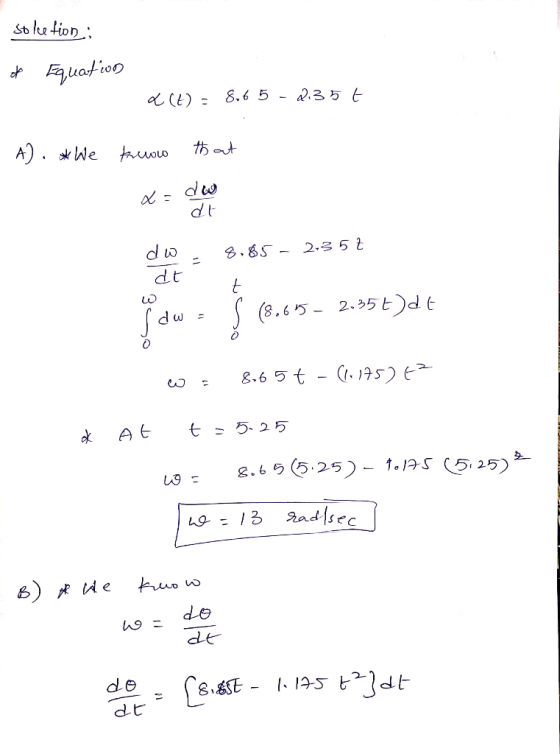
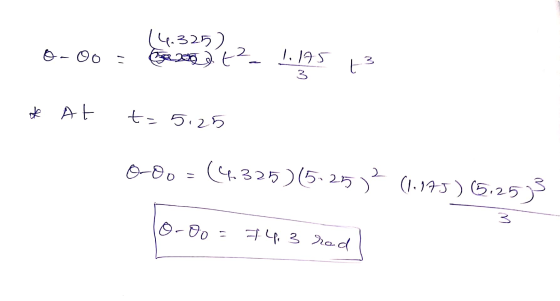
A flywheel has angular acceleration az(t) = 8.65 rad/s2 - (2.35 rad/s2 )t , where counterclockwise...
At t = 0, a flywheel has an angular velocity of 3.9 rad/s, an angular acceleration...
At t = 0, a flywheel has an angular velocity of 3.9 rad/s, an angular acceleration of -0.44 rad/s2, and a reference line at θ0 = 0. (a) Through what maximum angle θmax will the reference line turn in the positive direction? What are the (b) first and (c) second times the reference line will be at θ = θmax/4? At what (d) negative time and (e) positive time will the reference line be at θ = -9.9 rad?
At t = 0, a flywheel has an angular velocity of 2.7 rad/s, an angular acceleration...
At t = 0, a flywheel has an angular velocity of 2.7 rad/s, an angular acceleration of -0.39 rad/s2, and a reference line at θ0 = 0. (a) Through what maximum angle θmax will the reference line turn in the positive direction? What are the (b) first and (c) second times the reference line will be at θ = θmax/8? At what (d) negative time and (e) positive time will the reference line be at θ = -10 rad?
At time t=0 a grinding wheel has an angular velocity of 22.0 rad/s . It has...
At time t=0 a grinding wheel has an angular velocity of 22.0 rad/s . It has a constant angular acceleration of 29.0 rad/s2 until a circuit breaker trips at time t = 2.10 s . From then on, the wheel turns through an angle of 436 rad as it coasts to a stop at constant angular deceleration. (a) Through what total angle did the wheel turn between t=0 and the time it stopped? Express your answer in radians. (b) At...
At time t=0 a grinding wheel has an angular velocity of 30.0 rad/s . It has...
At time t=0 a grinding wheel has an angular velocity of 30.0 rad/s . It has a constant angular acceleration of 34.0 rad/s2 until a circuit breaker trips at time t = 2.30 s . From then on, the wheel turns through an angle of 433 rad as it coasts to a stop at constant angular deceleration. Part A Through what total angle did the wheel turn between t=0 and the time it stopped? Express your answer in radians. Part...
A motor gives gear A an angular acceleration of aA- (2t) rad/s2, where t is in...
 A motor gives gear A an angular acceleration of aA- (2t) rad/s2, where t is in seconds 175 mm 100 mm C B a Tap image to zoom Part A If this gear is initially turning at wA 13 rad/s, determine the angular velocity of gear B when t3 s, measured counterclockwise. Express your answer using three significant figures. Enter positive value if the angular velocity is counterclockwise and negative value if the angular velocity is clockwise. rad/s WB
At time t=0 a grinding wheel has an angular velocity of 24.0 rad/s. It has a constant angular acceleration of 35.0 rad/...
At time t=0 a grinding wheel has an angular velocity of 24.0 rad/s. It has a constant angular acceleration of 35.0 rad/s^2 until a circuit breaker trips at time t= 2.50 s. From then on, the wheel turns through an angle of 440 rad as it coasts to a stop at constant angular deceleration. a.) Through what total angle did the wheel turn between t= 0 and the time it stopped? answer in rad b.) At what time does the...
Fundamental Problem 16.3 The flywheel rotates with an angular velocity of w( g/2) rad/s, where 0...
 Fundamental Problem 16.3 The flywheel rotates with an angular velocity of w( g/2) rad/s, where 0 is in radians. (Figure 1) Part A Determine the time it takes to achieve an angular velocity of-130 rad/s . When t-o. ?. 1 rad. Express your answer to three significant figures and include the appropriate units. t Value s Figure
A flywheel has a constant angular acceleration of −0.89 rad/s2. What is its angular velocity 18...
A flywheel has a constant angular acceleration of −0.89 rad/s2. What is its angular velocity 18 s after its angular velocity is 4.4 rad/s?
A56 (9.2) A flywheel rotates at a constant angular acceleration of 0.35 rad/s2. It has an...
 A56 (9.2) A flywheel rotates at a constant angular acceleration of 0.35 rad/s2. It has an initial angular velocity uOz 4.6 rad/s when θ(,-0. (a) Detormine the time it takes for the flywheel to reach the position of 4.0 rev. (b) At what time does the flywheel stop rotating? (c) What is the value of θ (in revolutions) based on the time calculated in part (b)? Answers: (a) 31 s, (b) 13 s, c)-4.8 rev
Starting from rest, disk A begins rotating with a counterclockwise angular acceleration of 3t rad/s2 (where...
 Starting from rest, disk A begins rotating with a counterclockwise angular acceleration of 3t rad/s2 (where t is time in seconds). For disk D, calculate the angular acceleration, angular velocity, and the number of revolutions after5 seconds. RA 200 mm Re 100 mm Rc 175 mm Ro 150 mm A/ 0 RB
 A motor gives gear A an angular acceleration of aA- (2t) rad/s2, where t is in seconds 175 mm 100 mm C B a Tap image to zoom Part A If this gear is initially turning at wA 13 rad/s, determine the angular velocity of gear B when t3 s, measured counterclockwise. Express your answer using three significant figures. Enter positive value if the angular velocity is counterclockwise and negative value if the angular velocity is clockwise. rad/s WB
 Fundamental Problem 16.3 The flywheel rotates with an angular velocity of w( g/2) rad/s, where 0 is in radians. (Figure 1) Part A Determine the time it takes to achieve an angular velocity of-130 rad/s . When t-o. ?. 1 rad. Express your answer to three significant figures and include the appropriate units. t Value s Figure
 A56 (9.2) A flywheel rotates at a constant angular acceleration of 0.35 rad/s2. It has an initial angular velocity uOz 4.6 rad/s when θ(,-0. (a) Detormine the time it takes for the flywheel to reach the position of 4.0 rev. (b) At what time does the flywheel stop rotating? (c) What is the value of θ (in revolutions) based on the time calculated in part (b)? Answers: (a) 31 s, (b) 13 s, c)-4.8 rev
 Starting from rest, disk A begins rotating with a counterclockwise angular acceleration of 3t rad/s2 (where t is time in seconds). For disk D, calculate the angular acceleration, angular velocity, and the number of revolutions after5 seconds. RA 200 mm Re 100 mm Rc 175 mm Ro 150 mm A/ 0 RB
Most questions answered within 3 hours.
-
Where is the error in this code sequence?
String s1 = "Hello";
String s2 = "ello";...
asked 10 months ago -
Financial data for Joel de Paris, Inc., for last year
follow:
Joel de Paris, Inc.
Balance...
asked 10 months ago -
Consider this reaction:
Al2(SO4)3 (aq)+ BaCl3
(aq) Al2Cl6 (aq)- +
3BaSO4(s) . What is the...
asked 10 months ago -
Suppose that Savneet is considering increasing her
recent random sample from 20 car rentals to 40...
asked 10 months ago -
Trucks arrive at an unloading terminal at an average rate of 120
per hour.
Trucks arrive...
asked 10 months ago -
Why are methanol and ethanol completely soluble in water while
octanol is not very little soluble....
asked 10 months ago -
A facilities manager at a university reads in a research report
that the mean amount of...
asked 10 months ago -
When the CuSO4 is rehydrated by adding water to the anhydrous
compound, is this an endothermic...
asked 10 months ago -
A ray of sunlight is passing from diamond into crown glass; the
angle of incidence is...
asked 10 months ago -
A block of mass 0.249 kg is placed on top of a light, vertical
spring of...
asked 10 months ago -
how do the kidneys compensate in the presences of acidosis
a) trigger hyperventilate
b) reserve acid...
asked 10 months ago -
Question 501 pts
The rental rate of capital to the firm increases. Which of the
following...
asked 10 months ago