
Homework Answers


Add Answer to:
Please answer all the parts.
1. During the daytime, water is drawn from an upper reservoir...
The pump-turbine system in Figure 4 draws the water from the upper reservoir in the daytime to pr...
 The pump-turbine system in Figure 4 draws the water from the
upper reservoir in the daytime to produce power for a city. At
night, it pumps water from lower to upper reservoir to restore the
situation. For the design flow rate of 0.157m3/s, the
friction head loss,
hL=4vA2/(2g).
Determine the jet velocity at A.
Find the friction head loss in the system.
Estimate the energy head in meters delivered by the pump at
night.
Estimate the power in kW delivered...
The pump-turbine system in Figure 4 draws the water from the
upper reservoir in the daytime to produce power for a city. At
night, it pumps water from lower to upper reservoir to restore the
situation. For the design flow rate of 0.157m3/s, the
friction head loss,
hL=4vA2/(2g).
Determine the jet velocity at A.
Find the friction head loss in the system.
Estimate the energy head in meters delivered by the pump at
night.
Estimate the power in kW delivered...
4. Water is to be moved from one large reservoir to another a higher elevation as...
 4. Water is to be moved from one large reservoir to another a higher elevation as indicated in the V 2 Figure. The flow rate, Q =2 ft/s and the head loss hi = 60 where Vis the average velocity. 2g the pump power required 15000 ft.Ib/s. Determine the pump head loss hp. Section (2) p=1.94 slugs/ft P2 = P1 = V1 = V2 = 0 8-in. inside- diameter pipe 50 ft Section (1) Pump P v + + Z1+...
4. Water is to be moved from one large reservoir to another a higher elevation as...
 4. Water is to be moved from one large reservoir to another a higher elevation as indicated in the Figure. The flow rate, Q=2 ft/s and the head loss hz = 60 where Vis the average velocity. the pump power required 15000 ft.lb/s. Determine the pump head loss hp. Section (2) p=1.94 slugs/ft3 P2 = P1 = V1 = V2 = 0 8-in. inside diameter pipe 50 Ft P2 + v +24thp = Section (1) Pump P2 vž ==+ +...
Wp=Q×hp×gama Sec 729*24h 4. Water is to be moved from one large reservoir to another a...
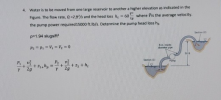 Wp=Q×hp×gama
Sec 729*24h 4. Water is to be moved from one large reservoir to another a higher elevation as indicated in the Figure. The flow rate, Q-2 ft/s and the head loss h = 60 where is the average velocity. 20 the pump power required 15000 ft.ib/s. Determine the pump head loss he p=1.94 slugs/ft P2 - P. = V = V2 = 0 Pit + + 2 thi Y SIR Sen PUTO
Wp=Q×hp×gama
Sec 729*24h 4. Water is to be moved from one large reservoir to another a higher elevation as indicated in the Figure. The flow rate, Q-2 ft/s and the head loss h = 60 where is the average velocity. 20 the pump power required 15000 ft.ib/s. Determine the pump head loss he p=1.94 slugs/ft P2 - P. = V = V2 = 0 Pit + + 2 thi Y SIR Sen PUTO
Water is pumped from a lower reservoir to a higher reservoir by a pump that provides...
 Water is pumped from a lower reservoir to a higher reservoir by a pump that provides 20 kW of shaft power. The free surface of the upper reservoir is 46 m higher than that of the lower reservoir. If the flow rate of water is measured to be0.03 m /s, determine mechanical power that is converted to thermal energy during this process due to frictional effects. 46 m 20 kW Pump 1kW
1 A pump delivers water from the lower reservoir to the upper reservoir at a rate of 60 L/s. Both...
 1 A pump delivers water from the lower reservoir to the upper reservoir at a rate of 60 L/s. Both the suction and discharge pipes are DN 150 schedule 40steel pipe. The length of the suction pipe leading to the pump is 3.5 m, and 7 m of discharge pipe extend from the pump outlet to the upper tank. There are three standard 900 elbows and a fully open gate valve. The depth of the fluid level inside the lower...
Water is pumped from a lower reservoir to a higher reservoir by a pump that provides...
 Water is pumped from a lower reservoir to a higher reservoir by a pump that provides 20 kW of shaft power. The free surface of the upper reservoir is 45 m higher than that of the lower reservoir. If the flow rate of water is measured to be 0.03 m3/s, determine (a) mechanical power that is converted to thermal energy (in kW) during this process due to frictional effects and (b) the pump efficiency (%). Take the density of water...
NO QUESTIONS DURING T Water is to be pumped from a reservoir (ZA30 /s- to another reservoir at a higher elevati rate...
 NO QUESTIONS DURING T Water is to be pumped from a reservoir (ZA30 /s- to another reservoir at a higher elevati rate of elevation (Zn THE EXAM! n) through a long pipe, as shown in the figure at a volume ow olume flow rate has been calculated and is 11 m he head loss in the pipe at this usefuf pump ) Demostrate that wh en a pump moves a fluid from one reservoir to ano e elevation difference between...
In a hydroelectric power station, the turbine is driven by water flowing from a reservoir at...
 In a hydroelectric power station, the turbine is driven by water flowing from a reservoir at the rate of 551 m s. The water is pumped through a pipe 2.06 km long of 2.53 m intemal diameter with a friction factor of 0.004. The water is assumed to have a kinematic viscosity of 13x10 mʻls. The elevation of the upper reservoir above sea level is 400 m and that of the lower reservoir is 40 m. Determine the following Mean...
Q2. 50 marks Water at 20°C is pumped at 5.7 m3 min-1 from the lower to...
 Q2. 50 marks Water at 20°C is pumped at 5.7 m3 min-1 from the lower to the upper reservoir, as in Fig. 2. The free surface of the upper reservoir is at height Z2 = 46 m, and of the lower reservoir at 21 = 15 m. The pipe diameter before and after the pump is D= 15 cm. Pipe friction losses are approximated by h = 27v2/(29), where V is the average velocity in the pipe. The gravitational acceleration...
 The pump-turbine system in Figure 4 draws the water from the
upper reservoir in the daytime to produce power for a city. At
night, it pumps water from lower to upper reservoir to restore the
situation. For the design flow rate of 0.157m3/s, the
friction head loss,
hL=4vA2/(2g).
Determine the jet velocity at A.
Find the friction head loss in the system.
Estimate the energy head in meters delivered by the pump at
night.
Estimate the power in kW delivered...
The pump-turbine system in Figure 4 draws the water from the
upper reservoir in the daytime to produce power for a city. At
night, it pumps water from lower to upper reservoir to restore the
situation. For the design flow rate of 0.157m3/s, the
friction head loss,
hL=4vA2/(2g).
Determine the jet velocity at A.
Find the friction head loss in the system.
Estimate the energy head in meters delivered by the pump at
night.
Estimate the power in kW delivered...
 4. Water is to be moved from one large reservoir to another a higher elevation as indicated in the V 2 Figure. The flow rate, Q =2 ft/s and the head loss hi = 60 where Vis the average velocity. 2g the pump power required 15000 ft.Ib/s. Determine the pump head loss hp. Section (2) p=1.94 slugs/ft P2 = P1 = V1 = V2 = 0 8-in. inside- diameter pipe 50 ft Section (1) Pump P v + + Z1+...
 4. Water is to be moved from one large reservoir to another a higher elevation as indicated in the Figure. The flow rate, Q=2 ft/s and the head loss hz = 60 where Vis the average velocity. the pump power required 15000 ft.lb/s. Determine the pump head loss hp. Section (2) p=1.94 slugs/ft3 P2 = P1 = V1 = V2 = 0 8-in. inside diameter pipe 50 Ft P2 + v +24thp = Section (1) Pump P2 vž ==+ +...
 Wp=Q×hp×gama
Sec 729*24h 4. Water is to be moved from one large reservoir to another a higher elevation as indicated in the Figure. The flow rate, Q-2 ft/s and the head loss h = 60 where is the average velocity. 20 the pump power required 15000 ft.ib/s. Determine the pump head loss he p=1.94 slugs/ft P2 - P. = V = V2 = 0 Pit + + 2 thi Y SIR Sen PUTO
Wp=Q×hp×gama
Sec 729*24h 4. Water is to be moved from one large reservoir to another a higher elevation as indicated in the Figure. The flow rate, Q-2 ft/s and the head loss h = 60 where is the average velocity. 20 the pump power required 15000 ft.ib/s. Determine the pump head loss he p=1.94 slugs/ft P2 - P. = V = V2 = 0 Pit + + 2 thi Y SIR Sen PUTO
 Water is pumped from a lower reservoir to a higher reservoir by a pump that provides 20 kW of shaft power. The free surface of the upper reservoir is 46 m higher than that of the lower reservoir. If the flow rate of water is measured to be0.03 m /s, determine mechanical power that is converted to thermal energy during this process due to frictional effects. 46 m 20 kW Pump 1kW
 1 A pump delivers water from the lower reservoir to the upper reservoir at a rate of 60 L/s. Both the suction and discharge pipes are DN 150 schedule 40steel pipe. The length of the suction pipe leading to the pump is 3.5 m, and 7 m of discharge pipe extend from the pump outlet to the upper tank. There are three standard 900 elbows and a fully open gate valve. The depth of the fluid level inside the lower...
 Water is pumped from a lower reservoir to a higher reservoir by a pump that provides 20 kW of shaft power. The free surface of the upper reservoir is 45 m higher than that of the lower reservoir. If the flow rate of water is measured to be 0.03 m3/s, determine (a) mechanical power that is converted to thermal energy (in kW) during this process due to frictional effects and (b) the pump efficiency (%). Take the density of water...
 NO QUESTIONS DURING T Water is to be pumped from a reservoir (ZA30 /s- to another reservoir at a higher elevati rate of elevation (Zn THE EXAM! n) through a long pipe, as shown in the figure at a volume ow olume flow rate has been calculated and is 11 m he head loss in the pipe at this usefuf pump ) Demostrate that wh en a pump moves a fluid from one reservoir to ano e elevation difference between...
 In a hydroelectric power station, the turbine is driven by water flowing from a reservoir at the rate of 551 m s. The water is pumped through a pipe 2.06 km long of 2.53 m intemal diameter with a friction factor of 0.004. The water is assumed to have a kinematic viscosity of 13x10 mʻls. The elevation of the upper reservoir above sea level is 400 m and that of the lower reservoir is 40 m. Determine the following Mean...
 Q2. 50 marks Water at 20°C is pumped at 5.7 m3 min-1 from the lower to the upper reservoir, as in Fig. 2. The free surface of the upper reservoir is at height Z2 = 46 m, and of the lower reservoir at 21 = 15 m. The pipe diameter before and after the pump is D= 15 cm. Pipe friction losses are approximated by h = 27v2/(29), where V is the average velocity in the pipe. The gravitational acceleration...
Most questions answered within 3 hours.
-
Where is the error in this code sequence?
String s1 = "Hello";
String s2 = "ello";...
asked 10 months ago -
Financial data for Joel de Paris, Inc., for last year
follow:
Joel de Paris, Inc.
Balance...
asked 10 months ago -
Consider this reaction:
Al2(SO4)3 (aq)+ BaCl3
(aq) Al2Cl6 (aq)- +
3BaSO4(s) . What is the...
asked 10 months ago -
Suppose that Savneet is considering increasing her
recent random sample from 20 car rentals to 40...
asked 10 months ago -
Trucks arrive at an unloading terminal at an average rate of 120
per hour.
Trucks arrive...
asked 10 months ago -
Why are methanol and ethanol completely soluble in water while
octanol is not very little soluble....
asked 10 months ago -
A facilities manager at a university reads in a research report
that the mean amount of...
asked 10 months ago -
When the CuSO4 is rehydrated by adding water to the anhydrous
compound, is this an endothermic...
asked 10 months ago -
A ray of sunlight is passing from diamond into crown glass; the
angle of incidence is...
asked 10 months ago -
A block of mass 0.249 kg is placed on top of a light, vertical
spring of...
asked 10 months ago -
how do the kidneys compensate in the presences of acidosis
a) trigger hyperventilate
b) reserve acid...
asked 10 months ago -
Question 501 pts
The rental rate of capital to the firm increases. Which of the
following...
asked 10 months ago