When a chemical process occurs under standard conditions, which of the following conditions always apply? 1....
When a chemical process occurs under standard conditions, which of the following conditions always apply? 1. Gaseous species are at a pressure of 1 bar. 2. Solution concentrations species are 1 molal. 3. The temperature is 298.15 K.
a.) 1 only
b.) 2 only
c.) 3 only
d.) 1 and 2
e.) 1, 2, and 3
Homework Answers

Add Answer to:
When a chemical process occurs under standard conditions, which
of the following conditions always apply? 1....
1. Answer the following questions under standard conditions
Ag3+(aq) + e− ⇌ Ag2+(aq)E° = 1.800 V2H+(aq) + 2e− ⇌ H2(g)E° = 0.000 V1. Answer the following questions under standard conditions(a) The half-cell containing Ag2+/Ag3+ is the cathode .(b) The half-cell containing H+/H2 is the anode .(c) What is E°cell (in V)? Report your answer to three decimal places in standard notation (i.e., 0.123 V).1.800 V(b) What is ΔG° (in kJ/mol) for the process that is occurring in the electrochemical cell? Report your answer to three significant figures in...
For a gaseous reaction, standard conditions are 298 K and a partial pressure of 1 bar...
 For a gaseous reaction, standard conditions are 298 K and a partial pressure of 1 bar for all species. For the reaction N2(g) + 3 H2(g) = 2 NH3(g) the standard change in Gibbs free energy is AGⓇ = -72.6 kJ/mol. What is AG for this reaction at 298 K when the partial pressures are PN, = 0.200 bar, Ph, = 0.150 bar, and PnHz = 0.800 bar. kJ AG = mol
For a gaseous reaction, standard conditions are 298 K and a partial pressure of 1 bar...
For a gaseous reaction, standard conditions are 298 K and a partial pressure of 1 bar for all species. For the reaction N2(g)+3H2(g)↽−−⇀2NH3(g) the standard change in Gibbs free energy is Δ?∘=−69.0 kJ/mol. What is Δ? for this reaction at 298 K when the partial pressures are ?N2=0.500 bar, ?H2=0.150 bar, and ?NH3=0.750 bar? Show work please!
QUESTION 23 Which of the following statements is incorrect? a. A spontaneous process occurs under specified...
 QUESTION 23 Which of the following statements is incorrect? a. A spontaneous process occurs under specified conditions without outside intervention. Ob. AGsys --TASuniv c. A nonspontaneous process occurs only if the surroundings continuously supply energy to the system. d. The relationship between AGⓇ and K at 25°C is: if K< 1, AG° <0. e. A spontaneous change may be exothermic or endothermic.
Under standard conditions, what reaction occurs, if any, when each of the following operations are performed?...
Under standard conditions, what reaction occurs, if any, when each of the following operations are performed? For the reactions that occur, write a balanced, net ionic equation and calculate ℰ°, ΔG°, and K at 25°C. (Use the lowest possible coefficients. Include states-of-matter at 25°C and 1 atm in your answer. If an answer does not exist, enter DNE.) a. Cl2 gas is bubbled into a solution of NaI. ______________________________ ℰ° ____ V ΔG° ____ kJ K b. An acidic solution of...
Identify the conditions for a standard electrochemical cell. Select one or more: Pressure of 1 atm...
Identify the conditions for a standard electrochemical cell. Select one or more: Pressure of 1 atm Solution concentrations of 1 M Pressure of 5 atm Solute masses of 1 g Temperature of 273 K Temperature of 298 K
The flow rates of all gases are given as listed in Table 1 under ‘normal’ conditions...
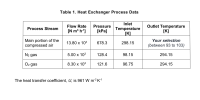 The flow rates of all gases are given as listed in Table 1 under
‘normal’ conditions (i.e. N m h , or 101.325 kPa and 25 °C).
Convert these to the flow rates under ‘standard’ condition.
Table:
Table 1. Heat Exchanger Process Data Process Stream Flow Rate [N m3 h-1] Pressure [kPa] Inlet Temperature [K] Outlet Temperature [K] Main portion of the compressed air 13.80 x 10³ 678.3 298.15 Your selection (between 93 to 103) N2 gas 5.00 x 10³...
The flow rates of all gases are given as listed in Table 1 under
‘normal’ conditions (i.e. N m h , or 101.325 kPa and 25 °C).
Convert these to the flow rates under ‘standard’ condition.
Table:
Table 1. Heat Exchanger Process Data Process Stream Flow Rate [N m3 h-1] Pressure [kPa] Inlet Temperature [K] Outlet Temperature [K] Main portion of the compressed air 13.80 x 10³ 678.3 298.15 Your selection (between 93 to 103) N2 gas 5.00 x 10³...
For a gaseous reaction, standard conditions are 298 K and a partial pressure of 1 atm...
 For a gaseous reaction, standard conditions are 298 K and a partial pressure of 1 atm for all species. For the reaction Ng(8) + 3 H (8)=2 NH (8) the standard change in Gibbs free energy is AG° = -72.6 kJ/mol. What is AG for this reaction at 298 K when the partial pressures are PN, = 0.450 atm, P, = 0.250 atm, and PH, = 0.950 atm? kJ/mol AG -
For a gaseous reaction, standard conditions are 298 K and a partial pressure of 1 atm...
For a gaseous reaction, standard conditions are 298 K and a partial pressure of 1 atm for all species. For the reaction N 2 ( g ) + 3 H 2 ( g ) − ⇀ ↽ − 2 NH 3 ( g ) the standard change in Gibbs free energy is Δ G ° = − 32.8 kJ/mol . What is ΔG for this reaction at 298 K when the partial pressures are P N 2 = 0.100 atm...
Standard reduction potentials are listed for reactions under standard conditions. Standard conditions are 1 M concentrations of ions, 1 atm (or 1 bar) partial pressures for gases, and a tem...
 Standard reduction potentials are listed for reactions under standard conditions. Standard conditions are 1 M concentrations of ions, 1 atm (or 1 bar) partial pressures for gases, and a temperature of 298 K a. In Part I, you were asked to compare your measured cell potential to a calculated standard cell 3. potential. The cell potential you measured was for a galvanic cell you prepared using 0.10 M solutions of Pb and Cu, not 1.0 M solutions. Write out the...
 For a gaseous reaction, standard conditions are 298 K and a partial pressure of 1 bar for all species. For the reaction N2(g) + 3 H2(g) = 2 NH3(g) the standard change in Gibbs free energy is AGⓇ = -72.6 kJ/mol. What is AG for this reaction at 298 K when the partial pressures are PN, = 0.200 bar, Ph, = 0.150 bar, and PnHz = 0.800 bar. kJ AG = mol
 QUESTION 23 Which of the following statements is incorrect? a. A spontaneous process occurs under specified conditions without outside intervention. Ob. AGsys --TASuniv c. A nonspontaneous process occurs only if the surroundings continuously supply energy to the system. d. The relationship between AGⓇ and K at 25°C is: if K< 1, AG° <0. e. A spontaneous change may be exothermic or endothermic.
 The flow rates of all gases are given as listed in Table 1 under
‘normal’ conditions (i.e. N m h , or 101.325 kPa and 25 °C).
Convert these to the flow rates under ‘standard’ condition.
Table:
Table 1. Heat Exchanger Process Data Process Stream Flow Rate [N m3 h-1] Pressure [kPa] Inlet Temperature [K] Outlet Temperature [K] Main portion of the compressed air 13.80 x 10³ 678.3 298.15 Your selection (between 93 to 103) N2 gas 5.00 x 10³...
The flow rates of all gases are given as listed in Table 1 under
‘normal’ conditions (i.e. N m h , or 101.325 kPa and 25 °C).
Convert these to the flow rates under ‘standard’ condition.
Table:
Table 1. Heat Exchanger Process Data Process Stream Flow Rate [N m3 h-1] Pressure [kPa] Inlet Temperature [K] Outlet Temperature [K] Main portion of the compressed air 13.80 x 10³ 678.3 298.15 Your selection (between 93 to 103) N2 gas 5.00 x 10³...
 For a gaseous reaction, standard conditions are 298 K and a partial pressure of 1 atm for all species. For the reaction Ng(8) + 3 H (8)=2 NH (8) the standard change in Gibbs free energy is AG° = -72.6 kJ/mol. What is AG for this reaction at 298 K when the partial pressures are PN, = 0.450 atm, P, = 0.250 atm, and PH, = 0.950 atm? kJ/mol AG -
 Standard reduction potentials are listed for reactions under standard conditions. Standard conditions are 1 M concentrations of ions, 1 atm (or 1 bar) partial pressures for gases, and a temperature of 298 K a. In Part I, you were asked to compare your measured cell potential to a calculated standard cell 3. potential. The cell potential you measured was for a galvanic cell you prepared using 0.10 M solutions of Pb and Cu, not 1.0 M solutions. Write out the...
Most questions answered within 3 hours.
-
Where is the error in this code sequence?
String s1 = "Hello";
String s2 = "ello";...
asked 10 months ago -
Financial data for Joel de Paris, Inc., for last year
follow:
Joel de Paris, Inc.
Balance...
asked 10 months ago -
Consider this reaction:
Al2(SO4)3 (aq)+ BaCl3
(aq) Al2Cl6 (aq)- +
3BaSO4(s) . What is the...
asked 10 months ago -
Suppose that Savneet is considering increasing her
recent random sample from 20 car rentals to 40...
asked 10 months ago -
Trucks arrive at an unloading terminal at an average rate of 120
per hour.
Trucks arrive...
asked 10 months ago -
Why are methanol and ethanol completely soluble in water while
octanol is not very little soluble....
asked 10 months ago -
A facilities manager at a university reads in a research report
that the mean amount of...
asked 10 months ago -
When the CuSO4 is rehydrated by adding water to the anhydrous
compound, is this an endothermic...
asked 10 months ago -
A ray of sunlight is passing from diamond into crown glass; the
angle of incidence is...
asked 10 months ago -
A block of mass 0.249 kg is placed on top of a light, vertical
spring of...
asked 10 months ago -
how do the kidneys compensate in the presences of acidosis
a) trigger hyperventilate
b) reserve acid...
asked 10 months ago -
Question 501 pts
The rental rate of capital to the firm increases. Which of the
following...
asked 10 months ago