The position of a particle as a function of time is given by the following formula:...
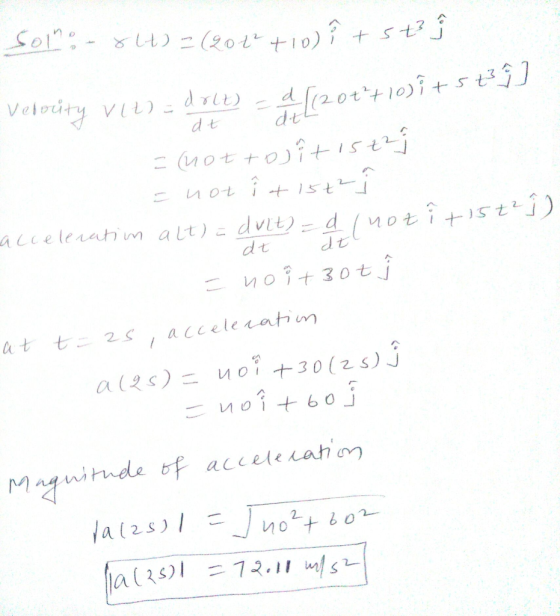
The position of a particle as a function of time is given by the following formula: r(t) = (20t^2 + 10)i + 5t^3j
What is the magnitude of the acceleration at a time t = 2 s? (Assume SI units throughout.)
Homework Answers
Add Answer to:
The position of a particle as a function of time is given by the
following formula:...
Suppose that the position vector of a particle is given by the following function of time:...
Suppose that the position vector of a particle is given by the following function of time: r = (6.0 + 2.0t^2)i + (3.0 - 2.0t + 3.0t^2)j where distance is measured in meters and time in seconds. (a) What is the instantaneous velocity vector at t=2.0 s? What is the magnitude of this vector? (b) What is the instantaneous acceleration vector? What are the magnitude and direction of this vector?
the position of a particle is given by s(t)=5t^2 -6t+8 find the funtion that describes its...
 the
position of a particle is given by s(t)=5t^2 -6t+8 find the funtion
that describes its acceleration at time t
10 points. 7. The position of a particle is Pind the function that describes its acceleration at time to given by s(t)=5t'-6t+8.
the
position of a particle is given by s(t)=5t^2 -6t+8 find the funtion
that describes its acceleration at time t
10 points. 7. The position of a particle is Pind the function that describes its acceleration at time to given by s(t)=5t'-6t+8.
The position of a particular particle as a function of time is given by r =
The position of a particular particle as a function of time is given by r = (9.80t·i-885j-1.00 t2·k)m, where t is in seconds. Part AWhat is the average velocity of the particle between t=1.00 s and t=3.00 S? Part B What is the magnitude of the instantaneous velocity at 3.00 s?
The position of a particle for t > 0 is given by ?⃗(?) = (3.0 ?...
The position of a particle for t > 0 is given by ?⃗(?) = (3.0 ? ?̂ − 7.0 ? ?̂ − 5.0 ? ?) m (a) What is the velocity as a function of time? (b) What is the acceleration as a function of time? (c) What is the particle’s velocity at t = 2.0 s? (d) What is its speed at t = 1.0 s and t = 3.0 s? (e) What is the average velocity between t...
the velocity of a particle is given by v=[16t^2i+4t^3j +(5t+2)k]m/s, where t is in seconds
the velocity of a particle is given by v=[16t^2i+4t^3j +(5t+2)k]m/s, where t is in seconds. If the particle is at the origin when t=0, determine the magnitude of the particle's acceleration when t=2s. What is the x,y,z coordinate position of the particle at this instant.
horizontal position, x, of a particle as a function of time is given by the equation...
 horizontal position, x, of a particle as a function of time is given by the equation xo + vo t + ½ at' , where xa vo and ao are constants. Find the velocity as a function of time. (2) Ifx0 2.0 m and vo 2.0 m/s and ao 1.0 m/s, find the acceleration of the particle in problem (1) at the time t-10.0 s
If the position of a particle is given by x=20t-5t^3 x = 20 t ? 5...
If the position of a particle is given by x=20t-5t^3 x = 20 t ? 5 t 3 , with x in meters and t in seconds, when, if ever, is the particle's velocity zero? b) When is the acceleration a zero? c) For what time range (positive or negative) is a negative? d) Positive? e) Graph x ( t ) , v ( t ) , and a ( t ) .
(8c4p11) A particle moves so that its position as a function of time in SI units...
 (8c4p11) A particle moves so that its position as a function of time in SI units is r= i + (7.0) t- j ut k. Write expressions for its velocity and its acceleration as functions of time. Evaluate for t = 7.1 s. i-componen velocity? Submit Answer Tries 0/8 j-component of velocity? Submit Answer Tries 0/8 k-component of velocity? Submit Answer Tries 0/8 i-component of acceleration? Submit Answer Tries 0/8 j-component of acceleration? Submit Answer Tries 0/8 k-component of acceleration?...
3.) The position of a particle is given by x(t) = 3t3 – 2t2 – 5t...
 3.) The position of a particle is given by x(t) = 3t3 – 2t2 – 5t + 10, where t is in seconds and x is in meters. Find the initial position of the particle. Find the position of the particle after 5 seconds. Find the average velocity from 0 sec to t = 5sec Find the instantaneous velocity as a function of time Find the instantaneous velocity at t = 2 seconds. Find the instantaneous velocity at t=4 seconds...
Object A has a position as a function of time given by r A(t) = (3.00...
Object A has a position as a function of time given by r A(t) = (3.00 m/s)t i^ + (1.00 m/s2)t2 j^. Object B has a position as a function of time given by rB(t) = (4.00 m/s)t i^ + (−1.00 m/s2)t2 j^. All quantities are SI units. What is the distance between object A and object B at time t = 3.00 s?
 the
position of a particle is given by s(t)=5t^2 -6t+8 find the funtion
that describes its acceleration at time t
10 points. 7. The position of a particle is Pind the function that describes its acceleration at time to given by s(t)=5t'-6t+8.
the
position of a particle is given by s(t)=5t^2 -6t+8 find the funtion
that describes its acceleration at time t
10 points. 7. The position of a particle is Pind the function that describes its acceleration at time to given by s(t)=5t'-6t+8.
 horizontal position, x, of a particle as a function of time is given by the equation xo + vo t + ½ at' , where xa vo and ao are constants. Find the velocity as a function of time. (2) Ifx0 2.0 m and vo 2.0 m/s and ao 1.0 m/s, find the acceleration of the particle in problem (1) at the time t-10.0 s
 (8c4p11) A particle moves so that its position as a function of time in SI units is r= i + (7.0) t- j ut k. Write expressions for its velocity and its acceleration as functions of time. Evaluate for t = 7.1 s. i-componen velocity? Submit Answer Tries 0/8 j-component of velocity? Submit Answer Tries 0/8 k-component of velocity? Submit Answer Tries 0/8 i-component of acceleration? Submit Answer Tries 0/8 j-component of acceleration? Submit Answer Tries 0/8 k-component of acceleration?...
 3.) The position of a particle is given by x(t) = 3t3 – 2t2 – 5t + 10, where t is in seconds and x is in meters. Find the initial position of the particle. Find the position of the particle after 5 seconds. Find the average velocity from 0 sec to t = 5sec Find the instantaneous velocity as a function of time Find the instantaneous velocity at t = 2 seconds. Find the instantaneous velocity at t=4 seconds...
Most questions answered within 3 hours.
-
Where is the error in this code sequence?
String s1 = "Hello";
String s2 = "ello";...
asked 11 months ago -
Financial data for Joel de Paris, Inc., for last year
follow:
Joel de Paris, Inc.
Balance...
asked 11 months ago -
Consider this reaction:
Al2(SO4)3 (aq)+ BaCl3
(aq) Al2Cl6 (aq)- +
3BaSO4(s) . What is the...
asked 11 months ago -
Suppose that Savneet is considering increasing her
recent random sample from 20 car rentals to 40...
asked 11 months ago -
Trucks arrive at an unloading terminal at an average rate of 120
per hour.
Trucks arrive...
asked 11 months ago -
Why are methanol and ethanol completely soluble in water while
octanol is not very little soluble....
asked 11 months ago -
A facilities manager at a university reads in a research report
that the mean amount of...
asked 11 months ago -
When the CuSO4 is rehydrated by adding water to the anhydrous
compound, is this an endothermic...
asked 11 months ago -
A ray of sunlight is passing from diamond into crown glass; the
angle of incidence is...
asked 11 months ago -
A block of mass 0.249 kg is placed on top of a light, vertical
spring of...
asked 11 months ago -
how do the kidneys compensate in the presences of acidosis
a) trigger hyperventilate
b) reserve acid...
asked 11 months ago -
Question 501 pts
The rental rate of capital to the firm increases. Which of the
following...
asked 11 months ago