
Homework Answers

Add Answer to:
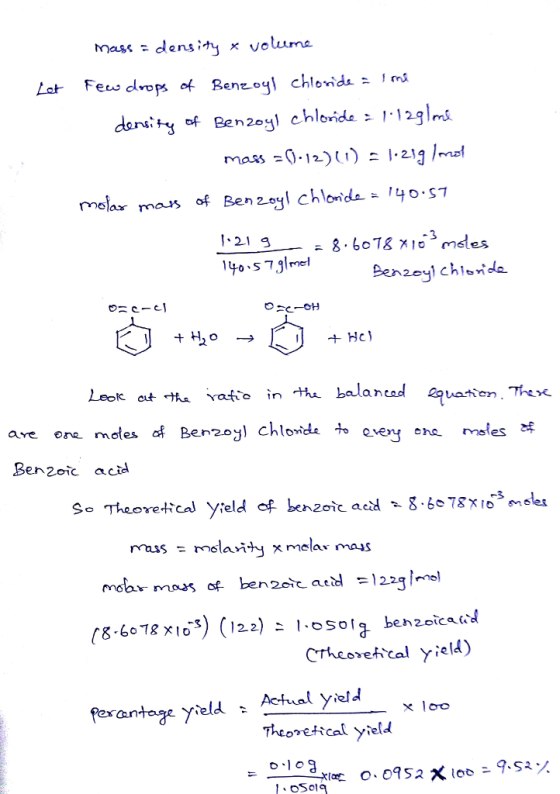
Determine the yield of the products.
The first should be the yield of benzoic acid.
The...
I was wondering if anyone could help with finding the theoretical yield? i need to get...
 I was wondering if anyone could help with finding the
theoretical yield? i need to get the Limiting Reagent to find the
theoretical yield. it would be appreciated thanks!
cyclohexanol MW: 110.16
cyclohexene MW: 82.14
Walol. 2. Cyclohexanol and especially cyclohexene are flammable liquids. Do not heating source in this experiment som stalo tento omos nopo of videos bos bosohoo Physical constants Cyclohexanol Cyclohexene bp (°C) 161 density (g/mL) 0.960 0.810 83 Experimental Procedure (macroscale) Add 20 mL of cyclohexanol...
I was wondering if anyone could help with finding the
theoretical yield? i need to get the Limiting Reagent to find the
theoretical yield. it would be appreciated thanks!
cyclohexanol MW: 110.16
cyclohexene MW: 82.14
Walol. 2. Cyclohexanol and especially cyclohexene are flammable liquids. Do not heating source in this experiment som stalo tento omos nopo of videos bos bosohoo Physical constants Cyclohexanol Cyclohexene bp (°C) 161 density (g/mL) 0.960 0.810 83 Experimental Procedure (macroscale) Add 20 mL of cyclohexanol...
please show the reaction mechanisms drying. Dry the crude t-pentyl chloride over 1.0 g of anhydrous...
 please show the reaction mechanisms
drying. Dry the crude t-pentyl chloride over 1.0 g of anhydrous calcium chloride until it is clear (se- Technique 12, Section 12.9). Swirl the alkyl halide with the drying agent to aid the drying. Part C: Distillation and Analysis of t-pentyl chloride product Transfer the clear liquid to a dry 25-mL round-bottom flask using a Pasteur pipet. Add a boili stone and distill the crude t-pentyl chloride in a dry apparatus (see Technique 14, Section...
please show the reaction mechanisms
drying. Dry the crude t-pentyl chloride over 1.0 g of anhydrous calcium chloride until it is clear (se- Technique 12, Section 12.9). Swirl the alkyl halide with the drying agent to aid the drying. Part C: Distillation and Analysis of t-pentyl chloride product Transfer the clear liquid to a dry 25-mL round-bottom flask using a Pasteur pipet. Add a boili stone and distill the crude t-pentyl chloride in a dry apparatus (see Technique 14, Section...
please show the reaction mechanisms drying. Dry the crude t-pentyl chloride over 1.0 g of anhydrous...
 please show the reaction mechanisms
drying. Dry the crude t-pentyl chloride over 1.0 g of anhydrous calcium chloride until it is clear (se- Technique 12, Section 12.9). Swirl the alkyl halide with the drying agent to aid the drying. Part C: Distillation and Analysis of t-pentyl chloride product Transfer the clear liquid to a dry 25-mL round-bottom flask using a Pasteur pipet. Add a boili stone and distill the crude t-pentyl chloride in a dry apparatus (see Technique 14, Section...
please show the reaction mechanisms
drying. Dry the crude t-pentyl chloride over 1.0 g of anhydrous calcium chloride until it is clear (se- Technique 12, Section 12.9). Swirl the alkyl halide with the drying agent to aid the drying. Part C: Distillation and Analysis of t-pentyl chloride product Transfer the clear liquid to a dry 25-mL round-bottom flask using a Pasteur pipet. Add a boili stone and distill the crude t-pentyl chloride in a dry apparatus (see Technique 14, Section...
Experiment: A mixture of equal proportions of benzoic acid, ethyl 4-aminobenzoate, and 1,4-dimethoxybenzene are to be...
Experiment: A mixture of equal proportions of benzoic acid, ethyl 4-aminobenzoate, and 1,4-dimethoxybenzene are to be separated by extraction using the solvent diethyl ether. Day 1: Part A. Isolation of the basic component: In a small beaker, dissolve 3 g of the mixture (benzoic acid, ethyl 4-aminobenzoate, and 1,4-dimethoxybenzene) in 30 mL of diethyl ether and transfer the mixture to a 125- mL separatory funnel (see Fig. 1) using a little diethyl ether to complete the transfer. Add 10 mL...
Find the crude yield and percent yield of trans-4-methoxycinnamic acid Find the crude and percent yield...
 Find the crude yield and percent yield of trans-4-methoxycinnamic
acid
Find the crude and percent yield of ethyl trans-4
methoxycinnamic acid
Synthesis of trans-4-methoxycinnamic acid 0.585 gused To a 25 mL round-bottom flask equipped with a stir bar, add 1 mL of pyridine (Caution! Pyridine is toxic!) followed by 320 mg of 4-methoxybenzaldehyde, 320mg 10. 200ML 585 mg of malonic acid and 33 mg of B-alanine. Clamp the round-bottom flask Ucdi over a stir plate in a sand bath and...
Find the crude yield and percent yield of trans-4-methoxycinnamic
acid
Find the crude and percent yield of ethyl trans-4
methoxycinnamic acid
Synthesis of trans-4-methoxycinnamic acid 0.585 gused To a 25 mL round-bottom flask equipped with a stir bar, add 1 mL of pyridine (Caution! Pyridine is toxic!) followed by 320 mg of 4-methoxybenzaldehyde, 320mg 10. 200ML 585 mg of malonic acid and 33 mg of B-alanine. Clamp the round-bottom flask Ucdi over a stir plate in a sand bath and...
question in first picture information located below mass of empty vial (979.2mg) then mass with crude...
 question in first picture
information located below
mass of empty vial (979.2mg) then mass with crude
(1769.1mg)
mass of empty vial (1769.1mg) then yield with pure
ester product(18535.6mg)
Actual ester yield (calculations in your lab notebook must be present, re-type it in the report). Theoretical yield (calculations in your lab notebook must be present, re-type it in the report). Percent yield (calculations in your lab notebook must be present, re-type it in the report). in loto in table format) drawstructure...
question in first picture
information located below
mass of empty vial (979.2mg) then mass with crude
(1769.1mg)
mass of empty vial (1769.1mg) then yield with pure
ester product(18535.6mg)
Actual ester yield (calculations in your lab notebook must be present, re-type it in the report). Theoretical yield (calculations in your lab notebook must be present, re-type it in the report). Percent yield (calculations in your lab notebook must be present, re-type it in the report). in loto in table format) drawstructure...
please show the reaction mechanisms sride over 1.0 g of anhydrous calcium chloride until it is...
 please show the reaction mechanisms
sride over 1.0 g of anhydrous calcium chloride until it is clear (se the alkyl halide with the drying agent to aid the drying. drying. Dry the crude t-pentyl chloride Technique 12, Section 12.9). Swirl the all c. Distillation and Analysis of l-pentyl chloride Transfer the clear liquid to a dry 25, stone and distill the crude t-pentyl chlori 14.1). Collect the pure t-pentyl chloride in erial that boils between 78°C and 84°C. Record the...
please show the reaction mechanisms
sride over 1.0 g of anhydrous calcium chloride until it is clear (se the alkyl halide with the drying agent to aid the drying. drying. Dry the crude t-pentyl chloride Technique 12, Section 12.9). Swirl the all c. Distillation and Analysis of l-pentyl chloride Transfer the clear liquid to a dry 25, stone and distill the crude t-pentyl chlori 14.1). Collect the pure t-pentyl chloride in erial that boils between 78°C and 84°C. Record the...
What is the percent yield of Terr-amyl chloride if I collected 12.02 mL ? Pom) Simple...
 What is the percent yield of Terr-amyl chloride if I collected
12.02 mL ?
Pom) Simple Distillation Results: I collected 12.02 mL of tert-amyl chloride. 5. Calculate the percent yield of tert-amyl chloride. (2 points) P.S : Use the same amounts as pg.89 part 1 - preparation of tert-amyl chloride Conclusion: 6. Can you mention how you lost % of the product? ( 2 points) Procedure Part 1-Synthesis: Preparation of tert-amyl chloride about 20 mL of concentrated hydrochloric acid (12...
What is the percent yield of Terr-amyl chloride if I collected
12.02 mL ?
Pom) Simple Distillation Results: I collected 12.02 mL of tert-amyl chloride. 5. Calculate the percent yield of tert-amyl chloride. (2 points) P.S : Use the same amounts as pg.89 part 1 - preparation of tert-amyl chloride Conclusion: 6. Can you mention how you lost % of the product? ( 2 points) Procedure Part 1-Synthesis: Preparation of tert-amyl chloride about 20 mL of concentrated hydrochloric acid (12...
I need help calculating theoretical yield for my Diels-Alder lab experiment. This reaction was between 1,3-butadiene...
 I need help calculating theoretical yield for my
Diels-Alder lab experiment. This reaction was between 1,3-butadiene
and maleic anhydride, forming cis 1,2,3,6-tetrahydrophthalic
anhydride. In this experiment 1.0g of maleic anhydride was combined
with 1.8g 3-sulfolene and 2 mL dry xylene and refluxed for 30 mins.
6 mL of xylene was added to dissolve solids and then decanted, then
warm pet. ether was added to form crystalline product after
cooling. some of this info may be irrelevant in what is needed...
I need help calculating theoretical yield for my
Diels-Alder lab experiment. This reaction was between 1,3-butadiene
and maleic anhydride, forming cis 1,2,3,6-tetrahydrophthalic
anhydride. In this experiment 1.0g of maleic anhydride was combined
with 1.8g 3-sulfolene and 2 mL dry xylene and refluxed for 30 mins.
6 mL of xylene was added to dissolve solids and then decanted, then
warm pet. ether was added to form crystalline product after
cooling. some of this info may be irrelevant in what is needed...
Place 3.0 g of salicylic acid in a 125-ml Erlenmeyer flask. Carefully add, stirring constantly, 6...
 Place 3.0 g of salicylic acid in a 125-ml Erlenmeyer flask. Carefully add, stirring constantly, 6 mL of acetic anhydride, followed by 10 drops of concentrated sulfuric acid. Swirl the contents of the flask so that the reactants are thoroughly mixed. Stopper the flask with a one- hole cork fitted with an inverted Pasteur pipet to prevent condensation of water in the reaction flask during heating on the steam bath. Heat the flask in a boiling-water or steam bath for...
 I was wondering if anyone could help with finding the
theoretical yield? i need to get the Limiting Reagent to find the
theoretical yield. it would be appreciated thanks!
cyclohexanol MW: 110.16
cyclohexene MW: 82.14
Walol. 2. Cyclohexanol and especially cyclohexene are flammable liquids. Do not heating source in this experiment som stalo tento omos nopo of videos bos bosohoo Physical constants Cyclohexanol Cyclohexene bp (°C) 161 density (g/mL) 0.960 0.810 83 Experimental Procedure (macroscale) Add 20 mL of cyclohexanol...
I was wondering if anyone could help with finding the
theoretical yield? i need to get the Limiting Reagent to find the
theoretical yield. it would be appreciated thanks!
cyclohexanol MW: 110.16
cyclohexene MW: 82.14
Walol. 2. Cyclohexanol and especially cyclohexene are flammable liquids. Do not heating source in this experiment som stalo tento omos nopo of videos bos bosohoo Physical constants Cyclohexanol Cyclohexene bp (°C) 161 density (g/mL) 0.960 0.810 83 Experimental Procedure (macroscale) Add 20 mL of cyclohexanol...
 please show the reaction mechanisms
drying. Dry the crude t-pentyl chloride over 1.0 g of anhydrous calcium chloride until it is clear (se- Technique 12, Section 12.9). Swirl the alkyl halide with the drying agent to aid the drying. Part C: Distillation and Analysis of t-pentyl chloride product Transfer the clear liquid to a dry 25-mL round-bottom flask using a Pasteur pipet. Add a boili stone and distill the crude t-pentyl chloride in a dry apparatus (see Technique 14, Section...
please show the reaction mechanisms
drying. Dry the crude t-pentyl chloride over 1.0 g of anhydrous calcium chloride until it is clear (se- Technique 12, Section 12.9). Swirl the alkyl halide with the drying agent to aid the drying. Part C: Distillation and Analysis of t-pentyl chloride product Transfer the clear liquid to a dry 25-mL round-bottom flask using a Pasteur pipet. Add a boili stone and distill the crude t-pentyl chloride in a dry apparatus (see Technique 14, Section...
 please show the reaction mechanisms
drying. Dry the crude t-pentyl chloride over 1.0 g of anhydrous calcium chloride until it is clear (se- Technique 12, Section 12.9). Swirl the alkyl halide with the drying agent to aid the drying. Part C: Distillation and Analysis of t-pentyl chloride product Transfer the clear liquid to a dry 25-mL round-bottom flask using a Pasteur pipet. Add a boili stone and distill the crude t-pentyl chloride in a dry apparatus (see Technique 14, Section...
please show the reaction mechanisms
drying. Dry the crude t-pentyl chloride over 1.0 g of anhydrous calcium chloride until it is clear (se- Technique 12, Section 12.9). Swirl the alkyl halide with the drying agent to aid the drying. Part C: Distillation and Analysis of t-pentyl chloride product Transfer the clear liquid to a dry 25-mL round-bottom flask using a Pasteur pipet. Add a boili stone and distill the crude t-pentyl chloride in a dry apparatus (see Technique 14, Section...
 Find the crude yield and percent yield of trans-4-methoxycinnamic
acid
Find the crude and percent yield of ethyl trans-4
methoxycinnamic acid
Synthesis of trans-4-methoxycinnamic acid 0.585 gused To a 25 mL round-bottom flask equipped with a stir bar, add 1 mL of pyridine (Caution! Pyridine is toxic!) followed by 320 mg of 4-methoxybenzaldehyde, 320mg 10. 200ML 585 mg of malonic acid and 33 mg of B-alanine. Clamp the round-bottom flask Ucdi over a stir plate in a sand bath and...
Find the crude yield and percent yield of trans-4-methoxycinnamic
acid
Find the crude and percent yield of ethyl trans-4
methoxycinnamic acid
Synthesis of trans-4-methoxycinnamic acid 0.585 gused To a 25 mL round-bottom flask equipped with a stir bar, add 1 mL of pyridine (Caution! Pyridine is toxic!) followed by 320 mg of 4-methoxybenzaldehyde, 320mg 10. 200ML 585 mg of malonic acid and 33 mg of B-alanine. Clamp the round-bottom flask Ucdi over a stir plate in a sand bath and...
 question in first picture
information located below
mass of empty vial (979.2mg) then mass with crude
(1769.1mg)
mass of empty vial (1769.1mg) then yield with pure
ester product(18535.6mg)
Actual ester yield (calculations in your lab notebook must be present, re-type it in the report). Theoretical yield (calculations in your lab notebook must be present, re-type it in the report). Percent yield (calculations in your lab notebook must be present, re-type it in the report). in loto in table format) drawstructure...
question in first picture
information located below
mass of empty vial (979.2mg) then mass with crude
(1769.1mg)
mass of empty vial (1769.1mg) then yield with pure
ester product(18535.6mg)
Actual ester yield (calculations in your lab notebook must be present, re-type it in the report). Theoretical yield (calculations in your lab notebook must be present, re-type it in the report). Percent yield (calculations in your lab notebook must be present, re-type it in the report). in loto in table format) drawstructure...
 please show the reaction mechanisms
sride over 1.0 g of anhydrous calcium chloride until it is clear (se the alkyl halide with the drying agent to aid the drying. drying. Dry the crude t-pentyl chloride Technique 12, Section 12.9). Swirl the all c. Distillation and Analysis of l-pentyl chloride Transfer the clear liquid to a dry 25, stone and distill the crude t-pentyl chlori 14.1). Collect the pure t-pentyl chloride in erial that boils between 78°C and 84°C. Record the...
please show the reaction mechanisms
sride over 1.0 g of anhydrous calcium chloride until it is clear (se the alkyl halide with the drying agent to aid the drying. drying. Dry the crude t-pentyl chloride Technique 12, Section 12.9). Swirl the all c. Distillation and Analysis of l-pentyl chloride Transfer the clear liquid to a dry 25, stone and distill the crude t-pentyl chlori 14.1). Collect the pure t-pentyl chloride in erial that boils between 78°C and 84°C. Record the...
 What is the percent yield of Terr-amyl chloride if I collected
12.02 mL ?
Pom) Simple Distillation Results: I collected 12.02 mL of tert-amyl chloride. 5. Calculate the percent yield of tert-amyl chloride. (2 points) P.S : Use the same amounts as pg.89 part 1 - preparation of tert-amyl chloride Conclusion: 6. Can you mention how you lost % of the product? ( 2 points) Procedure Part 1-Synthesis: Preparation of tert-amyl chloride about 20 mL of concentrated hydrochloric acid (12...
What is the percent yield of Terr-amyl chloride if I collected
12.02 mL ?
Pom) Simple Distillation Results: I collected 12.02 mL of tert-amyl chloride. 5. Calculate the percent yield of tert-amyl chloride. (2 points) P.S : Use the same amounts as pg.89 part 1 - preparation of tert-amyl chloride Conclusion: 6. Can you mention how you lost % of the product? ( 2 points) Procedure Part 1-Synthesis: Preparation of tert-amyl chloride about 20 mL of concentrated hydrochloric acid (12...
 I need help calculating theoretical yield for my
Diels-Alder lab experiment. This reaction was between 1,3-butadiene
and maleic anhydride, forming cis 1,2,3,6-tetrahydrophthalic
anhydride. In this experiment 1.0g of maleic anhydride was combined
with 1.8g 3-sulfolene and 2 mL dry xylene and refluxed for 30 mins.
6 mL of xylene was added to dissolve solids and then decanted, then
warm pet. ether was added to form crystalline product after
cooling. some of this info may be irrelevant in what is needed...
I need help calculating theoretical yield for my
Diels-Alder lab experiment. This reaction was between 1,3-butadiene
and maleic anhydride, forming cis 1,2,3,6-tetrahydrophthalic
anhydride. In this experiment 1.0g of maleic anhydride was combined
with 1.8g 3-sulfolene and 2 mL dry xylene and refluxed for 30 mins.
6 mL of xylene was added to dissolve solids and then decanted, then
warm pet. ether was added to form crystalline product after
cooling. some of this info may be irrelevant in what is needed...
 Place 3.0 g of salicylic acid in a 125-ml Erlenmeyer flask. Carefully add, stirring constantly, 6 mL of acetic anhydride, followed by 10 drops of concentrated sulfuric acid. Swirl the contents of the flask so that the reactants are thoroughly mixed. Stopper the flask with a one- hole cork fitted with an inverted Pasteur pipet to prevent condensation of water in the reaction flask during heating on the steam bath. Heat the flask in a boiling-water or steam bath for...
Most questions answered within 3 hours.
-
Where is the error in this code sequence?
String s1 = "Hello";
String s2 = "ello";...
asked 11 months ago -
Financial data for Joel de Paris, Inc., for last year
follow:
Joel de Paris, Inc.
Balance...
asked 11 months ago -
Consider this reaction:
Al2(SO4)3 (aq)+ BaCl3
(aq) Al2Cl6 (aq)- +
3BaSO4(s) . What is the...
asked 11 months ago -
Suppose that Savneet is considering increasing her
recent random sample from 20 car rentals to 40...
asked 11 months ago -
Trucks arrive at an unloading terminal at an average rate of 120
per hour.
Trucks arrive...
asked 11 months ago -
Why are methanol and ethanol completely soluble in water while
octanol is not very little soluble....
asked 11 months ago -
A facilities manager at a university reads in a research report
that the mean amount of...
asked 11 months ago -
When the CuSO4 is rehydrated by adding water to the anhydrous
compound, is this an endothermic...
asked 11 months ago -
A ray of sunlight is passing from diamond into crown glass; the
angle of incidence is...
asked 11 months ago -
A block of mass 0.249 kg is placed on top of a light, vertical
spring of...
asked 11 months ago -
how do the kidneys compensate in the presences of acidosis
a) trigger hyperventilate
b) reserve acid...
asked 11 months ago -
Question 501 pts
The rental rate of capital to the firm increases. Which of the
following...
asked 11 months ago