
Homework Answers
Add Answer to:
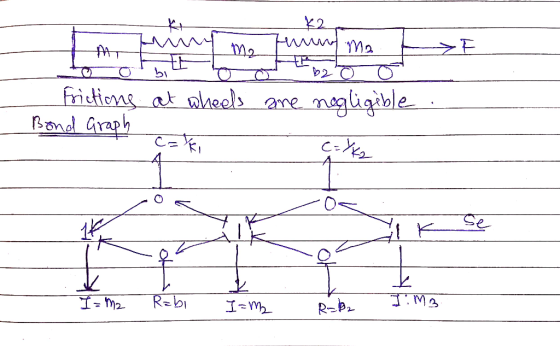
Draw a complete bond graph of a train system below. Given that bı, b2 are damper...
complete the molecular orbital for B2 with arrows given below and then predict its bond order....
 complete the molecular orbital for B2 with arrows given below
and then predict its bond order.
Complete the molecular orbital occupancy for B_2 with the arrows given below and then predict its bond order. Do not leave any boxes unfilled.
complete the molecular orbital for B2 with arrows given below
and then predict its bond order.
Complete the molecular orbital occupancy for B_2 with the arrows given below and then predict its bond order. Do not leave any boxes unfilled.
1. Given the spring-mass-damper system in the figure below T3 T1 T2 b2 b1 k3 (a) Find the equatio...
 1. Given the spring-mass-damper system in the figure below T3 T1 T2 b2 b1 k3 (a) Find the equations of motion for each of the masses 脳. Fi(s) (b) Assume F1 0 and find the transfer function (c) Assume Fs 0 and find the transfer function (d) Write the equations in matrix-vector form: M.ї + Bi + Kx-F where z is a 3 x 1 vector with the displacements r,2, r3 as components, M is the mass matrix, B is...
Please show work 3. Given a mass-spring-damper system, the 2kg mass is connected to two linear...
 Please show work
3. Given a mass-spring-damper system, the 2kg mass is connected to two linear springs with stiffness coefficients ki- 100 N/m and ki 150 N/m and a viscous damper with b 50 Ns/m. A constant force of SN is applied as shown. The effect of friction is negligible. ki m b 3.1 [2pts] Determine the equivalent stiffness of the springs. 3.2 [3pts] Draw the free-body diagram of the system. Define the generalized coordinate and label your forces and...
Please show work
3. Given a mass-spring-damper system, the 2kg mass is connected to two linear springs with stiffness coefficients ki- 100 N/m and ki 150 N/m and a viscous damper with b 50 Ns/m. A constant force of SN is applied as shown. The effect of friction is negligible. ki m b 3.1 [2pts] Determine the equivalent stiffness of the springs. 3.2 [3pts] Draw the free-body diagram of the system. Define the generalized coordinate and label your forces and...
Given the the mass-spring-damper system in Figure 3.10, assume that the contact forces are viscous friction....
 Given the the mass-spring-damper system in Figure 3.10, assume
that the contact forces are viscous friction. 1. State the number
of degrees of freedom in the system.
2. Derive the equations of motion and state them in matrix
notation. 3. If f(t) = a (a constant), what is the long term state
of the system? 4. If the forcing is f(t) = A sin(ωt), and the
system parameters are given in Table 3.1, simulate the response
from rest. Plot all...
Given the the mass-spring-damper system in Figure 3.10, assume
that the contact forces are viscous friction. 1. State the number
of degrees of freedom in the system.
2. Derive the equations of motion and state them in matrix
notation. 3. If f(t) = a (a constant), what is the long term state
of the system? 4. If the forcing is f(t) = A sin(ωt), and the
system parameters are given in Table 3.1, simulate the response
from rest. Plot all...
- Draw a "complete" free body diagram for the system. Inclusing coordinates of x & y....
 - Draw a "complete" free body diagram for the system. Inclusing
coordinates of x & y. Label normal force, weight, kinetic
friction, etc
- Create an acceleration equation for M4
- Solve for the accleration of M4 algebraically
- Evaluate your answers if both thetas equal 90 degrees and if
m1, m2, and m3 are in the same height.
Note: kinetic friction ?k1 exists on M1
and ?k2 exists on M2 only
- Draw a "complete" free body diagram for the system. Inclusing
coordinates of x & y. Label normal force, weight, kinetic
friction, etc
- Create an acceleration equation for M4
- Solve for the accleration of M4 algebraically
- Evaluate your answers if both thetas equal 90 degrees and if
m1, m2, and m3 are in the same height.
Note: kinetic friction ?k1 exists on M1
and ?k2 exists on M2 only
Homework problem! Need help fast Example 2: Figure below shows the principle of a vibration damper....
 Homework problem! Need help fast
Example 2: Figure below shows the principle of a vibration damper. The main platform (mass mi) is suspended on a spring/damper system. The suspension has the spring conn Di and the friction coefficient RF. On the platform is a device that produces oscillatioss such as a vibrating sieve (indicated by the dashed box in Figure). The oscillabory force im- posed on the platform by the device can be described as Fit)-Fn(t) D. m. D2 The...
Homework problem! Need help fast
Example 2: Figure below shows the principle of a vibration damper. The main platform (mass mi) is suspended on a spring/damper system. The suspension has the spring conn Di and the friction coefficient RF. On the platform is a device that produces oscillatioss such as a vibrating sieve (indicated by the dashed box in Figure). The oscillabory force im- posed on the platform by the device can be described as Fit)-Fn(t) D. m. D2 The...
More details and instructions in picture below 1) draw the forces acting on each mass *pulleys...
 More details and instructions in picture below
1) draw the forces acting on each mass *pulleys are "ideal".
(use appropriate coordinate systems)
2) sum the forces in x,y and find acceleration
Free Body Diagram. Three masses mi, m2, and m3 are attached by a light rope that does not stretch. The rope goes over two massless and frictionless pulleys. Draw the complete free body diagram on each of the three masses. The coefficient of kinetic friction between mi and the...
More details and instructions in picture below
1) draw the forces acting on each mass *pulleys are "ideal".
(use appropriate coordinate systems)
2) sum the forces in x,y and find acceleration
Free Body Diagram. Three masses mi, m2, and m3 are attached by a light rope that does not stretch. The rope goes over two massless and frictionless pulleys. Draw the complete free body diagram on each of the three masses. The coefficient of kinetic friction between mi and the...
. (40pts) Consider a spring-mass-damper system shown below, where the input u() is displacement input at...
 . (40pts) Consider a spring-mass-damper system shown below, where the input u() is displacement input at the right end of the spring k3 and x() is the displacement of mass ml. (Note that the input is displacement, NOT force) k3 k1 m2 (a) (10pts) Draw necessary free-body diagrams, and the governing equations of motion of the system. (b) (10pts) Find the transfer function from the input u() to the output x(t). (c) (10pts) Given the system parameter values of m1-m2-1,...
Consider the mass-spring system given below. Suppose that the upper weight is pulled down one unit and the lower weight is raised one unit, then both weights are released from rest simultaneously...
 Consider the mass-spring system given below. Suppose that the upper weight is pulled down one unit and the lower weight is raised one unit, then both weights are released from rest simultaneously at time t = 0, The governing differential equations of the system are 1. For mi-m2 1, k1-3, k2 2 and k3 6, find the position of the masses at any time t>0 Note that the initial conditions are yi(0) 1, 32(0)1, 1 (0) 0 and 2(0)-0. For...
(a) x(t) undergoes impulse train sampling through the following system below: x(t) 20 n=-00 3 i. (5 pts) What is the s...
 (a) x(t) undergoes impulse train sampling through the following system below: x(t) 20 n=-00 3 i. (5 pts) What is the sampling frequency w used by this system? What is the equation for the output Fourier Transform X,(jw) in terms of X(jw)? ii. (5 pts) Using your equation from (i), sketch the output spectrum X, (jw) vs. w. Make sure to label all critical points iii. (5 pts) Using your sketch from (ii), determine if there is aliasing or not....
 complete the molecular orbital for B2 with arrows given below
and then predict its bond order.
Complete the molecular orbital occupancy for B_2 with the arrows given below and then predict its bond order. Do not leave any boxes unfilled.
complete the molecular orbital for B2 with arrows given below
and then predict its bond order.
Complete the molecular orbital occupancy for B_2 with the arrows given below and then predict its bond order. Do not leave any boxes unfilled.
 1. Given the spring-mass-damper system in the figure below T3 T1 T2 b2 b1 k3 (a) Find the equations of motion for each of the masses 脳. Fi(s) (b) Assume F1 0 and find the transfer function (c) Assume Fs 0 and find the transfer function (d) Write the equations in matrix-vector form: M.ї + Bi + Kx-F where z is a 3 x 1 vector with the displacements r,2, r3 as components, M is the mass matrix, B is...
 Please show work
3. Given a mass-spring-damper system, the 2kg mass is connected to two linear springs with stiffness coefficients ki- 100 N/m and ki 150 N/m and a viscous damper with b 50 Ns/m. A constant force of SN is applied as shown. The effect of friction is negligible. ki m b 3.1 [2pts] Determine the equivalent stiffness of the springs. 3.2 [3pts] Draw the free-body diagram of the system. Define the generalized coordinate and label your forces and...
Please show work
3. Given a mass-spring-damper system, the 2kg mass is connected to two linear springs with stiffness coefficients ki- 100 N/m and ki 150 N/m and a viscous damper with b 50 Ns/m. A constant force of SN is applied as shown. The effect of friction is negligible. ki m b 3.1 [2pts] Determine the equivalent stiffness of the springs. 3.2 [3pts] Draw the free-body diagram of the system. Define the generalized coordinate and label your forces and...
 Given the the mass-spring-damper system in Figure 3.10, assume
that the contact forces are viscous friction. 1. State the number
of degrees of freedom in the system.
2. Derive the equations of motion and state them in matrix
notation. 3. If f(t) = a (a constant), what is the long term state
of the system? 4. If the forcing is f(t) = A sin(ωt), and the
system parameters are given in Table 3.1, simulate the response
from rest. Plot all...
Given the the mass-spring-damper system in Figure 3.10, assume
that the contact forces are viscous friction. 1. State the number
of degrees of freedom in the system.
2. Derive the equations of motion and state them in matrix
notation. 3. If f(t) = a (a constant), what is the long term state
of the system? 4. If the forcing is f(t) = A sin(ωt), and the
system parameters are given in Table 3.1, simulate the response
from rest. Plot all...
 - Draw a "complete" free body diagram for the system. Inclusing
coordinates of x & y. Label normal force, weight, kinetic
friction, etc
- Create an acceleration equation for M4
- Solve for the accleration of M4 algebraically
- Evaluate your answers if both thetas equal 90 degrees and if
m1, m2, and m3 are in the same height.
Note: kinetic friction ?k1 exists on M1
and ?k2 exists on M2 only
- Draw a "complete" free body diagram for the system. Inclusing
coordinates of x & y. Label normal force, weight, kinetic
friction, etc
- Create an acceleration equation for M4
- Solve for the accleration of M4 algebraically
- Evaluate your answers if both thetas equal 90 degrees and if
m1, m2, and m3 are in the same height.
Note: kinetic friction ?k1 exists on M1
and ?k2 exists on M2 only
 Homework problem! Need help fast
Example 2: Figure below shows the principle of a vibration damper. The main platform (mass mi) is suspended on a spring/damper system. The suspension has the spring conn Di and the friction coefficient RF. On the platform is a device that produces oscillatioss such as a vibrating sieve (indicated by the dashed box in Figure). The oscillabory force im- posed on the platform by the device can be described as Fit)-Fn(t) D. m. D2 The...
Homework problem! Need help fast
Example 2: Figure below shows the principle of a vibration damper. The main platform (mass mi) is suspended on a spring/damper system. The suspension has the spring conn Di and the friction coefficient RF. On the platform is a device that produces oscillatioss such as a vibrating sieve (indicated by the dashed box in Figure). The oscillabory force im- posed on the platform by the device can be described as Fit)-Fn(t) D. m. D2 The...
 More details and instructions in picture below
1) draw the forces acting on each mass *pulleys are "ideal".
(use appropriate coordinate systems)
2) sum the forces in x,y and find acceleration
Free Body Diagram. Three masses mi, m2, and m3 are attached by a light rope that does not stretch. The rope goes over two massless and frictionless pulleys. Draw the complete free body diagram on each of the three masses. The coefficient of kinetic friction between mi and the...
More details and instructions in picture below
1) draw the forces acting on each mass *pulleys are "ideal".
(use appropriate coordinate systems)
2) sum the forces in x,y and find acceleration
Free Body Diagram. Three masses mi, m2, and m3 are attached by a light rope that does not stretch. The rope goes over two massless and frictionless pulleys. Draw the complete free body diagram on each of the three masses. The coefficient of kinetic friction between mi and the...
 . (40pts) Consider a spring-mass-damper system shown below, where the input u() is displacement input at the right end of the spring k3 and x() is the displacement of mass ml. (Note that the input is displacement, NOT force) k3 k1 m2 (a) (10pts) Draw necessary free-body diagrams, and the governing equations of motion of the system. (b) (10pts) Find the transfer function from the input u() to the output x(t). (c) (10pts) Given the system parameter values of m1-m2-1,...
 Consider the mass-spring system given below. Suppose that the upper weight is pulled down one unit and the lower weight is raised one unit, then both weights are released from rest simultaneously at time t = 0, The governing differential equations of the system are 1. For mi-m2 1, k1-3, k2 2 and k3 6, find the position of the masses at any time t>0 Note that the initial conditions are yi(0) 1, 32(0)1, 1 (0) 0 and 2(0)-0. For...
 (a) x(t) undergoes impulse train sampling through the following system below: x(t) 20 n=-00 3 i. (5 pts) What is the sampling frequency w used by this system? What is the equation for the output Fourier Transform X,(jw) in terms of X(jw)? ii. (5 pts) Using your equation from (i), sketch the output spectrum X, (jw) vs. w. Make sure to label all critical points iii. (5 pts) Using your sketch from (ii), determine if there is aliasing or not....
Most questions answered within 3 hours.
-
Where is the error in this code sequence?
String s1 = "Hello";
String s2 = "ello";...
asked 10 months ago -
Financial data for Joel de Paris, Inc., for last year
follow:
Joel de Paris, Inc.
Balance...
asked 10 months ago -
Consider this reaction:
Al2(SO4)3 (aq)+ BaCl3
(aq) Al2Cl6 (aq)- +
3BaSO4(s) . What is the...
asked 10 months ago -
Suppose that Savneet is considering increasing her
recent random sample from 20 car rentals to 40...
asked 10 months ago -
Trucks arrive at an unloading terminal at an average rate of 120
per hour.
Trucks arrive...
asked 10 months ago -
Why are methanol and ethanol completely soluble in water while
octanol is not very little soluble....
asked 10 months ago -
A facilities manager at a university reads in a research report
that the mean amount of...
asked 10 months ago -
When the CuSO4 is rehydrated by adding water to the anhydrous
compound, is this an endothermic...
asked 10 months ago -
A ray of sunlight is passing from diamond into crown glass; the
angle of incidence is...
asked 10 months ago -
A block of mass 0.249 kg is placed on top of a light, vertical
spring of...
asked 10 months ago -
how do the kidneys compensate in the presences of acidosis
a) trigger hyperventilate
b) reserve acid...
asked 10 months ago -
Question 501 pts
The rental rate of capital to the firm increases. Which of the
following...
asked 10 months ago