
Homework Answers
Request Answer!
We need at least 10 more requests to produce the answer.
0 / 10 have requested this problem solution
The more requests, the faster the answer.
When sensors in a car detect a collision, they cause the reaction of sodium azide, NaN3,...
When sensors in a car detect a collision, they cause the reaction of sodium azide, NaN3, which generates nitrogen gas to fill the air bags within 0.03 s. 2NaN3(s)→2Na(s)+3N2(g) How many liters of N2 are produced at STP if the air bag contains 101 g of NaN3? Express your answer with the appropriate units.
In the formation of smog, nitrogen and oxygen gas react to form nitrogen dioxide: N2(g)+2O2(g)→2NO2(g) Part...
In the formation of smog, nitrogen and oxygen gas react to form nitrogen dioxide: N2(g)+2O2(g)→2NO2(g) Part A How many grams of NO2 will be produced when 2.0 L of nitrogen at 870 mmHg and 29 ∘C are completely reacted? Express your answer using two significant figures. mNO2 m N O 2 = When sensors in a car detect a collision, they cause the reaction of sodium azide, NaN3, which generates nitrogen gas to fill the air bags within 0.03 s....
solve please When sensors in a car detect a collision, they cause the reaction of sodium...
 solve please
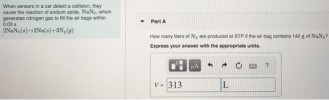
When sensors in a car detect a collision, they cause the reaction of sodium azide, NaNg, which generates nitrogen gas to fill the air bags within 0.03 s. 2NaNg(8)+2Na(8)+3N (9) Part A How many liters of N, are produced at STP if the air bag contains 142 g of NaNg? Express your answer with the appropriate units. °H HAO ? v- 313
solve please
When sensors in a car detect a collision, they cause the reaction of sodium azide, NaNg, which generates nitrogen gas to fill the air bags within 0.03 s. 2NaNg(8)+2Na(8)+3N (9) Part A How many liters of N, are produced at STP if the air bag contains 142 g of NaNg? Express your answer with the appropriate units. °H HAO ? v- 313
The air bags in automobiles were once inflated by nitrogen gas generated by the rapid decomposition...
 The air bags in automobiles were once inflated by nitrogen gas generated by the rapid decomposition of sodium azide, NaN3. 2 NaNz (s) + 2 Na (s) + 3 N2(g) If an air bag has a volume of 47.2 L and is to be filled with nitrogen gas at a pressure of 1.02 atm at a temperature of 24.1°C, how many moles of NaN3 must decompose? You may assume the N2 behaves as an ideal gas.
Automobile air bags inflate during a crash or sudden stop by the rapid generation of nitrogen...
 Automobile air bags inflate during a crash or sudden stop by the
rapid generation of nitrogen gas from sodium azide, according to
the reaction:
2NaN3 (s) 2Na (s) + 3N2 (g)
How many grams of sodium azide are needed to provide sufficient
nitrogen gas to fill a 40.0 × 40.0 × 25.0 cm bag to a pressure of
1.13 atm at 23.0 °C?
Automobile air bags inflate during a crash or sudden stop by the
rapid generation of nitrogen gas from sodium azide, according to
the reaction:
2NaN3 (s) 2Na (s) + 3N2 (g)
How many grams of sodium azide are needed to provide sufficient
nitrogen gas to fill a 40.0 × 40.0 × 25.0 cm bag to a pressure of
1.13 atm at 23.0 °C?
Automobile air bags inflate during a crash or sudden stop by the rapid generation of nitrogen...
Automobile air bags inflate during a crash or sudden stop by the rapid generation of nitrogen gas from sodium azide, according to the reaction: 2NaN3(s) -----2Na(s)+3N2(g) How many grams of sodium azide are needed to provide sufficient nitrogen gas to fill a 30.0 × 30.0 × 25.0 cm bag to a pressure of 1.07 atm at 12.0 °C?
The air bags in automobiles were once inflated by nitrogen gas generated by the rapid decomposition...
 The air bags in automobiles were once inflated by nitrogen gas generated by the rapid decomposition of sodium azide, NaNz. 2 NaNz (s) → 2 Na (s) + 3 N2 (g) If an air bag has a volume of 42.7 L and is to be filled with nitrogen gas at a pressure of 1.16 atm temperature of 24.9°C, how many moles of NaNg must decompose? You may assume the N2 behaves as an ideal gas. If Carmen adds zeros behind...
The air bags in automobiles were once inflated by nitrogen gas generated by the rapid decomposition...
 The air bags in automobiles were once inflated by nitrogen gas generated by the rapid decomposition of sodium azide, NaN3. 2 NaNz (s) → 2 Na (s) + 3 N2(g) If an air bag has a volume of 43.8 L and is to be filled with nitrogen gas at a pressure of 1.13 atm at a temperature of 22.4°C, how many moles of NaN3 must decompose? You may assume the Ny behaves as an ideal gas. If Carmen adds zeros...
Automobile air bags inflate during a crash or sudden stop by the rapid generation of nitrogen...
 Automobile air bags inflate during a crash or sudden stop by the rapid generation of nitrogen gas from sodium azide, according to the reaction: 2NaN, (s) + 2Na(s) +3N2 (8) V 1st attempt See Periodic Table D See Hint How many grams of sodium azide are needed to provide sufficient nitrogen gas to fill a 40.0 x 40.0 25.0 cm bag to a pressure of 1.13 atm at 23.0 °C? g sodium azide
Automobile air bags inflate during a crash or sudden stop by the rapid generation of nitrogen...
 Automobile air bags inflate during a crash or sudden stop by the rapid generation of nitrogen gas from sodium azide, according to the reaction: 2NaN(s) —→ 2Na(s) + 3N, (g) v 4th attempt i See Periodic Table D See How many grams of sodium azide are needed to provide sufficient nitrogen gas to fill a 40.0 x 40.0 25.0 cm bag to a pressure of 1.21 atm at 23.0°C? 79.34 g sodium azide
 solve please
When sensors in a car detect a collision, they cause the reaction of sodium azide, NaNg, which generates nitrogen gas to fill the air bags within 0.03 s. 2NaNg(8)+2Na(8)+3N (9) Part A How many liters of N, are produced at STP if the air bag contains 142 g of NaNg? Express your answer with the appropriate units. °H HAO ? v- 313
solve please
When sensors in a car detect a collision, they cause the reaction of sodium azide, NaNg, which generates nitrogen gas to fill the air bags within 0.03 s. 2NaNg(8)+2Na(8)+3N (9) Part A How many liters of N, are produced at STP if the air bag contains 142 g of NaNg? Express your answer with the appropriate units. °H HAO ? v- 313
 The air bags in automobiles were once inflated by nitrogen gas generated by the rapid decomposition of sodium azide, NaN3. 2 NaNz (s) + 2 Na (s) + 3 N2(g) If an air bag has a volume of 47.2 L and is to be filled with nitrogen gas at a pressure of 1.02 atm at a temperature of 24.1°C, how many moles of NaN3 must decompose? You may assume the N2 behaves as an ideal gas.
 Automobile air bags inflate during a crash or sudden stop by the
rapid generation of nitrogen gas from sodium azide, according to
the reaction:
2NaN3 (s) 2Na (s) + 3N2 (g)
How many grams of sodium azide are needed to provide sufficient
nitrogen gas to fill a 40.0 × 40.0 × 25.0 cm bag to a pressure of
1.13 atm at 23.0 °C?
Automobile air bags inflate during a crash or sudden stop by the
rapid generation of nitrogen gas from sodium azide, according to
the reaction:
2NaN3 (s) 2Na (s) + 3N2 (g)
How many grams of sodium azide are needed to provide sufficient
nitrogen gas to fill a 40.0 × 40.0 × 25.0 cm bag to a pressure of
1.13 atm at 23.0 °C?
 The air bags in automobiles were once inflated by nitrogen gas generated by the rapid decomposition of sodium azide, NaNz. 2 NaNz (s) → 2 Na (s) + 3 N2 (g) If an air bag has a volume of 42.7 L and is to be filled with nitrogen gas at a pressure of 1.16 atm temperature of 24.9°C, how many moles of NaNg must decompose? You may assume the N2 behaves as an ideal gas. If Carmen adds zeros behind...
 The air bags in automobiles were once inflated by nitrogen gas generated by the rapid decomposition of sodium azide, NaN3. 2 NaNz (s) → 2 Na (s) + 3 N2(g) If an air bag has a volume of 43.8 L and is to be filled with nitrogen gas at a pressure of 1.13 atm at a temperature of 22.4°C, how many moles of NaN3 must decompose? You may assume the Ny behaves as an ideal gas. If Carmen adds zeros...
 Automobile air bags inflate during a crash or sudden stop by the rapid generation of nitrogen gas from sodium azide, according to the reaction: 2NaN, (s) + 2Na(s) +3N2 (8) V 1st attempt See Periodic Table D See Hint How many grams of sodium azide are needed to provide sufficient nitrogen gas to fill a 40.0 x 40.0 25.0 cm bag to a pressure of 1.13 atm at 23.0 °C? g sodium azide
 Automobile air bags inflate during a crash or sudden stop by the rapid generation of nitrogen gas from sodium azide, according to the reaction: 2NaN(s) —→ 2Na(s) + 3N, (g) v 4th attempt i See Periodic Table D See How many grams of sodium azide are needed to provide sufficient nitrogen gas to fill a 40.0 x 40.0 25.0 cm bag to a pressure of 1.21 atm at 23.0°C? 79.34 g sodium azide
Most questions answered within 3 hours.
-
Where is the error in this code sequence?
String s1 = "Hello";
String s2 = "ello";...
asked 11 months ago -
Financial data for Joel de Paris, Inc., for last year
follow:
Joel de Paris, Inc.
Balance...
asked 11 months ago -
Consider this reaction:
Al2(SO4)3 (aq)+ BaCl3
(aq) Al2Cl6 (aq)- +
3BaSO4(s) . What is the...
asked 11 months ago -
Suppose that Savneet is considering increasing her
recent random sample from 20 car rentals to 40...
asked 11 months ago -
Trucks arrive at an unloading terminal at an average rate of 120
per hour.
Trucks arrive...
asked 11 months ago -
Why are methanol and ethanol completely soluble in water while
octanol is not very little soluble....
asked 11 months ago -
A facilities manager at a university reads in a research report
that the mean amount of...
asked 11 months ago -
When the CuSO4 is rehydrated by adding water to the anhydrous
compound, is this an endothermic...
asked 11 months ago -
A ray of sunlight is passing from diamond into crown glass; the
angle of incidence is...
asked 11 months ago -
A block of mass 0.249 kg is placed on top of a light, vertical
spring of...
asked 11 months ago -
how do the kidneys compensate in the presences of acidosis
a) trigger hyperventilate
b) reserve acid...
asked 11 months ago -
Question 501 pts
The rental rate of capital to the firm increases. Which of the
following...
asked 11 months ago