
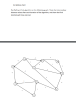
Execute Floyd’s algorithm on the matrix to produce a matrix containing path lengths. Show the final result.
Homework Answers
#include<stdio.h>
#define maxVertices 12
#define INF 55
int min(int a,int b){
return (a<b)?a:b;
}
void init(int distance[maxVertices][maxVertices]){
int iter,jter;
for(iter=0;iter<maxVertices;iter++){
for(jter=0;jter<maxVertices;jter++){
if(iter==jter){
distance[iter][jter] = 0;
}
else{
distance[iter][jter] = INF;
}
}
}}
void FloydWarshall(int distance[maxVertices][maxVertices],int vertices){
int k,i,j;
for(k=0;k<vertices;k++){
for(i=0;i<vertices;i++){
for(j=0;j<vertices;j++){
if(distance[i][j] > distance[i][k] + distance[k][j])
distance[i][j] = distance[i][k] + distance[k][j];
}
}
}
}
int main(){
int i,j;
int graph[maxVertices][maxVertices];
int distance[maxVertices][maxVertices];
int vertices,edges,iter,jter;
/* vertices represent number of vertices in the graph. */
scanf("%d",&vertices);
/*initialize distance between all pairs as infinity*/
init(distance);
int vertex1,vertex2,weight;
/* Here graph[i][j] represent the weight of edge joining i and j */
for(iter=0;iter<11;iter++)
{
scanf("%d%d%d", &vertex1, &vertex2, &weight);
graph[vertex1][vertex2] = weight;
distance[vertex1][vertex2] = weight;
distance[vertex2][vertex1] = weight;
}
FloydWarshall(distance,vertices);
return 0;}
Add Answer to:
Execute Floyd’s algorithm on the matrix to produce a matrix
containing path lengths. Show the final...
Java b) Bellman-Ford distance valuesaer each iteration of the algorithm, and show the final shortest path tree and cost...
 Java
b) Bellman-Ford distance valuesaer each iteration of the algorithm, and show the final shortest path tree and cost. 3. .2
b) Bellman-Ford distance valuesaer each iteration of the algorithm, and show the final shortest path tree and cost. 3. .2
Java
b) Bellman-Ford distance valuesaer each iteration of the algorithm, and show the final shortest path tree and cost. 3. .2
b) Bellman-Ford distance valuesaer each iteration of the algorithm, and show the final shortest path tree and cost. 3. .2
1. Compute the shortest path from D to all other vertices. 0 You must show your work below to rec...
 1. Compute the shortest path from D to all other vertices. 0 You must show your work below to receive full credit. Specifically, show your candidate edges (alphabetically) for each iteration of Dijkstra's Shortest Path Algorithm. Edges Path Lengths Iteration 1 D -A 4 Iteration 2
1. Compute the shortest path from D to all other vertices. 0 You must show your work below to receive full credit. Specifically, show your candidate edges (alphabetically) for each iteration of Dijkstra's Shortest...
1. Compute the shortest path from D to all other vertices. 0 You must show your work below to receive full credit. Specifically, show your candidate edges (alphabetically) for each iteration of Dijkstra's Shortest Path Algorithm. Edges Path Lengths Iteration 1 D -A 4 Iteration 2
1. Compute the shortest path from D to all other vertices. 0 You must show your work below to receive full credit. Specifically, show your candidate edges (alphabetically) for each iteration of Dijkstra's Shortest...
Find the shortest path from node 0 to all other nodes using Dijkstra's shortest path algorithm.
 Find the shortest path from node 0 to all other nodes using
Dijkstra's shortest path algorithm. (Show the steps involved, table
of each iteration and final solution)
Find the shortest path from node 0 to all other nodes using
Dijkstra's shortest path algorithm. (Show the steps involved, table
of each iteration and final solution)
Use the dynamic programming technique to find an optimal parenthesization of a matrix-chain product whose sequence...
 Use the dynamic programming technique to find
an optimal parenthesization of a matrix-chain product whose
sequence of dimensions is <5, 8, 4, 10, 7, 50, 6>.
Matrix Dimension
A1 5*8
A2 8*4
A3 4*10
A4 10*7
A5 7*50
A6 50*6
You may do this either by implementing the MATRIX-CHAIN-ORDER
algorithm in the text or by simulating the algorithm by hand. In
either case, show the dynamic programming tables at the end of the
computation.
Using Floyd’s algorithm (See Dynamic Programming...
Use the dynamic programming technique to find
an optimal parenthesization of a matrix-chain product whose
sequence of dimensions is <5, 8, 4, 10, 7, 50, 6>.
Matrix Dimension
A1 5*8
A2 8*4
A3 4*10
A4 10*7
A5 7*50
A6 50*6
You may do this either by implementing the MATRIX-CHAIN-ORDER
algorithm in the text or by simulating the algorithm by hand. In
either case, show the dynamic programming tables at the end of the
computation.
Using Floyd’s algorithm (See Dynamic Programming...
Java 4) Shortest Paths a) Dijkstra's Algorithm Run Dijkstra's algorithm on the following graph. Show the interm...
 Java
4) Shortest Paths a) Dijkstra's Algorithm Run Dijkstra's algorithm on the following graph. Show the intermediate cost values after each iteration of the algorithm, and show the final shortest path tree and cost
4) Shortest Paths a) Dijkstra's Algorithm Run Dijkstra's algorithm on the following graph. Show the intermediate cost values after each iteration of the algorithm, and show the final shortest path tree and cost
Java
4) Shortest Paths a) Dijkstra's Algorithm Run Dijkstra's algorithm on the following graph. Show the intermediate cost values after each iteration of the algorithm, and show the final shortest path tree and cost
4) Shortest Paths a) Dijkstra's Algorithm Run Dijkstra's algorithm on the following graph. Show the intermediate cost values after each iteration of the algorithm, and show the final shortest path tree and cost
Apply Dijkstra's Algorithm to find a shortest path from a to z. Show every step in the algorithm.
 Apply Dijkstra's Algorithm to find a shortest path from a to z. Show every step in the algorithm.
showing the path of the left-turning algorithm and the path of the right-turning algorithm. A switching...
 showing the path of the left-turning algorithm and the path of the right-turning algorithm. A switching Bug 0 algorithm (25 points). E1.2 (i) (10 points) Draw a flowchart for the following pseudo-code implementation of the switching Bug 0 algorithm: 1: choose an initial direction (either left or right) 2: while not at goal : move towards the goal if hit an obstacle : while not able to move towards goal : take a step along the obstacle boundary moving in...
10.For the following network, use Dijkstra’s least-cost path algorithm to compute the paths from A to...
 10.For the following network, use Dijkstra’s least-cost path
algorithm to compute the paths from A to all other nodes. Show all
the steps. Draw the final least-cost path tree.
10. For the following network, use Dijkstra's least-cost path algorithm to compute the paths from A to all other nodes. Show all the steps. Draw the final least-cost path tree. 4 10
10.For the following network, use Dijkstra’s least-cost path
algorithm to compute the paths from A to all other nodes. Show all
the steps. Draw the final least-cost path tree.
10. For the following network, use Dijkstra's least-cost path algorithm to compute the paths from A to all other nodes. Show all the steps. Draw the final least-cost path tree. 4 10
Algortithms Please answer question 7 using algorithm 3.5 7, /Analyze the Print Shortest Path algorithm (Algorithm...
 Algortithms
Please answer question 7 using algorithm 3.5
7, /Analyze the Print Shortest Path algorithm (Algorithm 3.5) and show that it has a linear-time complexity Algorithm 3.5 Print Shortest Path Problem: Print the intermediate vertices on a shortest path from one vertex to another vertex in a weighted graph. Inputs: the array P produced by Algorithm 3.4, and two indices, q and r, of vertices in the graph that is the input to Algorithm 3.4. highest index of an intermediate...
Algortithms
Please answer question 7 using algorithm 3.5
7, /Analyze the Print Shortest Path algorithm (Algorithm 3.5) and show that it has a linear-time complexity Algorithm 3.5 Print Shortest Path Problem: Print the intermediate vertices on a shortest path from one vertex to another vertex in a weighted graph. Inputs: the array P produced by Algorithm 3.4, and two indices, q and r, of vertices in the graph that is the input to Algorithm 3.4. highest index of an intermediate...
Please answer A and B 1. Consider the following adjacency matrix representing vertices v through v^:...
 Please answer A and B
1. Consider the following adjacency matrix representing vertices v through v^: weighted graph containing a ro 5 0 0 8 0 61 5 0 0 7 0 0 0 jo 0 0 0 0 1 3| 0 7 0 0 2 0 0 8 0 0 0 0 1 0 0 0 4 L6 0 3 0 0 4 0- 20 0 0 a. Draw the graph resulting from the adjacency matrix b. Assuming the...
Please answer A and B
1. Consider the following adjacency matrix representing vertices v through v^: weighted graph containing a ro 5 0 0 8 0 61 5 0 0 7 0 0 0 jo 0 0 0 0 1 3| 0 7 0 0 2 0 0 8 0 0 0 0 1 0 0 0 4 L6 0 3 0 0 4 0- 20 0 0 a. Draw the graph resulting from the adjacency matrix b. Assuming the...
 Java
b) Bellman-Ford distance valuesaer each iteration of the algorithm, and show the final shortest path tree and cost. 3. .2
b) Bellman-Ford distance valuesaer each iteration of the algorithm, and show the final shortest path tree and cost. 3. .2
Java
b) Bellman-Ford distance valuesaer each iteration of the algorithm, and show the final shortest path tree and cost. 3. .2
b) Bellman-Ford distance valuesaer each iteration of the algorithm, and show the final shortest path tree and cost. 3. .2
 1. Compute the shortest path from D to all other vertices. 0 You must show your work below to receive full credit. Specifically, show your candidate edges (alphabetically) for each iteration of Dijkstra's Shortest Path Algorithm. Edges Path Lengths Iteration 1 D -A 4 Iteration 2
1. Compute the shortest path from D to all other vertices. 0 You must show your work below to receive full credit. Specifically, show your candidate edges (alphabetically) for each iteration of Dijkstra's Shortest...
1. Compute the shortest path from D to all other vertices. 0 You must show your work below to receive full credit. Specifically, show your candidate edges (alphabetically) for each iteration of Dijkstra's Shortest Path Algorithm. Edges Path Lengths Iteration 1 D -A 4 Iteration 2
1. Compute the shortest path from D to all other vertices. 0 You must show your work below to receive full credit. Specifically, show your candidate edges (alphabetically) for each iteration of Dijkstra's Shortest...
 Find the shortest path from node 0 to all other nodes using
Dijkstra's shortest path algorithm. (Show the steps involved, table
of each iteration and final solution)
Find the shortest path from node 0 to all other nodes using
Dijkstra's shortest path algorithm. (Show the steps involved, table
of each iteration and final solution)
 Use the dynamic programming technique to find
an optimal parenthesization of a matrix-chain product whose
sequence of dimensions is <5, 8, 4, 10, 7, 50, 6>.
Matrix Dimension
A1 5*8
A2 8*4
A3 4*10
A4 10*7
A5 7*50
A6 50*6
You may do this either by implementing the MATRIX-CHAIN-ORDER
algorithm in the text or by simulating the algorithm by hand. In
either case, show the dynamic programming tables at the end of the
computation.
Using Floyd’s algorithm (See Dynamic Programming...
Use the dynamic programming technique to find
an optimal parenthesization of a matrix-chain product whose
sequence of dimensions is <5, 8, 4, 10, 7, 50, 6>.
Matrix Dimension
A1 5*8
A2 8*4
A3 4*10
A4 10*7
A5 7*50
A6 50*6
You may do this either by implementing the MATRIX-CHAIN-ORDER
algorithm in the text or by simulating the algorithm by hand. In
either case, show the dynamic programming tables at the end of the
computation.
Using Floyd’s algorithm (See Dynamic Programming...
 Java
4) Shortest Paths a) Dijkstra's Algorithm Run Dijkstra's algorithm on the following graph. Show the intermediate cost values after each iteration of the algorithm, and show the final shortest path tree and cost
4) Shortest Paths a) Dijkstra's Algorithm Run Dijkstra's algorithm on the following graph. Show the intermediate cost values after each iteration of the algorithm, and show the final shortest path tree and cost
Java
4) Shortest Paths a) Dijkstra's Algorithm Run Dijkstra's algorithm on the following graph. Show the intermediate cost values after each iteration of the algorithm, and show the final shortest path tree and cost
4) Shortest Paths a) Dijkstra's Algorithm Run Dijkstra's algorithm on the following graph. Show the intermediate cost values after each iteration of the algorithm, and show the final shortest path tree and cost
 showing the path of the left-turning algorithm and the path of the right-turning algorithm. A switching Bug 0 algorithm (25 points). E1.2 (i) (10 points) Draw a flowchart for the following pseudo-code implementation of the switching Bug 0 algorithm: 1: choose an initial direction (either left or right) 2: while not at goal : move towards the goal if hit an obstacle : while not able to move towards goal : take a step along the obstacle boundary moving in...
 10.For the following network, use Dijkstra’s least-cost path
algorithm to compute the paths from A to all other nodes. Show all
the steps. Draw the final least-cost path tree.
10. For the following network, use Dijkstra's least-cost path algorithm to compute the paths from A to all other nodes. Show all the steps. Draw the final least-cost path tree. 4 10
10.For the following network, use Dijkstra’s least-cost path
algorithm to compute the paths from A to all other nodes. Show all
the steps. Draw the final least-cost path tree.
10. For the following network, use Dijkstra's least-cost path algorithm to compute the paths from A to all other nodes. Show all the steps. Draw the final least-cost path tree. 4 10
 Algortithms
Please answer question 7 using algorithm 3.5
7, /Analyze the Print Shortest Path algorithm (Algorithm 3.5) and show that it has a linear-time complexity Algorithm 3.5 Print Shortest Path Problem: Print the intermediate vertices on a shortest path from one vertex to another vertex in a weighted graph. Inputs: the array P produced by Algorithm 3.4, and two indices, q and r, of vertices in the graph that is the input to Algorithm 3.4. highest index of an intermediate...
Algortithms
Please answer question 7 using algorithm 3.5
7, /Analyze the Print Shortest Path algorithm (Algorithm 3.5) and show that it has a linear-time complexity Algorithm 3.5 Print Shortest Path Problem: Print the intermediate vertices on a shortest path from one vertex to another vertex in a weighted graph. Inputs: the array P produced by Algorithm 3.4, and two indices, q and r, of vertices in the graph that is the input to Algorithm 3.4. highest index of an intermediate...
 Please answer A and B
1. Consider the following adjacency matrix representing vertices v through v^: weighted graph containing a ro 5 0 0 8 0 61 5 0 0 7 0 0 0 jo 0 0 0 0 1 3| 0 7 0 0 2 0 0 8 0 0 0 0 1 0 0 0 4 L6 0 3 0 0 4 0- 20 0 0 a. Draw the graph resulting from the adjacency matrix b. Assuming the...
Please answer A and B
1. Consider the following adjacency matrix representing vertices v through v^: weighted graph containing a ro 5 0 0 8 0 61 5 0 0 7 0 0 0 jo 0 0 0 0 1 3| 0 7 0 0 2 0 0 8 0 0 0 0 1 0 0 0 4 L6 0 3 0 0 4 0- 20 0 0 a. Draw the graph resulting from the adjacency matrix b. Assuming the...
Most questions answered within 3 hours.
-
Where is the error in this code sequence?
String s1 = "Hello";
String s2 = "ello";...
asked 11 months ago -
Financial data for Joel de Paris, Inc., for last year
follow:
Joel de Paris, Inc.
Balance...
asked 11 months ago -
Consider this reaction:
Al2(SO4)3 (aq)+ BaCl3
(aq) Al2Cl6 (aq)- +
3BaSO4(s) . What is the...
asked 11 months ago -
Suppose that Savneet is considering increasing her
recent random sample from 20 car rentals to 40...
asked 11 months ago -
Trucks arrive at an unloading terminal at an average rate of 120
per hour.
Trucks arrive...
asked 11 months ago -
Why are methanol and ethanol completely soluble in water while
octanol is not very little soluble....
asked 11 months ago -
A facilities manager at a university reads in a research report
that the mean amount of...
asked 11 months ago -
When the CuSO4 is rehydrated by adding water to the anhydrous
compound, is this an endothermic...
asked 11 months ago -
A ray of sunlight is passing from diamond into crown glass; the
angle of incidence is...
asked 11 months ago -
A block of mass 0.249 kg is placed on top of a light, vertical
spring of...
asked 11 months ago -
how do the kidneys compensate in the presences of acidosis
a) trigger hyperventilate
b) reserve acid...
asked 11 months ago -
Question 501 pts
The rental rate of capital to the firm increases. Which of the
following...
asked 11 months ago