
Homework Answers
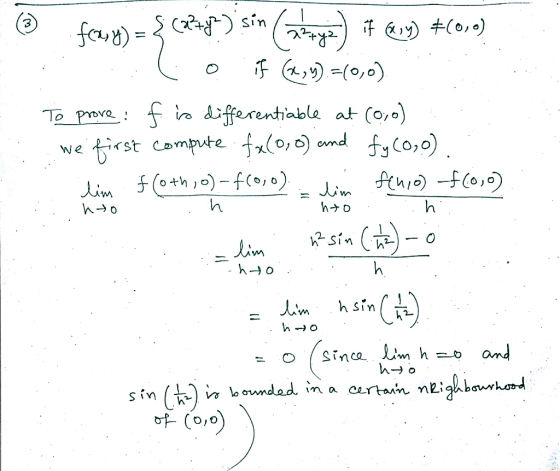
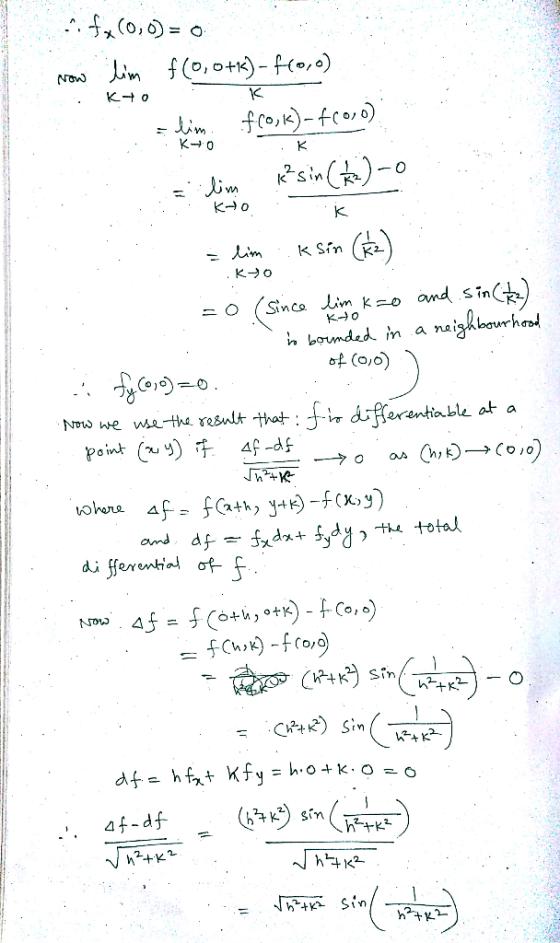
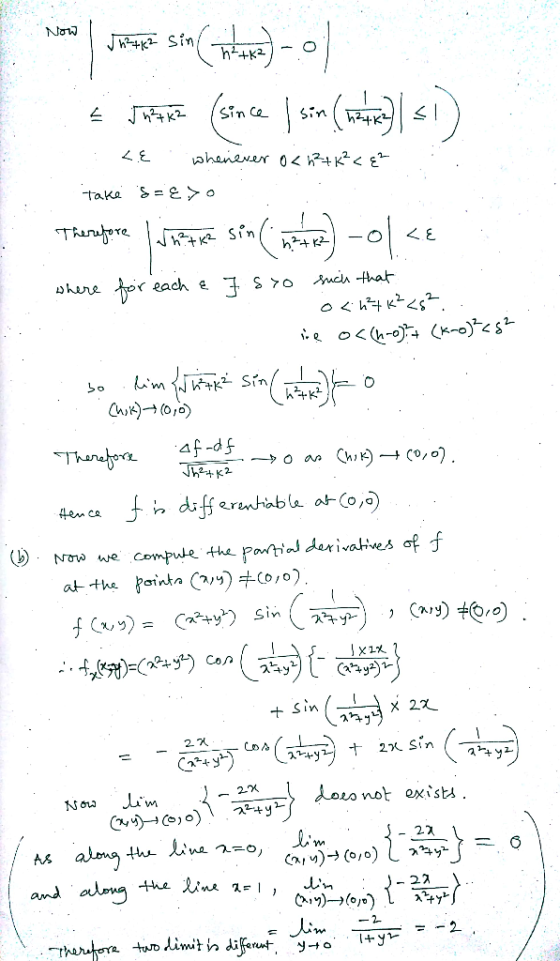
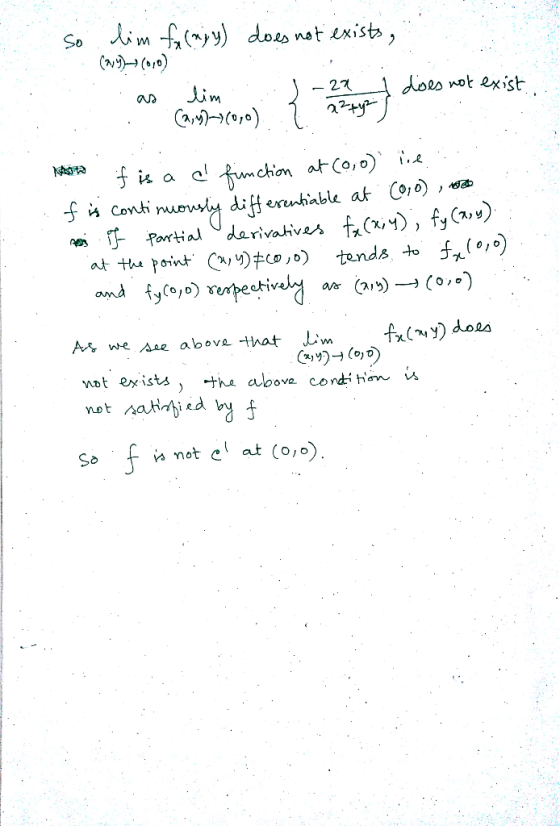
Question 2 (20 points): Consider the functions f(x, y)-xe y sin y and g(x, y)-ys 1. Show f is differentiable in its domain 2. Compute the partial derivatives of g at (0,0) 3. Show that g is not d...
 Question 2 (20 points): Consider the functions f(x, y)-xe y sin y and g(x, y)-ys 1. Show f is differentiable in its domain 2. Compute the partial derivatives of g at (0,0) 3. Show that g is not differentiable at (0,0) 4. You are told that there is a function F : R2 → R with partial derivatives F(x,y) = x2 +4y and Fy(x, y 3x - y. Should you believe it? Explain why. (Hint: use Clairaut's theorem)
Question 2...
Question 2 (20 points): Consider the functions f(x, y)-xe y sin y and g(x, y)-ys 1. Show f is differentiable in its domain 2. Compute the partial derivatives of g at (0,0) 3. Show that g is not differentiable at (0,0) 4. You are told that there is a function F : R2 → R with partial derivatives F(x,y) = x2 +4y and Fy(x, y 3x - y. Should you believe it? Explain why. (Hint: use Clairaut's theorem)
Question 2...
y? - 2xy x + y2 if (x, y) + (0,0) 7. Given the piecewise function:...
 y? - 2xy x + y2 if (x, y) + (0,0) 7. Given the piecewise function: f(x,y) 0 if (x, y) = (0,0) a) Show that: limf(x,y) does not exist. *(x,y) (0,0) b) Find: fy(0,0). c) Where is f continuous? Where is f differentiable? Explain.
2. Consider the function f : R2 → R defined below. r3уг_ if (x,y) (0,0) f(x,y)...
 2. Consider the function f : R2 → R defined below. r3уг_ if (x,y) (0,0) f(x,y) = if (x, y) (0, 0) (a) Prove that f is continuous at (0,0) (b) Calculate the partial derivatives (0,0) and (0,0) directly from the definition of partial derivatives. (c) Prove that f is not differentiable at (0,0).
showing multivariable calculus functions are differentiable Please help! 2. Recall that by Theorem 3 of Section 14.3, a...
 showing multivariable calculus functions are differentiable
Please help!
2. Recall that by Theorem 3 of Section 14.3, a function f(x,y) is differentiable if its partial derivatives fa and fy both exist and are continuous. (a) Use this idea to show that the function f(x,y)-esin ry is differentiable. (b) Let o be a differentiable function and f(,)Jy Find the partial derivatives of f and determine whether they are continuous. Hint: The Fundamental Theorem of Calculus gives us that Ø has an...
showing multivariable calculus functions are differentiable
Please help!
2. Recall that by Theorem 3 of Section 14.3, a function f(x,y) is differentiable if its partial derivatives fa and fy both exist and are continuous. (a) Use this idea to show that the function f(x,y)-esin ry is differentiable. (b) Let o be a differentiable function and f(,)Jy Find the partial derivatives of f and determine whether they are continuous. Hint: The Fundamental Theorem of Calculus gives us that Ø has an...
1. Consider a continuous random variable X with the probability density function Sx(x) = 3<x<7, zero...
 1. Consider a continuous random variable X with the probability density function Sx(x) = 3<x<7, zero elsewhere. a) Find the value of C that makes fx(x) a valid probability density function. b) Find the cumulative distribution function of X, Fx(x). "Hint”: To double-check your answer: should be Fx(3)=0, Fx(7)=1. 1. con (continued) Consider Y=g(x)- 20 100 X 2 + Find the support (the range of possible values) of the probability distribution of Y. d) Use part (b) and the c.d.f....
Fx 0. Show that =-- dx Fy dy 8. Suppose y is a function of z, F(x, y) = 0, and F,メO. Show that d...
 Fx 0. Show that =-- dx Fy dy 8. Suppose y is a function of z, F(x, y) = 0, and F,メO. Show that dr--Fr 9. Fid the critical points of f(z, y) if any exist, for (a, y) = ex sin y 10. Calculate the iterated integral: ysin(zy)d dy
Fx 0. Show that =-- dx Fy dy 8. Suppose y is a function of z, F(x, y) = 0, and F,メO. Show that dr--Fr 9. Fid the critical points...
Fx 0. Show that =-- dx Fy dy 8. Suppose y is a function of z, F(x, y) = 0, and F,メO. Show that dr--Fr 9. Fid the critical points of f(z, y) if any exist, for (a, y) = ex sin y 10. Calculate the iterated integral: ysin(zy)d dy
Fx 0. Show that =-- dx Fy dy 8. Suppose y is a function of z, F(x, y) = 0, and F,メO. Show that dr--Fr 9. Fid the critical points...
23. [-16 Points] DETAILS LARCALCET7 4.4.028.EP. Consider the following function. f(x) = 3 sin(x) + 3...
 23. [-16 Points] DETAILS LARCALCET7 4.4.028.EP. Consider the following function. f(x) = 3 sin(x) + 3 cos(x), [0, 27) Find f'(x). f'(x) = Find f'(x). f"(x) = Find the points of inflection of the graph of the function. (If an answer does not exist, enter DNE.) (x, y) = (smaller x-value) (x, y) = (larger x-value) Describe the concavity. (Enter your answer using interval notation. If an answer does not exist, enter DNE.) concave upward concave downward
If z = f(x,y), where f is differentiable, and x = g(t) y = hết) g(3)...
 If z = f(x,y), where f is differentiable, and x = g(t) y = hết) g(3) = 2 h(3) = 7 g'(3) = 5 h'(3) = -4 fx(2,7) = 6 fy(2,7) = -8 Find dz/dt when t = 3.
the function of two real variables defined below: 1 –9x + 2y“ (x, y) + (0,0),...
 the function of two real variables defined below: 1 –9x + 2y“ (x, y) + (0,0), f(x, y) = { 6x + 3y 10 (x, y) = (0,0). Use the limit definition of partial derivatives to compute the following partial derivatives. Enter "DNE" if the derivative does not exist. fx(0,0) = DNE fy(0,0) = 0
Consider the function
Consider the function \(f(x, y)=\frac{x y}{x^{2}+y^{2}}\) if \((x, y) \neq(0,0)\)$$ =0 \text { if }(x, y)=(0,0) $$Which one of the statement is incorrect.Select one:a. \(f(x, y)\) is differentiable everywhere.b. \(f(x, y)\) is differentiable everywhere except at the origin.c. \(f(x, y)\) is not continuousd. First partial derivatives \(f(x, y)\) exist.e. \(\lim _{(x, y) \rightarrow(0,0)} \frac{x y}{x^{2}+y^{2}}\) does not exist.
 Question 2 (20 points): Consider the functions f(x, y)-xe y sin y and g(x, y)-ys 1. Show f is differentiable in its domain 2. Compute the partial derivatives of g at (0,0) 3. Show that g is not differentiable at (0,0) 4. You are told that there is a function F : R2 → R with partial derivatives F(x,y) = x2 +4y and Fy(x, y 3x - y. Should you believe it? Explain why. (Hint: use Clairaut's theorem)
Question 2...
Question 2 (20 points): Consider the functions f(x, y)-xe y sin y and g(x, y)-ys 1. Show f is differentiable in its domain 2. Compute the partial derivatives of g at (0,0) 3. Show that g is not differentiable at (0,0) 4. You are told that there is a function F : R2 → R with partial derivatives F(x,y) = x2 +4y and Fy(x, y 3x - y. Should you believe it? Explain why. (Hint: use Clairaut's theorem)
Question 2...
 y? - 2xy x + y2 if (x, y) + (0,0) 7. Given the piecewise function: f(x,y) 0 if (x, y) = (0,0) a) Show that: limf(x,y) does not exist. *(x,y) (0,0) b) Find: fy(0,0). c) Where is f continuous? Where is f differentiable? Explain.
 2. Consider the function f : R2 → R defined below. r3уг_ if (x,y) (0,0) f(x,y) = if (x, y) (0, 0) (a) Prove that f is continuous at (0,0) (b) Calculate the partial derivatives (0,0) and (0,0) directly from the definition of partial derivatives. (c) Prove that f is not differentiable at (0,0).
 showing multivariable calculus functions are differentiable
Please help!
2. Recall that by Theorem 3 of Section 14.3, a function f(x,y) is differentiable if its partial derivatives fa and fy both exist and are continuous. (a) Use this idea to show that the function f(x,y)-esin ry is differentiable. (b) Let o be a differentiable function and f(,)Jy Find the partial derivatives of f and determine whether they are continuous. Hint: The Fundamental Theorem of Calculus gives us that Ø has an...
showing multivariable calculus functions are differentiable
Please help!
2. Recall that by Theorem 3 of Section 14.3, a function f(x,y) is differentiable if its partial derivatives fa and fy both exist and are continuous. (a) Use this idea to show that the function f(x,y)-esin ry is differentiable. (b) Let o be a differentiable function and f(,)Jy Find the partial derivatives of f and determine whether they are continuous. Hint: The Fundamental Theorem of Calculus gives us that Ø has an...
 1. Consider a continuous random variable X with the probability density function Sx(x) = 3<x<7, zero elsewhere. a) Find the value of C that makes fx(x) a valid probability density function. b) Find the cumulative distribution function of X, Fx(x). "Hint”: To double-check your answer: should be Fx(3)=0, Fx(7)=1. 1. con (continued) Consider Y=g(x)- 20 100 X 2 + Find the support (the range of possible values) of the probability distribution of Y. d) Use part (b) and the c.d.f....
 Fx 0. Show that =-- dx Fy dy 8. Suppose y is a function of z, F(x, y) = 0, and F,メO. Show that dr--Fr 9. Fid the critical points of f(z, y) if any exist, for (a, y) = ex sin y 10. Calculate the iterated integral: ysin(zy)d dy
Fx 0. Show that =-- dx Fy dy 8. Suppose y is a function of z, F(x, y) = 0, and F,メO. Show that dr--Fr 9. Fid the critical points...
Fx 0. Show that =-- dx Fy dy 8. Suppose y is a function of z, F(x, y) = 0, and F,メO. Show that dr--Fr 9. Fid the critical points of f(z, y) if any exist, for (a, y) = ex sin y 10. Calculate the iterated integral: ysin(zy)d dy
Fx 0. Show that =-- dx Fy dy 8. Suppose y is a function of z, F(x, y) = 0, and F,メO. Show that dr--Fr 9. Fid the critical points...
 23. [-16 Points] DETAILS LARCALCET7 4.4.028.EP. Consider the following function. f(x) = 3 sin(x) + 3 cos(x), [0, 27) Find f'(x). f'(x) = Find f'(x). f"(x) = Find the points of inflection of the graph of the function. (If an answer does not exist, enter DNE.) (x, y) = (smaller x-value) (x, y) = (larger x-value) Describe the concavity. (Enter your answer using interval notation. If an answer does not exist, enter DNE.) concave upward concave downward
 If z = f(x,y), where f is differentiable, and x = g(t) y = hết) g(3) = 2 h(3) = 7 g'(3) = 5 h'(3) = -4 fx(2,7) = 6 fy(2,7) = -8 Find dz/dt when t = 3.
 the function of two real variables defined below: 1 –9x + 2y“ (x, y) + (0,0), f(x, y) = { 6x + 3y 10 (x, y) = (0,0). Use the limit definition of partial derivatives to compute the following partial derivatives. Enter "DNE" if the derivative does not exist. fx(0,0) = DNE fy(0,0) = 0
Most questions answered within 3 hours.
-
Where is the error in this code sequence?
String s1 = "Hello";
String s2 = "ello";...
asked 10 months ago -
Financial data for Joel de Paris, Inc., for last year
follow:
Joel de Paris, Inc.
Balance...
asked 10 months ago -
Consider this reaction:
Al2(SO4)3 (aq)+ BaCl3
(aq) Al2Cl6 (aq)- +
3BaSO4(s) . What is the...
asked 10 months ago -
Suppose that Savneet is considering increasing her
recent random sample from 20 car rentals to 40...
asked 10 months ago -
Trucks arrive at an unloading terminal at an average rate of 120
per hour.
Trucks arrive...
asked 10 months ago -
Why are methanol and ethanol completely soluble in water while
octanol is not very little soluble....
asked 10 months ago -
A facilities manager at a university reads in a research report
that the mean amount of...
asked 10 months ago -
When the CuSO4 is rehydrated by adding water to the anhydrous
compound, is this an endothermic...
asked 10 months ago -
A ray of sunlight is passing from diamond into crown glass; the
angle of incidence is...
asked 10 months ago -
A block of mass 0.249 kg is placed on top of a light, vertical
spring of...
asked 10 months ago -
how do the kidneys compensate in the presences of acidosis
a) trigger hyperventilate
b) reserve acid...
asked 10 months ago -
Question 501 pts
The rental rate of capital to the firm increases. Which of the
following...
asked 10 months ago