
Homework Answers


Add Answer to:
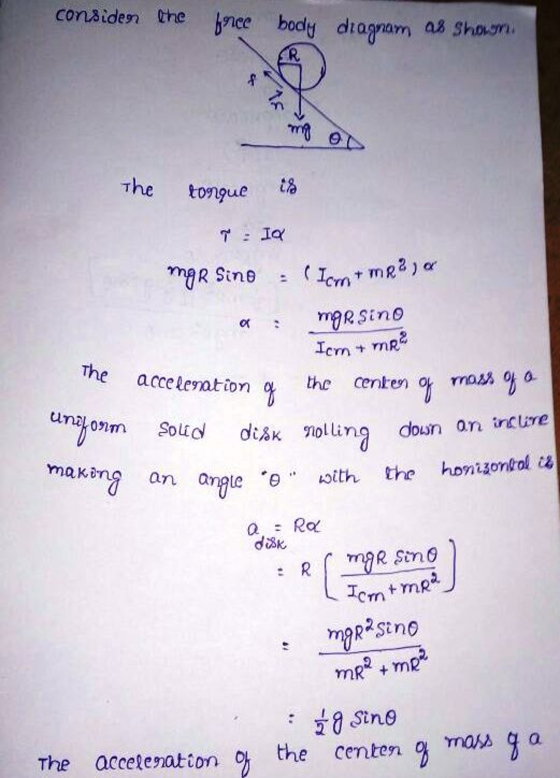
Determine the acceleration of the center of mass of a uniform solid disk rolling down an...
Consider a uniform disk of radius R and mass m sliding down an incline making an...
Consider a uniform disk of radius R and mass m sliding down an incline making an angle θ with respect to the horizontal. The coefficient of kinetic friction between the disk and the surface is μk. The torque due to friction causes the disk to rotate as it slides down the incline. a) Compute the linear acceleration of the disk as it slides down the incline. b) Compute the angular acceleration of the disk as it slides down the incline....
Consider a uniform disk of mass m, and radius R that is rolling with slipping. The surface has a ...
 ANS:
PLEASE USE LAGRANGIAN, THANK YOU, WILL UPVOTE GOOD ANSWER
IMMEDIATELY
Consider a uniform disk of mass m, and radius R that is rolling with slipping. The surface has a coefficient of kinetic friction a) Find the equations of motion. b) Next consider the same disk when it is rolling without slipping. Find the EOM using either x or θ. Hint: be careful with the generalized force for θ. If we label point P as the point on the disk...
ANS:
PLEASE USE LAGRANGIAN, THANK YOU, WILL UPVOTE GOOD ANSWER
IMMEDIATELY
Consider a uniform disk of mass m, and radius R that is rolling with slipping. The surface has a coefficient of kinetic friction a) Find the equations of motion. b) Next consider the same disk when it is rolling without slipping. Find the EOM using either x or θ. Hint: be careful with the generalized force for θ. If we label point P as the point on the disk...
Q4 (15 points): A uniform hoop of radius R - 15 cm and mass M 1.2...
 Q4 (15 points): A uniform hoop of radius R - 15 cm and mass M 1.2 kg is placed at the top of an incline of height h-2 m. The surface of the incline makes an angle θ-30° with the horizontal. The hoop is released from rest and rolls without slipping. m MR2 for hoopl a) What is the acceleration of its center of mass (açom) during rolling? b) What is the force of friction in unit vector notation required...
A thin light string is wrapped around a solid uniform disk of mass M and radius...
A thin light string is wrapped around a solid uniform disk of mass M and radius R, mounted as shown. The loose end of the string is attached to the axle of a solid uniform disc of mass m and the same radius r which is can roll down without slipping down an inclined plane that makes angle θ with the horizontal. Find the acceleration a of the rolling disc. Neglect friction in the axle of the pulley. a =...
7090 2. A circular rigid body of mass m and radius of gyration k is released...
 7090 2. A circular rigid body of mass m and radius of gyration k is released from stationary in an incline plane of incline angle θ and coefficient of friction μ Determine the normal reaction force, friction force, linear and angular accelerations when it is in (1) pure rolling motion. (2) rolling with slipping motion. (3) Compare a cylinder (radius of gyration k 1/ 2) and a hoop (k- 1) of the same mass, which one travels faster along the...
A uniform solid disk, a uniform solid sphere, and a uniform hoop are placed side by...
 A uniform solid disk, a uniform solid sphere, and a uniform hoop are placed side by side at the top of an incline of height h. They are released from rest and roll without slipping. Place the objects in order of fastest to slowest at the bottom the incline. (Be sure to be able to explain why, in words, without equations.) Verify your answer by deriving a formula for their speeds when they reach the bottom in terms of h....
#335. Rolling disk kinetics A uniform rigid disk of mass m = 6 kg and radius...
 #335. Rolling disk kinetics A uniform rigid disk of mass m = 6 kg and radius r = 4 m starts at rest on a flat ground as shown. Force Ď= 28î + 589 N acts at point P on the right edge, and gravity g = 9.8 m/s² acts vertically. The coefficient of friction between the disk and the ground is j = 0.75. D lo c. P What is the angular acceleration ā of the disk? Matlab/Mathematica input:...
A uniform hoop rolls without slipping down a 19° inclined plane. What is the acceleration of...
A uniform hoop rolls without slipping down a 19° inclined plane. What is the acceleration of the hoop's center of mass? The moment of inertia of a uniform solid disk about an axis that passes through its center = mr². The moment of inertia of a uniform solid disk about an axis that is tangent to its surface = 2mr².
A uniform solid disk and a uniform hoop are placed side by side at the top...
 A uniform solid disk and a uniform hoop are placed side by side at the top of an incline of height h. If they are released from rest and roll without slipping, which object reaches the bottom first? solid disk uniform hoop it's a tie Verify your answer by calculating their speeds when they reach the bottom in terms of h. (Use any variable or symbol stated above along with the following as necessary: g for the acceleration of gravity.)...
A solid, uniform disk of radius 0.250 m and mass 53.2 kg rolls down a ramp...
A solid, uniform disk of radius 0.250 m and mass 53.2 kg rolls down a ramp of length 4.20 m that makes an angle of 15.0°with the horizontal. The disk starts from rest from the top of the ramp. (a) Find the speed of the disk's center of mass when it reaches the bottom of the ramp. m/s (b) Find the angular speed of the disk at the bottom of the ramp.
 ANS:
PLEASE USE LAGRANGIAN, THANK YOU, WILL UPVOTE GOOD ANSWER
IMMEDIATELY
Consider a uniform disk of mass m, and radius R that is rolling with slipping. The surface has a coefficient of kinetic friction a) Find the equations of motion. b) Next consider the same disk when it is rolling without slipping. Find the EOM using either x or θ. Hint: be careful with the generalized force for θ. If we label point P as the point on the disk...
ANS:
PLEASE USE LAGRANGIAN, THANK YOU, WILL UPVOTE GOOD ANSWER
IMMEDIATELY
Consider a uniform disk of mass m, and radius R that is rolling with slipping. The surface has a coefficient of kinetic friction a) Find the equations of motion. b) Next consider the same disk when it is rolling without slipping. Find the EOM using either x or θ. Hint: be careful with the generalized force for θ. If we label point P as the point on the disk...
 Q4 (15 points): A uniform hoop of radius R - 15 cm and mass M 1.2 kg is placed at the top of an incline of height h-2 m. The surface of the incline makes an angle θ-30° with the horizontal. The hoop is released from rest and rolls without slipping. m MR2 for hoopl a) What is the acceleration of its center of mass (açom) during rolling? b) What is the force of friction in unit vector notation required...
 7090 2. A circular rigid body of mass m and radius of gyration k is released from stationary in an incline plane of incline angle θ and coefficient of friction μ Determine the normal reaction force, friction force, linear and angular accelerations when it is in (1) pure rolling motion. (2) rolling with slipping motion. (3) Compare a cylinder (radius of gyration k 1/ 2) and a hoop (k- 1) of the same mass, which one travels faster along the...
 A uniform solid disk, a uniform solid sphere, and a uniform hoop are placed side by side at the top of an incline of height h. They are released from rest and roll without slipping. Place the objects in order of fastest to slowest at the bottom the incline. (Be sure to be able to explain why, in words, without equations.) Verify your answer by deriving a formula for their speeds when they reach the bottom in terms of h....
 #335. Rolling disk kinetics A uniform rigid disk of mass m = 6 kg and radius r = 4 m starts at rest on a flat ground as shown. Force Ď= 28î + 589 N acts at point P on the right edge, and gravity g = 9.8 m/s² acts vertically. The coefficient of friction between the disk and the ground is j = 0.75. D lo c. P What is the angular acceleration ā of the disk? Matlab/Mathematica input:...
 A uniform solid disk and a uniform hoop are placed side by side at the top of an incline of height h. If they are released from rest and roll without slipping, which object reaches the bottom first? solid disk uniform hoop it's a tie Verify your answer by calculating their speeds when they reach the bottom in terms of h. (Use any variable or symbol stated above along with the following as necessary: g for the acceleration of gravity.)...
Most questions answered within 3 hours.
-
Where is the error in this code sequence?
String s1 = "Hello";
String s2 = "ello";...
asked 11 months ago -
Financial data for Joel de Paris, Inc., for last year
follow:
Joel de Paris, Inc.
Balance...
asked 11 months ago -
Consider this reaction:
Al2(SO4)3 (aq)+ BaCl3
(aq) Al2Cl6 (aq)- +
3BaSO4(s) . What is the...
asked 11 months ago -
Suppose that Savneet is considering increasing her
recent random sample from 20 car rentals to 40...
asked 11 months ago -
Trucks arrive at an unloading terminal at an average rate of 120
per hour.
Trucks arrive...
asked 11 months ago -
Why are methanol and ethanol completely soluble in water while
octanol is not very little soluble....
asked 11 months ago -
A facilities manager at a university reads in a research report
that the mean amount of...
asked 11 months ago -
When the CuSO4 is rehydrated by adding water to the anhydrous
compound, is this an endothermic...
asked 11 months ago -
A ray of sunlight is passing from diamond into crown glass; the
angle of incidence is...
asked 11 months ago -
A block of mass 0.249 kg is placed on top of a light, vertical
spring of...
asked 11 months ago -
how do the kidneys compensate in the presences of acidosis
a) trigger hyperventilate
b) reserve acid...
asked 11 months ago -
Question 501 pts
The rental rate of capital to the firm increases. Which of the
following...
asked 11 months ago