Please answer the following question and show all work to receive credit:
Homework Answers

Add Answer to:
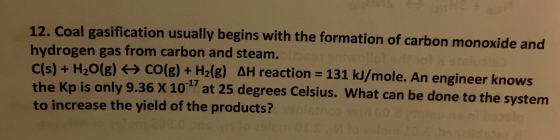
Please answer the following question and show all work to
receive credit:
12. Coal gasification usually...
In the coal-gasification process, carbon monoxide reacts with water to produce carbon dioxide and hydrogen gas....
In the coal-gasification process, carbon monoxide reacts with water to produce carbon dioxide and hydrogen gas. CO (g) + H2O (g) CO2 (g) + H2 (g) In an experiment, 0.35 mol of CO and 0.40 mol of H2O were placed in a 1.00-L reaction vessel. At equilibrium, there were 0.22 mol of CO remaining. Keq at the temperature of the experiment is ________. Group of answer choices 5.5 0.28 0.75 3.5 1.0
Coal gasification produces an easily-transportable, clean-burning combination of carbon monoxide and hydrogen from coal by reacting...
 Coal gasification produces an easily-transportable, clean-burning combination of carbon monoxide and hydrogen from coal by reacting it with steam, like this: C(s)+H2O(g) → CO(g)+H,(8) Suppose an engineer decides to study the rate of this reaction. He prepares four reaction vessels with 147.0 g of solid carbon and 5.95 g of steam each. The volume and temperature of each vessel is shown in the table below. Arrange the reaction vessels in decreasing order of initial rate of reaction. In other words,...
The reaction of coal with water at high temperatures produces synthesis gas, which is a mixture...
The reaction of coal with water at high temperatures produces synthesis gas, which is a mixture of carbon monoxide and hydrogen. Use the bond energies in the table below to estimate the enthalpy of the reaction C(g) + H2O(g) ? CO(g) + H2(g) Bond C–O C=O C?O O–H H–H Energy (kJ/mol) 358 770 1070 465 435 ____kJ/mole
Problem Solving: Show all work, units, sie fies and balanced equations needed to answer the following...
 Problem Solving: Show all work, units, sie fies and balanced equations needed to answer the following 1. To make the hydrogen necessary for the manufacture of ammonia in the Haber/Bosch process a steam reforming method is used. This method combines methane gas with steam (water gas) to make hydrogen gas and carbon monoxide gas. The AH for this reaction is + 206 kJ/mole. What amount of energy is needed to produce 1 kg of hydrogen? 2. Given: P.(s) + 3...
D. Complete the following stoichiometry problems. Show ALL of your work to receive full credit. Equations...
 D. Complete the following stoichiometry problems. Show ALL of your work to receive full credit. Equations and mole-to-mole relationships 21. For the following reaction: 4Cr(s) + 302(g) → 2Cr2O3(s) a. How many moles of oxygen (O2) would react with 0.35 moles of chromium (Cr)? b. Starting with 10.4g of Oz, how many moles of Cr203 can be produced: c. How many grams of Cr metal would be needed to produce 38.2g of chromium (III) oxide? 22. Sulfuric acid (H2SO4) is...
please I need the answers to all of the following questions step by step 14. Balance...
 please I need the answers to all of the following
questions step by step
14. Balance the following equation that describes the steam reforming reaction. (6 points) CH4 +H2O → CO + H2 15. Draw the following dot structures including charges, if any. (12 points) Oxygen gas Carbon monoxide 16. Write the electron configuration for the neutral element chlorine. (3 points) 17. Write the electron configuration for the negatively charged chloride, Cr. (3 points) 18. The Haber reaction fixes atmospheric...
please I need the answers to all of the following
questions step by step
14. Balance the following equation that describes the steam reforming reaction. (6 points) CH4 +H2O → CO + H2 15. Draw the following dot structures including charges, if any. (12 points) Oxygen gas Carbon monoxide 16. Write the electron configuration for the neutral element chlorine. (3 points) 17. Write the electron configuration for the negatively charged chloride, Cr. (3 points) 18. The Haber reaction fixes atmospheric...
Please answer 12-17 and show work. I’m not sure which equations to use 15. The gas...
 Please answer 12-17 and show work. I’m not sure which
equations to use
15. The gas above the liquid in a sealed bottle of soda is primarily carbon dioxide. Carbon dioxide is also dissolved in the soda. When the distribution of carbon dioxide between the gas and liquid is hase , , at equilibrium, molecules ofcarbon dioxide in the gas phase can stilldissolve in the iquid they strike the surface and are captured. Similarly, molecules of carbon dioxide can escape...
Please answer 12-17 and show work. I’m not sure which
equations to use
15. The gas above the liquid in a sealed bottle of soda is primarily carbon dioxide. Carbon dioxide is also dissolved in the soda. When the distribution of carbon dioxide between the gas and liquid is hase , , at equilibrium, molecules ofcarbon dioxide in the gas phase can stilldissolve in the iquid they strike the surface and are captured. Similarly, molecules of carbon dioxide can escape...
Pressure [Pa] QUESTION 5 Sav Which line represents a process for which PVaconstant? 12 10 A...
 Pressure [Pa] QUESTION 5 Sav Which line represents a process for which PVaconstant? 12 10 A 6 2 0 0 1 2 3 5 Volume [m3] ANSWI hmit to sme and submit. Click Save All Answers to save all ansuers parenthesis. 1. An insulated piston-cylinder device initially contains 10kg of saturated liquid water at 20°C. An electrical resistor embedded in the wall is turned on until the volume of the water triples, but its pressure remains constant. The piston moves...
please help with 3 and 8 please 3. Draw a properly labeled Bom-Haber cycle for the formation of MgF:(s) from Mg(o) and F-(S 4. Draw Lewis Electron Dot Structures for the following molecules: a)...
 please help with 3 and 8 please
3. Draw a properly labeled Bom-Haber cycle for the formation of MgF:(s) from Mg(o) and F-(S 4. Draw Lewis Electron Dot Structures for the following molecules: a) H20 b) CO2 d) PF 5. Determine the structures for the following molecules using the VSEPR theory. b) SF4 a) NH3 c) CIF3 6. a) Determine the structures for each of the following ions using the VSEPR theory. 2- i) NOs i) CO b) Draw 2...
please help with 3 and 8 please
3. Draw a properly labeled Bom-Haber cycle for the formation of MgF:(s) from Mg(o) and F-(S 4. Draw Lewis Electron Dot Structures for the following molecules: a) H20 b) CO2 d) PF 5. Determine the structures for the following molecules using the VSEPR theory. b) SF4 a) NH3 c) CIF3 6. a) Determine the structures for each of the following ions using the VSEPR theory. 2- i) NOs i) CO b) Draw 2...
To receive credit: please write properly annotated balanced chemical reactions, please show all work using dimensional...
 To receive credit: please write properly annotated balanced chemical reactions, please show all work using dimensional analysis and correct significant figures. Just a correct result has no value. To facilitate calculations here molar masses of involved elements to be used: 26.982 74.922 137.327 79.904 Aluminum g/mol Arsenic g/mol Barium g/mol Bromine g/mol 40.078 12.011 35.453 1.008 Calcium g/mol Carbon g/mol Chlorine g/mol Hydrogen g/mol 55.845 207.2 Iron g/mol Lead g/mol Lithium Magnesium 24.305 6.941 g/mol g/mol 14.007 15.999 Manganese 54.938...
 Coal gasification produces an easily-transportable, clean-burning combination of carbon monoxide and hydrogen from coal by reacting it with steam, like this: C(s)+H2O(g) → CO(g)+H,(8) Suppose an engineer decides to study the rate of this reaction. He prepares four reaction vessels with 147.0 g of solid carbon and 5.95 g of steam each. The volume and temperature of each vessel is shown in the table below. Arrange the reaction vessels in decreasing order of initial rate of reaction. In other words,...
 Problem Solving: Show all work, units, sie fies and balanced equations needed to answer the following 1. To make the hydrogen necessary for the manufacture of ammonia in the Haber/Bosch process a steam reforming method is used. This method combines methane gas with steam (water gas) to make hydrogen gas and carbon monoxide gas. The AH for this reaction is + 206 kJ/mole. What amount of energy is needed to produce 1 kg of hydrogen? 2. Given: P.(s) + 3...
 D. Complete the following stoichiometry problems. Show ALL of your work to receive full credit. Equations and mole-to-mole relationships 21. For the following reaction: 4Cr(s) + 302(g) → 2Cr2O3(s) a. How many moles of oxygen (O2) would react with 0.35 moles of chromium (Cr)? b. Starting with 10.4g of Oz, how many moles of Cr203 can be produced: c. How many grams of Cr metal would be needed to produce 38.2g of chromium (III) oxide? 22. Sulfuric acid (H2SO4) is...
 please I need the answers to all of the following
questions step by step
14. Balance the following equation that describes the steam reforming reaction. (6 points) CH4 +H2O → CO + H2 15. Draw the following dot structures including charges, if any. (12 points) Oxygen gas Carbon monoxide 16. Write the electron configuration for the neutral element chlorine. (3 points) 17. Write the electron configuration for the negatively charged chloride, Cr. (3 points) 18. The Haber reaction fixes atmospheric...
please I need the answers to all of the following
questions step by step
14. Balance the following equation that describes the steam reforming reaction. (6 points) CH4 +H2O → CO + H2 15. Draw the following dot structures including charges, if any. (12 points) Oxygen gas Carbon monoxide 16. Write the electron configuration for the neutral element chlorine. (3 points) 17. Write the electron configuration for the negatively charged chloride, Cr. (3 points) 18. The Haber reaction fixes atmospheric...
 Please answer 12-17 and show work. I’m not sure which
equations to use
15. The gas above the liquid in a sealed bottle of soda is primarily carbon dioxide. Carbon dioxide is also dissolved in the soda. When the distribution of carbon dioxide between the gas and liquid is hase , , at equilibrium, molecules ofcarbon dioxide in the gas phase can stilldissolve in the iquid they strike the surface and are captured. Similarly, molecules of carbon dioxide can escape...
Please answer 12-17 and show work. I’m not sure which
equations to use
15. The gas above the liquid in a sealed bottle of soda is primarily carbon dioxide. Carbon dioxide is also dissolved in the soda. When the distribution of carbon dioxide between the gas and liquid is hase , , at equilibrium, molecules ofcarbon dioxide in the gas phase can stilldissolve in the iquid they strike the surface and are captured. Similarly, molecules of carbon dioxide can escape...
 Pressure [Pa] QUESTION 5 Sav Which line represents a process for which PVaconstant? 12 10 A 6 2 0 0 1 2 3 5 Volume [m3] ANSWI hmit to sme and submit. Click Save All Answers to save all ansuers parenthesis. 1. An insulated piston-cylinder device initially contains 10kg of saturated liquid water at 20°C. An electrical resistor embedded in the wall is turned on until the volume of the water triples, but its pressure remains constant. The piston moves...
 please help with 3 and 8 please
3. Draw a properly labeled Bom-Haber cycle for the formation of MgF:(s) from Mg(o) and F-(S 4. Draw Lewis Electron Dot Structures for the following molecules: a) H20 b) CO2 d) PF 5. Determine the structures for the following molecules using the VSEPR theory. b) SF4 a) NH3 c) CIF3 6. a) Determine the structures for each of the following ions using the VSEPR theory. 2- i) NOs i) CO b) Draw 2...
please help with 3 and 8 please
3. Draw a properly labeled Bom-Haber cycle for the formation of MgF:(s) from Mg(o) and F-(S 4. Draw Lewis Electron Dot Structures for the following molecules: a) H20 b) CO2 d) PF 5. Determine the structures for the following molecules using the VSEPR theory. b) SF4 a) NH3 c) CIF3 6. a) Determine the structures for each of the following ions using the VSEPR theory. 2- i) NOs i) CO b) Draw 2...
 To receive credit: please write properly annotated balanced chemical reactions, please show all work using dimensional analysis and correct significant figures. Just a correct result has no value. To facilitate calculations here molar masses of involved elements to be used: 26.982 74.922 137.327 79.904 Aluminum g/mol Arsenic g/mol Barium g/mol Bromine g/mol 40.078 12.011 35.453 1.008 Calcium g/mol Carbon g/mol Chlorine g/mol Hydrogen g/mol 55.845 207.2 Iron g/mol Lead g/mol Lithium Magnesium 24.305 6.941 g/mol g/mol 14.007 15.999 Manganese 54.938...
Most questions answered within 3 hours.
-
Where is the error in this code sequence?
String s1 = "Hello";
String s2 = "ello";...
asked 10 months ago -
Financial data for Joel de Paris, Inc., for last year
follow:
Joel de Paris, Inc.
Balance...
asked 10 months ago -
Consider this reaction:
Al2(SO4)3 (aq)+ BaCl3
(aq) Al2Cl6 (aq)- +
3BaSO4(s) . What is the...
asked 10 months ago -
Suppose that Savneet is considering increasing her
recent random sample from 20 car rentals to 40...
asked 10 months ago -
Trucks arrive at an unloading terminal at an average rate of 120
per hour.
Trucks arrive...
asked 10 months ago -
Why are methanol and ethanol completely soluble in water while
octanol is not very little soluble....
asked 10 months ago -
A facilities manager at a university reads in a research report
that the mean amount of...
asked 10 months ago -
When the CuSO4 is rehydrated by adding water to the anhydrous
compound, is this an endothermic...
asked 10 months ago -
A ray of sunlight is passing from diamond into crown glass; the
angle of incidence is...
asked 10 months ago -
A block of mass 0.249 kg is placed on top of a light, vertical
spring of...
asked 10 months ago -
how do the kidneys compensate in the presences of acidosis
a) trigger hyperventilate
b) reserve acid...
asked 10 months ago -
Question 501 pts
The rental rate of capital to the firm increases. Which of the
following...
asked 10 months ago