![(5 pt) Signal x(t) 5cos(2? x5x106x1) Is transmitted. The received signal is 6. 4 cos (2 x 5 x 106 x 1-?) . Assume the phase shift is caused by propagation delay. y(t) a. (3 pt) Suppose [rad]. What is the minimum distance between the transmitter and the receiver? b. (2* pt) Suppose ?--[rad]. What is the minimum distance between the 4 transmitter and the receiver? Page 4 of 9](http://img.homeworklib.com/questions/ba214e00-a3b3-11eb-8e48-b906669ed0a3.png?x-oss-process=image/resize,w_560)
Homework Answers

Add Answer to:
(5 pt) Signal x(t) 5cos(2? x5x106x1) Is transmitted. The received signal is 6. 4 cos (2...
2. A DSBSC signal has the information signal m(t) and the carrier cos(wct). The received signal...
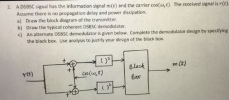 2. A DSBSC signal has the information signal m(t) and the carrier cos(wct). The received signal is r(c) Assume there is no propagation delay and power dissipation. a) Draw the block diagram of the transmitter b) Draw the typical coherent DSBSC demodulator. c) A n alternate DSBSC demodulator is given below. Complete the demodulator design by specitying the black box. Use analysis to justify your design of the black box. 2 m (t) Black Bex Ytt)
Decompose the signal s(t) = 5cos(2t) • cos(3t + π/4) into a linear combination and determine...
Decompose the signal s(t) = 5cos(2t) • cos(3t + π/4) into a linear combination and determine the amplitude, frequency, and phase shift of each component after decomposition. (Show all work and explain why.) Be Neat Please.
Drill Problem 4.3 with extension 2. A signal is transmitted by an FM transmitter with a...
 Drill Problem 4.3 with extension 2. A signal is transmitted by an FM transmitter with a frequency deviation constant Ja of 5 Hz per unit of message signal m(t) where m(t) = cos(40rt)+2sin(60) Assuming a zero initial phase, i.e., P()-, for this transmitted signal, (a) determine the expression of the phase deviation P(in radian and the peak phase deviation; 1 do(t) (b) determine the expression of the frequency deviation 2t hertz and the peak frequency deviation. dt in Solution
Drill...
Drill Problem 4.3 with extension 2. A signal is transmitted by an FM transmitter with a frequency deviation constant Ja of 5 Hz per unit of message signal m(t) where m(t) = cos(40rt)+2sin(60) Assuming a zero initial phase, i.e., P()-, for this transmitted signal, (a) determine the expression of the phase deviation P(in radian and the peak phase deviation; 1 do(t) (b) determine the expression of the frequency deviation 2t hertz and the peak frequency deviation. dt in Solution
Drill...
Problem 6: Nonlinear Channel Suppose a transmitter sends a signal X over a channel, where X is exponentially distributed with mean 1. The channel non-linearly distorts the transmitted signal, such th...
 Problem 6: Nonlinear Channel Suppose a transmitter sends a signal X over a channel, where X is exponentially distributed with mean 1. The channel non-linearly distorts the transmitted signal, such that the signal at the receiver is given by Y-1-e-Ax, where λ > 0 is a constant. The receiver then estimates X using a linear estimator X based on Y which minimizes the mean squared error between X and X. Find this linear estimator
Problem 6: Nonlinear Channel Suppose a...
Problem 6: Nonlinear Channel Suppose a transmitter sends a signal X over a channel, where X is exponentially distributed with mean 1. The channel non-linearly distorts the transmitted signal, such that the signal at the receiver is given by Y-1-e-Ax, where λ > 0 is a constant. The receiver then estimates X using a linear estimator X based on Y which minimizes the mean squared error between X and X. Find this linear estimator
Problem 6: Nonlinear Channel Suppose a...
Problem 6: Nonlinear Channel Suppose a transmitter sends a signal X over a channel, where X is exponentially distributed with mean 1. The channel non-linearly distorts the transmitted signal, such th...
 Problem 6: Nonlinear Channel Suppose a transmitter sends a signal X over a channel, where X is exponentially distributed with mean 1. The channel non-linearly distorts the transmitted signal, such that the signal at the receiver is given by Y-1-e-Ax, where λ > 0 is a constant. The receiver then estimates X using a linear estimator X based on Y which minimizes the mean squared error between X and X. Find this linear estimator
Problem 6: Nonlinear Channel Suppose a...
Problem 6: Nonlinear Channel Suppose a transmitter sends a signal X over a channel, where X is exponentially distributed with mean 1. The channel non-linearly distorts the transmitted signal, such that the signal at the receiver is given by Y-1-e-Ax, where λ > 0 is a constant. The receiver then estimates X using a linear estimator X based on Y which minimizes the mean squared error between X and X. Find this linear estimator
Problem 6: Nonlinear Channel Suppose a...
8 8.6-4 For a DSB-SC system with a channel noise PSD of Sn() 10-12 and a baseband signal of bandw...
 8 8.6-4 For a DSB-SC system with a channel noise PSD of Sn() 10-12 and a baseband signal of bandwidth 5 kHz, the receiver output SNR is required to be at least 47 dB. The receiver is as shown in Fig. 8.30. (a) What must be the signal power Si received at the receiver input? (b) What is the receiver output noise power No? (c) What is the minimum transmitted power Sr if the channel transfer function is He)10-3 over...
An input signal: vi (t)-5cos(100mt+20 ) + 5 cos(400π t + 60 ) [V] is applied...
 An input signal: vi (t)-5cos(100mt+20 ) + 5 cos(400π t + 60 ) [V] is applied to a first order high pass RL filter with break frequecyf 100 [Hz/The filter contains one resistor and one inductor connected in series. The output signal will have the form Vout(t)-Vi cos( 100 π t + Φ) + V2 cos(400 π t + Φ) [vj a) Calculate values for the amplitudes and phase angles for each of the components of the output signal, and...
Find the instantaneous frequency of the next signal at t = 4. (a) x(t) = 10...
 Find the instantaneous frequency of the next signal at t = 4. (a) x(t) = 10 cos[20xt+10 sin(t/4)) (b) x(t) = 262719) () X(t)=10[cos(2nt) cos(atº/4) + sin(24t) sin( nt/ 4)] Suppose that the information signal is as shown in the following figure. When each modulating this signal using 100KHz as the carrier frequency, find the frequency shift and phase shift when FM is modulated with 5,=10. What is the maximum frequency shift and maximum phase shift? 0.5+ -0.5 ost Suppose...
A wireless service provider transmits a signal s(t) = 5 cos(2π fc t) to a receiver,...
A wireless service provider transmits a signal s(t) = 5 cos(2π fc t) to a receiver, where fc is a variable carrier frequency. The impulse response of the channel linking transmitter and receiver is c(t) = 0.80δ(t − Td ) − 0.47δ(t − T1 ) where Td = 270 nsec, T1 = 430 nsec, and “nsec” = 10 − 9 sec. (a) Compute the simplest math expression for the magnitude-squared frequency response |C(f)|2. (b) Suppose the service provider is allocated...
A wireless service provider transmits a signal s(t) = 5 cos(2π fc t) to a receiver,...
A wireless service provider transmits a signal s(t) = 5 cos(2π fc t) to a receiver, where fc is a variable carrier frequency. The impulse response of the channel linking transmitter and receiver is c(t) = 0.80δ(t − Td ) − 0.47δ(t − T1 ) where Td = 270 nsec, T1 = 430 nsec, and “nsec” = 10 − 9 sec. (a) Compute the simplest math expression for the magnitude-squared frequency response |C(f)|2. (b) Suppose the service provider is allocated...
 2. A DSBSC signal has the information signal m(t) and the carrier cos(wct). The received signal is r(c) Assume there is no propagation delay and power dissipation. a) Draw the block diagram of the transmitter b) Draw the typical coherent DSBSC demodulator. c) A n alternate DSBSC demodulator is given below. Complete the demodulator design by specitying the black box. Use analysis to justify your design of the black box. 2 m (t) Black Bex Ytt)
 Drill Problem 4.3 with extension 2. A signal is transmitted by an FM transmitter with a frequency deviation constant Ja of 5 Hz per unit of message signal m(t) where m(t) = cos(40rt)+2sin(60) Assuming a zero initial phase, i.e., P()-, for this transmitted signal, (a) determine the expression of the phase deviation P(in radian and the peak phase deviation; 1 do(t) (b) determine the expression of the frequency deviation 2t hertz and the peak frequency deviation. dt in Solution
Drill...
Drill Problem 4.3 with extension 2. A signal is transmitted by an FM transmitter with a frequency deviation constant Ja of 5 Hz per unit of message signal m(t) where m(t) = cos(40rt)+2sin(60) Assuming a zero initial phase, i.e., P()-, for this transmitted signal, (a) determine the expression of the phase deviation P(in radian and the peak phase deviation; 1 do(t) (b) determine the expression of the frequency deviation 2t hertz and the peak frequency deviation. dt in Solution
Drill...
 Problem 6: Nonlinear Channel Suppose a transmitter sends a signal X over a channel, where X is exponentially distributed with mean 1. The channel non-linearly distorts the transmitted signal, such that the signal at the receiver is given by Y-1-e-Ax, where λ > 0 is a constant. The receiver then estimates X using a linear estimator X based on Y which minimizes the mean squared error between X and X. Find this linear estimator
Problem 6: Nonlinear Channel Suppose a...
Problem 6: Nonlinear Channel Suppose a transmitter sends a signal X over a channel, where X is exponentially distributed with mean 1. The channel non-linearly distorts the transmitted signal, such that the signal at the receiver is given by Y-1-e-Ax, where λ > 0 is a constant. The receiver then estimates X using a linear estimator X based on Y which minimizes the mean squared error between X and X. Find this linear estimator
Problem 6: Nonlinear Channel Suppose a...
 Problem 6: Nonlinear Channel Suppose a transmitter sends a signal X over a channel, where X is exponentially distributed with mean 1. The channel non-linearly distorts the transmitted signal, such that the signal at the receiver is given by Y-1-e-Ax, where λ > 0 is a constant. The receiver then estimates X using a linear estimator X based on Y which minimizes the mean squared error between X and X. Find this linear estimator
Problem 6: Nonlinear Channel Suppose a...
Problem 6: Nonlinear Channel Suppose a transmitter sends a signal X over a channel, where X is exponentially distributed with mean 1. The channel non-linearly distorts the transmitted signal, such that the signal at the receiver is given by Y-1-e-Ax, where λ > 0 is a constant. The receiver then estimates X using a linear estimator X based on Y which minimizes the mean squared error between X and X. Find this linear estimator
Problem 6: Nonlinear Channel Suppose a...
 8 8.6-4 For a DSB-SC system with a channel noise PSD of Sn() 10-12 and a baseband signal of bandwidth 5 kHz, the receiver output SNR is required to be at least 47 dB. The receiver is as shown in Fig. 8.30. (a) What must be the signal power Si received at the receiver input? (b) What is the receiver output noise power No? (c) What is the minimum transmitted power Sr if the channel transfer function is He)10-3 over...
 An input signal: vi (t)-5cos(100mt+20 ) + 5 cos(400π t + 60 ) [V] is applied to a first order high pass RL filter with break frequecyf 100 [Hz/The filter contains one resistor and one inductor connected in series. The output signal will have the form Vout(t)-Vi cos( 100 π t + Φ) + V2 cos(400 π t + Φ) [vj a) Calculate values for the amplitudes and phase angles for each of the components of the output signal, and...
 Find the instantaneous frequency of the next signal at t = 4. (a) x(t) = 10 cos[20xt+10 sin(t/4)) (b) x(t) = 262719) () X(t)=10[cos(2nt) cos(atº/4) + sin(24t) sin( nt/ 4)] Suppose that the information signal is as shown in the following figure. When each modulating this signal using 100KHz as the carrier frequency, find the frequency shift and phase shift when FM is modulated with 5,=10. What is the maximum frequency shift and maximum phase shift? 0.5+ -0.5 ost Suppose...
Most questions answered within 3 hours.
-
Where is the error in this code sequence?
String s1 = "Hello";
String s2 = "ello";...
asked 11 months ago -
Financial data for Joel de Paris, Inc., for last year
follow:
Joel de Paris, Inc.
Balance...
asked 11 months ago -
Consider this reaction:
Al2(SO4)3 (aq)+ BaCl3
(aq) Al2Cl6 (aq)- +
3BaSO4(s) . What is the...
asked 11 months ago -
Suppose that Savneet is considering increasing her
recent random sample from 20 car rentals to 40...
asked 11 months ago -
Trucks arrive at an unloading terminal at an average rate of 120
per hour.
Trucks arrive...
asked 11 months ago -
Why are methanol and ethanol completely soluble in water while
octanol is not very little soluble....
asked 11 months ago -
A facilities manager at a university reads in a research report
that the mean amount of...
asked 11 months ago -
When the CuSO4 is rehydrated by adding water to the anhydrous
compound, is this an endothermic...
asked 11 months ago -
A ray of sunlight is passing from diamond into crown glass; the
angle of incidence is...
asked 11 months ago -
A block of mass 0.249 kg is placed on top of a light, vertical
spring of...
asked 11 months ago -
how do the kidneys compensate in the presences of acidosis
a) trigger hyperventilate
b) reserve acid...
asked 11 months ago -
Question 501 pts
The rental rate of capital to the firm increases. Which of the
following...
asked 11 months ago